Predicting the Properties of Unknown Elements
A concise revision guide to using periodicity: how to predict the characteristic properties of an element from its group, and how to deduce the nature, likely position in the Periodic Table and identity of an unknown element from information about its physical and chemical properties, with worked examples in the style of the examination.
Before You Start
Periodicity is a prediction tool. Elements in a group have the same outer electron configuration, so an unfamiliar element behaves like the members of its group, with the trends down the group extended.
- Trends down a group: reactivity, melting point, metallic character and solubility patterns from Topic 10 Group 2 and Topic 11 Group 17.
- Trends across Period 3: metals to non-metals, basic to acidic oxides, ionic to covalent chlorides: the elements, the oxides and the chlorides.
- Structure types from melting point and conductivity: Period 3 Oxides: Structure, Bonding and Melting Points.
- Oxidation numbers in oxides and chlorides give the group number directly.
Remember: A prediction is an argument: “astatine is below iodine in Group 17, and oxidising power falls down the group, so astatine is a weaker oxidising agent than iodine”. Name the trend every time.
GCSE Recap: Trends in a Group
Three quick questions on the GCSE ideas this page builds on.
Predicting from the Group
Three worked predictions for elements that are rarely met in the laboratory. In each, the group fixes the type of chemistry and the position down the group fixes how far the trends have gone.
Radium, Group 2, below barium
- A reactive metal, more reactive than barium: Ra(s) + 2H₂O(l) → Ra(OH)₂(aq) + H₂(g), faster than barium reacts.
- Forms the Ra²⁺ ion; the oxide RaO is basic: RaO(s) + H₂O(l) → Ra(OH)₂(aq), an alkaline solution.
- Ra(OH)₂ is soluble (hydroxide solubility rises down Group 2); RaSO₄ is insoluble (sulfate solubility falls); RaCO₃ is the most thermally stable Group 2 carbonate.
Astatine, Group 17, below iodine
- A dark, almost black solid (melting point rises down the group); forms At₂ molecules and the At⁻ ion.
- A weaker oxidising agent than iodine, so the astatide ion is easily oxidised: Cl₂(aq) + 2At⁻(aq) → 2Cl⁻(aq) + At₂(s).
- Forms HAt, a strong acid and the least stable hydrogen halide; AgAt is an insoluble precipitate that does not dissolve in concentrated ammonia.
Germanium, Group 14, below silicon
- A metalloid with a giant covalent structure like silicon: high melting point, a semiconductor.
- Oxidation number +4 in GeO₂, a weakly acidic oxide with some amphoteric character (metallic character grows down the group).
- GeCl₄ is a covalent liquid that is hydrolysed: GeCl₄(l) + 2H₂O(l) → GeO₂(s) + 4HCl(aq).
Exam focus: Give the equation for the predicted reaction, not just the words. “Radium reacts with water to form the hydroxide and hydrogen” scores more with Ra(s) + 2H₂O(l) → Ra(OH)₂(aq) + H₂(g) beside it.
Quick Check: Extending a Trend
Pick the one accurate prediction in each set.
A Method for an Unknown Element
Questions give a list of properties and ask for the type of element, its likely group and sometimes its identity. Ask five questions in order.
- Melting point and conductivity: high and conducts as a solid means a metal; very high and non-conducting means giant covalent; low means simple molecular.
- Formula of the oxide or chloride: the oxidation number gives the group (X₂O and XCl: Group 1; XO and XCl₂: Group 2; XO₂ and XCl₄: Group 14).
- pH of the oxide in water: alkaline means a metal oxide; acidic means a non-metal oxide; insoluble suggests a giant structure or an amphoteric oxide.
- Reaction with water or acids: vigorous with cold water means a Group 1 or lower Group 2 metal; hydrolysis of the chloride means a non-metal or metalloid.
- Appearance and state: a soft, low-melting metal points to Group 1; a coloured gas or volatile solid to Group 17; a hard, brittle, shiny solid to a metalloid.
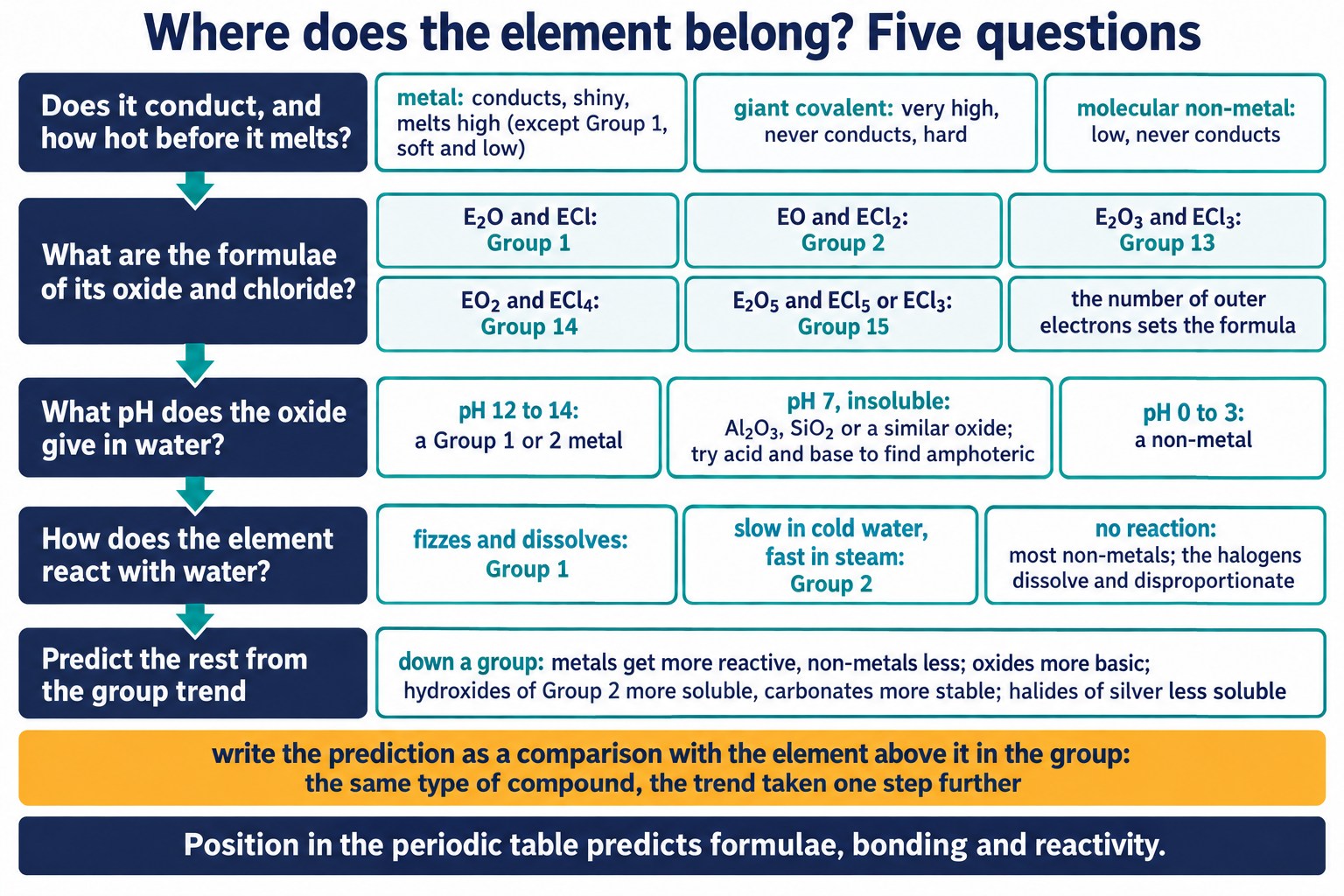
The five questions as a flow chart, each branch ending in a type of element and a likely group.
Remember: The group comes from the formulae and the chemistry; the period comes from the size of the trends (how reactive, how high the melting point) compared with known members of the group.
Quick Check: Deduce the Type and the Family
Work through the five questions on paper for each element, then flip the card to compare.
Worked Unknowns X and Y
Two unknowns in the style of the examination. Work through the questions in order and quote the evidence for every step.
Element X
Data. Melting point 1410 °C; does not conduct electricity as a solid; its oxide XO₂ is acidic and insoluble in water; its chloride XCl₄ fumes in moist air.
Element Y
Data. A soft metal with a low melting point; its oxide Y₂O dissolves in water to give a solution of pH 14; its chloride YCl is an ionic solid.
Step 1. soft, low-melting metal: Group 1 (weak metallic bonding with one delocalised electron per atom).
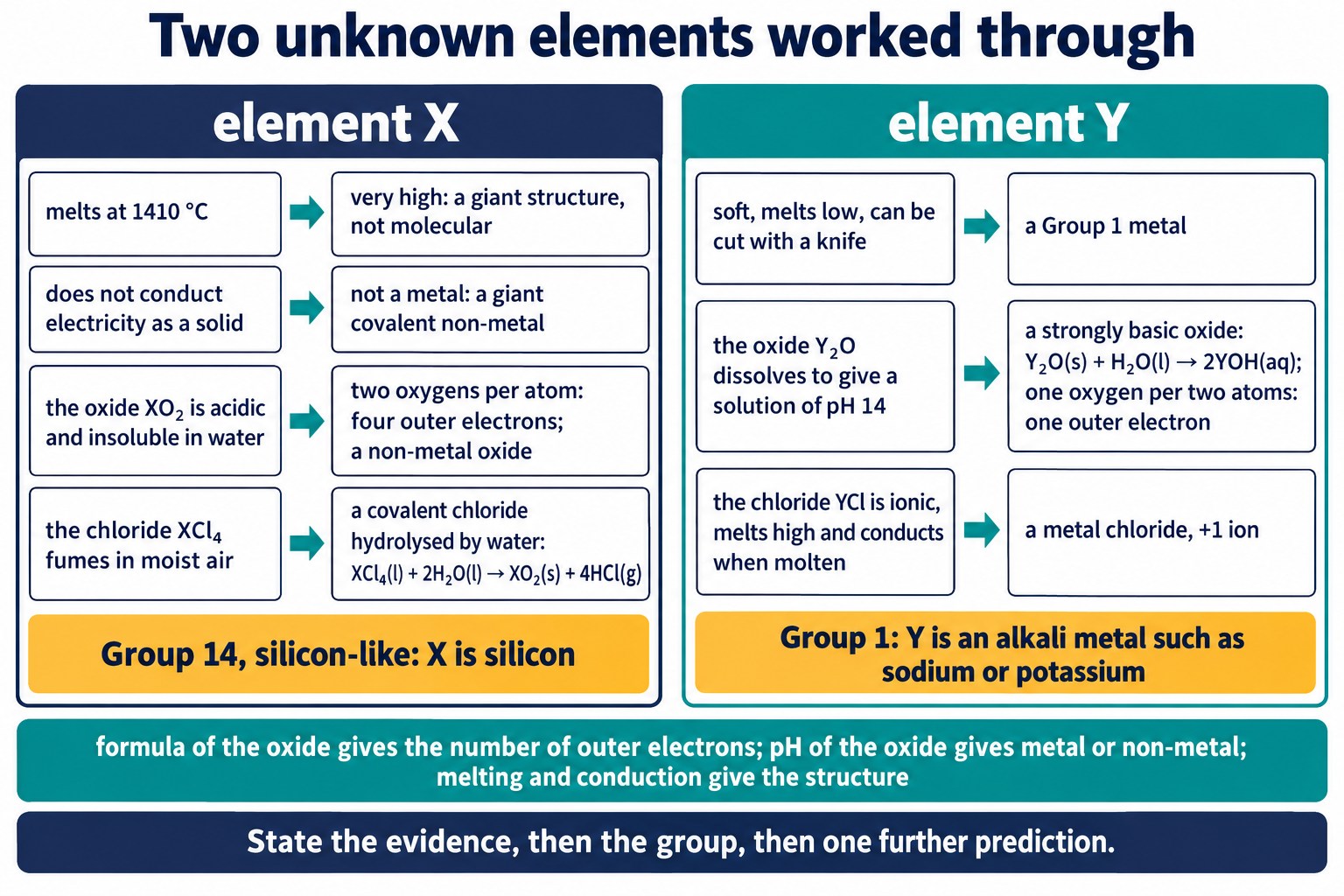
The X and Y data as cards with the deduction written under each clue, ending at Group 14 and Group 1.
Exam focus: Write the oxidation number explicitly: “in XCl₄ the oxidation number of X is +4, so X has four outer-shell electrons and is in Group 14”. That sentence is the mark.
Check: Predicting and Deducing Elements
Predict the properties of an unfamiliar element from its group, deduce the group and type of an unknown from its data, and state the evidence that fixes each conclusion.
Common Exam Points
- Same group, same outer electron configuration, same formulae and type of chemistry; extend the trend down the group for an element below the familiar ones.
- Group 2 downwards: more reactive metals, more soluble hydroxides, less soluble sulfates, more stable carbonates and nitrates.
- Group 17 downwards: darker and less volatile elements, weaker oxidising agents, halide ions more easily oxidised, silver halides less soluble in ammonia.
- Group 14 downwards: giant covalent non-metal to metalloid to metal; oxidation number +4 in XO₂ and XCl₄; the dioxides go from acidic to amphoteric.
- Deducing a type: melting point and conductivity (metal, giant covalent, molecular); formula of the oxide or chloride (group); pH of the oxide solution (metal or non-metal); reaction with water (reactivity).
- Unknown X with XO₂ acidic and XCl₄ fuming is Group 14, silicon-like; unknown Y with Y₂O giving pH 14 and ionic YCl is Group 1.
- Quote the evidence with the conclusion: the oxidation number for the group, the melting point and conductivity for the structure, the pH for metal or non-metal.
FAQs
Use these quick answers to check how to predict the properties of an element from its group, how to deduce the group and nature of an unknown element from its melting point, conductivity, oxide and chloride, and the method that earns the marks.
How do I predict the properties of radium from its position in Group 2?
Follow the trends down the group: radium is a reactive metal forming Ra²⁺ ions, reacts with water to give hydrogen and a soluble hydroxide, and has a basic oxide, RaO. Its carbonate is very stable to heat because the large cation hardly polarises the anion.
What would I expect astatine, at the bottom of Group 17, to be like?
A dark, almost metallic solid with a higher melting point than iodine because its London forces are stronger. It is the weakest oxidising agent in the group, so At⁻ ions are easily oxidised, and silver astatide, like AgI, is insoluble in water and ammonia.
Element X has a melting point of 1410 °C, does not conduct as a solid, forms an acidic insoluble oxide XO₂ and a chloride XCl₄ that fumes in moist air: where is it?
Group 14, with silicon-like behaviour. The very high melting point without conduction means a giant covalent structure; the formulae XO₂ and XCl₄ show four bonding electrons; the acidic oxide marks a non-metal and the fuming chloride is covalent and hydrolysed by water.
Element Y is soft with a low melting point, its oxide Y₂O dissolves to give pH 14 and its chloride YCl is ionic: which group?
Group 1. The formulae Y₂O and YCl show one outer electron forming a Y⁺ ion, the strongly alkaline solution means a very basic oxide of a reactive metal, and the softness and low melting point fit weak metallic bonding, as in sodium or potassium.
What is the method for deducing an unknown element in an exam question?
Ask five questions in order: do the melting point and conductivity suggest a metal, giant covalent or molecular structure; what do the oxide and chloride formulae say about the group; is the oxide solution acidic or alkaline; how does the element react with water or acids; what are its appearance and state?

Copyright notice: This OLS revision content, including the explanations, layout, diagrams, tables and embedded learning structure, is authored for Online Learning System by Dr. Mohammed Al-Fatah. It may not be copied, reproduced, redistributed or adapted without written permission.
Keep this note — free
Save your progress across every Cambridge topic. A free account remembers which topics you have covered, saves your question scores, and syncs across your phone and laptop.
- Track every topic you have finished
- Keep your practice-question scores
- No payment, no card, free forever
Already registered? Log in