Period 3 Chlorides and Deducing Bonding from Properties
A concise revision guide to the chlorides of Period 3: sodium and magnesium chlorides dissolving in water, aluminium chloride, silicon tetrachloride and phosphorus pentachloride hydrolysing to acidic solutions, the pH of each, the equations, why the covalent chlorides react with water, and how to deduce the bonding in an oxide or chloride from its melting point, conductivity and behaviour with water.
Before You Start
The chlorides repeat the story of the oxides with one difference: the covalent chlorides are not merely acidic, they are torn apart by water. Three earlier ideas are needed.
- How the chlorides form: the elements heated in chlorine, from Reactions of Period 3 Elements with Oxygen, Chlorine and Water.
- Ionic and covalent bonding and the electronegativity difference that decides between them: Ionic Bonding.
- Dative covalent bonds: a lone pair donated into an empty orbital, the first step of every hydrolysis here: Dative Covalent Bonding.
- The oxides with water for comparison: Period 3 Oxides with Water, Acids and Bases.
Remember: Hydrolysis means a reaction with water in which bonds in the compound break. Dissolving is not hydrolysis: the ions of NaCl are unchanged in solution.
GCSE Recap: Ionic and Covalent Substances
Three quick questions on the GCSE ideas this page builds on.
The Chlorides with Water
Add each chloride to water and test with universal indicator. Sodium and magnesium chlorides dissolve; the chlorides of aluminium, silicon and phosphorus are hydrolysed, releasing hydrogen chloride.
| Chloride | With water | pH |
|---|---|---|
| NaCl | NaCl(s) → Na⁺(aq) + Cl⁻(aq): dissolves, no reaction | 7 |
| MgCl₂ | MgCl₂(s) → Mg²⁺(aq) + 2Cl⁻(aq): dissolves; [Mg(H₂O)₆]²⁺ is hydrolysed very slightly | about 6.5 |
| AlCl₃ | AlCl₃(s) + 3H₂O(l) → Al(OH)₃(s) + 3HCl(aq): vigorous hydrolysis, fumes of HCl | 3 |
| SiCl₄ | SiCl₄(l) + 2H₂O(l) → SiO₂(s) + 4HCl(aq): vigorous, white fumes, white precipitate | 2 |
| PCl₅ | PCl₅(s) + 4H₂O(l) → H₃PO₄(aq) + 5HCl(aq): vigorous, fumes of HCl | 2 |
Aluminium chloride: is also described as dissolving to the hexaaqua ion, which is acidic: [Al(H₂O)₆]³⁺(aq) ⇌ [Al(H₂O)₅(OH)]²⁺(aq) + H⁺(aq). Either account earns the mark; the solution is acidic and HCl fumes are seen.
The fumes: hydrogen chloride gas meets moisture in the air and forms a mist of hydrochloric acid droplets: “steamy” or “misty” fumes.
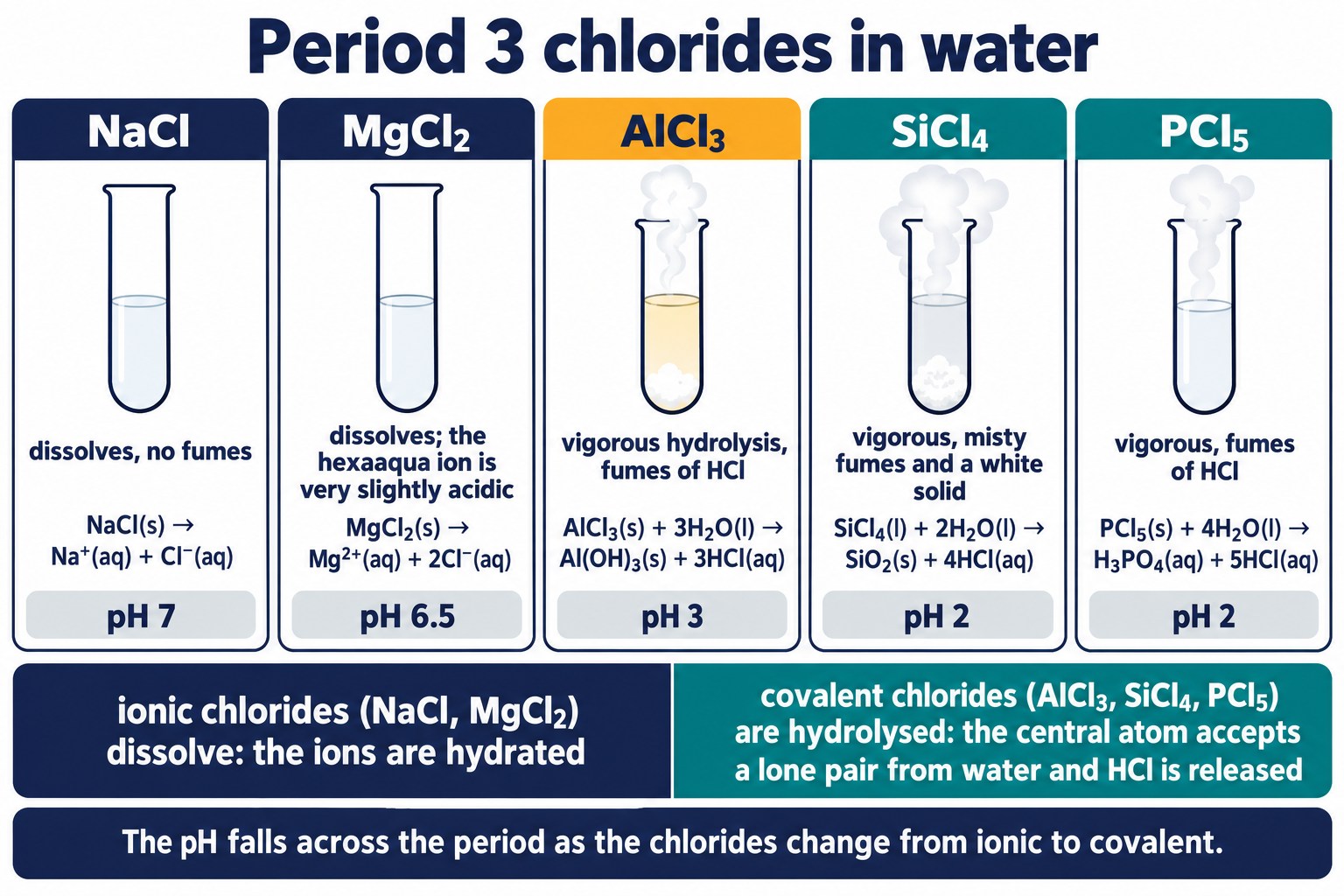
Five tiles, one per chloride: what is seen, the products and the pH of the solution.
Exam focus: Write the pH as a number and the observation as what is seen: “vigorous reaction, misty fumes of HCl, white solid, solution pH 2”. Each is a separate mark.
Dissolving or Hydrolysis? Why the Chlorides Differ
The ionic chlorides dissolve; the covalent chlorides are hydrolysed. The difference is whether the central atom can accept a lone pair from water.
Ionic chlorides: NaCl and MgCl₂ are lattices of ions. Water molecules surround and hydrate each ion, the lattice breaks up and the ions enter solution unchanged, so the solution is neutral.
Covalent chlorides: chlorine is more electronegative, so the central atom is δ+. The oxygen of a water molecule donates a lone pair to it, a dative bond forms and a chloride leaves as HCl.
Which orbital: aluminium in AlCl₃ has only six electrons around it and an empty 3p orbital; silicon and phosphorus have empty 3d orbitals of low energy. All three can accept the lone pair.
Contrast: tetrachloromethane, CCl₄, does not hydrolyse: carbon has no empty orbital of low energy and is too small for a fifth group to approach.
Magnesium: the Mg²⁺ ion is small and doubly charged, so [Mg(H₂O)₆]²⁺ polarises its water molecules slightly and a little H⁺ is released: pH about 6.5 rather than 7.
Remember: The trend follows electronegativity: the difference between the element and chlorine falls from sodium to phosphorus, so the bonding changes from ionic to covalent and the behaviour from dissolving to hydrolysis.
Check: Chlorides with Water
Predict what is seen when each chloride meets water, write the hydrolysis equations with state symbols, and explain why ionic chlorides dissolve while covalent ones react.
Quick Check: Explain Two New Halides
Apply the explanation to two bromides outside Period 3, then compare your answer with the model.
The pH Trend Across the Chlorides
The pH falls across the period: 7, about 6.5, 3, 2, 2. Each step has a reason.
- NaCl, pH 7: no hydrolysis; Na⁺ is large and singly charged and does not disturb the water around it.
- MgCl₂, about 6.5: slight hydrolysis of the hydrated ion.
- AlCl₃, pH 3: complete hydrolysis releases three moles of HCl per mole of chloride, or the hexaaqua ion is strongly acidic.
- SiCl₄ and PCl₅, pH 2: four and five moles of HCl per mole, a strong acid in high concentration.
Common mistake: Saying AlCl₃ is ionic because aluminium is a metal. Its reaction with water, its low sublimation temperature and the Al₂Cl₆ dimer all show covalent bonding.
Phosphorus(V) Chloride in Two Stages, and the Attack on SiCl₄
Hydrolysis of PCl₅ happens in two stages. With a little water the first product is phosphorus trichloride oxide, POCl₃; excess water takes it on to phosphoric(V) acid.
Stage 1: PCl₅(s) + H₂O(l) → POCl₃(l) + 2HCl(g): limited water.
Stage 2: POCl₃(l) + 3H₂O(l) → H₃PO₄(aq) + 3HCl(aq): excess water.
Overall: PCl₅(s) + 4H₂O(l) → H₃PO₄(aq) + 5HCl(aq). Add the two stages and POCl₃ cancels.
SiCl₄: a lone pair on the oxygen of water attacks the δ+ silicon atom, a Si–O bond forms and a Si–Cl bond breaks, releasing HCl. Four such steps give Si(OH)₄, which loses water to leave hydrated SiO₂.
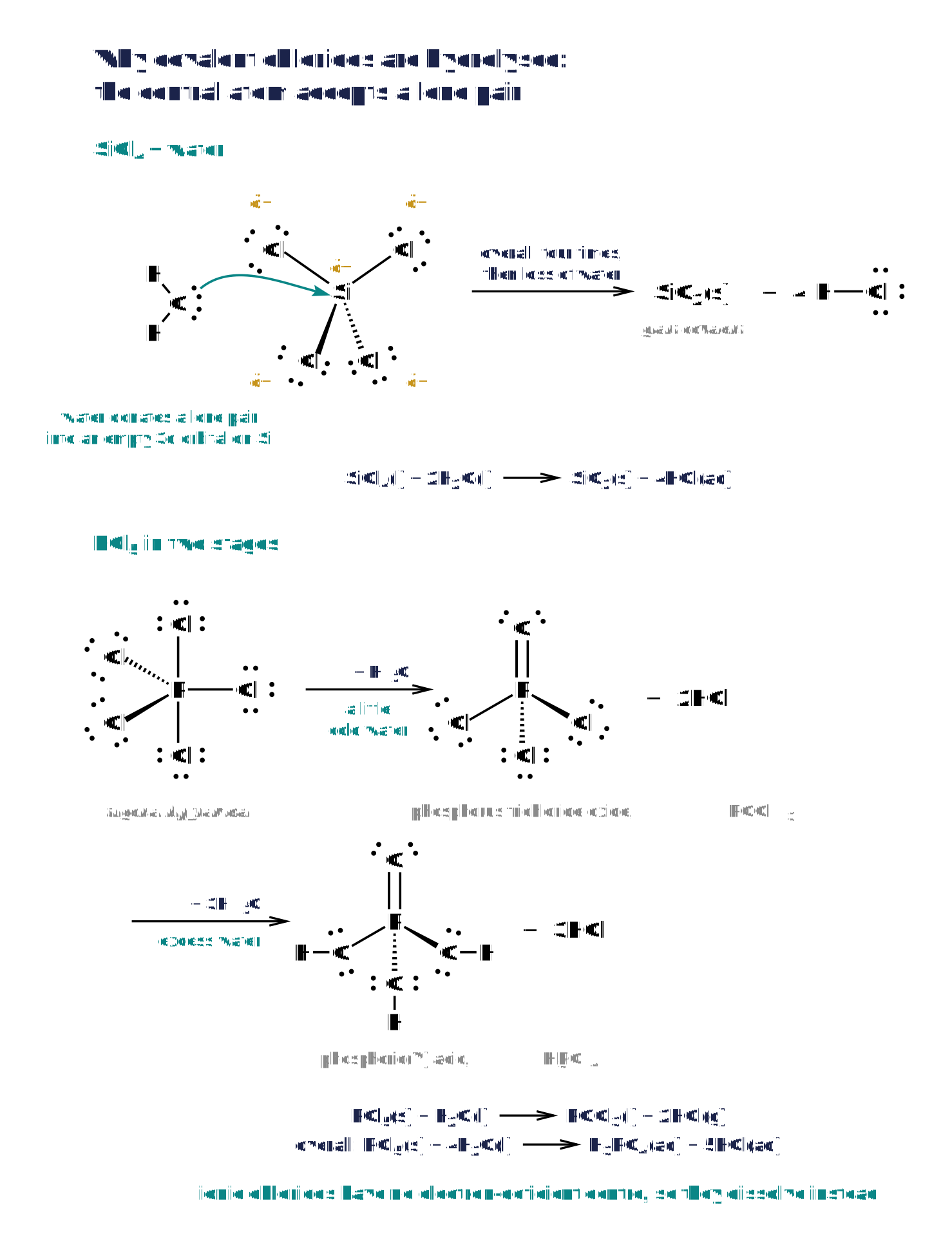
Water attacking the δ+ silicon of SiCl₄ with one curly arrow, then the two-stage scheme PCl₅ → POCl₃ → H₃PO₄ with the water added at each step.
Exam focus: A two-stage question wants both equations balanced separately and the overall equation that results from adding them. Check that the HCl adds to five.
Quick Check: Titrate the Products
Follow the moles from the hydrolysis to the titration.
Deducing Bonding from Properties
Examiners give data for an unknown oxide or chloride and ask for its bonding. Three properties settle it: melting point, electrical conductivity and behaviour with water.
| Property | Giant ionic | Covalent molecular | Giant covalent |
|---|---|---|---|
| Melting point | high (hundreds of degrees) | low; often a liquid or gas at room temperature | very high |
| Conducts when molten | yes: the ions are free to move | no: no ions or free electrons | no |
| Conducts as a solid | no: the ions are fixed | no | no |
| With water | dissolves to a neutral (or nearly neutral) solution | hydrolysed: acidic, fuming solution; or forms an acid | insoluble, no reaction |
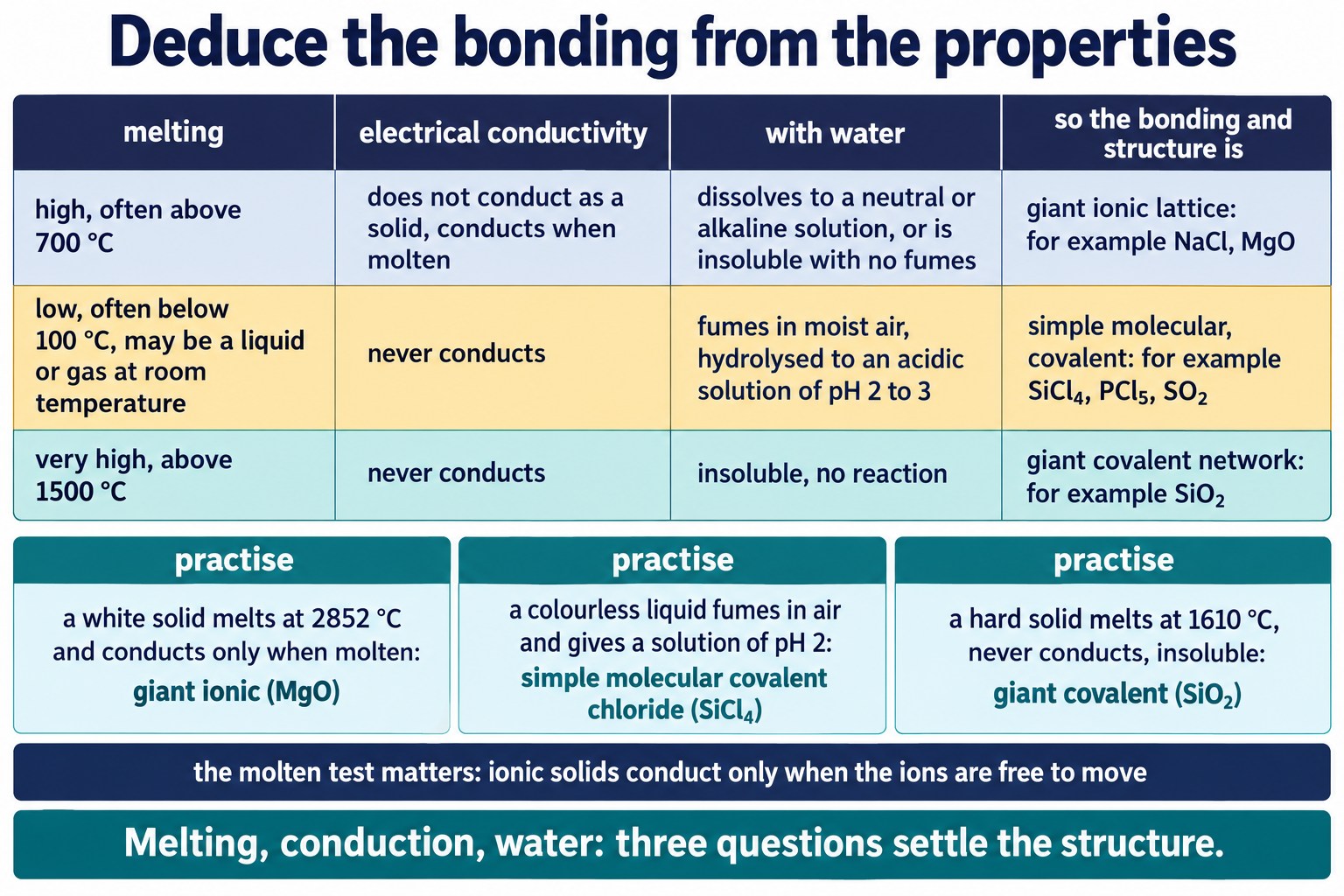
Decision table: melting point, conductivity and behaviour with water leading to giant ionic, covalent molecular or giant covalent.
Worked unknown A
Data. A colourless liquid, boiling point 58 °C, which does not conduct electricity and fumes in moist air; with water it gives a white solid and a solution of pH 2.
Worked unknown B
Data. A white solid, melting point 801 °C, which conducts when molten but not as a solid, and dissolves in water to give a neutral solution.
Worked unknown C
Data. A hard white solid, melting point 1610 °C, which does not conduct in either state, is insoluble in water and leaves the water at pH 7, yet reacts with hot concentrated sodium hydroxide.
Remember: Molten conduction is the decisive test for ions. A high melting point alone cannot separate giant ionic from giant covalent; the conductivity does.
Check: Deducing Bonding
Use melting points, conductivity and behaviour with water to classify unknown oxides and chlorides, and justify each deduction in one sentence.
Common Exam Points
- NaCl and MgCl₂ dissolve to give pH 7 and about 6.5; AlCl₃, SiCl₄ and PCl₅ are hydrolysed to acidic solutions of pH 3, 2 and 2 with fumes of HCl.
- Hydrolysis equations: AlCl₃ + 3H₂O → Al(OH)₃ + 3HCl; SiCl₄ + 2H₂O → SiO₂ + 4HCl; PCl₅ + 4H₂O → H₃PO₄ + 5HCl (state symbols in answers).
- PCl₅ in two stages: PCl₅ + H₂O → POCl₃ + 2HCl, then POCl₃ + 3H₂O → H₃PO₄ + 3HCl.
- Covalent chlorides hydrolyse because the δ+ central atom accepts a lone pair from water into an empty orbital (3p on Al, 3d on Si and P); CCl₄ cannot.
- The trend from ionic to covalent chlorides follows the falling electronegativity difference across the period.
- Deducing bonding: high melting point plus molten conduction means giant ionic; low melting point plus fuming hydrolysis means covalent molecular; very high melting point, no conduction, insoluble means giant covalent.
- Observations are marked as observations: misty fumes, white solid, vigorous reaction, pH value from universal indicator.
FAQs
Use these quick answers to check how each Period 3 chloride behaves in water, why the covalent chlorides are hydrolysed, the pH of the solutions and how to deduce the bonding in a compound from its melting point, conductivity and reaction with water.
Why does sodium chloride dissolve to give pH 7 while aluminium chloride gives pH 3?
NaCl is ionic: the ions simply separate and are hydrated, NaCl(s) → Na⁺(aq) + Cl⁻(aq), with no acid formed. AlCl₃ is hydrolysed vigorously, AlCl₃(s) + 3H₂O(l) → Al(OH)₃(s) + 3HCl(aq), releasing fumes of hydrogen chloride and leaving an acidic solution.
Why does silicon tetrachloride fume in moist air?
Water molecules attack the silicon atom, donating a lone pair into its empty 3d orbitals, and chloride is displaced: SiCl₄(l) + 2H₂O(l) → SiO₂(s) + 4HCl(aq).
Hydrogen chloride escapes as white fumes, a white precipitate of silicon dioxide forms and the solution reaches pH 2.
What are the two stages in the hydrolysis of phosphorus(V) chloride?
First PCl₅(s) + H₂O(l) → POCl₃(l) + 2HCl(aq), then POCl₃ reacts with more water to give phosphoric(V) acid. Overall PCl₅(s) + 4H₂O(l) → H₃PO₄(aq) + 5HCl(aq), a vigorous reaction producing fumes of HCl and a solution of pH about 2.
How do I deduce the bonding in an unknown chloride or oxide from its properties?
A high melting point, conduction when molten and a neutral solution point to an ionic lattice. A low melting point, no conduction and an acidic, fuming solution mean a covalent molecular compound being hydrolysed. Very high melting point, no conduction and insolubility mean giant covalent.
Why is a solution of magnesium chloride slightly acidic at pH 6.5 if the compound is ionic?
The small, doubly charged Mg²⁺ ion attracts electrons from the water molecules around it in [Mg(H₂O)₆]²⁺, weakening their O–H bonds.
A tiny fraction of these water molecules lose a proton, so the solution is very slightly acidic. The more polarising Al³⁺ does this far more.

Copyright notice: This OLS revision content, including the explanations, layout, diagrams, tables and embedded learning structure, is authored for Online Learning System by Dr. Mohammed Al-Fatah. It may not be copied, reproduced, redistributed or adapted without written permission.
Keep this note — free
Save your progress across every Cambridge topic. A free account remembers which topics you have covered, saves your question scores, and syncs across your phone and laptop.
- Track every topic you have finished
- Keep your practice-question scores
- No payment, no card, free forever
Already registered? Log in