Redox, Oxidation Numbers and Half-Equations
A concise revision guide to redox: oxidation and reduction as electron transfer and as changes in oxidation number, oxidising and reducing agents, and building full redox equations from half-equations for s-, p- and d-block elements.
- 16.1-a
- 16.1-b
- 16.1-c
- 16.1-d
- 16.1-e
- 16.1-f
- 16.1-g
What these spec points say
- 16.1-a understand oxidation in terms of electron transfer
- 16.1-b understand reduction in terms of electron transfer
- 16.1-c understand oxidation in terms of changes in oxidation number
- 16.1-d understand reduction in terms of changes in oxidation number
- 16.1-e apply oxidation and reduction to s-block elements
- 16.1-f apply oxidation and reduction to p-block elements
- 16.1-g apply oxidation and reduction to d-block elements
Recap: Electron Transfer and Oxidation numbers
Five quick questions on what you already know: OIL RIG, the rules for assigning an oxidation number, and working one out in a compound or an ion.
Oxidation and Reduction
A redox reaction is one in which electrons are transferred. Oxidation and reduction always happen together: one species loses the electrons that another gains.
| Oxidation | Reduction | |
|---|---|---|
| Electrons | loss of electrons | gain of electrons |
| Oxidation number | increases | decreases |
| Example | Zn → Zn²⁺ + 2e⁻ | Cu²⁺ + 2e⁻ → Cu |
| Change in oxidation number | zinc: 0 to +2 | copper: +2 to 0 |
Adding the two halves gives the full equation: Zn(s) + Cu²⁺(aq) → Zn²⁺(aq) + Cu(s).
- The two definitions always agree. A species that loses electrons becomes more positive.
- The oxidation number definition is the more useful one when no ions are visible, as in covalent compounds.
- Your earlier notes, Topic 8 Redox Chemistry and Groups 1, 2 and 7, introduced both definitions.
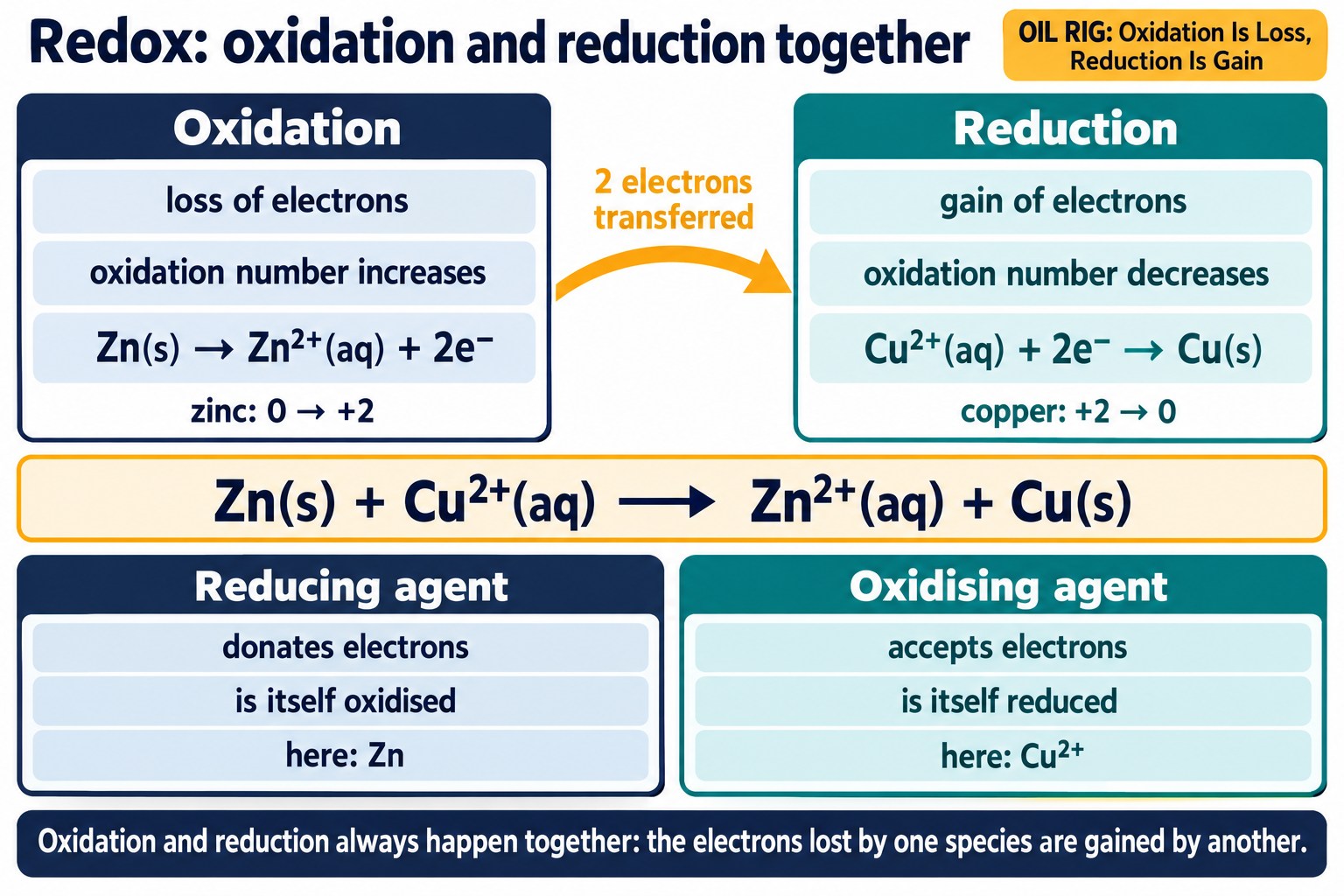
Oxidation and reduction side by side for zinc and copper(II) ions: electrons lost and gained, the oxidation number going up and down, and the two agents.
Definition: Oxidation is the loss of electrons or an increase in oxidation number. Reduction is the gain of electrons or a decrease in oxidation number.
Oxidation number Rules
An oxidation number is the charge an atom would have if every bond in the species were ionic. The rules are applied in order.
| Species | Oxidation number |
|---|---|
| an uncombined element, such as Zn or Cl₂ | 0 |
| a simple ion, such as Fe³⁺ or Cl⁻ | the charge on the ion |
| Group 1 and Group 2 metals in compounds | +1 and +2 |
| fluorine in compounds | −1 |
| chlorine, bromine and iodine in compounds | −1 (but positive when combined with oxygen or fluorine, as in NaClO) |
| hydrogen in compounds | +1 (but −1 in metal hydrides such as NaH) |
| oxygen in compounds | −2 (but −1 in peroxides such as H₂O₂) |
| all the atoms in a neutral compound | add up to 0 |
| all the atoms in an ion | add up to the charge on the ion |
Worked example: manganese in MnO₄⁻
Step 1. Four oxygen atoms contribute 4 × (−2) = −8.
Step 2. The total must equal the charge on the ion: Mn + (−8) = −1.
Worked example: chromium in Cr₂O₇²⁻
Step 1. Seven oxygen atoms contribute 7 × (−2) = −14.
Step 2. 2Cr + (−14) = −2, so 2Cr = +12.
Remember: Write the sign before the number in an oxidation number (+6), and after the number in an ionic charge (2−). Roman numerals in a name show the oxidation number: sulfur is +6 in sulfate(VI), SO₄²⁻.
Oxidising Agents and Reducing Agents
The species that causes the oxidation is not the one that is oxidised. This is the idea most often reversed in answers.
| Oxidising agent | Reducing agent | |
|---|---|---|
| What it does to electrons | accepts electrons | donates electrons |
| What happens to it | it is itself reduced | it is itself oxidised |
| Its oxidation number | decreases | increases |
| In Zn + Cu²⁺ → Zn²⁺ + Cu | Cu²⁺ | Zn |
- An oxidising agent takes electrons from another species, so it oxidises that species.
- A reducing agent gives electrons to another species, so it reduces that species.
- Name the exact species: the oxidising agent above is the Cu²⁺ ion, not “copper”.
Definition: An oxidising agent is an electron acceptor and is itself reduced. A reducing agent is an electron donor and is itself oxidised.
Check: Electron Transfer, Oxidation numbers and Agents
Decide what is oxidised and reduced, and which species is the oxidising agent, in reactions not used on this page.
Redox Across the Periodic Table
The same ideas apply to elements of the s-block, the p-block and the d-block. In each reaction below, follow the oxidation numbers.
s-block: metals as reducing agents
- Mg(s) + 2HCl(aq) → MgCl₂(aq) + H₂(g). Magnesium is oxidised, 0 to +2. Hydrogen is reduced, +1 to 0.
- 2Na(s) + 2H₂O(l) → 2NaOH(aq) + H₂(g). Sodium is oxidised, 0 to +1. Hydrogen in water is reduced, +1 to 0.
- s-block metals lose their outer electrons easily, so they are strong reducing agents.
p-block: halogens as oxidising agents
- Cl₂(aq) + 2Br⁻(aq) → 2Cl⁻(aq) + Br₂(aq). Chlorine is reduced, 0 to −1. Bromide ions are oxidised, −1 to 0.
- Chlorine is the oxidising agent: it accepts electrons from the bromide ions.
Disproportionation
In cold dilute sodium hydroxide, chlorine is oxidised and reduced in the same reaction.
Cl₂(aq) + 2NaOH(aq) → NaCl(aq) + NaClO(aq) + H₂O(l)
- One chlorine atom is reduced from 0 to −1, in NaCl.
- The other is oxidised from 0 to +1, in NaClO.
- Disproportionation is the oxidation and reduction of the same element in one reaction.
d-block: several oxidation numbers
| Reaction | Oxidised | Reduced |
|---|---|---|
| Zn + Cu²⁺ → Zn²⁺ + Cu | Zn: 0 to +2 | Cu: +2 to 0 |
| MnO₄⁻ with Fe²⁺ in acid | Fe: +2 to +3 | Mn: +7 to +2 |
| Cr₂O₇²⁻ with Fe²⁺ in acid | Fe: +2 to +3 | Cr: +6 to +3 |
- Transition metals have more than one stable oxidation number, so their ions take part in many redox reactions.
- MnO₄⁻ and Cr₂O₇²⁻ are powerful oxidising agents in acidic solution.
Quick Check: Which Reactions Are Disproportionation?
Work out the oxidation numbers of the key element in each new reaction before you decide.
Writing Half-Equations
A half-equation shows either the oxidation or the reduction, with the electrons written in. For a reaction in acidic solution, balance in this order.
- Balance the atoms of the element that is oxidised or reduced.
- Balance oxygen atoms by adding H₂O.
- Balance hydrogen atoms by adding H⁺.
- Balance the charge by adding electrons, e⁻, to the more positive side.
Example: MnO₄⁻ reduced to Mn²⁺
Step 2. Four oxygen atoms on the left need four water molecules on the right: MnO₄⁻ → Mn²⁺ + 4H₂O.
Step 3. Eight hydrogen atoms on the right need 8H⁺ on the left: MnO₄⁻ + 8H⁺ → Mn²⁺ + 4H₂O.
Answer. MnO₄⁻ + 8H⁺ + 5e⁻ → Mn²⁺ + 4H₂O.
- The number of electrons equals the change in oxidation number: manganese falls from +7 to +2, a change of 5.
- Electrons appear on the left in a reduction and on the right in an oxidation.
- Simple ions need only electrons: Fe²⁺ → Fe³⁺ + e⁻ and 2I⁻ → I₂ + 2e⁻.
- In alkaline solution, balance with H⁺ first, then add the same number of OH⁻ ions to both sides so that each H⁺ becomes H₂O.
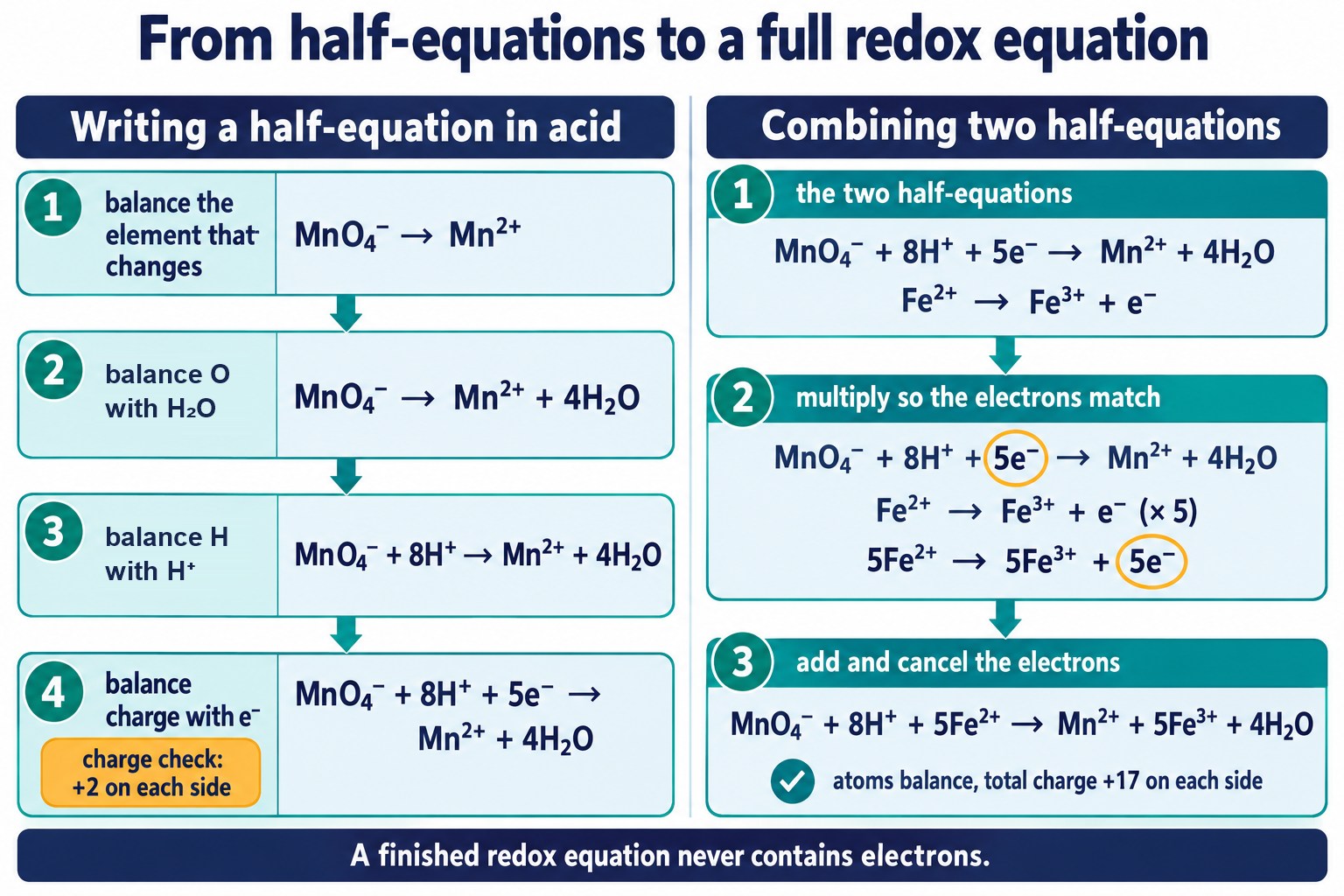
The four balancing steps for a half-equation in acid, then two half-equations combined by matching the electrons.
Exam focus: Check every half-equation twice: the atoms of each element must balance, and the total charge on the left must equal the total charge on the right.
Combining Half-Equations
The electrons lost in the oxidation must equal the electrons gained in the reduction. Multiply one or both half-equations until the electrons match, then add them.
Worked example 1: manganate(VII) ions and iron(II) ions
Step 3. Add the two half-equations and cancel the 5e⁻ on each side.
Answer. MnO₄⁻ + 8H⁺ + 5Fe²⁺ → Mn²⁺ + 5Fe³⁺ + 4H₂O.
Check. Charge on the left: −1 + 8 + 10 = +17. Charge on the right: +2 + 15 = +17.
Worked example 2: dichromate(VI) ions and iodide ions
Answer. Cr₂O₇²⁻ + 14H⁺ + 6I⁻ → 2Cr³⁺ + 3I₂ + 7H₂O.
Check. Charge on the left: −2 + 14 − 6 = +6. Charge on the right: 2 × (+3) = +6.
Remember: A finished redox equation contains no electrons. If H⁺ or H₂O appears on both sides after adding, cancel the smaller amount from each side.
Balancing with Oxidation numbers
An equation can also be balanced directly. The total increase in oxidation number must equal the total decrease.
Worked example: dichromate(VI) ions and iron(II) ions in acid
Step 3. Write the ratio: Cr₂O₇²⁻ + 6Fe²⁺ → 2Cr³⁺ + 6Fe³⁺.
Step 4. Balance the seven oxygen atoms with 7H₂O, then the hydrogen with 14H⁺.
Answer. Cr₂O₇²⁻ + 14H⁺ + 6Fe²⁺ → 2Cr³⁺ + 6Fe³⁺ + 7H₂O.
Check. Charge on the left: −2 + 14 + 12 = +24. Charge on the right: 6 + 18 = +24.
- Both methods give the same equation. Use half-equations when they are supplied, as they are in a data table.
- Data tables list half-equations with their electrode potentials: see Standard Electrode Potentials and the Hydrogen Electrode.
Quick Check: Balance It by Oxidation Numbers
Work out each answer on paper, then flip the card to compare.
Common Exam Points
Say
- “The oxidising agent accepts electrons and is itself reduced.”
- “The oxidation number of manganese decreases from +7 to +2, so it is reduced.”
- “Chlorine is both oxidised and reduced, so this is disproportionation.”
Do not say
- “The oxidising agent is oxidised” (it is reduced).
- “Iron is oxidised” when the species is an ion: say iron(II) ions, Fe²⁺.
- “The oxidation number is 2+” (write +2 for an oxidation number; 2+ is a charge).
Watch for
- Two atoms in one formula, as in Cr₂O₇²⁻ and I₂: the electron count is for both.
- An oxidation number is quoted for one atom: each chlorine in CaCl₂ is −1, not −2.
- Electrons left in the final equation: they must cancel completely.
- Charge that does not balance, even when every atom does.
- Using OH⁻ to balance an equation in acidic solution: use H⁺ and H₂O.
Check: Half-Equations and Full Redox Equations
Build and combine half-equations, and balance the charge, for redox systems not used on this page.
FAQs
Use these quick answers to check oxidation, reduction, oxidation numbers and half-equations.
How do I tell which species is oxidised in a reaction?
Look for the species that loses electrons, or whose oxidation number increases. In Zn + Cu²⁺ → Zn²⁺ + Cu, zinc goes from 0 to +2, so zinc is oxidised. Copper goes from +2 to 0, so Cu²⁺ is reduced.
Is the oxidising agent the species that gets oxidised?
No. An oxidising agent accepts electrons from another species, so it is itself reduced. A reducing agent donates electrons and is itself oxidised. In Cl₂ + 2Br⁻ → 2Cl⁻ + Br₂, chlorine is the oxidising agent and bromide ions are the reducing agent.
How do I balance a half-equation in acidic solution?
Balance the atoms of the main element first. Then balance oxygen by adding H₂O, hydrogen by adding H⁺ and, last of all, charge by adding electrons. For manganate(VII) this gives MnO₄⁻ + 8H⁺ + 5e⁻ → Mn²⁺ + 4H₂O.
How do I combine two half-equations into a full equation?
Multiply one or both so that the electrons lost equal the electrons gained, then add them and cancel the electrons. One MnO₄⁻ needs five electrons and each Fe²⁺ supplies one, so the equation contains MnO₄⁻ and 5Fe²⁺.
What is disproportionation?
It is a reaction in which the same element is both oxidised and reduced. In Cl₂ + 2NaOH → NaCl + NaClO + H₂O, the oxidation number of chlorine changes from 0 to −1 in NaCl and to +1 in NaClO.

Copyright notice: This OLS revision content, including the explanations, layout, diagrams, tables and embedded learning structure, is authored for Online Learning System by Dr. Mohammed Al-Fatah. It may not be copied, reproduced, redistributed or adapted without written permission.
Keep this note — free
Save your progress across every Edexcel IAL topic. A free account remembers which topics you have covered, saves your question scores, and syncs across your phone and laptop.
- Track every topic you have finished
- Keep your practice-question scores
- No payment, no card, free forever
Already registered? Log in