Cell Potential, Total Entropy and Equilibrium Constants
A concise revision guide to the link between electrochemistry and thermodynamics: why E⦵cell is directly proportional to the total entropy change and to ln K, and what the sign and size of E⦵cell say about the position of equilibrium.
- 13.9
- 16.10
- 16.11
What these spec points say
- 13.9 be able to apply knowledge of equilibrium constant values to predict the extent to which a reaction takes place
- 16.10 be able to use standard electrode potentials to predict the thermodynamic feasibility of a reaction
- 16.11 understand that Eo cell is directly proportional to the total entropy change and to lnK for a reaction
Before You Start
This page joins two topics: cell potentials, from Electrochemical Cells, Cell Diagrams and Cell Potentials and The Electrochemical Series and Feasibility of Reactions, and the thermodynamics of Topic 12 Entropy and Energetics and Topic 13 Chemical Equilibria.
What you need to remember
- The total entropy change is ΔStotal = ΔSsystem + ΔSsurroundings.
- A reaction is thermodynamically feasible when ΔStotal is positive.
- ΔStotal and the equilibrium constant are linked by ΔStotal = R ln K, where R = 8.31 J K⁻¹ mol⁻¹.
- The standard emf is E⦵cell = E⦵(half-cell where reduction happens) − E⦵(half-cell where oxidation happens).
- A positive E⦵cell means the reaction is thermodynamically feasible.
E⦵cell and the Total Entropy Change
A feasible cell reaction pushes electrons round a circuit. The voltmeter reading measures how strongly it does so. The driving force behind any feasible change is a positive total entropy change.
E⦵cell ∝ ΔStotal
- The symbol ∝ means “is directly proportional to”: for a given reaction, if one quantity doubles, so does the other.
- A positive E⦵cell goes with a positive ΔStotal.
- A negative E⦵cell goes with a negative ΔStotal.
- The constant of proportionality is not needed. It depends on the temperature and on the number of electrons transferred.
Bringing in the equilibrium constant
The total entropy change also fixes the size of the equilibrium constant, K.
ΔStotal = R ln K
R is a constant, so ΔStotal is directly proportional to ln K. Put the two relationships together:
E⦵cell ∝ ΔStotal ∝ ln K
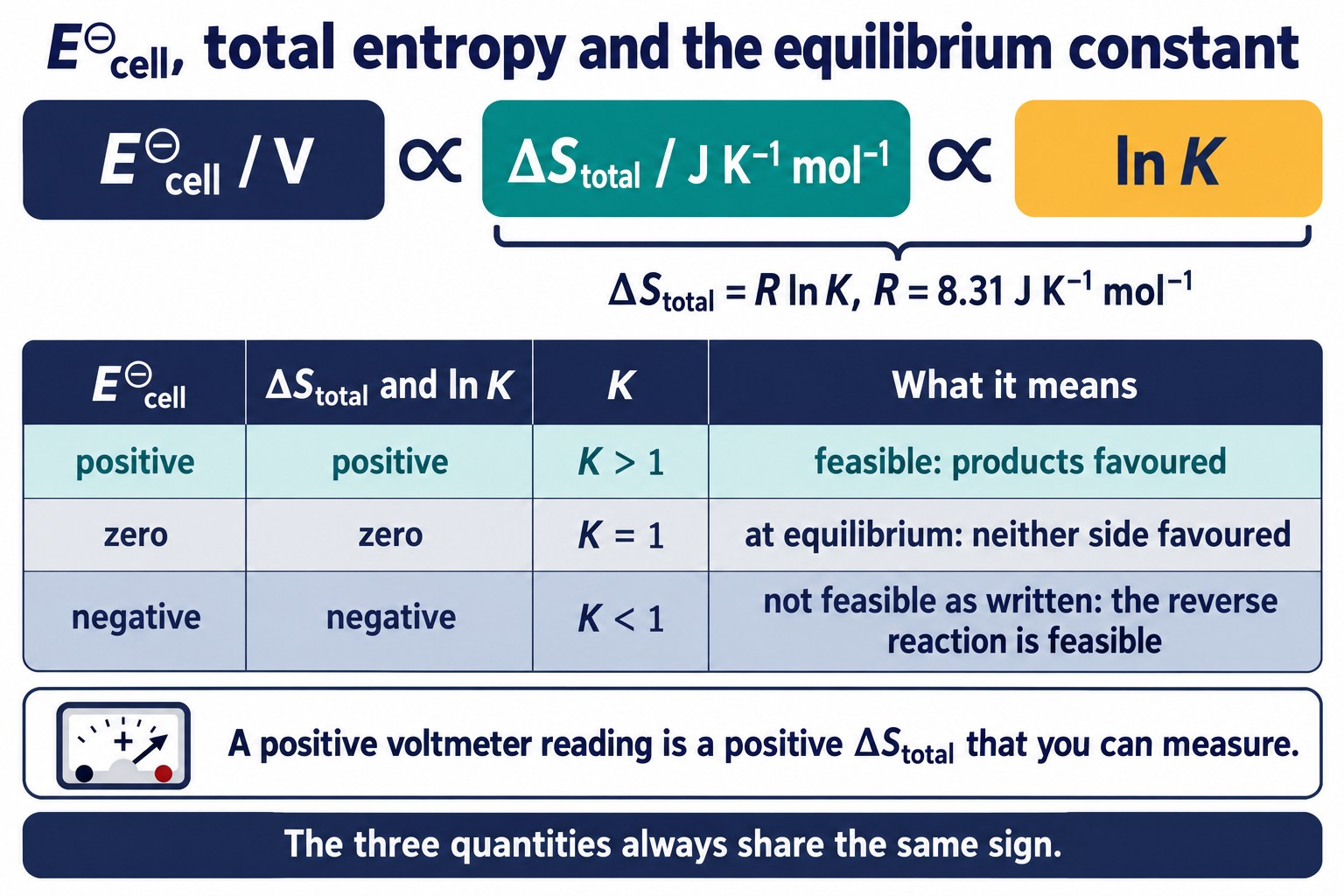
The standard emf of a cell, the total entropy change and ln K are directly proportional to each other, so the three always have the same sign.
Key idea: E⦵cell is directly proportional to ΔStotal and to ln K. One voltmeter reading therefore shows whether a reaction is feasible and how far it goes.
What the Sign of E⦵cell Tells You
Because the three quantities are proportional, they change sign together.
| E⦵cell | ΔStotal | ln K | K | What it means |
|---|---|---|---|---|
| positive | positive | positive | K > 1 | feasible: products favoured at equilibrium |
| zero | zero | zero | K = 1 | at equilibrium: neither side favoured |
| negative | negative | negative | K < 1 | not feasible as written: the reverse reaction is feasible |
A reminder about ln K
- ln 1 = 0, so ln K = 0 means K = 1.
- The ln of any number greater than 1 is positive.
- The ln of any number between 0 and 1 is negative.
Worked example 1
For Zn(s) + Cu²⁺(aq) → Zn²⁺(aq) + Cu(s), deduce the signs of ΔStotal and ln K. E⦵ values: Zn²⁺/Zn −0.76 V, Cu²⁺/Cu +0.34 V.
Step 2. E⦵cell is positive, so ΔStotal is positive and ln K is positive.
Worked example 2
Explain, in terms of entropy, why copper does not react with dilute acid: Cu(s) + 2H⁺(aq) → Cu²⁺(aq) + H₂(g).
Step 2. E⦵cell is negative, so ΔStotal is negative.
Check: The Sign of E⦵cell, ΔStotal and K
Calculate E⦵cell for reactions not used on this page and decide the sign of the total entropy change, the sign of ln K and whether K is greater or less than 1.
What the Size of E⦵cell Tells You
The sign shows the direction. The size of E⦵cell shows how far the reaction goes.
- A larger positive E⦵cell means a larger positive ΔStotal.
- A larger ΔStotal means a larger ln K, and so a larger K.
- A larger K means the position of equilibrium lies further towards the products.
- A reaction with a very large K goes almost to completion.
The values below are for reactions that transfer two electrons at 298 K. They are for comparison only: calculating K from E⦵cell is not needed.
| E⦵cell / V | K | Position of equilibrium |
|---|---|---|
| −0.23 | about 2 × 10⁻⁸ | almost all reactants |
| +0.10 | about 2 × 10³ | products favoured |
| +0.23 | about 6 × 10⁷ | well towards the products |
| +0.46 | about 4 × 10¹⁵ | effectively complete |
| +1.10 | about 2 × 10³⁷ | effectively complete |
Why K changes so quickly
E⦵cell is proportional to ln K, not to K itself. A small increase in E⦵cell adds a little to ln K, and that multiplies K by a large factor.
Worked example: doubling E⦵cell
Reaction A is 2Fe³⁺ + 2I⁻ → 2Fe²⁺ + I₂. Reaction B is Cu + 2Ag⁺ → Cu²⁺ + 2Ag. Both transfer two electrons. Compare their equilibrium constants at 298 K.
Step 1. Reaction A: E⦵cell = (+0.77) − (+0.54) = +0.23 V.
Step 2. Reaction B: E⦵cell = (+0.80) − (+0.34) = +0.46 V, which is twice the value for A.
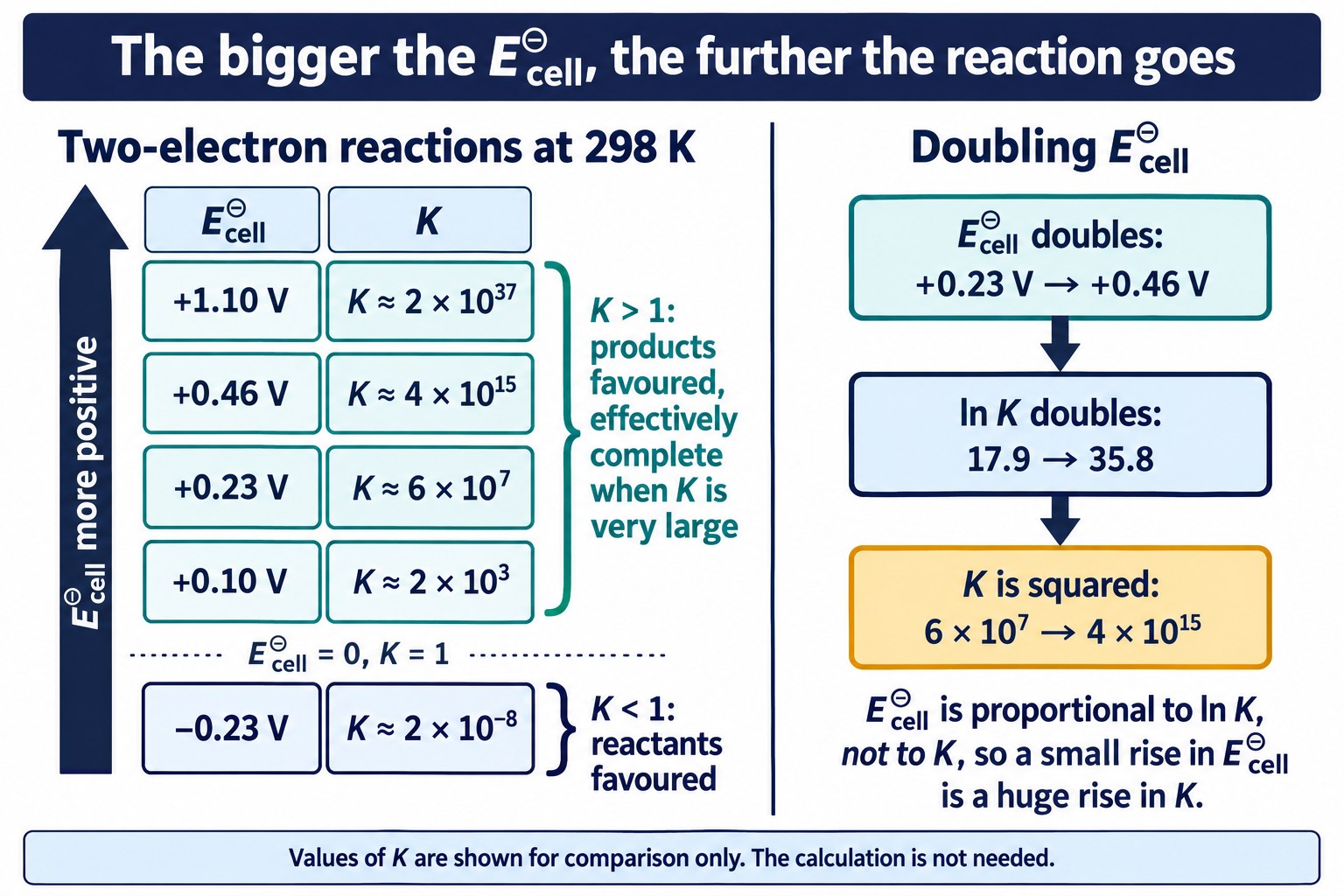
A ladder of standard cell potentials with the matching equilibrium constants. Doubling E⦵cell doubles ln K, so K is squared.
Remember: Doubling E⦵cell doubles ΔStotal and doubles ln K. It does not double K: it squares K.
Quick Check: Rank the Equilibrium Constants
Work out each cell potential first, then use it to rank the reactions.
Multiplying the Equation
An equation can be written with every coefficient doubled. The three quantities do not all respond in the same way.
| Equation | Electrons transferred | E⦵cell / V | ΔStotal | ln K | K |
|---|---|---|---|---|---|
| Zn + Cu²⁺ → Zn²⁺ + Cu | 2 | +1.10 | ΔStotal | ln K | K |
| 2Zn + 2Cu²⁺ → 2Zn²⁺ + 2Cu | 4 | +1.10 | 2 × ΔStotal | 2 × ln K | K² |
Why E⦵cell stays the same
- A potential is the energy transferred per unit of charge, so it does not depend on how much substance reacts.
- A large zinc–copper cell and a small one both read 1.10 V under standard conditions.
- An E⦵ value is therefore never multiplied by a coefficient from the equation.
Why ΔStotal and ln K change
- ΔStotal is quoted per mole of the equation as written, so twice the amount gives twice the entropy change.
- Every power in the expression for K doubles, so K is squared and ln K doubles.
- The proportionality still holds: the constant includes the number of electrons transferred, which has also doubled.
Key idea: E⦵cell ∝ ΔStotal ∝ ln K is used for one equation as written, or to compare reactions that transfer the same number of electrons at the same temperature.
Limits of the Prediction
A positive E⦵cell shows that ΔStotal is positive and K is greater than 1. It does not guarantee that the reaction is seen.
- Kinetic stability: E⦵cell, ΔStotal and K say nothing about rate. A feasible reaction with a high activation energy may be too slow to observe.
- Non-standard conditions: E⦵ values apply only at 298 K, 100 kPa and 1.00 mol dm⁻³. Other concentrations or temperatures change the electrode potentials.
- A small E⦵cell, positive or negative, means K is not far from 1. A change in concentration can then be enough to alter the direction.
Both limitations are explained with examples on The Electrochemical Series and Feasibility of Reactions.
Quick Check: Scaling Equations and Limits
Make a fast decision for each new case.
Common Exam Points
Say
- “E⦵cell is directly proportional to ΔStotal and to ln K.”
- “E⦵cell is positive, so ΔStotal is positive and the reaction is thermodynamically feasible.”
- “A larger E⦵cell means a larger K, so the reaction goes further towards completion.”
Do not say
- “E⦵cell is proportional to K” (it is proportional to ln K).
- “A larger E⦵cell means a faster reaction” (it says nothing about rate).
- “Double the equation, so double E⦵cell” (E⦵cell is unchanged).
Watch for
- E⦵cell = 0 means ΔStotal = 0 and K = 1, not K = 0.
- A negative E⦵cell means K is less than 1. K is never negative: only ln K is.
- Compare the sizes of K only for reactions that transfer the same number of electrons.
Check: The Size of E⦵cell and the Extent of Reaction
Compare cells not used on this page: rank reactions by how far they go, and work out what happens to ΔStotal, ln K and K when E⦵cell changes or the equation is multiplied.
FAQs
Use these quick answers to check how E⦵cell is linked to the total entropy change and to the equilibrium constant.
How is E⦵cell linked to the total entropy change?
E⦵cell is directly proportional to ΔStotal. A positive E⦵cell therefore means a positive total entropy change, which is the condition for a reaction to be thermodynamically feasible. The constant of proportionality does not need to be known.
How is E⦵cell linked to the equilibrium constant?
ΔStotal = R ln K and E⦵cell ∝ ΔStotal, so E⦵cell is also directly proportional to ln K. A positive E⦵cell gives a positive ln K, so K is greater than 1 and the products are favoured at equilibrium.
What does a zero or negative E⦵cell mean?
At zero, ΔStotal = 0, ln K = 0 and K = 1. A negative value gives a negative ΔStotal and K less than 1, so the reactants are favoured. Cu + 2H⁺ → Cu²⁺ + H₂ has E⦵cell = −0.34 V.
What happens to K if E⦵cell doubles?
ln K doubles, so K is squared, provided the same number of electrons is transferred. For two-electron reactions at 298 K, +0.23 V gives K of about 6 × 10⁷, and +0.46 V gives about 4 × 10¹⁵.
Does multiplying the equation change E⦵cell?
No. E⦵cell does not depend on the amounts in the equation, so doubling Zn + Cu²⁺ → Zn²⁺ + Cu still gives +1.10 V. ΔStotal and ln K both double, because they refer to the equation as written, so K is squared.

Copyright notice: This OLS revision content, including the explanations, layout, diagrams, tables and embedded learning structure, is authored for Online Learning System by Dr. Mohammed Al-Fatah. It may not be copied, reproduced, redistributed or adapted without written permission.
Keep this note — free
Save your progress across every Edexcel IAL topic. A free account remembers which topics you have covered, saves your question scores, and syncs across your phone and laptop.
- Track every topic you have finished
- Keep your practice-question scores
- No payment, no card, free forever
Already registered? Log in