Choosing Procedures and Managing Hazards
A concise revision guide to choosing a practical procedure for a reaction: which technique suits which functional group and product, reading hazard data to pick control measures such as fume cupboards, water baths and gloves, and justifying the choice of apparatus, solvent, temperature and reagent excess.
Before You Start
Exam questions describe a preparation and ask you to choose, or to justify, the apparatus and conditions. Every choice follows from the properties of the compounds involved.
- Heating under reflux and simple distillation, with the labelled apparatus, are covered on Preparing and Purifying Organic Liquids.
- The reactions themselves come from the reaction map on Planning a Synthetic Route: this page is about how to carry them out.
- Purifying a solid product is on Preparing and Purifying Organic Solids and purifying a liquid on Purifying Liquids and Checking Purity.
- Hazard symbols on reagent bottles were met at GCSE; this page turns them into control measures that reduce risk.
Choosing a Procedure: Match the Method to the Reaction
A practical procedure is the set of choices about apparatus, temperature, solvent and quantities. Each choice answers a question about the compounds: how volatile, how flammable, how fast, how stable?
| Situation | Procedure | Reason |
|---|---|---|
| slow reaction with volatile or flammable reagents | heat under reflux | vapour condenses and returns, so nothing escapes during long heating |
| the product is volatile and would react further | distil the product off as it forms | an aldehyde boils below its alcohol, so it leaves before it is oxidised to the acid |
| a liquid product mixed with reagents and by-products | distil after the reaction and collect the right fraction | a pure liquid distils at a steady boiling temperature |
| exothermic or unstable step | ice bath, add the reagent slowly | keeps the temperature down: nitration of benzene is held below 55 °C to avoid dinitration |
| a flammable liquid must be heated | water bath or electric heating mantle | no naked flame near ethanol, ethoxyethane or a volatile halogenoalkane |
| a reversible reaction or an expensive reagent | use an excess of the cheaper reagent | pushes the position of equilibrium towards the product and uses up the costly reagent |
| a wet organic liquid | add an anhydrous drying agent, then decant | anhydrous magnesium sulfate or calcium chloride takes up the dissolved water |
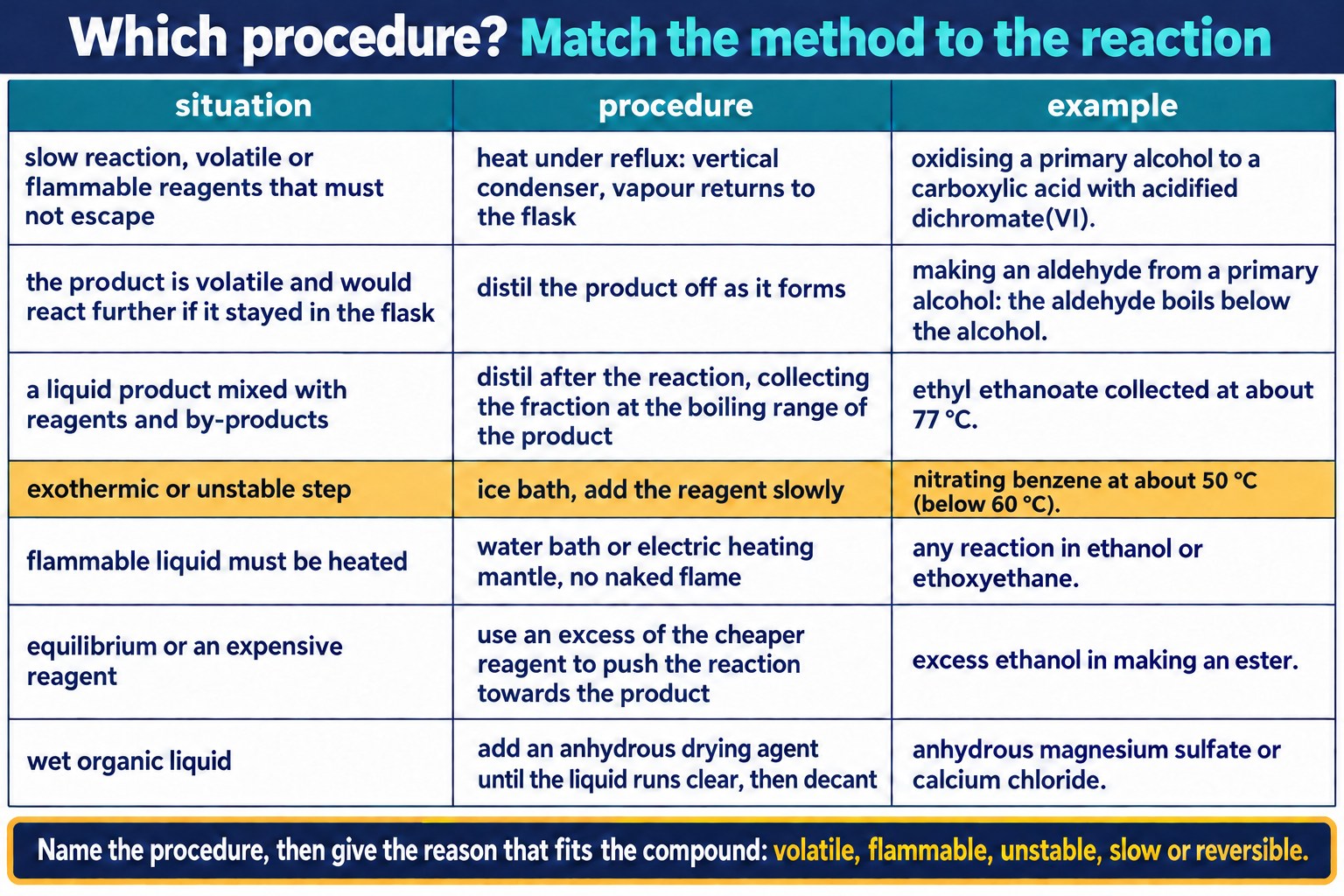
Seven situations and the procedure that fits each one. Learn the reason as well as the name.
Exam focus: Name the procedure and give the property that demands it: “heat under reflux because bromoethane is volatile and would escape” scores; “reflux because it is a slow reaction” alone does not.
Quick Check: Pick the Procedure
Each line describes a job in a new preparation. Choose the better procedure.
Solvent, Temperature and Quantities
Three further choices complete the procedure, and each must be justified in the same way.
Solvent
- Water for hydrolysis and for substitution of a halogenoalkane with aqueous NaOH or KOH.
- Ethanol for KCN with a halogenoalkane (both dissolve) and for KOH when elimination to the alkene is wanted.
- Dry ethoxyethane for Grignard reagents, because water destroys RMgBr.
- A mixed solvent, such as ethanol and water, gives a mixture of substitution and elimination products.
Temperature
- Warm or heat under reflux for slow reactions; the higher the temperature, the faster the reaction.
- Keep cool when a side reaction takes over at higher temperatures: nitration above 55 °C gives dinitrobenzene.
- Below 10 °C for diazotisation, because the diazonium salt decomposes as it warms.
- Never a naked flame with a flammable liquid: water bath for anything boiling below 100 °C, electric mantle above.
Quantities
- An excess of one reagent drives a reversible reaction towards the product and makes the other reagent the limiting one for the yield.
- Choose the cheaper, safer or easier-to-remove reagent as the one in excess: excess ethanol in an esterification distils off at the end.
- Keep the scale small when a reagent is hazardous; the yield calculation is the same at any scale.
Remember: Solvent: does everything dissolve, and does it steer the reaction? Temperature: fast enough without side reactions. Quantities: excess of the cheap reagent, the other one limits the yield.
Check: Choosing a Technique
Choose reflux, distillation, an ice bath or a water bath for preparations that are not on this page, and say which reagent goes in excess.
Reading Hazard Data
Hazard data on a reagent bottle or in a data sheet names the type of harm a substance can do. A control measure is a change to the procedure that reduces the risk from that hazard.
| Hazard class | Typical reagents | Control measures |
|---|---|---|
| flammable | ethanol, ethoxyethane, bromoethane, cyclohexene | no naked flames; water bath or electric heating mantle; keep bottles stoppered |
| toxic | bromine, potassium cyanide, methanol, phenylamine, dichromate(VI) salts | fume cupboard; gloves; small quantities; wash hands afterwards |
| corrosive | concentrated acids, sodium hydroxide, acyl chlorides, ethanoic anhydride, bromine | goggles and gloves; add slowly; dilute where the reaction allows |
| harmful or irritant | dilute acids, dilute ammonia solution, copper(II) sulfate solution | goggles; avoid skin contact; clear spills at once |
| oxidising | potassium manganate(VII), nitric acid, hydrogen peroxide | keep away from flammable liquids; smallest workable amount |
| dangerous to the environment | halogenoalkanes, bromine | collect waste for disposal; never pour down the sink |
- The measure must match the hazard: a fume cupboard controls toxic vapour but does nothing about a corrosive splash.
- Reduce the risk at source first: a smaller scale, a lower temperature or a safer substitute reagent.
- Then control what remains: fume cupboard, water bath, ice bath, protective equipment.
- Substitution example: PCl₅ with an alcohol gives fumes of HCl, so a question may ask for a safer chlorinating method or a fume cupboard.
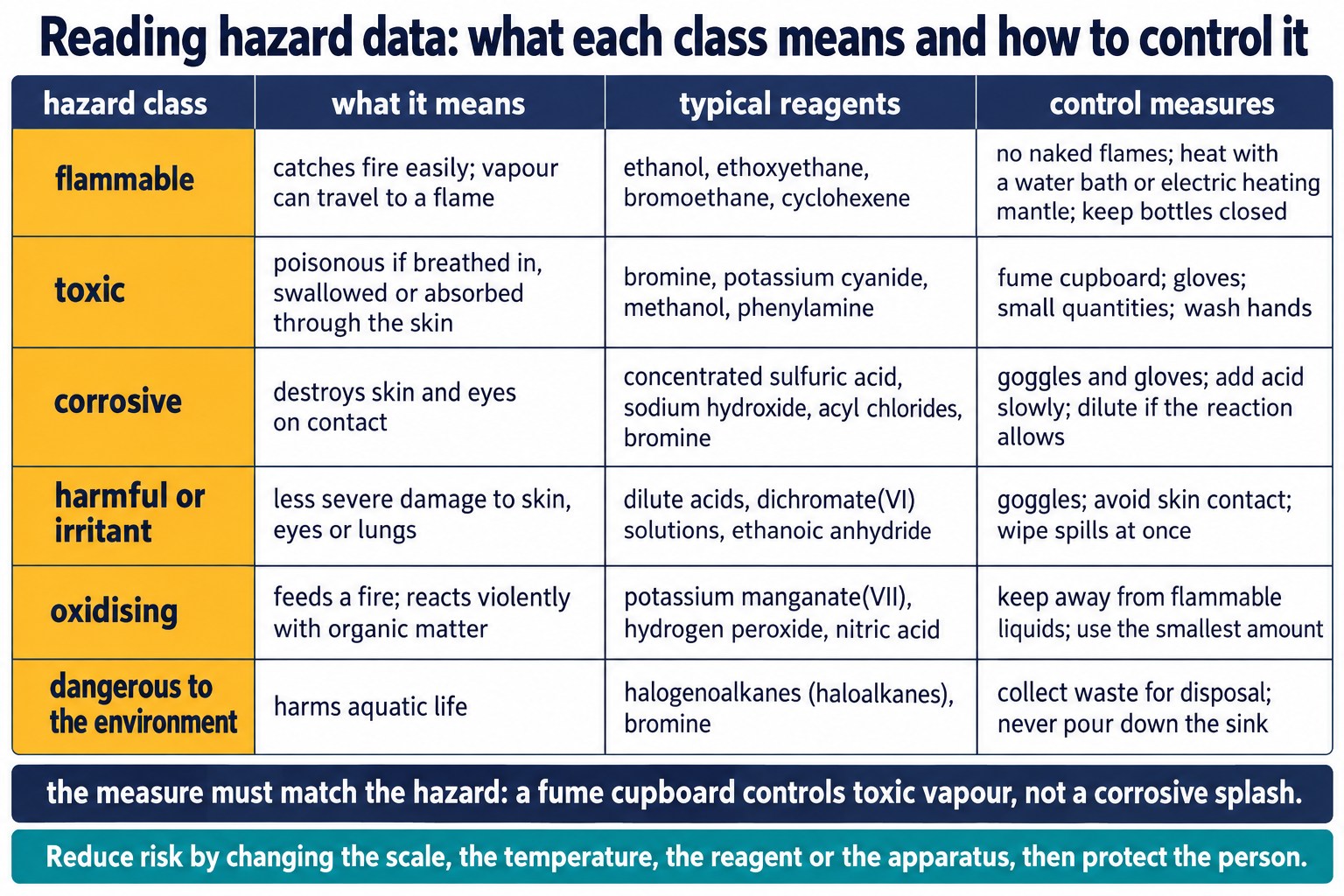
Six hazard classes, the reagents that carry them and the control measures that fit each one.
Exam wording: “Ethoxyethane is highly flammable, so heat with a water bath and keep it away from naked flames.” Hazard, then measure, then the link between them.
Quick Check: Hazard, Measure, Link
Pick the one accurate statement in each set.
Worked Example: a Risk Assessment for Bromoethane
Bromoethane is made by heating ethanol with sodium bromide and concentrated sulfuric acid, which generate hydrogen bromide in the flask, and distilling off the product.
Question. Use the hazard data to identify suitable control measures for this preparation.
| Substance or step | Hazard | Control measure |
|---|---|---|
| ethanol | highly flammable | electric heating mantle or water bath; no naked flames |
| concentrated sulfuric acid | corrosive; mixing is exothermic | goggles and gloves; add the acid slowly to the mixture cooled in ice |
| HBr, SO₂ and Br₂ fumes | toxic and corrosive vapours | fume cupboard; apparatus open at one point so pressure cannot build |
| bromoethane (boils at 38 °C) | highly flammable, harmful, very volatile | collect in a receiver cooled in ice; keep it covered; small scale |
| washing with sodium carbonate solution | carbon dioxide released | invert the funnel and open the tap to release the pressure |
| waste | halogenoalkanes harm aquatic life | collect organic waste in a labelled bottle for disposal |
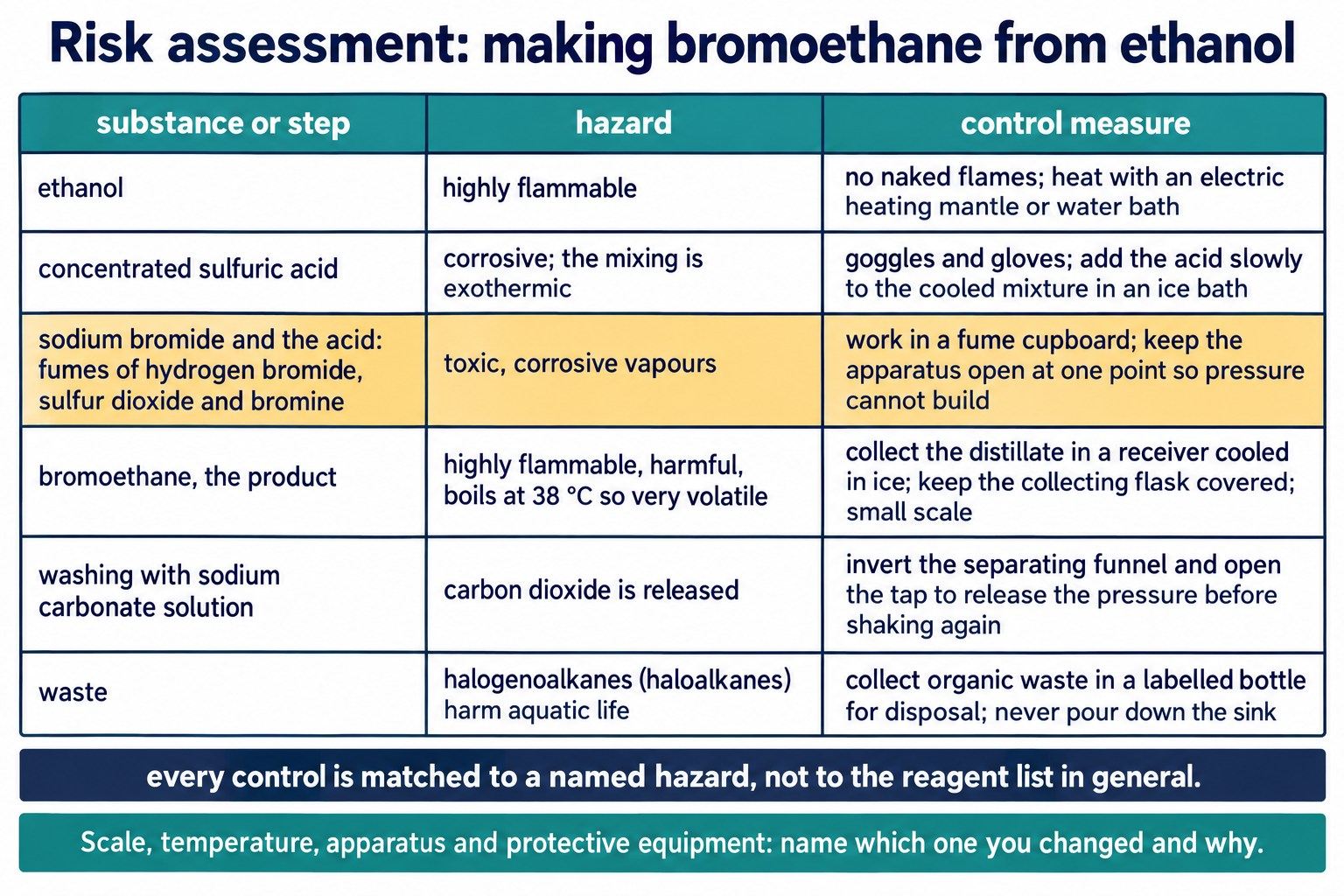
The bromoethane preparation as a risk assessment: substance or step, hazard, control measure.
Common mistake: Listing “goggles, gloves, lab coat” for every reagent earns little. Name the hazard of the specific reagent and the measure that controls it.
Worked Example: Justifying a Procedure for Ethyl Ethanoate
Ethyl ethanoate is made from ethanol and ethanoic acid with a concentrated sulfuric acid catalyst. Every step of the procedure can be justified from the properties of the four liquids involved.
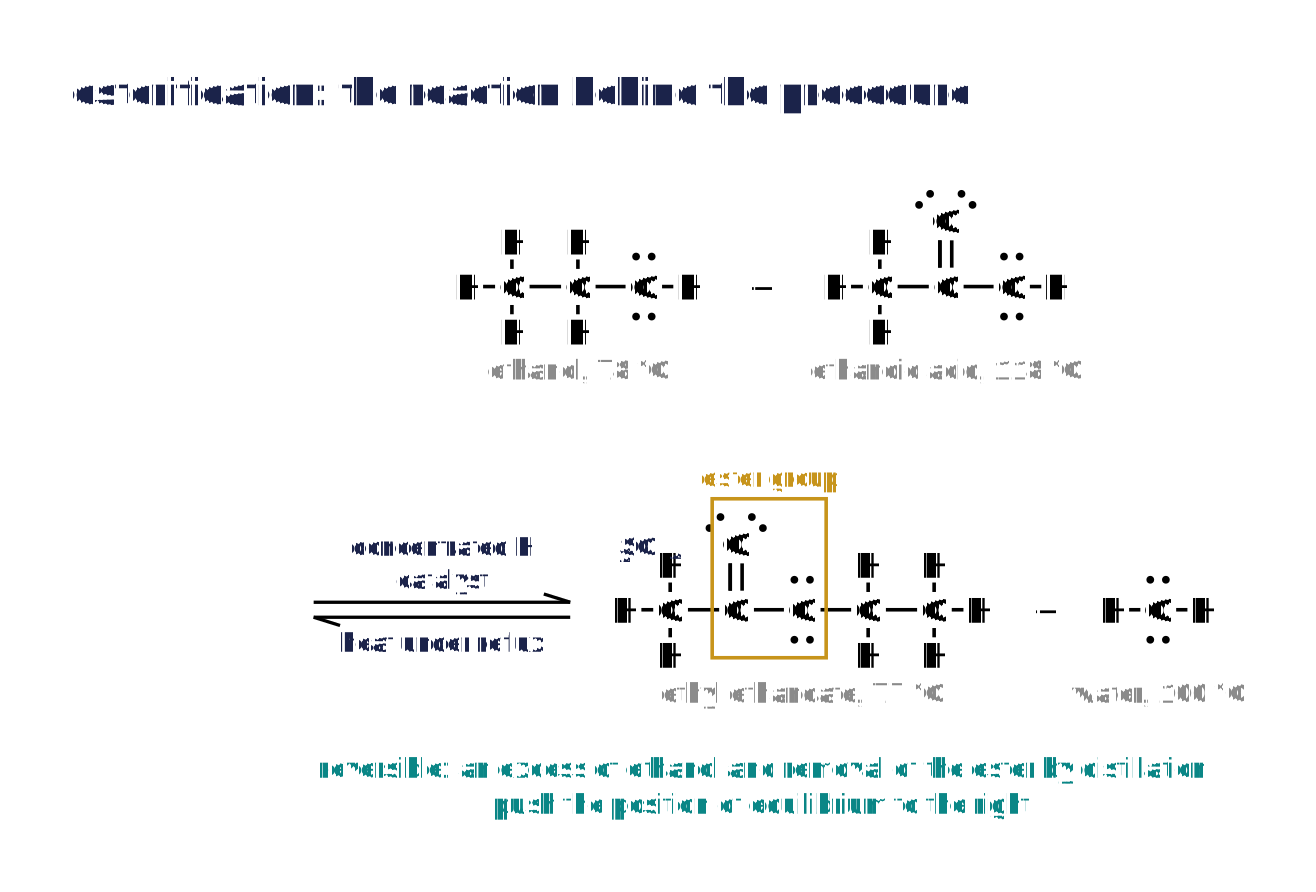
The esterification equilibrium with its conditions, and the boiling temperature of each liquid: ethanol 78 °C, ethanoic acid 118 °C, ethyl ethanoate 77 °C, water 100 °C.
Question. Justify each stage of the procedure used to prepare a pure sample of ethyl ethanoate.
Step 5. Run off the aqueous layer, dry the ester with anhydrous magnesium sulfate until the liquid is clear, then decant and redistil.
Exam wording: A justification pairs each step with the property it deals with: “distil at 77 °C because ethyl ethanoate is the most volatile component” is the whole mark in one sentence.
Check: Justifying a Procedure
Justify the apparatus, solvent, excess and drying choices for preparations that are not worked above.
Common Exam Points
- Reflux keeps volatile reagents in the flask during long heating; distillation takes the most volatile liquid out, during or after the reaction.
- Distil an aldehyde off as it forms so that it is not oxidised further; reflux to take a primary alcohol all the way to the acid.
- Ice bath for exothermic or unstable steps (nitration below 55 °C); water bath or electric mantle, never a flame, for flammable liquids.
- Use an excess of the cheaper reagent to push a reversible reaction towards the product; the other reagent limits the yield.
- Aqueous solvent for substitution, ethanolic for elimination or for KCN; always say which and why.
- Hazard data names the class (flammable, toxic, corrosive, harmful, oxidising, environmental); the control measure must match that class.
- Reduce risk at source first (scale, temperature, safer reagent), then contain what remains (fume cupboard, water bath, protective equipment).
- A justification links each step to a property: volatile, flammable, slow, reversible, unstable or acidic.
FAQs
Use these quick answers to check when to use reflux, distillation or an ice bath, why one reagent is in excess, how hazard data leads to control measures and how to justify a whole procedure.
When do I heat under reflux and when do I distil?
Reflux when the reaction is slow and the reagents are volatile: the vapour condenses and runs back, so nothing is lost during long heating. Distil when the product is volatile and must be removed as it forms, such as an aldehyde before it oxidises further.
Why is one reagent used in excess, and which one?
An excess pushes a reversible reaction towards the product and makes sure the other reagent is used up. Choose the cheaper reagent or the one that is easiest to remove afterwards: excess ethanol in making ethyl ethanoate is removed by washing and distillation.
What control measures do I use for a flammable liquid such as ethoxyethane?
No naked flames anywhere in the laboratory: heat with a water bath or an electric heating mantle, keep the container stoppered and work in a fume cupboard so vapour cannot build up. Use the smallest volume that works and keep it away from oxidising agents.
How do I write a risk assessment for making bromoethane from ethanol?
List each hazard with its control: concentrated sulfuric acid is corrosive (goggles, gloves, add slowly with cooling), ethanol is flammable (water bath, no flames), bromoethane is volatile and harmful (collect under ice-cold water in a fume cupboard), and mixing is exothermic (ice bath).
How do I justify the procedure for preparing ethyl ethanoate?
Reflux ethanol and ethanoic acid with a little concentrated sulfuric acid (catalyst), using excess ethanol to shift the equilibrium. Distil off the ester, wash with sodium carbonate solution to remove acid, dry with anhydrous calcium chloride, then redistil, collecting at its boiling temperature, 77 °C.

Copyright notice: This OLS revision content, including the explanations, layout, diagrams, tables and embedded learning structure, is authored for Online Learning System by Dr. Mohammed Al-Fatah. It may not be copied, reproduced, redistributed or adapted without written permission.
Keep this note — free
Save your progress across every Edexcel IAL topic. A free account remembers which topics you have covered, saves your question scores, and syncs across your phone and laptop.
- Track every topic you have finished
- Keep your practice-question scores
- No payment, no card, free forever
Already registered? Log in