Topic 20
Organic
Synthesis
Topic 20 closes Unit 5 by pulling the organic chemistry of the whole course together: deducing empirical, molecular and structural formulae from combustion analysis, percentage composition, characteristic reactions and spectra; lengthening the carbon chain with Grignard reagents; predicting the properties of unfamiliar compounds, planning reaction schemes of up to four steps, and selecting procedures and control measures from hazard data; the preparation of aspirin (Core Practical 16); and the techniques used to prepare and purify organic compounds, from reflux and recrystallisation to steam distillation and melting and boiling temperature determination.
Revision Notes
7 revision notes, in the order the specification teaches them.

Deducing Formulae from Analytical Data
Deducing empirical, molecular and structural formulae from combustion analysis, percentage composition and spectra.
Start revising
Identifying Functional Groups by Chemical Tests
Identifying functional groups by chemical tests and predicting the properties and reactions of unfamiliar compounds.
Start revising
Grignard Reagents and Carbon–Carbon Bond Formation
Forming carbon–carbon bonds in synthesis: Grignard reagents with carbon dioxide and carbonyl compounds, and the nitrile route.
Start revising
Planning a Synthetic Route
Planning multi-step organic synthesis routes: the reaction map, working backwards from the target.
Start revising
Choosing Procedures and Managing Hazards
Selecting and justifying practical procedures for organic reactions and choosing control measures from hazard data.
Start revising
Preparing and Purifying Organic Solids
Preparing and purifying organic solids: reflux, filtration, recrystallisation, drying and melting temperature determination.
Start revising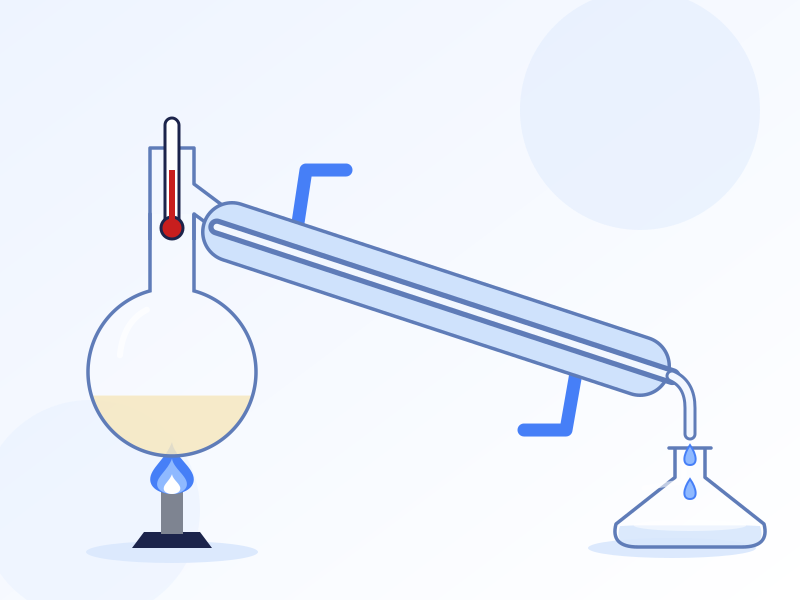
Purifying Liquids: Distillation, Steam Distillation and Solvent Extraction
Purifying organic liquids: distillation, steam distillation, solvent extraction, drying and checking purity.
Start revisingSummary Map
Download, print and revise the key facts of this topic at a glance.
Summary maps
Download, print and revise the key facts of this topic at a glance.

Grignard Reagents Map
Edexcel International A Level Chemistry · Unit 5 · Topic 20
Every reaction on one A4 page: reagents, conditions and reaction type for each arrow, colour coded, with the key tests.
Formulae and Structures Summary Map
Edexcel International A Level Chemistry
Percentage composition, combustion analysis, chemical tests, and mass, infrared and NMR spectra.
Grignard and Routes Summary Map
Edexcel International A Level Chemistry
Grignard reagents, new C–C bonds, aliphatic and aromatic routes, and working backwards.
Practical Techniques Summary Map
Edexcel International A Level Chemistry
Reflux, distillation, washing and drying, recrystallisation, melting temperature, and hazards.
© 2026 Online Learning System. For personal study: printing is allowed; editing, copying and redistribution are not.
Virtual Lessons
Recorded video lessons that teach the topic step by step.
The Virtual Lessons for Topic 20 Organic Synthesis are being recorded.
MCQ Bank
Multiple-choice papers on this topic, marked the moment you submit.
The MCQ papers for Topic 20 Organic Synthesis are being written.
SAQ Bank
Written, drawn and worked exam practice on this topic.
The exam practice papers for Topic 20 Organic Synthesis are being written.
Revision Game
Match reagents to products, free, with your board's reagents and conditions.

Study Cards
Pick a deck, then turn each card to check what you remember.
Specification
Every specification point in this topic, in the exam board's own words. Rate how confident you are with each one.
Self-assessment · 26 points
Sign in to rate how confident you feel about each point. Your ratings are saved to your account, follow you to any device, and appear beside your KASP analytics, kept apart from your marks.
20.1
20.2
20.3
- i
be able to use knowledge of organic chemistry contained given in this specification to solve problems such as: predicting the properties of unfamiliar compounds containing one or more of the functional groups included in the specification and explain these predictions
Revise - ii
be able to use knowledge of organic chemistry contained given in this specification to solve problems such as: planning reaction schemes of up to four steps, recalling familiar reactions and using unfamiliar reactions given sufficient information
Revise - iii
be able to use knowledge of organic chemistry contained given in this specification to solve problems such as: selecting suitable practical procedures for carrying out reactions involving compounds with functional groups included in this specification
Revise - iv
be able to use knowledge of organic chemistry contained given in this specification to solve problems such as: identifying appropriate control measures to reduce risk based on data of hazards
Revise
20.4
- 20.4
CORE PRACTICAL 16 The preparation of aspirin.
20.5
- i
understand the following techniques used in the preparation and purification of organic compounds: refluxing
Revise - ii
understand the following techniques used in the preparation and purification of organic compounds: purification by washing, including with water and sodium carbonate solution
Revise - iii
understand the following techniques used in the preparation and purification of organic compounds: solvent extraction
Revise - iv
understand the following techniques used in the preparation and purification of organic compounds: recrystallisation
Revise - ix
understand the following techniques used in the preparation and purification of organic compounds: boiling temperature determination
Revise - v
understand the following techniques used in the preparation and purification of organic compounds: drying
Revise - vi
understand the following techniques used in the preparation and purification of organic compounds: distillation
Revise - vii
understand the following techniques used in the preparation and purification of organic compounds: steam distillation
Revise - viii
understand the following techniques used in the preparation and purification of organic compounds: melting temperature determination
Revise
Keep this note — free
Save your progress across every Edexcel IAL topic. A free account remembers which topics you have covered, saves your question scores, and syncs across your phone and laptop.
- Track every topic you have finished
- Keep your practice-question scores
- No payment, no card, free forever
Already registered? Log in