Standard Electrode Potentials and the Hydrogen Electrode
A concise revision guide to the standard electrode potential, E⦵: how an electrode potential arises, the standard conditions, the standard hydrogen electrode and why a reference electrode is needed.
- 14.3
- 14.4i
- 14.4ii
- 14.4iii
- 14.5-a
- 14.5-b
What these spec points say
- 14.3 know what is meant by the term ‘standard electrode potential’, Eo
- 14.4i know that the standard electrode potential, Eo, refers to conditions of: 298 K temperature
- 14.4ii know that the standard electrode potential, Eo, refers to conditions of: 100 kPa pressure of gases
- 14.4iii know that the standard electrode potential, Eo, refers to conditions of: 1.00 mol dm-3 concentration of ions
- 14.5-a know the features of the standard hydrogen electrode
- 14.5-b understand why a reference electrode is necessary
The standard hydrogen electrode
The reference half-cell that every standard electrode potential is measured against, set at 0.00 V by definition.
© Dr. Mohammed Al-Fatah – onlinelearningsystem.net
Before You Start
This page builds on Redox, Oxidation Numbers and Half-Equations: oxidation is the loss of electrons and reduction is the gain of electrons.
- A half-equation shows one half of a redox reaction, with the electrons written in.
- A reducing agent donates electrons; an oxidising agent accepts them.
- A reversible change reaches a dynamic equilibrium, and its position shifts when the conditions change.
- More reactive metals lose electrons more readily.
GCSE Recap: Reactivity, Cells and Electron Transfer
Three quick questions on the GCSE ideas this page builds on.
How an Electrode Potential Arises
Dip a strip of metal into a solution of its own ions. Two opposite changes begin at the surface of the metal.
- Metal atoms leave the surface as ions, and their electrons stay behind on the metal.
- Metal ions from the solution take electrons from the metal and are deposited as atoms.
- The two rates soon become equal: a dynamic equilibrium is set up.
Mⁿ⁺(aq) + ne⁻ ⇌ M(s)
At equilibrium the metal carries a small charge compared with the solution. This difference is the electrode potential of the metal.
| Zinc in Zn²⁺(aq) | Copper in Cu²⁺(aq) | |
|---|---|---|
| Equilibrium | Zn²⁺(aq) + 2e⁻ ⇌ Zn(s) | Cu²⁺(aq) + 2e⁻ ⇌ Cu(s) |
| Reactivity of the metal | more reactive | less reactive |
| Position of equilibrium | further to the left | further to the right |
| Electrons left on the metal | more | fewer |
| Electrode potential | more negative | more positive |
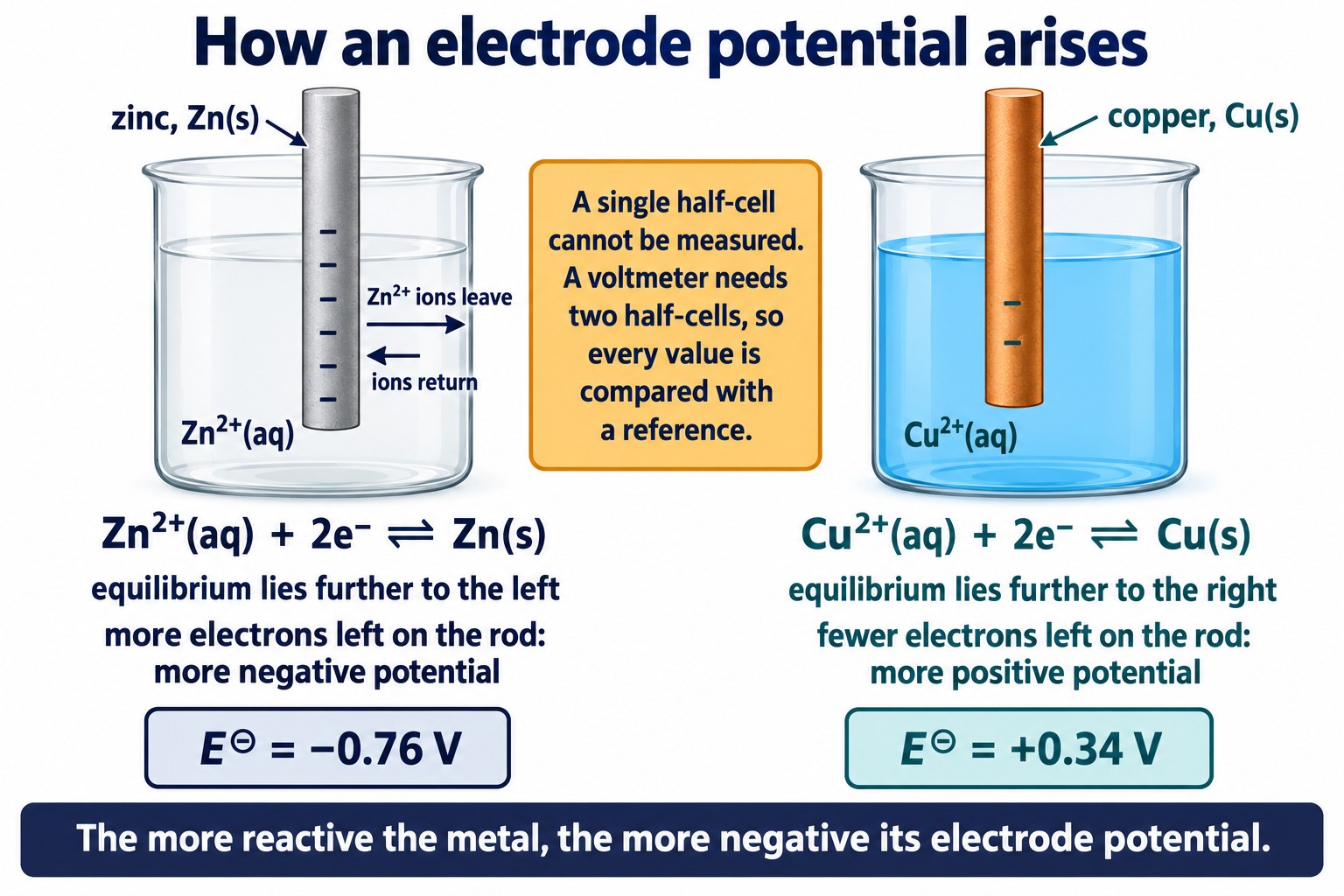
Zinc and copper half-cells compared: the more reactive metal forms ions more readily, keeps more electrons on the rod and has the more negative potential.
Remember: The more reactive the metal, the further the equilibrium Mⁿ⁺(aq) + ne⁻ ⇌ M(s) lies to the left, and the more negative the electrode potential.
Why a Reference Electrode Is Needed
A metal dipping into a solution of its ions is called a half-cell. The potential of one half-cell on its own cannot be measured.
- A voltmeter has two terminals. It measures a potential difference between two points.
- One terminal can be joined to the metal, but the other must also be connected to the solution.
- Any second connection dipped into the solution is itself a second half-cell.
- So only the difference between two half-cells can ever be measured.
The solution is to choose one half-cell as a reference and to give it a potential of exactly zero. Every other half-cell is then measured against it.
The hydrogen electrode is awkward to set up, so laboratories often use a simpler secondary reference electrode whose potential has already been measured against it.
Remember: Absolute electrode potentials cannot be measured, only differences. All values are quoted against the standard hydrogen electrode, which is given the value 0.00 V.
Check: Half-Cells and Electrode Potentials
Test how an electrode potential arises and why a single half-cell cannot be measured, using metals not compared on this page.
The Standard Hydrogen Electrode
The reference half-cell is the standard hydrogen electrode. It is based on the equilibrium between hydrogen ions and hydrogen gas.
2H⁺(aq) + 2e⁻ ⇌ H₂(g) E⦵ = 0.00 V
| Feature | Detail |
|---|---|
| Gas | hydrogen, H₂(g), at a pressure of 100 kPa |
| Electrode | platinum coated in platinum black |
| Solution | an acid with [H⁺(aq)] = 1.00 mol dm⁻³, such as HCl(aq) |
| Temperature | 298 K |
| Potential | 0.00 V by definition |
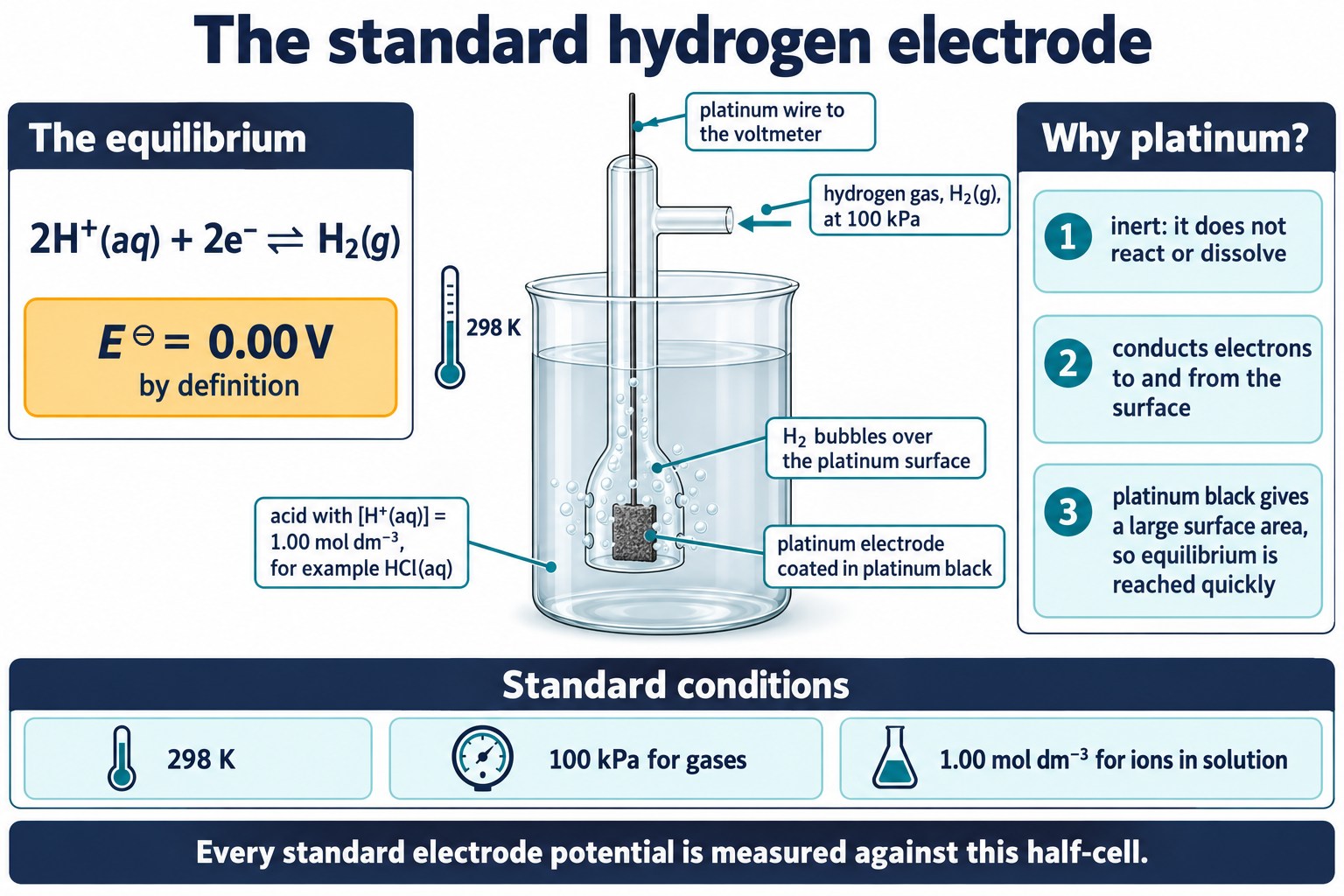
The standard hydrogen electrode: hydrogen at 100 kPa bubbles over a platinum black electrode in acid with a hydrogen ion concentration of 1.00 mol dm⁻³ at 298 K.
Why platinum?
- Hydrogen is a gas and cannot be made into an electrode, so a solid conductor is needed.
- Platinum is inert: it does not react with the acid or take part in the equilibrium.
- Platinum conducts, so electrons can travel to and from the surface.
- Platinum black is a rough, porous coating with a large surface area, so equilibrium is reached quickly.
Why not 1.00 mol dm⁻³ sulfuric acid?
- The condition is 1.00 mol dm⁻³ of H⁺ ions, not of acid.
- Each H₂SO₄ can release two H⁺ ions, so a 1.00 mol dm⁻³ solution would contain more than 1.00 mol dm⁻³ of H⁺.
- A 1.00 mol dm⁻³ solution of a strong monoprotic acid, such as HCl, gives the right concentration.
Exam focus: Four features earn the marks: H₂ gas at 100 kPa, a platinum electrode, a solution with 1.00 mol dm⁻³ H⁺ ions, and a temperature of 298 K.
Standard Conditions
The position of a half-cell equilibrium changes with temperature, pressure and concentration, so the potential changes too. Values can be compared only if they are measured under the same standard conditions.
| Condition | Standard value | Applies to |
|---|---|---|
| Temperature | 298 K (25 °C) | every half-cell |
| Pressure | 100 kPa | any gas, such as H₂ or Cl₂ |
| Concentration | 1.00 mol dm⁻³ | every ion in solution |
- The symbol ⦵ in E⦵ shows that the value was measured under standard conditions.
- A change in any one of the three conditions gives a different potential, written E without the ⦵ sign.
- A solid metal electrode needs no standard condition other than being pure.
Check: The Hydrogen Electrode and Standard Conditions
Pick out the correct features of the standard hydrogen electrode and the standard conditions, and explain the choice of platinum.
The Standard electrode potential, E⦵
The standard electrode potential, E⦵, of a half-cell is the emf measured when the half-cell is connected to a standard hydrogen electrode under standard conditions.
Measuring it
- Set up the half-cell under standard conditions: 298 K, with every ion at 1.00 mol dm⁻³.
- Join its solution to the standard hydrogen electrode with a salt bridge.
- Join the two electrodes through a high-resistance voltmeter.
- The voltmeter reading is E⦵ of the half-cell, with a sign.
| Half-cell | Against the hydrogen electrode it is | E⦵ / V |
|---|---|---|
| Zn²⁺(aq) + 2e⁻ ⇌ Zn(s) | the negative electrode | −0.76 |
| Cu²⁺(aq) + 2e⁻ ⇌ Cu(s) | the positive electrode | +0.34 |
What the sign means
- A negative E⦵: the half-cell releases electrons more readily than hydrogen does. Zinc atoms are oxidised and electrons flow to the hydrogen electrode.
- A positive E⦵: the half-cell accepts electrons more readily than H⁺ ions do. Cu²⁺ ions are reduced and electrons flow from the hydrogen electrode.
- Always include the sign, even when it is positive.
Written as reductions
By convention every half-equation in a data table is written as a reduction, with the electrons on the left.
| Half-equation | E⦵ / V |
|---|---|
| Mg²⁺(aq) + 2e⁻ ⇌ Mg(s) | −2.37 |
| Zn²⁺(aq) + 2e⁻ ⇌ Zn(s) | −0.76 |
| Fe²⁺(aq) + 2e⁻ ⇌ Fe(s) | −0.44 |
| 2H⁺(aq) + 2e⁻ ⇌ H₂(g) | 0.00 |
| Cu²⁺(aq) + 2e⁻ ⇌ Cu(s) | +0.34 |
| Ag⁺(aq) + e⁻ ⇌ Ag(s) | +0.80 |
The salt bridge and the voltmeter are explained on the next page, Electrochemical Cells, Cell Diagrams and Cell Potentials.
Definition: The standard electrode potential is the emf of a half-cell connected to a standard hydrogen electrode, measured at 298 K with all solutions at 1.00 mol dm⁻³ and all gases at 100 kPa.
Quick Check: From Voltmeter Readings to E⦵
Turn each reading into a signed value before you rank the metals.
Common Exam Points
Say
- “The standard hydrogen electrode has a potential of 0.00 V by definition.”
- “Platinum is inert and conducts electricity.”
- “298 K, 100 kPa and 1.00 mol dm⁻³ for the ions.”
Do not say
- “Room temperature and pressure” (state the values).
- “1.00 mol dm⁻³ acid” (the condition is 1.00 mol dm⁻³ of H⁺ ions).
- “The electrode potential of zinc was measured” without naming the reference half-cell.
Watch for
- Signs left off positive values: write +0.34 V.
- Half-equations copied backwards: data tables show reductions.
- A reactive metal has a negative E⦵, because its equilibrium lies towards the ions.
- The pressure applies only to gases, and the concentration only to ions in solution.
Check: Defining and Measuring E⦵
Use the definition, the sign of E⦵ and the way it is measured, with half-cells not used on this page.
FAQs
Use these quick answers to check the standard electrode potential, standard conditions and the standard hydrogen electrode.
Why can the potential of a single half-cell not be measured?
A voltmeter measures a potential difference, so it needs two electrodes. Adding a second electrode makes a second half-cell. Every half-cell is therefore compared with the same reference, the standard hydrogen electrode, which is given the value 0.00 V.
What does standard electrode potential mean?
E⦵ is the voltage measured when a half-cell is connected to the standard hydrogen electrode under standard conditions. The half-equation is always written as a reduction, with the electrons on the left.
What are the standard conditions?
A temperature of 298 K, a gas pressure of 100 kPa and all aqueous ions at a concentration of 1.00 mol dm⁻³. Changing any of these shifts the position of the half-cell equilibrium, so the measured potential changes.
Why is platinum used in the standard hydrogen electrode?
Hydrogen is a gas, so it cannot be an electrode itself. Platinum is inert and conducts electrons. A coating of platinum black gives a large surface area, on which the equilibrium 2H⁺(aq) + 2e⁻ ⇌ H₂(g) is established quickly.
Why is E⦵ negative for zinc but positive for copper?
Zinc is the more reactive metal, so Zn²⁺(aq) + 2e⁻ ⇌ Zn(s) lies further to the left and leaves more electrons on the metal: −0.76 V. Copper(II) ions accept electrons more readily than H⁺ ions do: +0.34 V.

Copyright notice: This OLS revision content, including the explanations, layout, diagrams, tables and embedded learning structure, is authored for Online Learning System by Dr. Mohammed Al-Fatah. It may not be copied, reproduced, redistributed or adapted without written permission.
Keep this note — free
Save your progress across every Edexcel topic. A free account remembers which topics you have covered, saves your question scores, and syncs across your phone and laptop.
- Track every topic you have finished
- Keep your practice-question scores
- No payment, no card, free forever
Already registered? Log in