Aldehydes and Ketones: Structure, Naming and Properties
A concise revision guide to carbonyl compounds: the aldehyde and ketone functional groups, naming and drawing them, the polar C=O bond, and how intermolecular forces explain their boiling temperatures and their solubility in water.
- 17B.6-a
- 17B.6-b
- 17B.7i
- 17B.7ii
What these spec points say
- 17B.6-a be able to identify the aldehyde functional group
- 17B.6-b be able to identify the ketone functional group
- 17B.7i understand that aldehydes and ketones: do not form intermolecular hydrogen bonds and this affects their physical properties
- 17B.7ii understand that aldehydes and ketones: can form hydrogen bonds with water and this affects their solubility
AS Recap: Oxidation of Alcohols
Three quick questions on what you already know: what primary and secondary alcohols give with acidified dichromate(VI), and why distilling and refluxing give different products.
The Carbonyl Group
Aldehydes and ketones both contain the carbonyl group, C=O. They are called carbonyl compounds. The difference is what is attached to the carbonyl carbon.
| Aldehyde | Ketone | |
|---|---|---|
| Position of C=O | at the end of the chain | inside the chain |
| On the C=O carbon | at least one hydrogen atom | two carbon groups, no hydrogen |
| General formula | RCHO | RCOR′ |
| Functional group written as | –CHO | –CO– |
| Smallest member | methanal, HCHO | propanone, CH₃COCH₃ |
| Name ending | -al | -one |
- The carbonyl carbon and the three atoms bonded to it lie in one plane, with bond angles of about 120°.
- The hydrogen on the C=O carbon of an aldehyde explains why aldehydes are easily oxidised and ketones are not.
- An aldehyde and a ketone with the same number of carbons are functional group isomers: propanal and propanone are both C₃H₆O.
Remember: Write the aldehyde group as –CHO, never –COH, which looks like an alcohol. The smallest ketone has three carbons, because the C=O must sit between two carbon atoms.
Naming Aldehydes and Ketones
Aldehydes: ending -al
- Count the longest chain that includes the –CHO carbon.
- The –CHO carbon is always carbon 1, so the name needs no number for it.
- Number any branches from that end: (CH₃)₂CHCHO is 2-methylpropanal.
Ketones: ending -one
- Count the longest chain that includes the C=O carbon.
- Number the chain from the end that gives the C=O carbon the lower number.
- Propanone and butanone need no number: the C=O can only be in one place.
- From five carbons, a number is essential: pentan-2-one and pentan-3-one are position isomers.
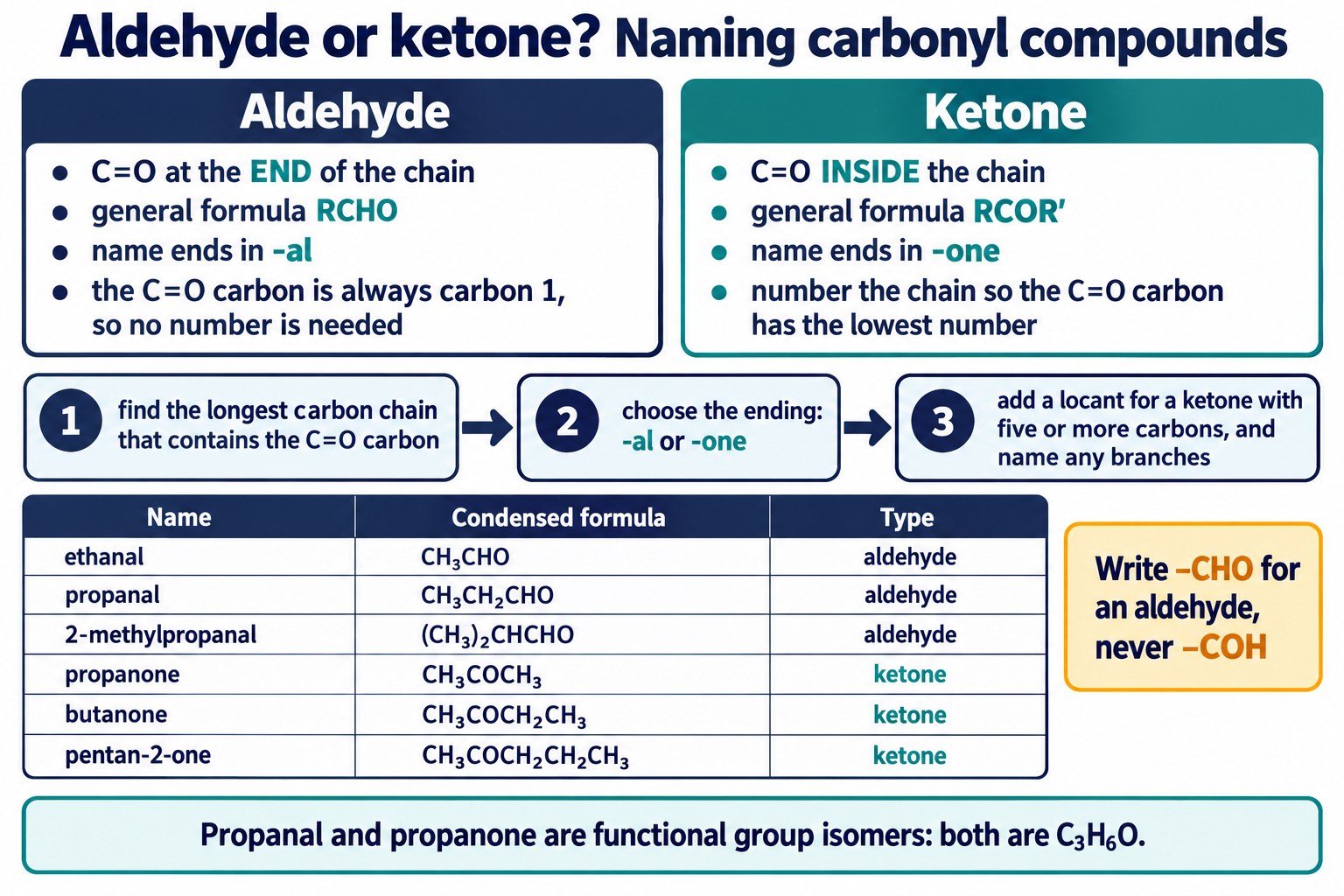
Aldehyde or ketone: where the C=O group sits, the name ending, the three naming steps and six named examples as condensed formulae.
| Name | Structural formula | Type |
|---|---|---|
| ethanal | CH₃CHO | aldehyde |
| propanal | CH₃CH₂CHO | aldehyde |
| propanone | CH₃COCH₃ | ketone |
| butanone | CH₃COCH₂CH₃ | ketone |
| pentan-2-one | CH₃COCH₂CH₂CH₃ | ketone |
| pentan-3-one | CH₃CH₂COCH₂CH₃ | ketone |
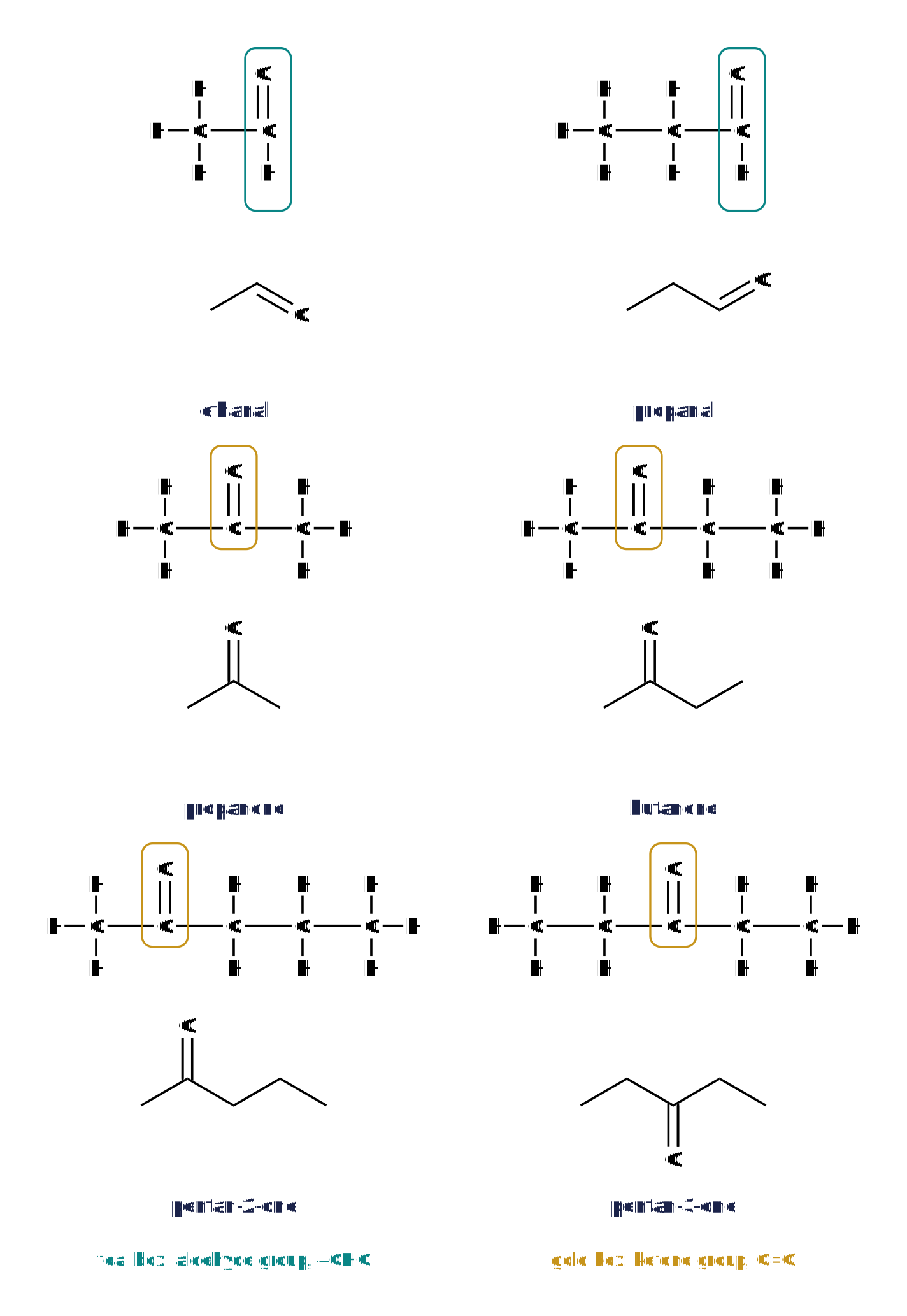
Displayed and skeletal formulae of ethanal, propanal, propanone, butanone, pentan-2-one and pentan-3-one, with the aldehyde group and the ketone group picked out.
Worked example 1: name (CH₃)₂CHCH₂CHO
Step 1. The –CHO group makes it an aldehyde, and its carbon is carbon 1.
Answer. 3-methylbutanal.
Worked example 2: name CH₃COCH₂CH(CH₃)₂
Step 2. Numbering from the left puts C=O on carbon 2 and the CH₃ branch on carbon 4.
Answer. 4-methylpentan-2-one.
Exam focus: In a skeletal formula an aldehyde appears as a chain ending in =O, and a ketone has =O on a carbon within the chain. Show the aldehyde hydrogen in a displayed formula.
Check: Naming and Drawing Carbonyl Compounds
Name aldehydes and ketones, classify them and pick out isomers, using compounds not named on this page.
The Polar C=O Bond
Oxygen is much more electronegative than carbon. It pulls the electrons of the C=O bond, especially the π electrons, towards itself.
- The oxygen atom carries a partial negative charge, δ−, and has two lone pairs.
- The carbon atom carries a partial positive charge, δ+.
- The bond has a permanent dipole: C(δ+)=O(δ−).
The polar bond controls the chemistry and the physical properties of carbonyl compounds.
| Feature | Consequence |
|---|---|
| δ+ carbon | attacked by nucleophiles such as CN⁻: see Reduction and Nucleophilic Addition |
| permanent dipole | permanent dipole–dipole forces between molecules: higher boiling temperature |
| lone pairs on δ− oxygen | accept hydrogen bonds from water: solubility |
| planar C=O group | attack from either side: racemic products (Optical Activity and Racemic Mixtures) |
Remember: The C=C bond in an alkene is non-polar and electron-rich, so it attracts electrophiles. The C=O bond is polar with a δ+ carbon, so it attracts nucleophiles.
Boiling temperatures of Carbonyl Compounds
Compare compounds of similar relative molecular mass, so that the London forces are about the same. Any difference then comes from the other intermolecular forces.
| Compound | Mᵣ | Boiling temperature / °C | Strongest force between molecules |
|---|---|---|---|
| butane, C₄H₁₀ | 58 | −1 | London forces only |
| propanal, CH₃CH₂CHO | 58 | 49 | permanent dipole–dipole |
| propanone, CH₃COCH₃ | 58 | 56 | permanent dipole–dipole |
| propan-1-ol, CH₃CH₂CH₂OH | 60 | 97 | hydrogen bonds |
- Higher than alkanes: carbonyl molecules attract each other by permanent dipole–dipole forces as well as London forces.
- Lower than alcohols: a carbonyl compound has no O–H bond, so its molecules cannot form hydrogen bonds with each other.
- Hydrogen bonds are stronger than permanent dipole–dipole forces, so more energy is needed to separate alcohol molecules.
- Along the series the boiling temperature rises as the chain grows, because there are more electrons and stronger London forces.
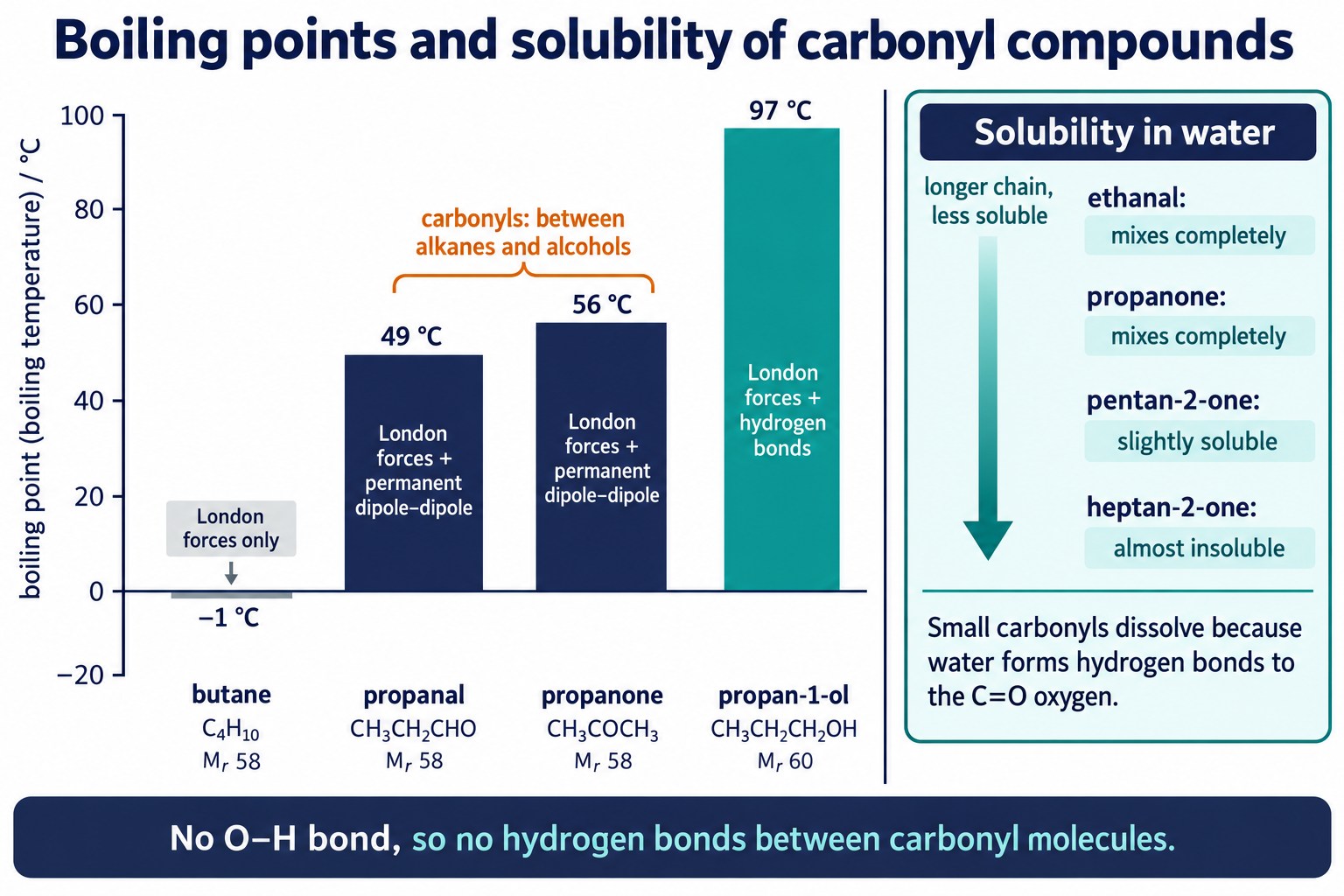
Butane, propanal, propanone and propan-1-ol compared: similar relative molecular mass, very different forces between the molecules, with the solubility trend alongside.
Exam focus: To explain a boiling temperature, name the strongest intermolecular force in each compound and say which needs more energy to overcome. Never refer to breaking covalent bonds.
Quick Check: Ranking by Boiling
Name the strongest force between the molecules of each compound, then rank them.
Solubility in Water
Carbonyl compounds cannot hydrogen bond to each other, but they can hydrogen bond to water.
- A δ+ hydrogen atom of a water molecule is attracted to a lone pair on the δ− oxygen of the C=O group.
- The hydrogen bond forms between the carbonyl oxygen and the O–H of water.
- The small carbonyl compounds, such as methanal, ethanal and propanone, mix completely with water.
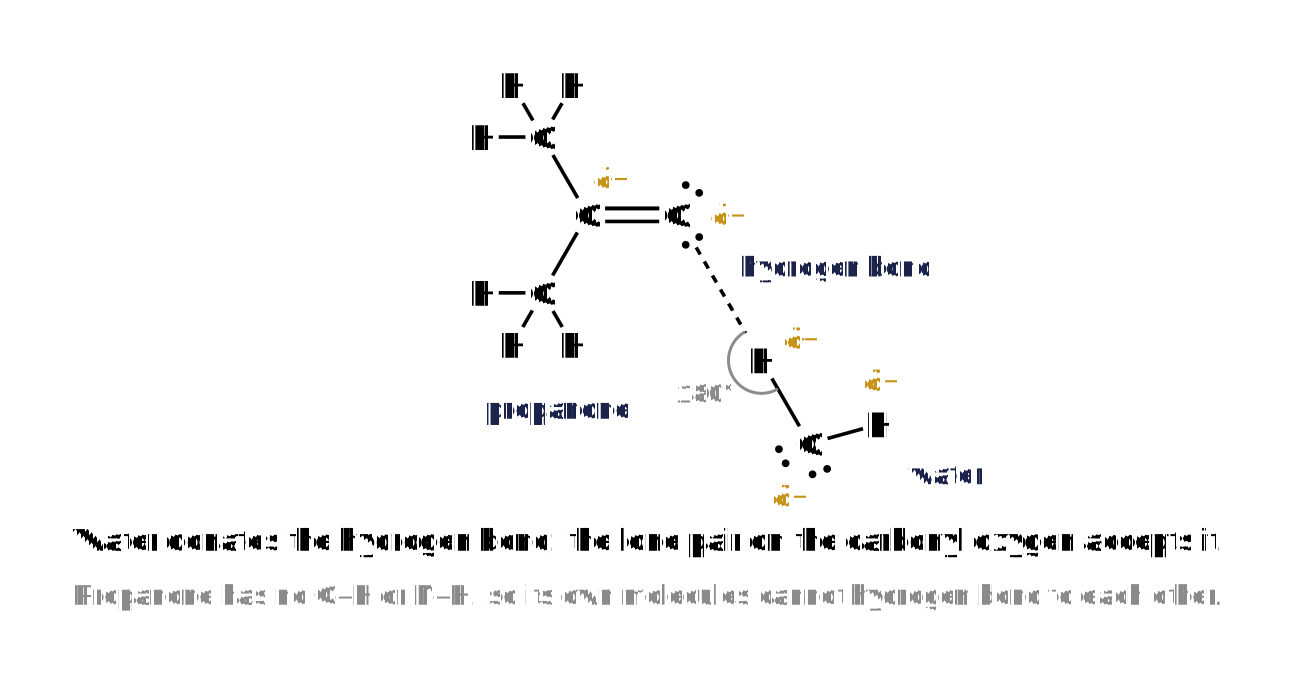
A hydrogen bond between a lone pair on the oxygen of propanone and a δ+ hydrogen of water, with the three atoms O, H and O in a straight line.
Solubility falls as the chain grows
- A longer hydrocarbon chain is non-polar and cannot hydrogen bond to water.
- It disrupts the hydrogen bonding between water molecules without replacing it.
- Pentan-2-one is only slightly soluble, and heptan-2-one is almost insoluble.
Exam focus: A hydrogen bond diagram needs the lone pair on the carbonyl oxygen, δ+ and δ− on the atoms involved, a dashed line from the lone pair to the hydrogen, and 180° about that hydrogen.
Where Carbonyl Compounds Come From
Aldehydes and ketones are made by oxidising alcohols with acidified potassium dichromate(VI), as covered in Topic 6 Organic Chemistry I.
- A primary alcohol, distilled as it forms, gives an aldehyde: CH₃CH₂OH + [O] → CH₃CHO + H₂O.
- A secondary alcohol, heated under reflux, gives a ketone: CH₃CH(OH)CH₃ + [O] → CH₃COCH₃ + H₂O.
- The next page, Oxidation and Tests for Carbonyl Compounds, shows how an aldehyde can be oxidised further.
Common Exam Points
Say
- “Carbonyl compounds have permanent dipole–dipole forces between their molecules.”
- “There is no hydrogen bonding between the molecules, because there is no O–H bond.”
- “Water forms hydrogen bonds to the lone pair on the carbonyl oxygen.”
Do not say
- “Aldehydes have hydrogen bonds” when describing the pure liquid.
- “The C=O bond is strong, so the boiling temperature is high” (boiling separates molecules; it does not break bonds).
- “Ethanone” or “propan-1-one” (a C=O at the end of a chain makes an aldehyde, so these ketones do not exist).
Watch for
- The aldehyde carbon is carbon 1, so branches are numbered from the –CHO end.
- Comparisons must use molecules of similar Mᵣ, or London forces will also differ.
- Skeletal formulae: the aldehyde hydrogen is often left out, so look for =O at the end of a chain.
Check: Boiling temperatures and Solubility
Explain the physical properties of carbonyl compounds from their intermolecular forces, using compounds and data not used on this page.
FAQs
Use these quick answers to check the structure, naming and physical properties of aldehydes and ketones.
What is the difference between an aldehyde and a ketone?
Both contain the carbonyl group, C=O. In an aldehyde the carbonyl carbon is at the end of the chain and carries at least one hydrogen atom, RCHO. In a ketone it sits between two carbon atoms, RCOR′.
How are aldehydes and ketones named?
Aldehydes end in -al and need no number, because the CHO carbon is always carbon 1. Ketones end in -one, with a number once the chain has five or more carbon atoms, such as pentan-2-one and pentan-3-one.
Why is the boiling temperature of an aldehyde lower than that of a similar alcohol?
The polar C=O bond gives permanent dipole-dipole forces between molecules, so the value is above that of a similar alkane. There is no H atom bonded to oxygen, so the molecules cannot hydrogen bond to each other as alcohol molecules do.
Why are small aldehydes and ketones soluble in water?
The lone pairs on the δ− oxygen of the C=O group accept hydrogen bonds from the δ+ hydrogen atoms of water molecules. Ethanal and propanone therefore mix with water. Solubility falls as the non-polar hydrocarbon chain grows.
How are aldehydes and ketones made?
Oxidise an alcohol with acidified potassium dichromate(VI). A primary alcohol gives an aldehyde if the product is distilled off as it forms; under reflux it goes on to the carboxylic acid. A secondary alcohol gives a ketone.

Copyright notice: This OLS revision content, including the explanations, layout, diagrams, tables and embedded learning structure, is authored for Online Learning System by Dr. Mohammed Al-Fatah. It may not be copied, reproduced, redistributed or adapted without written permission.
Keep this note — free
Save your progress across every Edexcel topic. A free account remembers which topics you have covered, saves your question scores, and syncs across your phone and laptop.
- Track every topic you have finished
- Keep your practice-question scores
- No payment, no card, free forever
Already registered? Log in