Optical Isomerism and Chirality
A concise revision guide to optical isomerism: what a chiral centre is, how to spot an asymmetric carbon atom, why the two enantiomers are non-superimposable mirror images, and how to draw them in 3D with wedge and dashed bonds.
- 17A.1
- 17A.2-a
- 17A.2-b
What these spec points say
- 17A.1 know that optical isomerism is a result of chirality in molecules with a single chiral centre
- 17A.2-a understand that optical isomerism results from chiral centres in a molecule with asymmetric carbon atoms
- 17A.2-b understand that optical isomers are object and non-superimposable mirror images
Mirror images that cannot be superimposed
A carbon atom with four different groups has a mirror image that no amount of turning will fit onto the original.
© Dr. Mohammed Al-Fatah – onlinelearningsystem.net
AS Recap: Structural Isomers and E/Z Isomers
Three quick questions on what you already know: chain, position and functional group isomers, and when a C=C bond gives E/Z isomers.
From Structural Isomers to Stereoisomers
Isomers are compounds with the same molecular formula but a different arrangement of atoms. Your earlier notes (Topic 6 Organic Chemistry I) met two kinds.
- Structural isomers have the same molecular formula but different structural formulae: the atoms are joined in a different order.
- Stereoisomers have the same structural formula but a different arrangement of the atoms in space.
| Type | Family | What differs | Example |
|---|---|---|---|
| Chain | structural | the carbon skeleton | butane and methylpropane |
| Position | structural | where the functional group sits | propan-1-ol and propan-2-ol |
| Functional group | structural | the functional group itself | propanal and propanone |
| E/Z | stereoisomer | positions of groups about a C=C bond | E-but-2-ene and Z-but-2-ene |
| Optical | stereoisomer | arrangement of four groups about one carbon | the two forms of butan-2-ol |
E/Z isomerism comes from restricted rotation about a C=C bond. Optical isomerism needs no double bond at all. It comes from one carbon atom carrying four different groups.
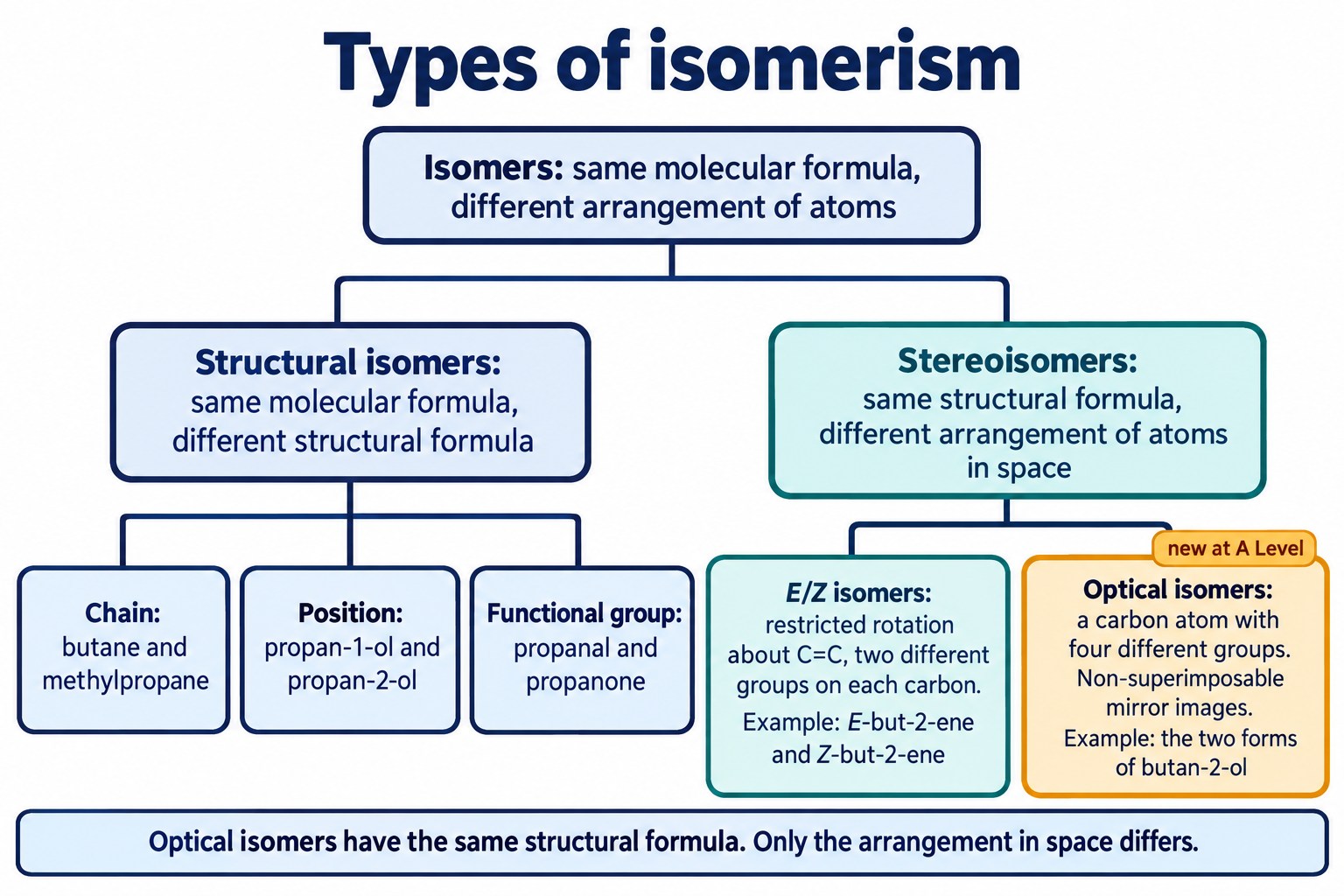
The family tree of isomerism: structural isomers on one side, stereoisomers on the other, with optical isomerism as the second kind of stereoisomerism.
Definition: Stereoisomers are compounds with the same structural formula but a different arrangement of atoms in space. Optical isomers and E/Z isomers are both stereoisomers.
The Chiral Centre
A carbon atom bonded to four different atoms or groups is called a chiral centre (or chiral carbon). It is also described as an asymmetric carbon atom.
A molecule with one chiral centre has no plane of symmetry. It is a chiral molecule, and it exists as two optical isomers.
Example: butan-2-ol, CH₃CH(OH)CH₂CH₃
| Carbon | Groups attached | Chiral centre? |
|---|---|---|
| C1 (CH₃) | H, H, H, rest of chain | no: three identical H atoms |
| C2 (CHOH) | H, OH, CH₃, CH₂CH₃ | yes: four different groups |
| C3 (CH₂) | H, H, CH₃, CH(OH)CH₃ | no: two identical H atoms |
| C4 (CH₃) | H, H, H, rest of chain | no: three identical H atoms |
- The chiral centre is marked with an asterisk: CH₃C*H(OH)CH₂CH₃.
- Compare whole groups, not just the first atom. CH₃ and CH₂CH₃ both start with carbon, but they are different groups.
- Propan-2-ol, CH₃CH(OH)CH₃, is not chiral: carbon 2 carries two identical CH₃ groups.
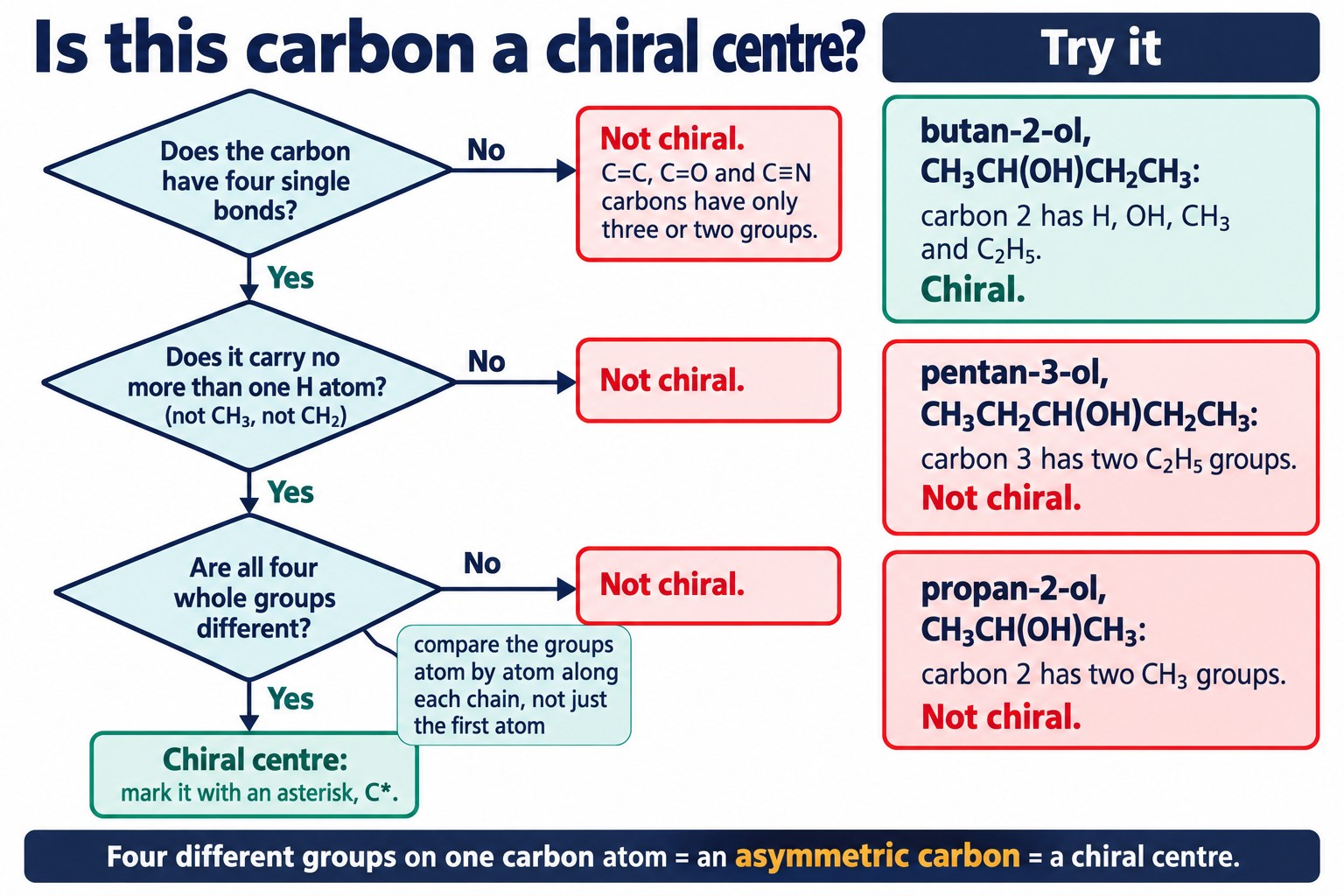
A decision route for any carbon atom: four single bonds, no repeated atoms, and four groups that are all different when each chain is read to its end.
Definition: A chiral centre is a carbon atom bonded to four different atoms or groups of atoms. A molecule with one chiral centre is chiral and shows optical isomerism.
Check: Spotting a Chiral Centre
Decide which carbon atoms are chiral centres, and which molecules are chiral, in compounds not used on this page.
Enantiomers: Non-Superimposable Mirror Images
Four different groups can be arranged around a tetrahedral carbon in two ways. One arrangement is the mirror image of the other, and the two cannot be placed exactly on top of each other.
- The two forms are called enantiomers (optical isomers).
- They are non-superimposable mirror images of each other.
- Your hands are a model: the left hand is the mirror image of the right, yet a left glove does not fit a right hand.
- Rotating a molecule never turns it into its enantiomer. Two bonds would have to be broken and re-made.
If any two of the four groups are identical, the molecule has a plane of symmetry. Its mirror image can then be turned round to fit exactly, so it is the same molecule.
Definition: Enantiomers are a pair of stereoisomers that are non-superimposable mirror images of each other.
Drawing Enantiomers in 3D
A flat structural formula cannot show the difference between enantiomers. A 3D drawing with wedge and dashed bonds is needed.
| Bond drawn as | Meaning |
|---|---|
| plain line | in the plane of the paper |
| solid wedge | coming out towards you |
| dashed (hashed) line | going back, away from you |
Method
- Draw the chiral carbon with two plain bonds, one wedge and one dashed bond, in a tetrahedral shape.
- Write the four different groups on the ends of the bonds.
- Draw a dashed vertical line beside the molecule to act as a mirror.
- Draw the reflection: each group stays at the same height, but left and right are swapped.
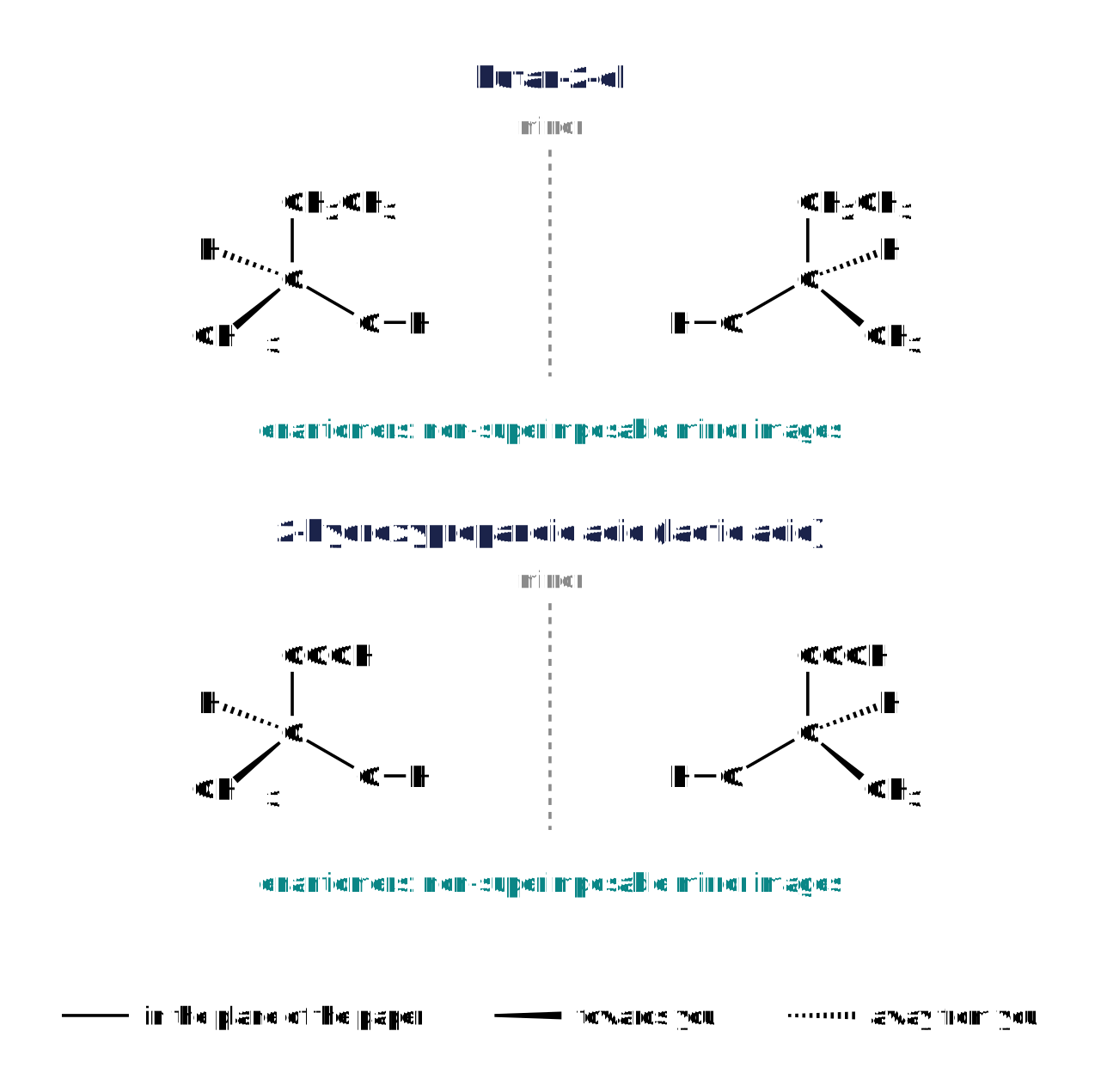
The two enantiomers of butan-2-ol and of 2-hydroxypropanoic acid, each drawn as a tetrahedral 3D structure and reflected in a mirror line.
- Attach each group through the correct atom. In the reflection write HO– so that the oxygen, not the hydrogen, is bonded to the carbon.
- Keep the shape tetrahedral. Four bonds at 90° in a cross do not show a 3D arrangement.
- Swapping any two groups on one drawing also gives the other enantiomer.
Exam focus: Use two plain bonds, one wedge and one dashed bond on each drawing, and make the second an exact mirror image of the first. Check that every bond goes to the right atom of the group.
Check: Enantiomers and 3D Drawings
Test the meaning of enantiomers, mirror images and wedge and dashed bonds with molecules not used on this page.
Finding Chiral Centres in Larger Molecules
In a large molecule, test each carbon atom in turn. Most can be rejected at a glance.
| Carbon in | Why it cannot be a chiral centre |
|---|---|
| CH₃ | three identical hydrogen atoms |
| CH₂ | two identical hydrogen atoms |
| C=C or C=O | only three groups attached, so it is not tetrahedral |
| C≡N or C≡C | only two groups attached |
| a benzene ring | each ring carbon has only three groups attached |
Any carbon that remains has four single bonds and at most one hydrogen. Check that its four groups are all different by reading along each chain.
Worked example 1: 3-methylhexane, CH₃CH₂CH(CH₃)CH₂CH₂CH₃
Step 2. List its groups: H, CH₃, CH₂CH₃ and CH₂CH₂CH₃.
Worked example 2: 1-bromobutane and 2-bromobutane
Step 2. In 2-bromobutane, CH₃CHBrCH₂CH₃, carbon 2 carries H, Br, CH₃ and CH₂CH₃.
Rings and molecules with more than one centre
- For a carbon in a ring, the two directions round the ring count as two groups. They are different only if the ring is not symmetrical about that carbon.
- In 2-methylcyclohexanone the ring carbon carrying the CH₃ group is chiral: one route round the ring meets C=O first, the other meets CH₂.
- In cyclohexanol the two routes from the C–OH carbon are identical, so there is no chiral centre.
- 2-Amino-3-hydroxybutanoic acid, CH₃CH(OH)CH(NH₂)COOH, has two chiral centres: carbon 2 and carbon 3.
- A molecule with n chiral centres can have up to 2ⁿ stereoisomers.
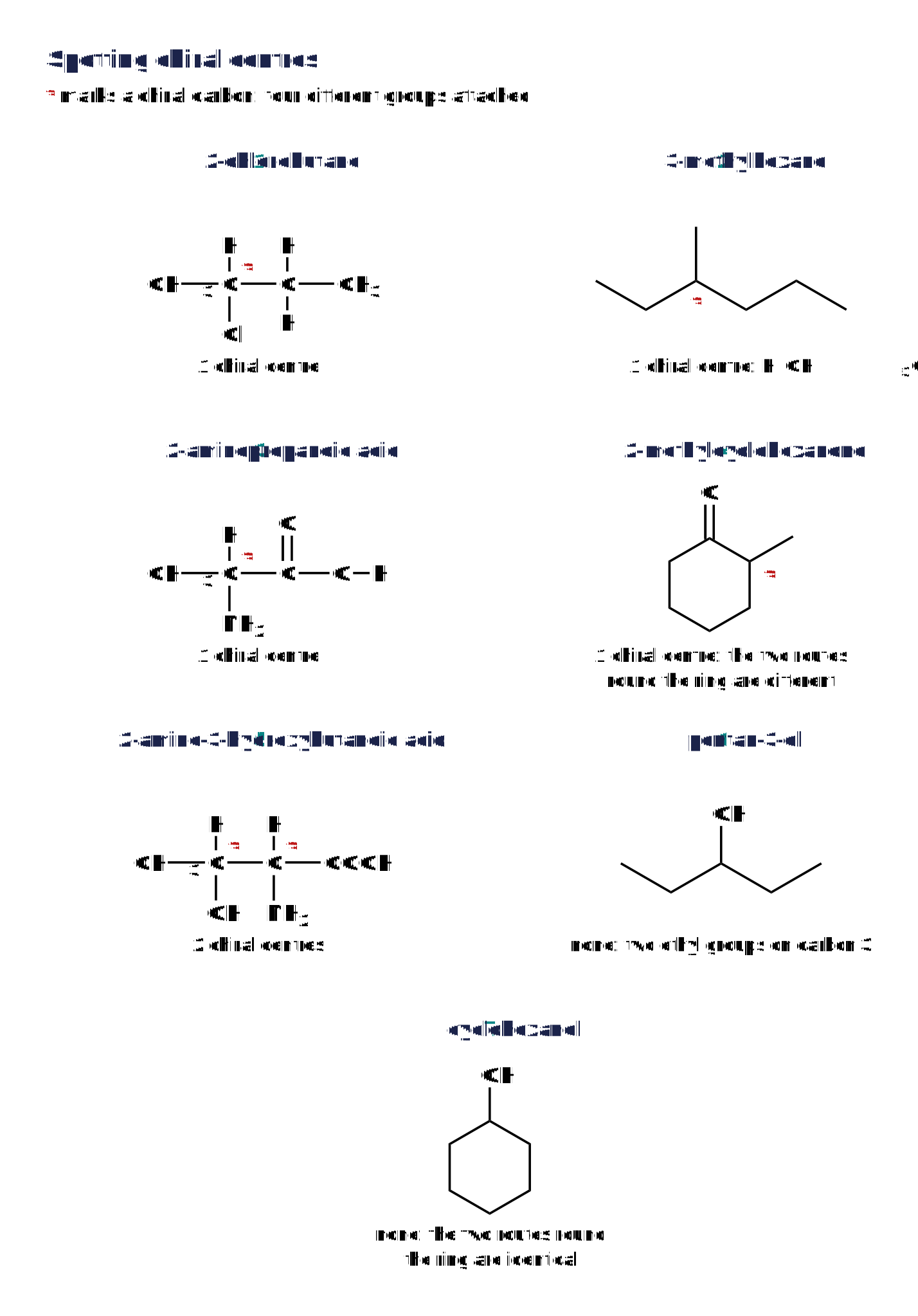
Chiral centres marked with an asterisk in chains and rings, with pentan-3-ol and cyclohexanol as molecules that have none.
Exam focus: When asked to identify chiral centres, mark each one with an asterisk on the structure given. In a skeletal formula remember the hydrogen atoms that are not drawn.
How Enantiomers Are Alike and How They Differ
The two enantiomers contain the same bonds and the same groups, so most of their properties are identical.
| Property | The two enantiomers |
|---|---|
| Melting and boiling temperatures | identical |
| Density and solubility | identical |
| Reactions with reagents that are not chiral | identical: same products, same rate |
| Effect on plane-polarised light | rotate the plane in opposite directions |
| Behaviour with other chiral molecules | can differ, for example with enzymes |
- The effect on plane-polarised light is why they are called optical isomers.
- The next page, Optical Activity and Racemic Mixtures, explains how the rotation is measured.
- Enzymes and receptors in the body are chiral, so the two enantiomers of a compound can taste, smell or act differently.
Common Exam Points
Say
- “A chiral centre is a carbon atom with four different groups attached.”
- “Enantiomers are non-superimposable mirror images.”
- “Carbon 2 has H, OH, CH₃ and C₂H₅ attached, so it is a chiral centre.”
Do not say
- “Four different atoms” when the groups begin with the same atom (say four different groups).
- “The isomers are mirror images” on its own (they must also be non-superimposable).
- “The molecule has a C=C bond, so it has optical isomers” (that is E/Z isomerism).
Watch for
- Reflections drawn with OH– instead of HO–, so that the hydrogen appears bonded to carbon.
- Two drawings that are the same molecule simply rotated, not a mirror-image pair.
- Ring carbons: compare the two routes round the ring before deciding.
- Hidden hydrogen atoms in skeletal formulae.
Check: Chirality in Larger Molecules
Count chiral centres in chains and rings and compare the properties of enantiomers, using molecules not used on this page.
FAQs
Use these quick answers to check chiral centres, enantiomers and how to draw them.
What makes a carbon atom a chiral centre?
It must be bonded to four different atoms or groups. Compare whole groups, not just the first atom: in butan-2-ol, C2 carries H, OH, CH₃ and C₂H₅, so it is chiral and is often marked with an asterisk.
What are enantiomers?
Enantiomers are the two optical isomers of a chiral molecule. They are mirror images that cannot be superimposed, like left and right hands. They have the same structural formula but a different arrangement of the groups in space.
How do I draw a pair of enantiomers?
Draw the chiral carbon with two ordinary bonds in the plane, one wedge coming forwards and one dashed bond going back. Then draw a mirror line and reflect every group across it to give the second isomer.
Why can a CH₂ or CH₃ carbon never be chiral?
These carbon atoms carry at least two identical hydrogen atoms, so they do not have four different groups. A carbon in a C=O or C=C double bond is ruled out too, because it is bonded to only three groups.
Do enantiomers have different properties?
They have identical melting temperatures, boiling temperatures and reactions with ordinary reagents. They differ in the direction in which they rotate the plane of plane-polarised light, and they can behave differently in biological systems such as enzymes.

Copyright notice: This OLS revision content, including the explanations, layout, diagrams, tables and embedded learning structure, is authored for Online Learning System by Dr. Mohammed Al-Fatah. It may not be copied, reproduced, redistributed or adapted without written permission.
Keep this note — free
Save your progress across every Edexcel topic. A free account remembers which topics you have covered, saves your question scores, and syncs across your phone and laptop.
- Track every topic you have finished
- Keep your practice-question scores
- No payment, no card, free forever
Already registered? Log in