Optical Activity and Racemic Mixtures
A concise revision guide to optical activity: plane-polarised light and the polarimeter, how the two enantiomers rotate the plane in opposite directions, what a racemic mixture is and why it is optically inactive, and how optical activity gives evidence for SN1, SN2 and nucleophilic addition mechanisms.
- 17A.3
- 17A.4
- 17A.5
What these spec points say
- 17A.3 know that optical activity is the ability of a single optical isomer to rotate the plane of polarisation of plane-polarised monochromatic light in molecules containing a single chiral centre
- 17A.4 understand the nature of a racemic mixture
- 17A.5 be able to use data on optical activity of reactants and products as evidence for SN1 and SN2 mechanisms
SN1: a Planar Carbocation Gives a Racemic Mixture
Watch one enantiomer of 3-bromo-3-methylhexane lose its bromide ion to form a flat carbocation, then see hydroxide ions attack it from above and from below, giving equal amounts of two mirror-image alcohols.
© Dr. Mohammed Al-Fatah – onlinelearningsystem.net
Before You Start
This page builds on Optical Isomerism and Chirality: chiral centres and enantiomers as non-superimposable mirror images.
- The two enantiomers of a compound have identical chemical properties with ordinary reagents.
- They differ in their effect on plane-polarised light, the subject of this page.
- The last part uses the SN1 and SN2 mechanisms of halogenoalkanes from Topic 6 Organic Chemistry I.
Plane-Polarised Light
Ordinary light is made of waves that vibrate in every plane at right angles to the direction of travel. It is unpolarised.
- A polarising filter (polariser) lets through only the waves vibrating in one plane.
- The light that emerges is plane-polarised light: all its vibrations are in a single plane.
- Monochromatic light (one wavelength, such as a sodium lamp) is used, because the angle of rotation depends on the wavelength.
The polarimeter
- Monochromatic light passes through the polariser and becomes plane-polarised.
- The polarised light passes through a tube holding a solution of the sample.
- A second filter, the analyser, is turned until the light passes at full brightness again.
- The angle through which the analyser was turned is the angle of rotation, α.
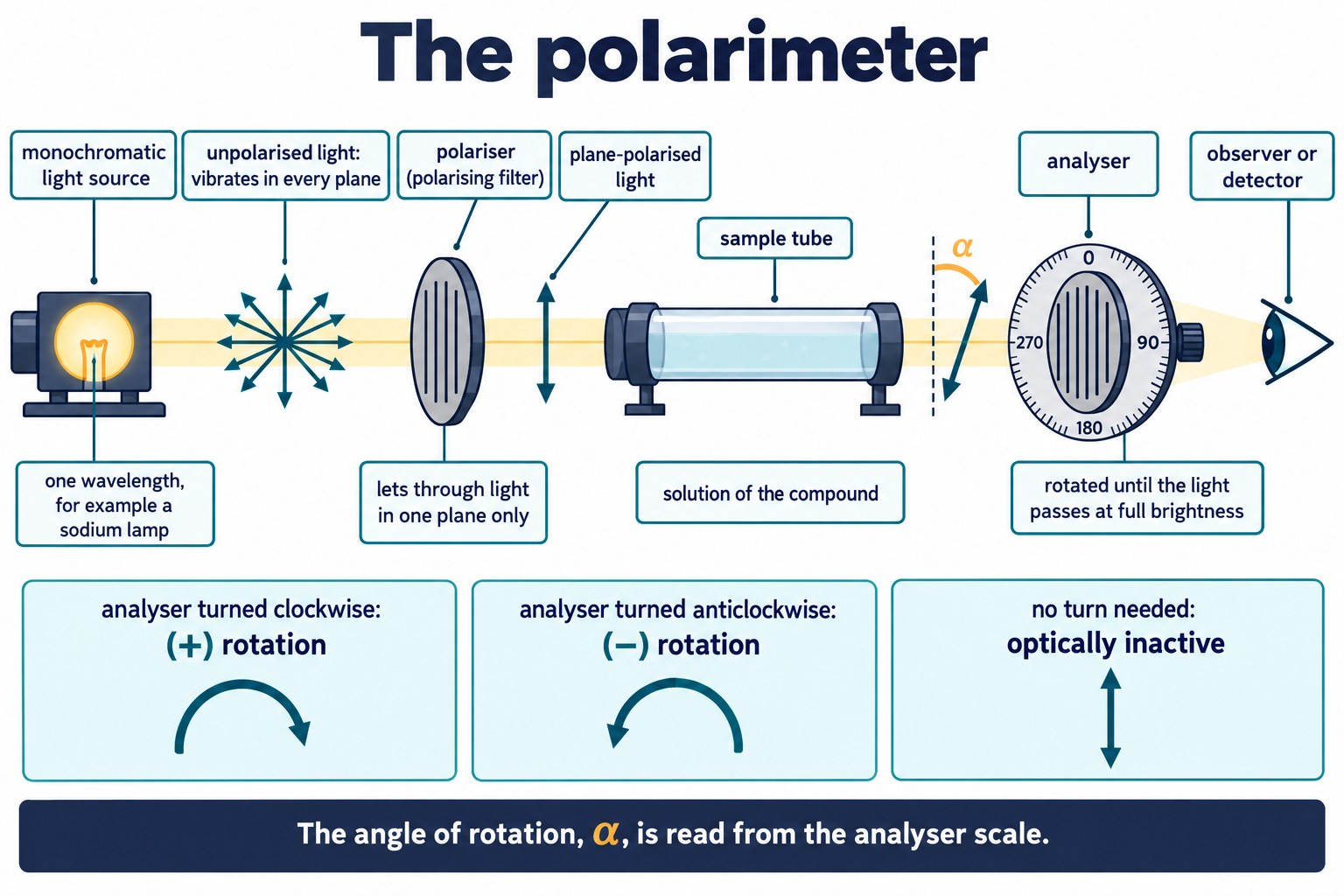
The parts of a polarimeter in order: light source, polariser, sample tube, analyser and observer, with the plane of the light shown at each stage.
Definition: Plane-polarised light is light in which all the waves vibrate in one plane only. It is made by passing ordinary monochromatic light through a polarising filter.
Optical Activity
A substance that rotates the plane of plane-polarised light is optically active. Every chiral compound, as a single enantiomer, is optically active.
| Sample | Effect on the plane of polarised light | Symbol |
|---|---|---|
| one enantiomer | rotates it clockwise | (+) |
| the other enantiomer | rotates it anticlockwise by the same angle | (−) |
| a compound that is not chiral | no rotation | none |
- The two enantiomers rotate the plane by equal angles in opposite directions, at the same concentration and tube length.
- The (+) or (−) sign is found only by experiment. It cannot be predicted from the drawing.
- A more concentrated solution, or a longer tube, gives a larger angle, because the light meets more molecules.
The polarimeter
Plane-polarised light passes through a solution. An optically active compound rotates the plane, and the analyser is turned to measure the angle of rotation.
© Dr. Mohammed Al-Fatah – onlinelearningsystem.net
Definition: An optically active substance rotates the plane of plane-polarised light. The two enantiomers of a chiral compound rotate it by equal amounts in opposite directions.
Check: Polarised Light and Optical Activity
Test the polarimeter, plane-polarised light and the meaning of (+) and (−) with values not used on this page.
Racemic Mixtures
A racemic mixture contains equal amounts of the two enantiomers of a chiral compound: 50% of the (+) form and 50% of the (−) form.
- The clockwise rotation caused by one enantiomer is exactly cancelled by the anticlockwise rotation caused by the other.
- There is no overall rotation, so a racemic mixture is optically inactive.
- The molecules themselves are still chiral. It is the mixture that shows no rotation.
- An unequal mixture, such as 75% (+) and 25% (−), is still optically active, but rotates less than the pure enantiomer.
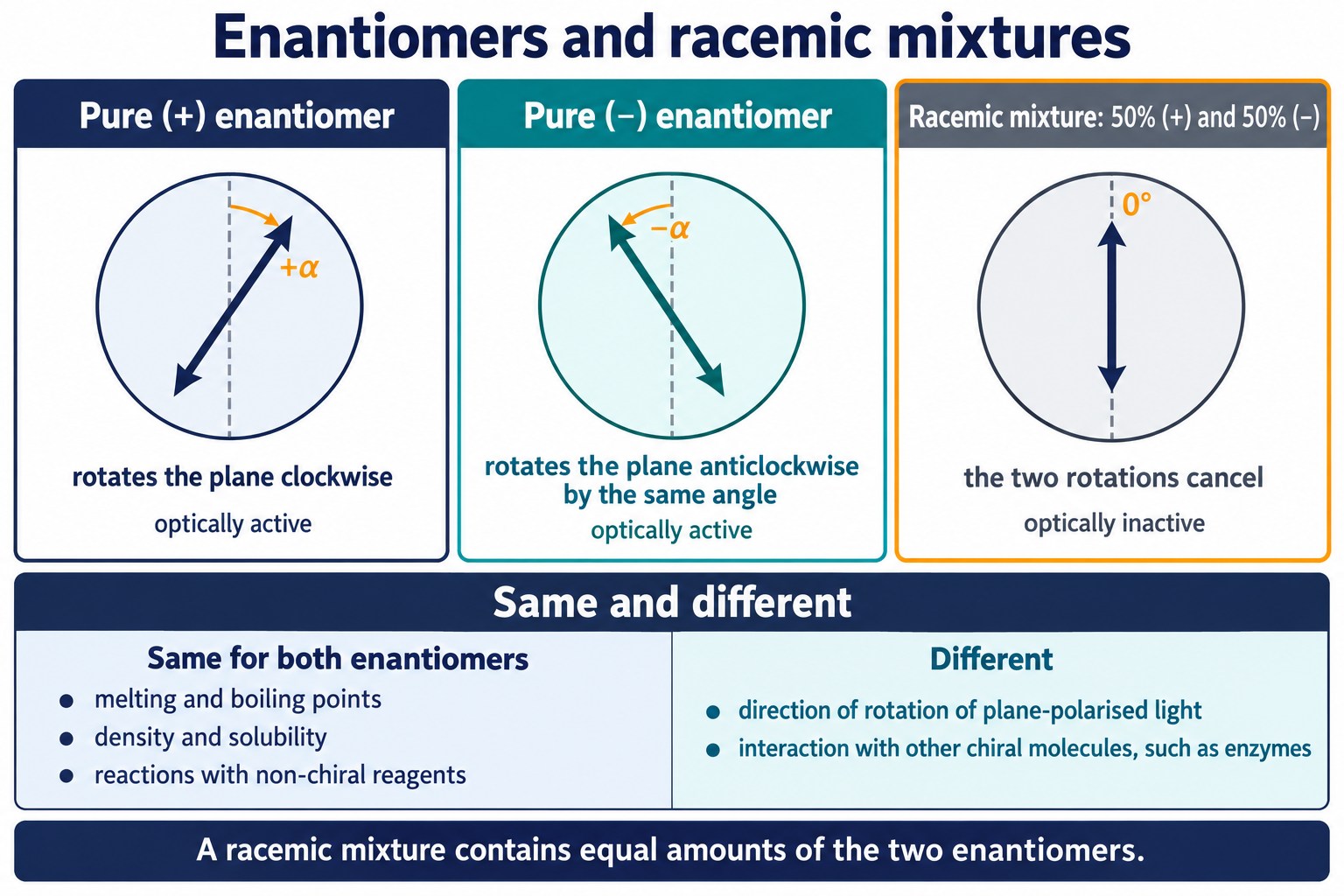
Polarimeter readings for the pure (+) enantiomer, the pure (−) enantiomer and the racemic mixture, with the properties that are the same and those that differ.
| Sample | Polarimeter reading | Optically active? |
|---|---|---|
| pure (+) enantiomer | +α | yes |
| pure (−) enantiomer | −α | yes |
| racemic mixture, 50 : 50 | 0° | no |
| compound with no chiral centre | 0° | no |
Definition: A racemic mixture is a mixture of equal amounts of the two enantiomers. It does not rotate plane-polarised light, because the two rotations cancel.
Why a Planar Centre Gives a Racemic Mixture
Laboratory reactions that create a chiral centre from non-chiral reagents usually give a racemic mixture. The reason lies in the shape of the reacting carbon.
- The carbon of a C=O group is trigonal planar: its three bonds lie flat, at 120°.
- A carbocation, such as the one formed from an alkene, is also trigonal planar.
- An attacking species can approach a planar centre from above or from below.
- The two faces are equally exposed, so attack from each side has an equal probability.
- Attack from one side gives one enantiomer; attack from the other gives its mirror image. Equal amounts form.
Example: ethanal and cyanide ions
CH₃CHO + HCN → CH₃CH(OH)CN
- In the product, 2-hydroxypropanenitrile, carbon 2 carries H, OH, CH₃ and CN, so it is a chiral centre.
- The CN⁻ ion attacks the planar C=O group from either side with equal chance.
- The product is a racemic mixture and does not rotate plane-polarised light.
- The mechanism is drawn on Reduction and Nucleophilic Addition.
Exam focus: Three points earn the marks: the C=O group (or carbocation) is planar; attack is equally likely from either side; so equal amounts of the two enantiomers form, a racemic mixture.
Check: Racemic Mixtures and Planar Centres
Decide which samples rotate plane-polarised light and explain why a planar centre gives equal amounts of two enantiomers, with examples not used on this page.
Optical Activity as Evidence for SN1 and SN2
A polarimeter can show how a reaction happens. Start with a single enantiomer of a chiral halogenoalkane and measure the optical activity of the product.
SN1: a planar carbocation
- Step 1: the C–halogen bond breaks, leaving a planar carbocation intermediate.
- Step 2: the nucleophile attacks the carbocation from either side with equal probability.
- Both enantiomers of the product form in equal amounts: a racemic mixture.
- Evidence: the optically active reactant gives an optically inactive product.
Example: one enantiomer of 3-bromo-3-methylhexane, a tertiary halogenoalkane, is hydrolysed to racemic 3-methylhexan-3-ol.
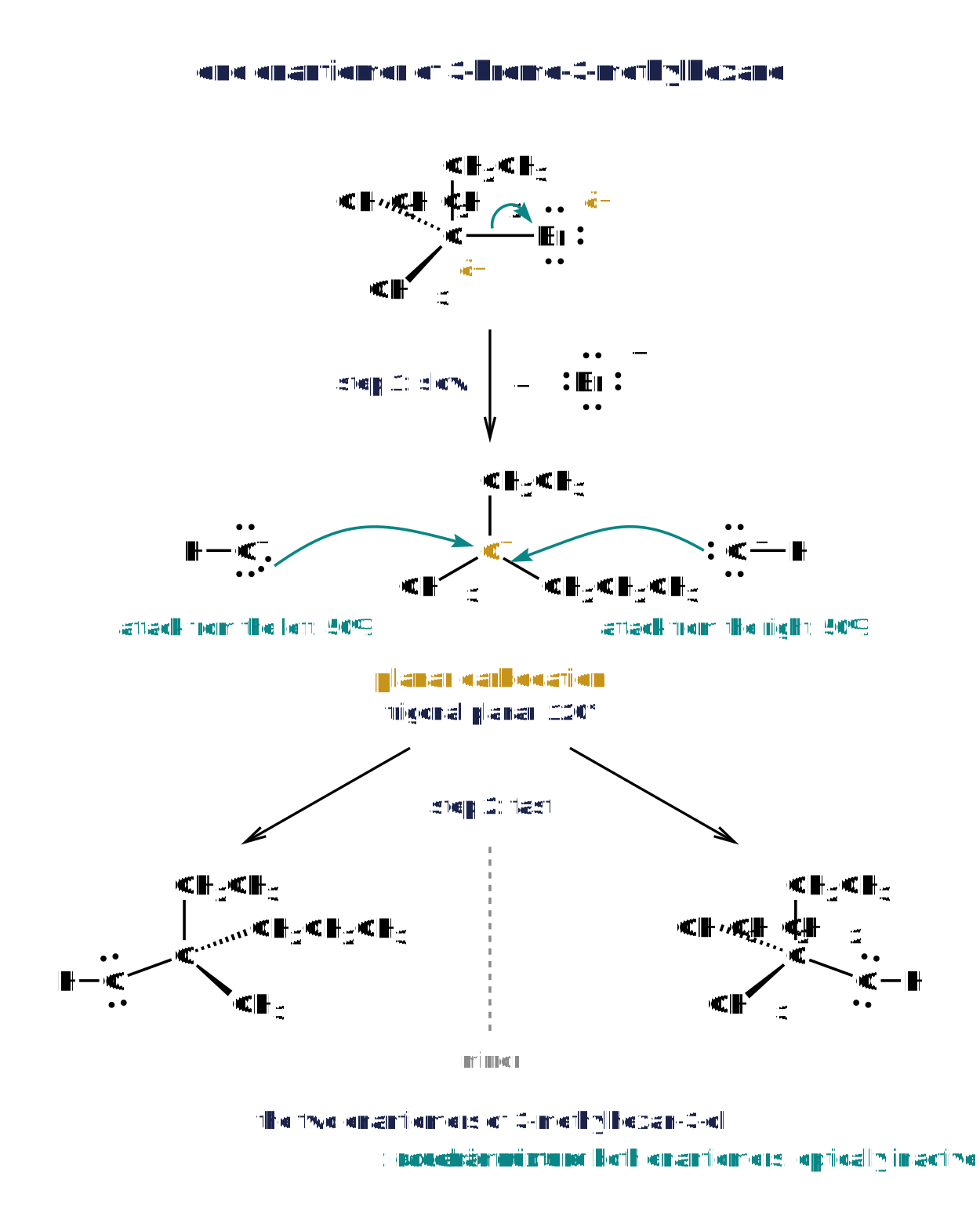
SN1 hydrolysis of one enantiomer of 3-bromo-3-methylhexane: the planar carbocation is attacked from both faces, giving both enantiomers of the alcohol in equal amounts.
SN2: attack from behind
- The nucleophile attacks the δ+ carbon from the side opposite the halogen, in one step, with no intermediate.
- The other three groups flip over, like an umbrella turning inside out. The arrangement is inverted.
- Only one enantiomer of the product forms.
- Evidence: the product is still optically active.
Example: one enantiomer of 2-bromobutane reacts with OH⁻ by SN2 to give a single enantiomer of butan-2-ol.
Nucleophilic Substitution of Bromoethane by Hydroxide
Watch a hydroxide ion attack the δ+ carbon of bromoethane from behind, pass through a single transition state and push out the bromide ion, turning the carbon inside out; then meet three more nucleophiles.
© Dr. Mohammed Al-Fatah – onlinelearningsystem.net
Nucleophilic addition to a carbonyl group
- The planar C=O group is attacked from above or below with equal chance.
- An aldehyde (other than methanal) or an unsymmetrical ketone gives a racemic, optically inactive product.
- This agrees with a mechanism in which the nucleophile attacks the carbonyl carbon directly.
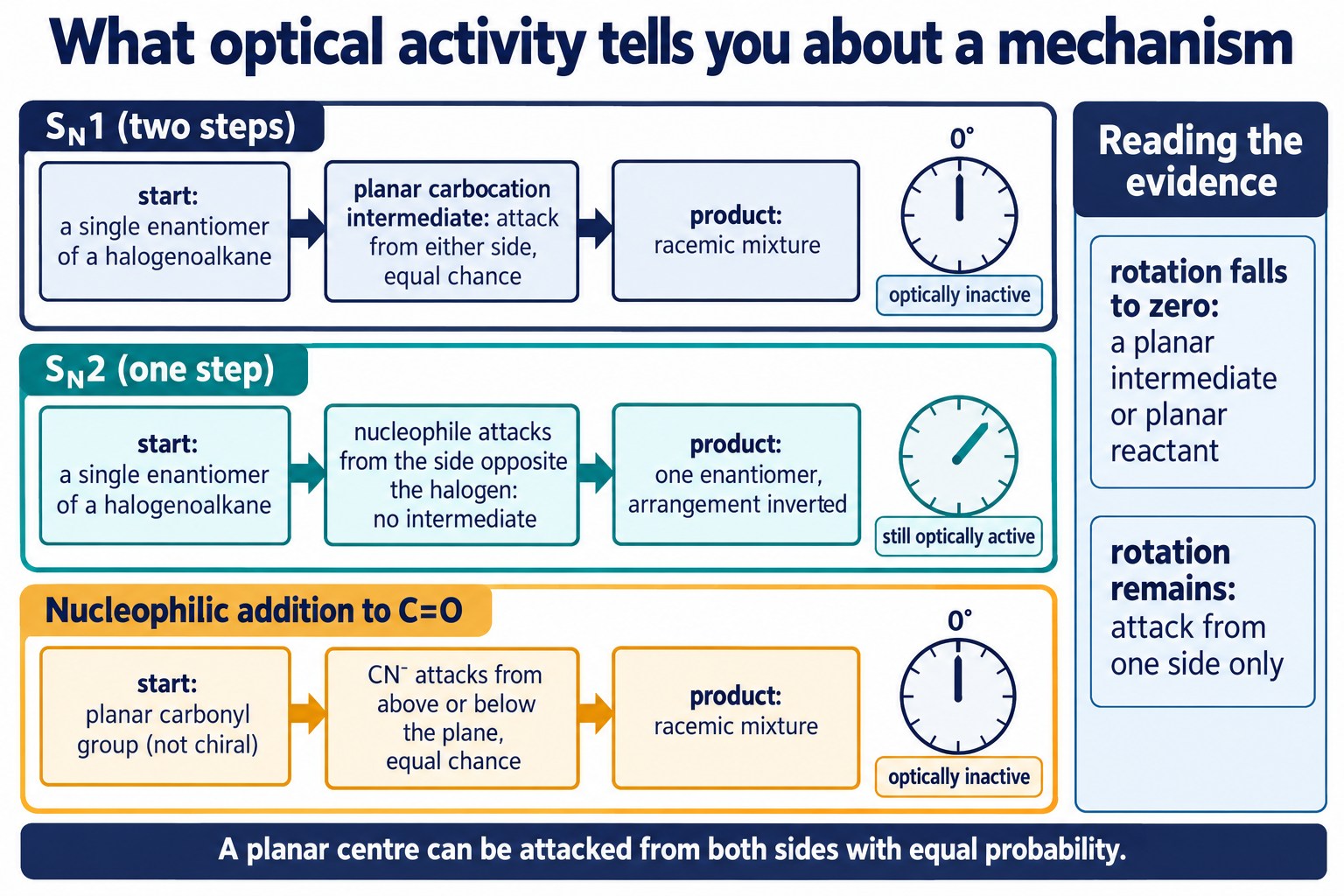
Three mechanisms and their optical evidence: SN1 gives a racemic product, SN2 gives one inverted enantiomer, and addition to a planar carbonyl gives a racemic product.
| Mechanism | Planar species? | Product | Optical activity of product |
|---|---|---|---|
| SN1 | yes: carbocation intermediate | racemic mixture | inactive |
| SN2 | no: attack from one side only | one enantiomer, inverted | active |
| nucleophilic addition to C=O | yes: the carbonyl group | racemic mixture | inactive |
Exam focus: Link the observation to the mechanism: loss of optical activity points to a planar intermediate or reactant attacked from both sides. Optical activity that remains points to attack from one side only.
Predicting the Optical Activity of a Product
Ask two questions about any product: does it contain a chiral centre, and was that centre made from a planar group?
Worked example 1: butanone and HCN
Step 2. It was made by attack on a planar C=O group, equally likely from either side.
Worked example 2: propanone and HCN
Worked example 3: but-1-ene and HBr
Step 1. The major product is 2-bromobutane, CH₃CHBrCH₂CH₃, which has a chiral centre at carbon 2.
Step 2. It forms through a planar secondary carbocation, attacked by Br⁻ from either side.
Answer. A racemic mixture of the two enantiomers of 2-bromobutane forms.
Quick Check: Why Is the Product Optically Inactive?
Work out the structure of the main organic product of each new reaction, then classify it.
Common Exam Points
Say
- “Enantiomers rotate the plane of plane-polarised light in opposite directions.”
- “A racemic mixture contains equal amounts of the two enantiomers.”
- “The carbonyl group is planar, so attack from either side is equally likely.”
- “SN1 goes through a planar carbocation, so a racemic mixture forms.”
Do not say
- “Enantiomers bend light” or “reflect light” (they rotate the plane of polarised light).
- “A racemic mixture is not chiral” (its molecules are chiral; the mixture is optically inactive).
- “The molecule is planar” when only the carbonyl group or the carbocation centre is planar.
Watch for
- Products with no chiral centre, such as the one from propanone and HCN: no enantiomers at all.
- Questions that ask why a product shows no optical activity: decide between “racemic” and “not chiral”.
- SN2 products: a single enantiomer, so still optically active, although the arrangement is inverted.
- The word “equal”: equal amounts, equal probability, equal and opposite rotation.
Check: Optical Activity and Reaction Pathways
Predict whether products rotate plane-polarised light and link the result to how they were formed, using reactions not used on this page.
FAQs
Use these quick answers to check plane-polarised light, optical activity and racemic mixtures.
What is plane-polarised light?
Ordinary light vibrates in every plane at right angles to its direction of travel. Passing it through a polarising filter leaves vibrations in one plane only. A polarimeter uses this light, usually of a single wavelength, to measure rotation.
What do (+) and (−) mean in the name of an enantiomer?
The (+) enantiomer rotates the plane of plane-polarised light clockwise and the (−) enantiomer rotates it anticlockwise. At the same concentration the two rotations are equal in size but opposite in direction.
Why is a racemic mixture optically inactive?
A racemic mixture contains equal amounts of the two enantiomers. One rotates the plane clockwise and the other rotates it anticlockwise by exactly the same angle, so the rotations cancel and there is no overall rotation.
Why does addition to a carbonyl group give a racemic mixture?
The carbonyl carbon and the three atoms around it are planar. The nucleophile can attack from above or below the plane with equal probability, so the two enantiomers form in equal amounts and the product is a racemic mixture.
How does optical activity tell SN1 from SN2?
Start with one enantiomer of a halogenoalkane. SN1 goes through a planar carbocation attacked from either side, giving a racemic, inactive product. SN2 attacks from behind in one step, giving a single inverted enantiomer that is still optically active.

Copyright notice: This OLS revision content, including the explanations, layout, diagrams, tables and embedded learning structure, is authored for Online Learning System by Dr. Mohammed Al-Fatah. It may not be copied, reproduced, redistributed or adapted without written permission.
Keep this note — free
Save your progress across every Edexcel topic. A free account remembers which topics you have covered, saves your question scores, and syncs across your phone and laptop.
- Track every topic you have finished
- Keep your practice-question scores
- No payment, no card, free forever
Already registered? Log in