Quickfit Apparatus: Heating under Reflux and Distillation
A concise revision guide to the Quickfit apparatus used in organic preparations: the parts and their joints, how to set up heating under reflux and simple distillation, why the condenser water enters at the bottom, why the system is never sealed, when each technique is chosen, and the safe heating methods for flammable organic liquids.
Quickfit: Reflux and Distillation
Choose a step to watch the reflux and distillation set-ups being built piece by piece, and see why the water enters at the bottom and the thermometer sits at the side arm.
© Dr. Mohammed Al-Fatah – onlinelearningsystem.net
Recap: Preparing Organic Liquids
Five quick questions on what you already know: the oxidation of alcohols with acidified dichromate(VI) (Oxidation of Alcohols) and the stages of preparing and purifying an organic liquid (Preparing and Purifying Organic Liquids).
What Quickfit Is
Quickfit is a set of glassware with standard ground-glass joints. Every part fits every other, so one kit builds a reflux or a distillation set-up without corks or rubber bungs.
- Ground-glass joints seal when pushed together; a thin smear of grease stops them sticking. Organic vapours would attack rubber or cork.
- Plastic clips hold each joint so that the apparatus stays together when hot and when the condenser is moved.
- Never force a joint, and never heat glass that is not in contact with liquid: thermal stress cracks it.
- Both set-ups use the same flask, condenser and heat source; only the arrangement changes.
| Part | What it does | Where it goes |
|---|---|---|
| pear-shaped flask | holds small volumes; the narrow base keeps a small volume deep enough to boil evenly | on the heating mantle |
| round-bottomed flask | holds larger volumes; also used as the receiving flask in distillation | on the mantle, or in iced water as the receiver |
| Liebig condenser | an inner tube for the vapour inside a water jacket; the vapour condenses on the cold glass | vertical for reflux, sloping for distillation |
| still-head | a T-piece that carries vapour sideways into the condenser and holds the thermometer | in the neck of the flask |
| thermometer and screw-cap adapter | reads the temperature of the vapour; the adapter seals the thermometer into the still-head | bulb level with the side arm |
| receiver adapter | leads the condensed liquid into the receiving flask; its side arm is open to the air | at the lower end of the condenser |
| stopper | closes a joint that is not in use | never on top of a reflux condenser |
| anti-bumping granules | small pieces of porous ceramic on which bubbles form, so the liquid boils smoothly | in the flask before heating starts |
Remember: Draw the joints as continuous glass. A line across the joint between flask and condenser is marked as a gap that lets vapour escape.
Heating under Reflux
Heating under reflux means boiling a mixture for a long time without losing anything. The vapour rises into a vertical condenser, condenses and runs back into the flask.
- Set-up: flask with the mixture and anti-bumping granules; Liebig condenser fitted vertically into the neck; heating mantle or water bath beneath.
- Water in at the bottom of the jacket and out at the top, so the jacket stays full.
- Open at the top: the condenser is never stoppered.
- Why reflux: many organic reactions are slow and need prolonged heating, but the reagents and products are volatile and flammable. Reflux keeps them in the flask.
- Used for: oxidising a primary alcohol all the way to a carboxylic acid, making an ester, hydrolysing a haloalkane with aqueous alkali.
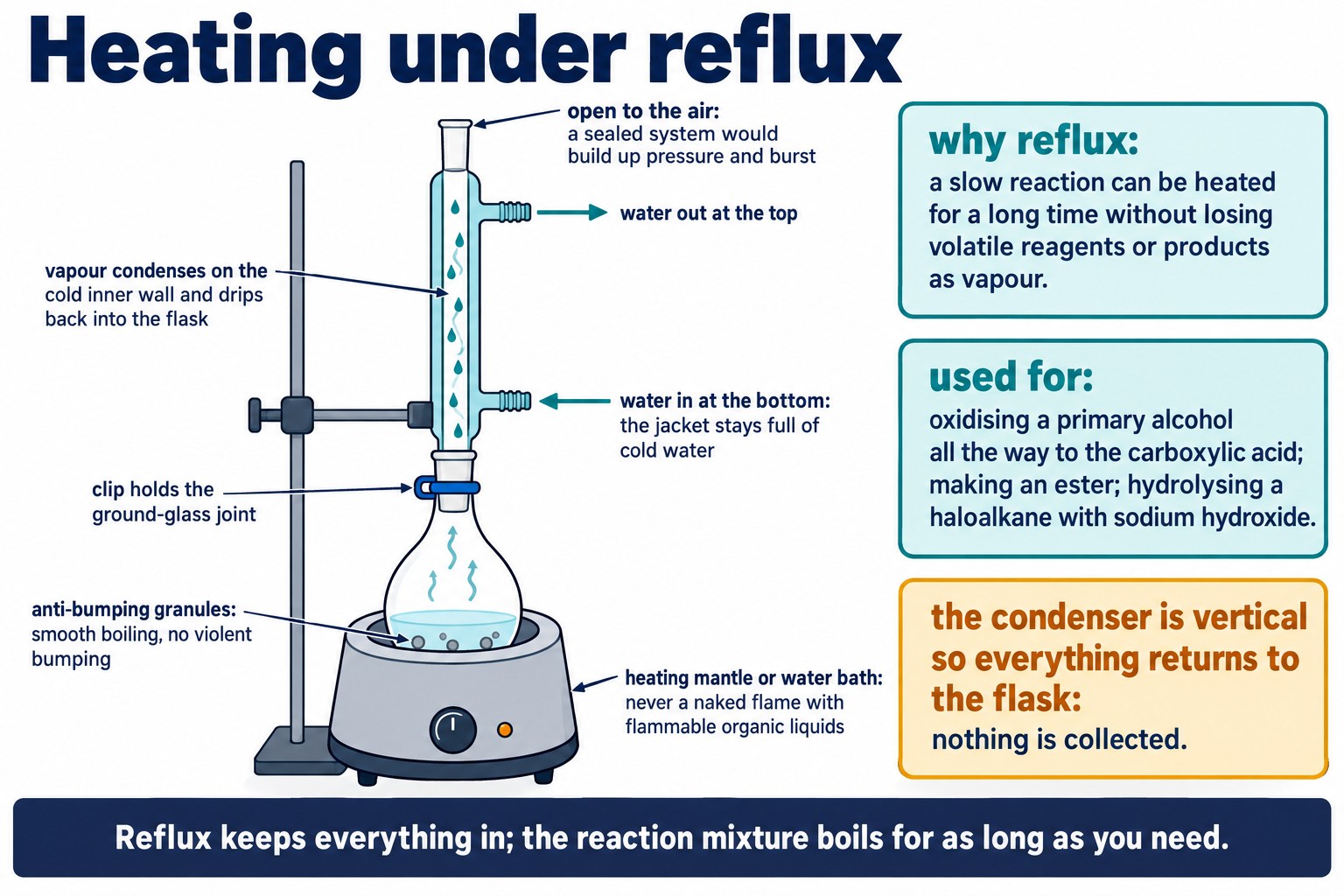
The reflux set-up with every part labelled: flask, granules, vertical condenser, water in at the bottom and out at the top, open top, heating mantle.
Exam focus: Three reasons examiners ask for: the condenser returns vapour to the flask, so volatile substances are not lost; the mixture can be heated for a long time; flammable vapour does not reach the room.
Four Rules Every Set-Up Obeys
The same four points are marked in every apparatus question, whether the diagram shows reflux or distillation.
- Water in at the bottom: the jacket fills completely with no air pocket, and the water flows against the direction of the vapour, which cools most efficiently.
- Never sealed: a closed system that is heated builds up pressure as the liquid boils and may shatter. The condenser top and the receiver side arm stay open.
- Anti-bumping granules: added before heating; bubbles form on their rough surface, so the liquid boils smoothly instead of in violent surges that throw liquid into the condenser.
- No naked flame: organic liquids are flammable, so a heating mantle, water bath or sand bath heats the flask. A water bath also limits the temperature to 100 °C.
Common mistake: Adding the granules to a liquid that is already boiling: it erupts. Add them to the cold mixture, and add fresh ones if the liquid cools and is reheated.
Check: Reflux and the Rules of Set-Up
Name the parts of a reflux set-up, give the reasons for the water direction, the open top, the granules and the heating method, and spot the errors in a drawn diagram.
Distillation
Distillation separates a liquid from a mixture by boiling it and condensing the vapour elsewhere. In organic preparations it removes a volatile product as it forms, or purifies the crude product.
- Set-up: flask with the mixture and granules; still-head in the neck; thermometer through a screw-cap adapter; condenser sloping downwards from the side arm; receiver adapter into a flask.
- Thermometer bulb level with the side arm: it reads the temperature of the vapour passing into the condenser, which is the boiling point of what is being collected.
- Condenser sloping down so the condensed liquid runs into the receiver; the water still enters at the lower end.
- Receiver in iced water when the product is volatile, so that it does not evaporate from the receiving flask.
- Collect over a narrow range around the boiling point of the product, and change the receiver if the temperature climbs.
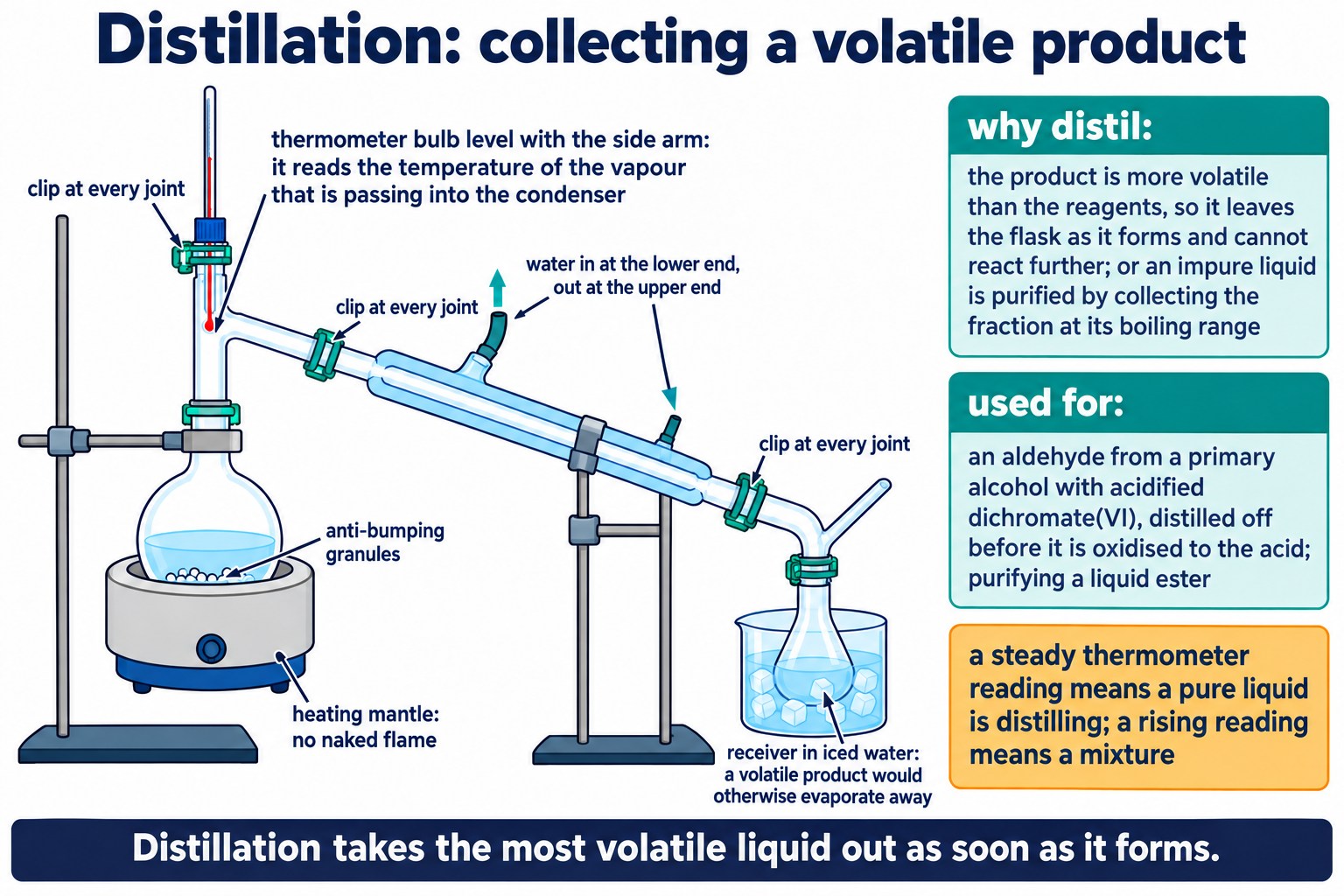
The distillation set-up labelled, with the thermometer bulb at the side arm, the condenser sloping down and the receiver in iced water.
Common mistake: Drawing the thermometer bulb dipping into the liquid: it then reads the liquid temperature, not the vapour. The bulb sits level with the side arm of the still-head.
Quick Check: Faults and Their Consequences
Each set describes a fault in a distillation. Pick the statement that gives its real consequence.
Reflux or Distillation? Making the Choice
The decision rests on two questions: does the reaction need prolonged heating, and does a volatile product need to be removed before it reacts further?
| Aim | Technique | Reason |
|---|---|---|
| primary alcohol → aldehyde | distil the aldehyde as it forms | the aldehyde has a lower boiling point than the alcohol and leaves before it is oxidised further |
| primary alcohol → carboxylic acid | reflux with excess acidified dichromate(VI) | the aldehyde is held in the flask until it is oxidised to the acid |
| secondary alcohol → ketone | reflux (or distil) | the ketone is not oxidised further, so prolonged heating is safe |
| carboxylic acid + alcohol → ester | reflux with a little concentrated sulfuric acid | a slow equilibrium reaction with volatile, flammable reagents |
| haloalkane → alcohol | reflux with aqueous sodium hydroxide | slow hydrolysis; the haloalkane is volatile and would be lost from an open flask |
| purifying the crude liquid product | redistil and collect at the boiling point | separates the product from reagents and by-products with different boiling points |
Worked example: what to make from ethanol
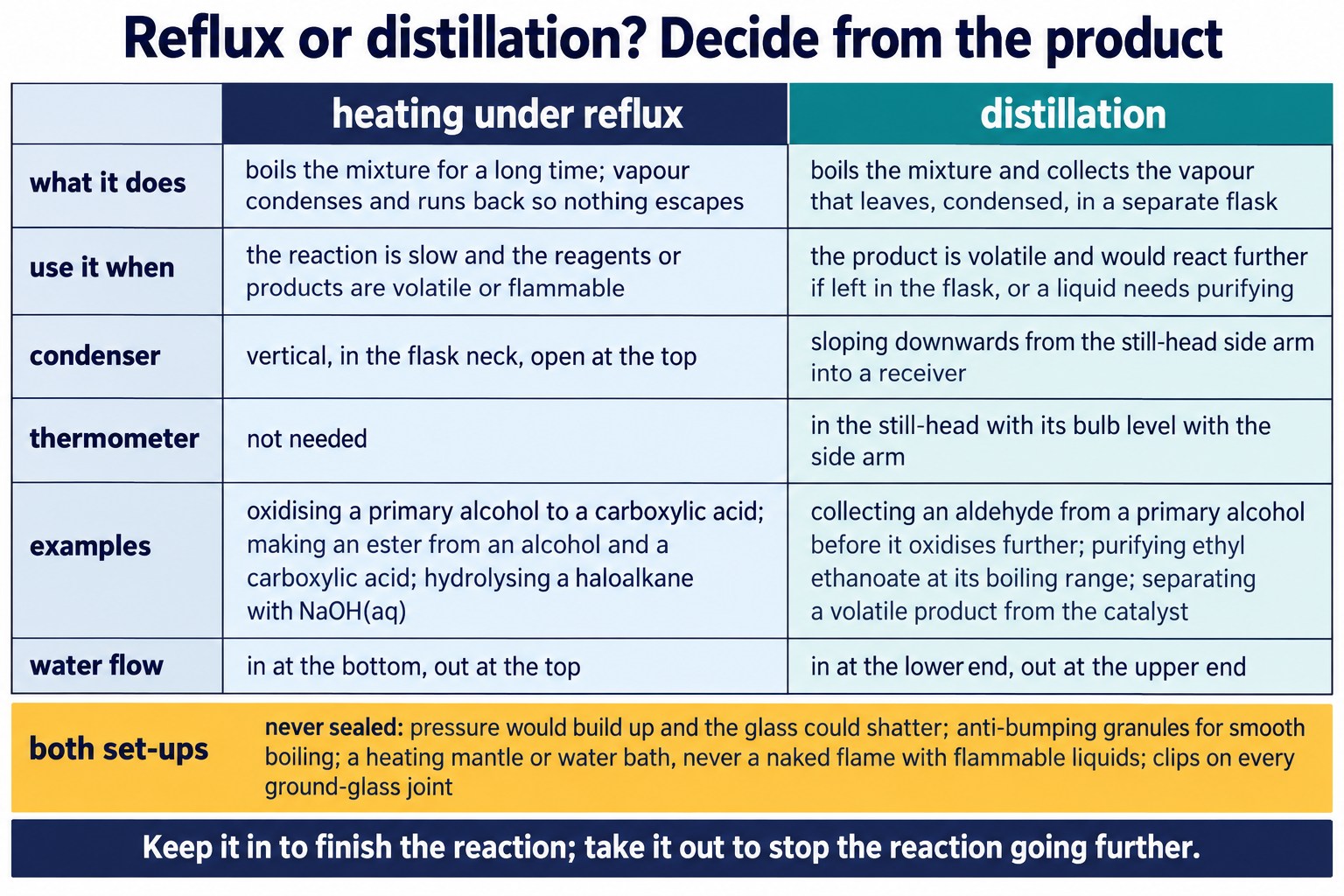
The decision table as a poster: the aim in the left column, the technique and the one-line reason beside it.
After the Reaction: Purifying the Liquid
Distillation gives a crude product. The purification steps are covered in full on Preparing and Purifying Organic Liquids; here is where the Quickfit set-ups fit into the whole preparation.
- Separating funnel: shake the distillate with sodium hydrogencarbonate solution and then water; run off the aqueous layer.
- Drying agent: anhydrous MgSO₄ or CaCl₂ until the liquid is clear; decant it away from the solid.
- Redistillation: collect only the fraction boiling within about 2 °C of the boiling point of the pure product.
- The practicals: PAG 5 Oxidation of an Alcohol: Distil or Reflux and PAG 5 Synthesis of an Organic Liquid use exactly these set-ups.
- Routes: every step in Two-Stage Synthetic Routes is carried out by reflux or distillation.
Exam focus: Purity is judged by the boiling range: a pure liquid distils over one or two degrees. A wide range means the product still contains reagent or by-product.
Check: Distillation and Choosing the Technique
Place the thermometer, choose reflux or distillation for a named preparation and justify it, and read the boiling range as a measure of purity.
Common Exam Points
- Reflux: vertical condenser, water in at the bottom and out at the top, open at the top, anti-bumping granules, heating mantle.
- Distillation: thermometer bulb level with the side arm, condenser sloping down, receiver in iced water, collect at the boiling point.
- Why reflux: volatile reagents and products return to the flask, so a slow reaction can be heated for a long time without loss.
- Why distil: a volatile product (an aldehyde) is removed before it reacts further; a crude liquid is purified by its boiling range.
- Never seal a heated system: pressure builds up and the glass can shatter.
- No naked flame near flammable organic liquids: use a heating mantle or a water bath.
- Draw joints as continuous glass, with the condenser jacket closed at both ends and two open water connections.
- Granules go into the cold mixture before heating; they give smooth boiling.
FAQs
Use these quick answers to check the Quickfit parts, how to set up heating under reflux and distillation, why the condenser water enters at the bottom, why the apparatus is never sealed and when each technique is chosen.
Why does the cooling water enter the condenser at the bottom and leave at the top?
Filling from the bottom keeps the jacket completely full of water with no air pockets, so the whole length of the inner tube is cooled. The coldest water also meets the vapour where it has already been partly cooled, giving efficient counter-current cooling.
Why must the top of the reflux condenser be left open?
Heating a sealed system raises the pressure as vapour builds up until the glass joints blow apart or shatter. With the top open, the vapour condenses on the cold inner wall and runs back into the flask, so nothing escapes and the pressure stays atmospheric.
Where exactly does the thermometer bulb go in a distillation, and why?
Level with the side arm of the still-head, where the vapour turns into the condenser. It then records the boiling point of the vapour actually being collected rather than the temperature of the boiling liquid, so you know which fraction is distilling.
When should I choose reflux and when distillation?
Reflux when a reaction is slow and the reagents are volatile, such as oxidising a primary alcohol fully to the carboxylic acid or making an ester. Distil when a volatile product such as an aldehyde must leave as it forms, or to purify a liquid.
Why do I add anti-bumping granules and heat with a mantle rather than a Bunsen flame?
Anti-bumping granules give rough surfaces where bubbles form, so the liquid boils smoothly instead of lurching violently and splashing into the condenser. Organic liquids are flammable, so a heating mantle or water bath avoids any naked flame near their vapour.

Copyright notice: This OLS revision content, including the explanations, layout, diagrams, tables and embedded learning structure, is authored for Online Learning System by Dr. Mohammed Al-Fatah. It may not be copied, reproduced, redistributed or adapted without written permission.
Keep this note — free
Save your progress across every OCR topic. A free account remembers which topics you have covered, saves your question scores, and syncs across your phone and laptop.
- Track every topic you have finished
- Keep your practice-question scores
- No payment, no card, free forever
Already registered? Log in