Two-Stage Synthetic Routes
A concise revision guide to planning short organic syntheses with the AS reactions: the reaction map linking alkenes, haloalkanes, alcohols, carbonyl compounds and carboxylic acids, how to work backwards from a target in two stages, writing reagents and conditions for every step, and analysing a given route for its reaction types and by-products.
Before You Start
Every reaction on this page was met when its functional group was taught. Here they are joined into one map so that a target two steps away can be reached.
- Alkenes: electrophilic addition of HBr, Br₂ and steam: Reactions of Alkenes.
- Haloalkanes: nucleophilic substitution by hydroxide: Nucleophilic Substitution Reactions.
- Alcohols: oxidation, dehydration, substitution by halide and esterification: Oxidation of Alcohols and Reactions of Alcohols.
- Reading the target: Identifying the Functional Groups in a Molecule shows how to pick out its groups.
- Apparatus: every step is carried out by reflux or distillation: Quickfit Apparatus: Heating under Reflux and Distillation.
- At A Level the map grows: Planning a Synthetic Route.
The AS Reaction Map
Five families sit on the map: alkenes, haloalkanes, alcohols, carbonyl compounds and carboxylic acids. Each arrow is one AS reaction with its reagents and conditions.
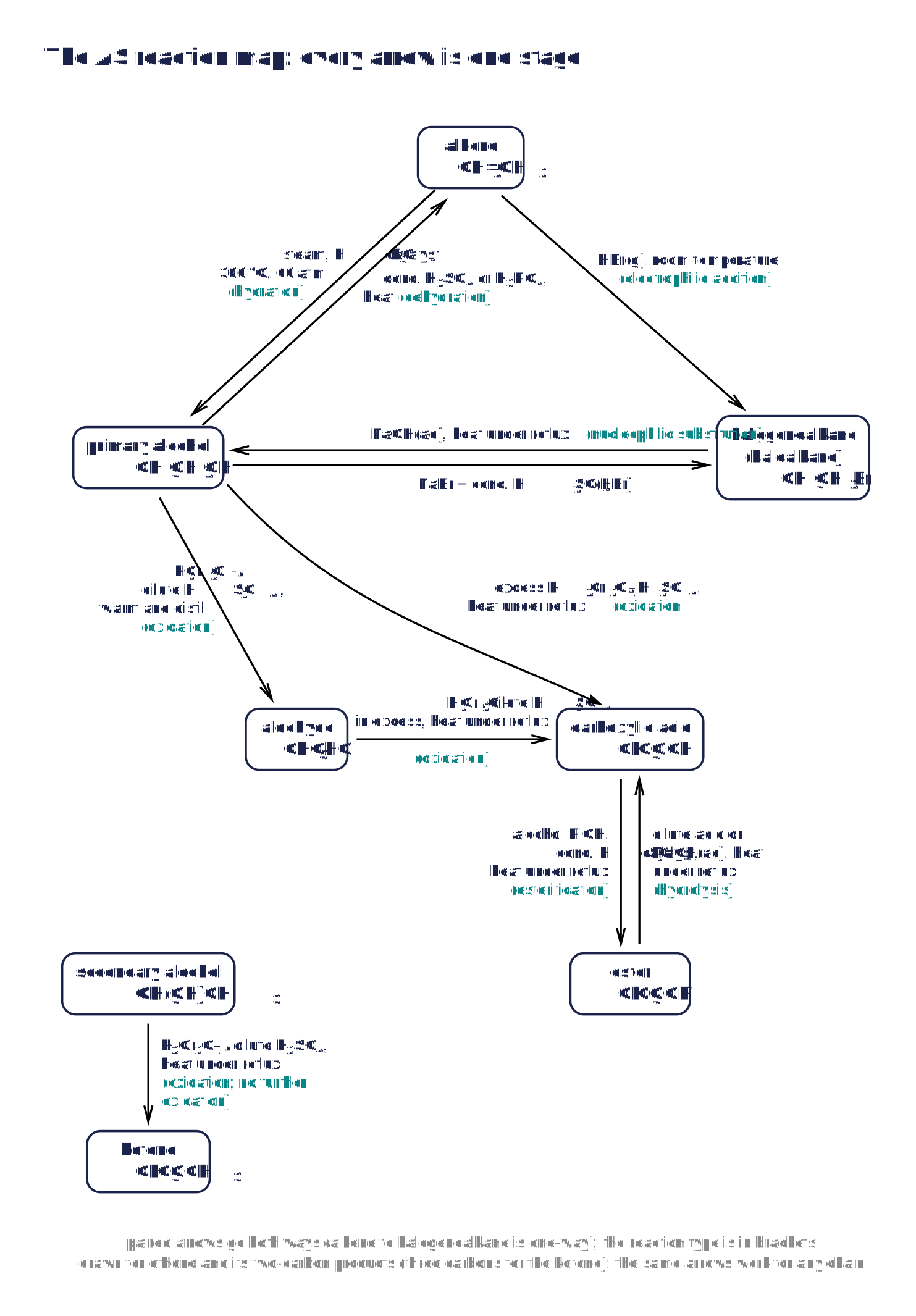
The map with condensed structures as nodes and the reagents and conditions on every arrow: learn it as a picture.
- Alkene → haloalkane: HBr(g) at room temperature, electrophilic addition.
- Alkene → alcohol: steam with a phosphoric acid catalyst, 300 °C and 60 atm (hydration).
- Haloalkane → alcohol: NaOH(aq), heat under reflux (nucleophilic substitution, hydrolysis).
- Alcohol → haloalkane: NaBr with concentrated H₂SO₄ (HBr made in the flask), or PCl₅.
- Alcohol → alkene: concentrated H₂SO₄ or H₃PO₄, heat (dehydration, an elimination).
- Primary alcohol → aldehyde → carboxylic acid: acidified K₂Cr₂O₇; distil for the aldehyde, reflux for the acid.
- Secondary alcohol → ketone: acidified K₂Cr₂O₇, heat; a tertiary alcohol is not oxidised.
- Carboxylic acid + alcohol ⇌ ester: concentrated H₂SO₄ catalyst, heat under reflux; dilute acid or NaOH(aq) hydrolyses the ester back.
Reagents and Conditions: The Table to Learn
Reagent and conditions are separate marks. The table holds every shared conversion in the form the mark scheme expects.
| Conversion | Reagent | Conditions | Reaction type |
|---|---|---|---|
| alkene → haloalkane | HBr(g) | room temperature | electrophilic addition |
| alkene → alcohol | H₂O(g), H₃PO₄ catalyst | 300 °C, 60 atm | electrophilic addition (hydration) |
| haloalkane → alcohol | NaOH(aq) | heat under reflux | nucleophilic substitution (hydrolysis) |
| alcohol → haloalkane | NaBr and concentrated H₂SO₄; or PCl₅ | warm; room temperature for PCl₅ | substitution |
| alcohol → alkene | concentrated H₂SO₄ or H₃PO₄ | heat | elimination (dehydration) |
| primary alcohol → aldehyde | K₂Cr₂O₇ / H₂SO₄ | warm and distil at once | oxidation |
| primary alcohol → acid; secondary alcohol → ketone | excess K₂Cr₂O₇ / H₂SO₄ | heat under reflux | oxidation |
| acid + alcohol → ester | concentrated H₂SO₄ catalyst | heat under reflux | esterification (condensation) |
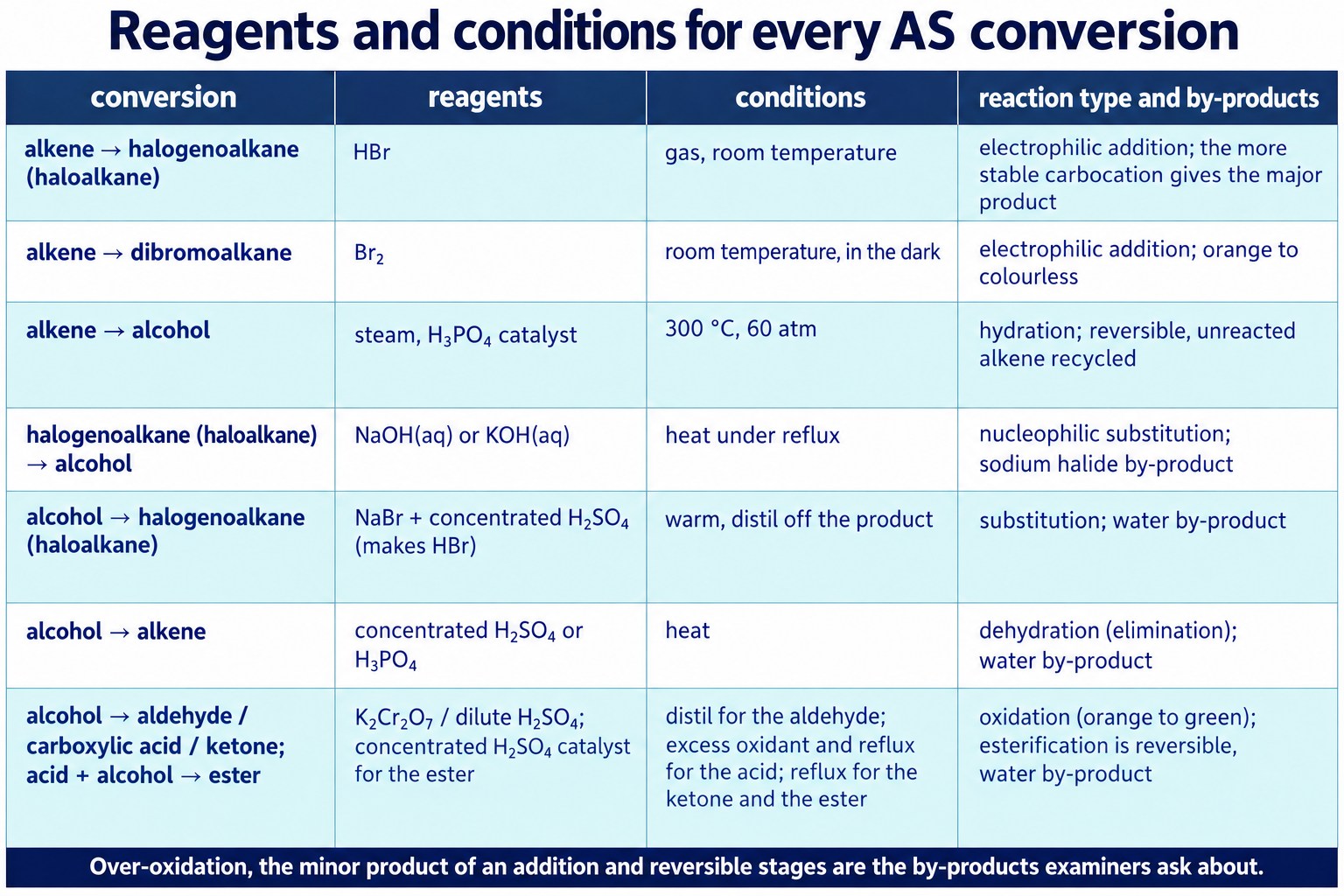
The conversions, reagents, conditions and reaction types as a poster table to learn from.
Exam focus: “Acidified potassium dichromate(VI), heat under reflux” earns the reagent and the condition marks; “dichromate” alone earns neither.
Check: The Map, Reagents and Conditions
Match each AS conversion to its reagent, conditions and reaction type, and pick the one arrow that joins two named compounds.
Planning Backwards from the Target
Start at the product, not at the starting material. Ask which single reaction makes the target group, then whether the compound that reaction needs is the one given.
- Name the target group and count its carbons (the AS reactions never change the carbon number).
- Choose the last step: the one AS reaction that makes that group. An acid comes from a primary alcohol or aldehyde; an alcohol from an alkene or a haloalkane.
- Write the intermediate that the last step needs, with its name and condensed formula.
- Choose the first step that turns the given starting material into that intermediate.
- Add reagents and conditions to both arrows, and the reaction type if asked.
- Check: carbon skeleton unchanged, group in the right position, each step a real AS reaction.
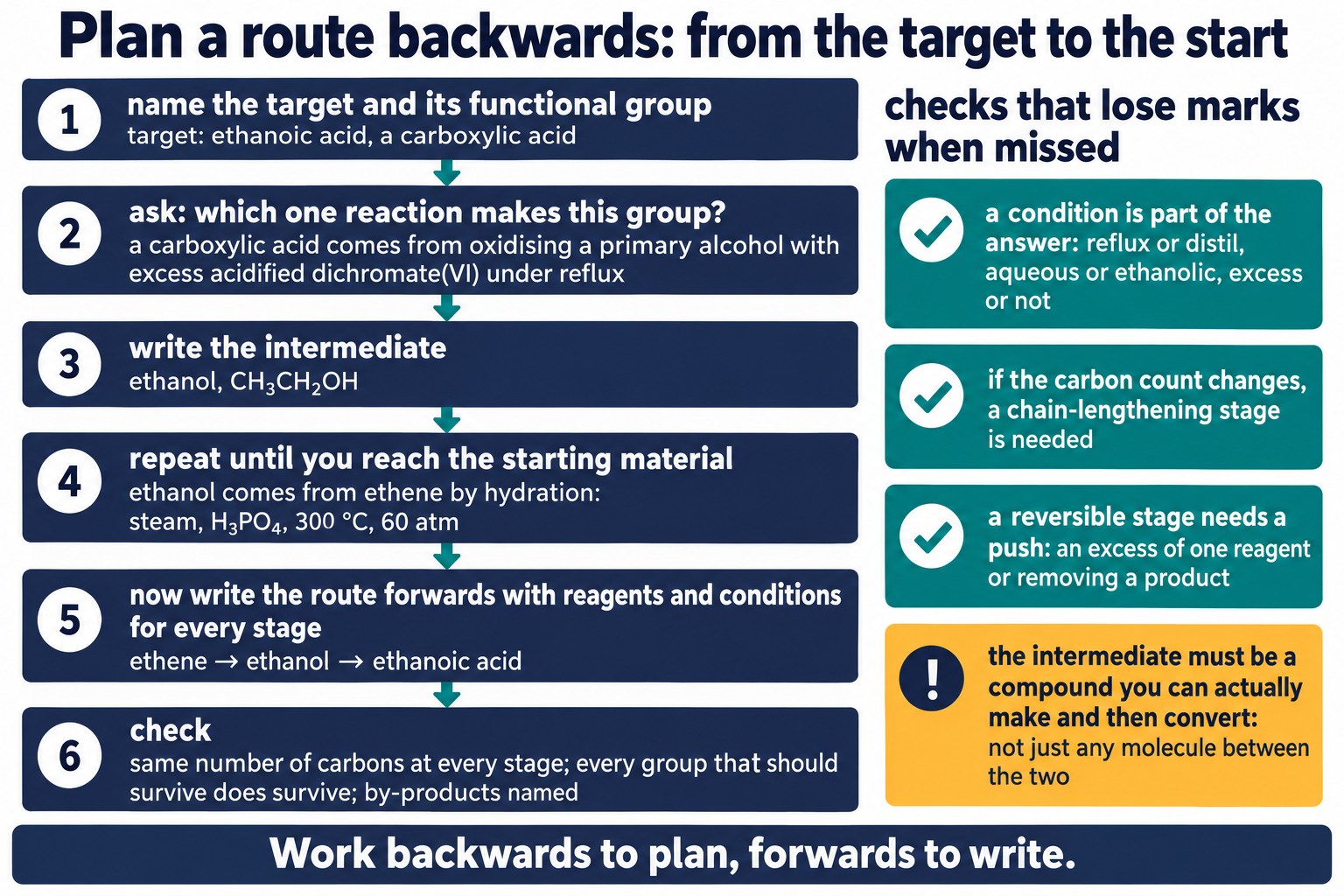
The backwards-planning checklist as a flow: target group, last step, intermediate, first step, reagents, check.
Common mistake: Planning forwards and drifting: ethene → ethanol → bromoethane when the target was ethanoic acid. Backwards planning cannot drift, because every step is chosen to reach the target.
Worked Routes (1) and (2)
Route (1): ethene to ethanoic acid
Step 2. Ethene gives ethanol by hydration: C₂H₄(g) + H₂O(g) → CH₃CH₂OH(g), steam, H₃PO₄ catalyst, 300 °C, 60 atm.
Route (2): propene to propanone
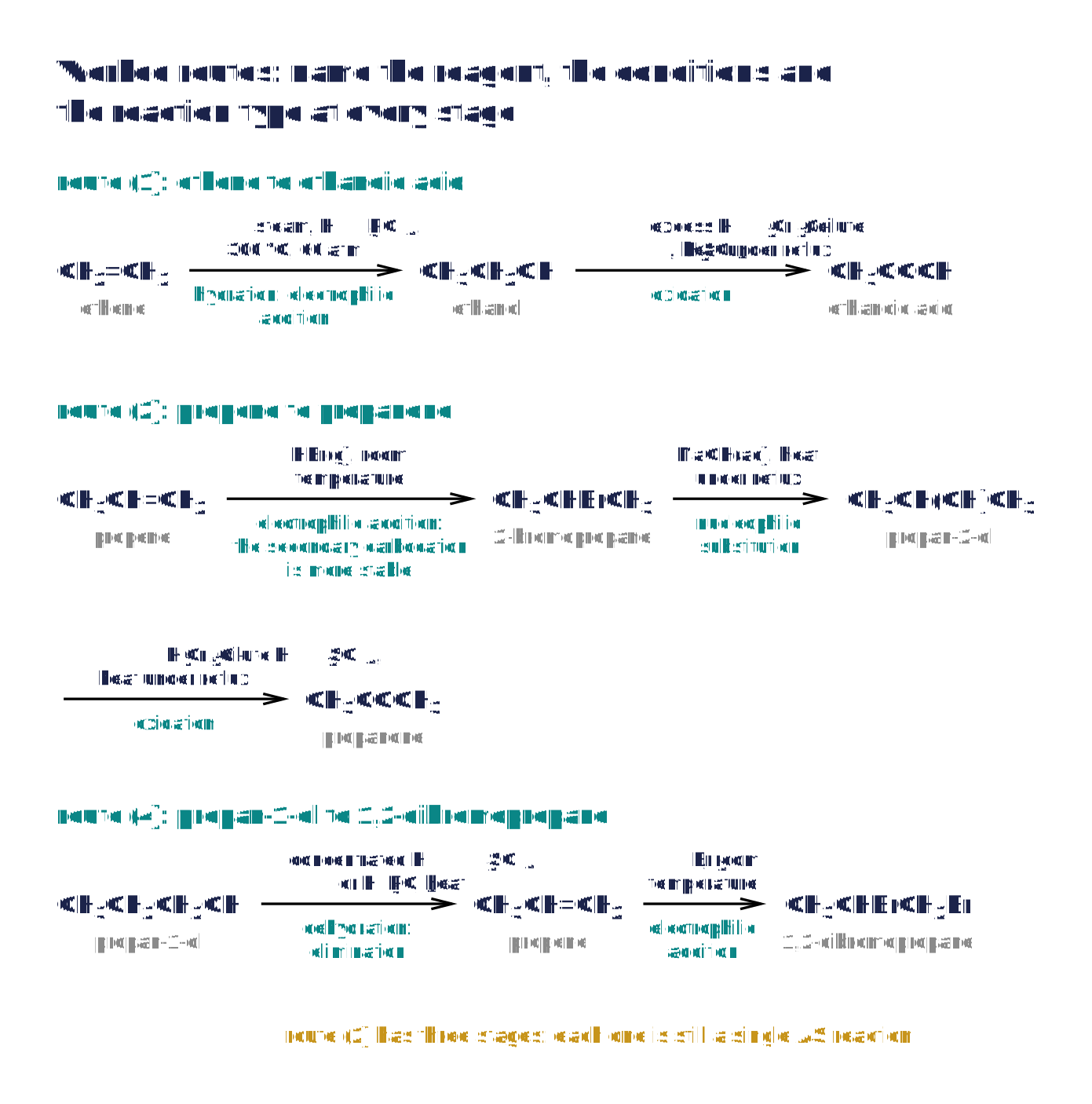
Routes (1), (2) and (4) drawn with condensed structures and the reagents and conditions written over every arrow.
Worked Routes (3), (4) and (5)
Route (3): 1-bromobutane to butanal
Route (4): propan-1-ol to 1,2-dibromopropane
Route (5): ethanol to ethyl ethanoate
Exam focus: Every intermediate is named and drawn, and every arrow carries reagents and conditions. A route with the right compounds but bare arrows scores half marks at best.
Check: Planning Two-Stage Routes
Work backwards from a target to the intermediate, name the reagents and conditions for both steps, and spot the route that changes the carbon skeleton by mistake.
Quick Check: Moving a Group Along the Chain
Plan backwards from a target that has its functional group in a new position.
Analysing a Given Route
A question may give the route and ask for the reaction type, the reagents and the likely by-products at each step. By-products come from competing reactions and from equilibria.
| Step in route (2) | Reaction type | Reagents and conditions | Possible by-product |
|---|---|---|---|
| propene → 2-bromopropane | electrophilic addition | HBr(g), room temperature | 1-bromopropane from the less stable primary carbocation |
| 2-bromopropane → propan-2-ol | nucleophilic substitution (hydrolysis) | NaOH(aq), heat under reflux | unreacted 2-bromopropane if the reflux is too short |
| propan-2-ol → propanone | oxidation | acidified K₂Cr₂O₇, heat | none from the ketone; a primary alcohol would over-oxidise to the acid |
- Over-oxidation: refluxing a primary alcohol gives the acid when the aldehyde was wanted; distil instead.
- Esterification equilibrium: the ester is mixed with water, unreacted acid and alcohol; distil, then wash with NaHCO₃(aq).
- Addition to an unsymmetrical alkene: both bromoalkanes form; the one from the more stable carbocation is the major product.
- Dehydration of a longer alcohol can give more than one alkene: positional isomers and E/Z isomers.
Remember: Reaction type names: electrophilic addition, nucleophilic substitution, elimination, oxidation, esterification, hydrolysis. Use the full name every time.
Check: Analysing a Route
Name the reaction type and reagents at each step of a given route and predict the by-product that each step could form.
Common Exam Points
- Plan backwards: name the target group, choose the last step, write the intermediate, then choose the first step.
- Every arrow carries reagents and conditions: HBr(g) room temperature; steam / H₃PO₄ 300 °C 60 atm; NaOH(aq) reflux; K₂Cr₂O₇ / H₂SO₄ distil or reflux.
- Distil for an aldehyde, reflux for a carboxylic acid or a ketone; concentrated H₂SO₄ is the catalyst for esterification and the reagent for dehydration.
- A haloalkane and an alcohol interconvert: NaOH(aq) one way, NaBr with concentrated H₂SO₄ (or PCl₅) the other.
- HBr adds to an unsymmetrical alkene to give mainly the product from the more stable carbocation; the other isomer is a by-product.
- No AS reaction changes the number of carbon atoms, so the target and the starting material have the same skeleton.
- By-products: over-oxidation, the esterification equilibrium, the minor addition isomer, more than one alkene from dehydration.
- Name the reaction type in full: electrophilic addition, nucleophilic substitution, elimination, oxidation, esterification, hydrolysis.
FAQs
Use these quick answers to check how to plan a two-stage route with the AS reactions of alkenes, haloalkanes, alcohols and carbonyl compounds, how to write reagents and conditions for every step and what by-products to mention.
How do I start planning a two-stage synthesis?
Work backwards from the target. Ask which single reaction could make it, write that compound down, then ask which reaction turns the starting material into it. Check the carbon skeleton is unchanged, then add reagents and conditions to each arrow before writing anything else.
How do I make ethanoic acid from ethene in two stages?
Stage 1: hydrate ethene with steam over a phosphoric(V) acid catalyst at about 300 °C and 60 atm to give ethanol. Stage 2: heat the ethanol under reflux with excess acidified potassium dichromate(VI), which oxidises it through ethanal to ethanoic acid.
How do I get from propene to propanone?
Add hydrogen bromide to propene to give 2-bromopropane (the hydrogen joins the end carbon, so bromine lands on the middle one). Hydrolyse the haloalkane with aqueous sodium hydroxide under reflux to propan-2-ol, then oxidise this secondary alcohol with acidified potassium dichromate(VI) to propanone.
How do I convert 1-bromobutane into butanal?
Hydrolyse the haloalkane by heating under reflux with aqueous sodium hydroxide to give butan-1-ol.
Then warm the alcohol with acidified potassium dichromate(VI) and distil the butanal off as it forms, so it leaves the oxidising mixture before it can be oxidised further to butanoic acid.
What by-products should I mention when I analyse a given route?
Ethanolic potassium hydroxide gives elimination to an alkene alongside substitution; a primary alcohol heated under reflux with dichromate is over-oxidised to the acid; esterification is an equilibrium, so acid and alcohol remain; and hydrogen bromide addition to an unsymmetrical alkene gives two isomers.

Copyright notice: This OLS revision content, including the explanations, layout, diagrams, tables and embedded learning structure, is authored for Online Learning System by Dr. Mohammed Al-Fatah. It may not be copied, reproduced, redistributed or adapted without written permission.
Keep this note — free
Save your progress across every OCR topic. A free account remembers which topics you have covered, saves your question scores, and syncs across your phone and laptop.
- Track every topic you have finished
- Keep your practice-question scores
- No payment, no card, free forever
Already registered? Log in