Identifying the Functional Groups in a Molecule
A concise revision guide to molecules with more than one functional group: how to pick out each group from a structure, which AS test identifies it, how the groups react independently, and how to predict the physical properties and reactions of an unfamiliar compound from the groups it contains, with worked examples.
Recap: AS Functional Groups and Their Tests
Five quick questions on what you already know: the names of the AS functional groups, the bromine water test (Reactions of Alkenes), the haloalkane hydrolysis test (Nucleophilic Substitution Reactions) and the oxidation of alcohols (Oxidation of Alcohols).
Spotting the Groups in a Structure
A molecule with several functional groups is still a set of familiar pieces. Find each piece before deciding on a single test.
- Trace the skeleton: follow the carbon chain and number it from the end nearest the highest-priority group.
- Circle every heteroatom and every C=C: each oxygen, halogen or double bond marks a group.
- Name the group by its atoms: C=C alkene; C–Br bromoalkane; C–OH alcohol; C=O with H aldehyde, without ketone; COOH carboxylic acid; COOR ester.
- Classify the alcohol as primary, secondary or tertiary: the oxidation test depends on it.
- List the groups, then the tests: one positive observation for each group, and the negatives that rule others out.
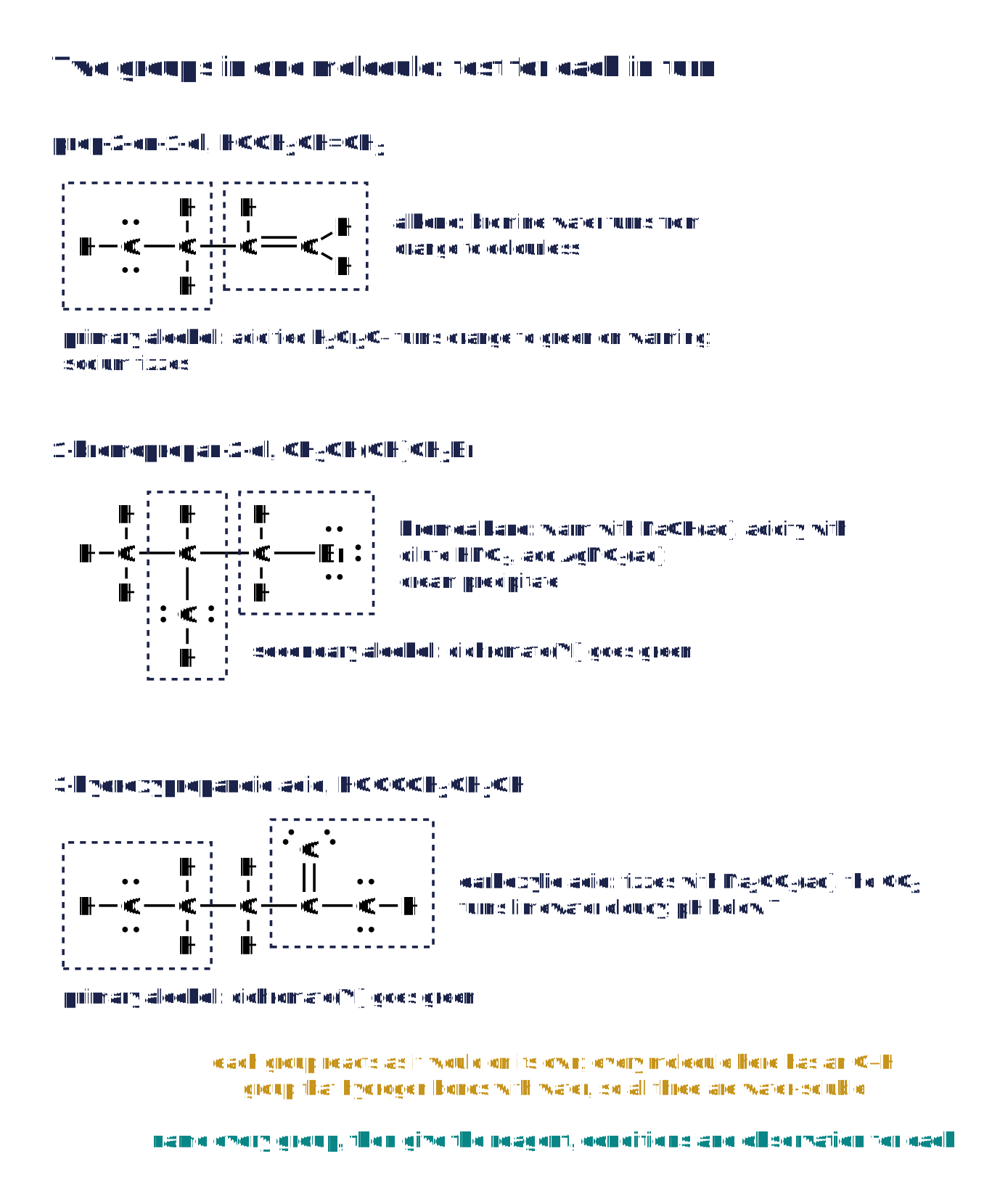
Prop-2-en-1-ol, 1-bromopropan-2-ol and 3-hydroxypropanoic acid drawn out, each functional group boxed and named.
Remember: The A Level page Identifying Functional Groups by Chemical Tests adds the groups met later. At AS the list is alkene, haloalkane, alcohol and carboxylic acid; the ester row in the table is A Level content (6.1.3).
The AS Test Table
Learn each row as reagent, conditions, observation and conclusion. The observation is the mark most often lost.
Important: OCR tests an alcohol with acidified potassium dichromate(VI). PCl₅ and sodium, in the table, the figures and the worked examples, are extension: neither is on the OCR specification, so do not rely on them in an OCR answer.
| Group | Reagent and conditions | Positive observation | What happens |
|---|---|---|---|
| alkene, C=C | bromine water, shake at room temperature | orange to colourless | electrophilic addition across the double bond |
| haloalkane, C–X | warm with NaOH(aq), acidify with dilute HNO₃, add AgNO₃(aq) | white (Cl), cream (Br) or yellow (I) precipitate | hydrolysis releases the halide ion, which is precipitated as the silver halide |
| alcohol, O–H (extension) | PCl₅ at room temperature; a small piece of sodium | misty fumes of HCl; steady fizzing | the O–H group reacts (a carboxylic acid does the same) |
| primary or secondary alcohol | warm with acidified potassium dichromate(VI) | orange to green | oxidation to an aldehyde, acid or ketone; a tertiary alcohol stays orange |
| carboxylic acid, COOH | sodium carbonate or sodium hydrogencarbonate solution; universal indicator | fizzing, the gas turns limewater cloudy; indicator red or orange | the acid releases CO₂ from the carbonate |
| ester, COOR (A Level, 6.1.3) | smell; warm with NaOH(aq) then acidify | sweet fruity smell; the smell goes as the ester is hydrolysed | hydrolysis to the acid and the alcohol |
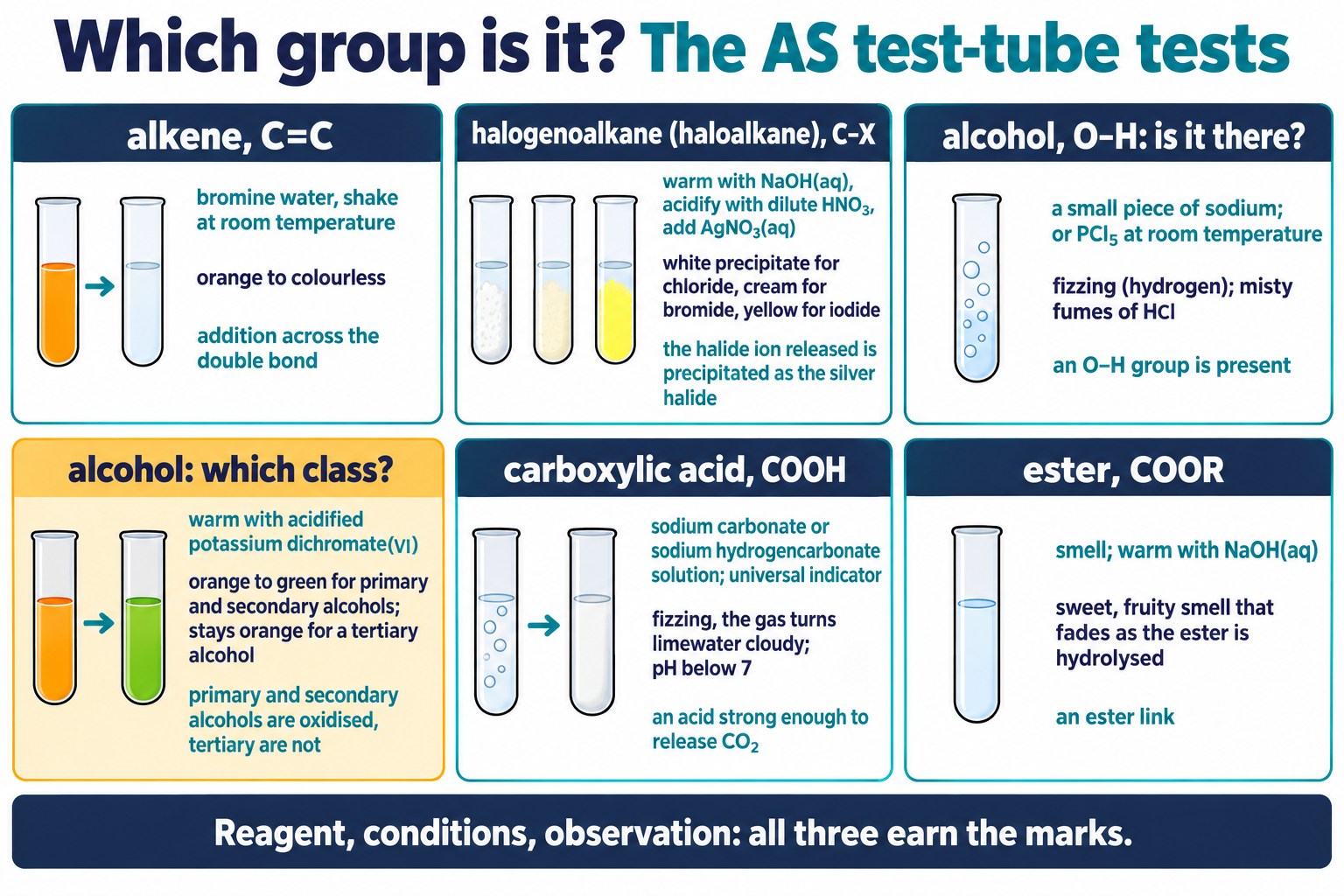
The six shared AS tests as tiles: reagent, conditions and the colour or observation for each group.
Exam focus: In the haloalkane test, say why each step is there: NaOH hydrolyses the C–X bond, the nitric acid destroys the excess hydroxide (which would give brown Ag₂O), and silver nitrate precipitates the halide.
Check: Tests and Observations
Match each AS test to its observation and the group it detects, choose the test that separates two compounds, and explain the steps of the halide test.
Worked Example (a): Prop-2-en-1-ol
HOCH₂CH=CH₂ carries a C=C bond and a CH₂OH group: an alkene and a primary alcohol.
Worked Example (b): 1-Bromopropan-2-ol
CH₃CH(OH)CH₂Br has an OH on a carbon bonded to two other carbons and a C–Br bond: a secondary alcohol and a bromoalkane.
Worked Example (c): 3-Hydroxypropanoic Acid
HOCH₂CH₂COOH has a CH₂OH group at one end and a COOH group at the other: a primary alcohol and a carboxylic acid.
Exam focus: Say which group causes each observation: “the fizzing with carbonate comes from the carboxylic acid; the colour change with dichromate(VI) comes from the primary alcohol”.
Quick Check: A Molecule with Three Groups
4-Chlorobut-2-enoic acid, ClCH₂CH=CHCOOH, carries three functional groups. Predict each result.
Predicting Physical Properties
An unfamiliar molecule is a set of familiar groups. Its boiling point and solubility follow from the strongest intermolecular force its groups can form.
| Group present | Intermolecular forces | Effect on boiling point and solubility |
|---|---|---|
| O–H (alcohol, carboxylic acid) | hydrogen bonding with itself and with water | high boiling point; small molecules mix with water |
| C=O, C–O or C–X (aldehyde, ketone, ester, haloalkane) | permanent dipole–dipole and London forces | moderate boiling point; accepts hydrogen bonds from water but cannot donate them |
| C=C and C–H only | London forces | low boiling point, rising with chain length; insoluble in water |
| two O–H groups (an acid and an alcohol) | more hydrogen bonds per molecule | higher boiling point than either group alone; very soluble in water |
Worked example: prop-2-en-1-ol against propene
Step 1. Propene, CH₃CH=CH₂, has only London forces between its molecules: a gas boiling at −48 °C, insoluble in water.
Step 2. Prop-2-en-1-ol adds an O–H group: hydrogen bonds form between its molecules and with water.
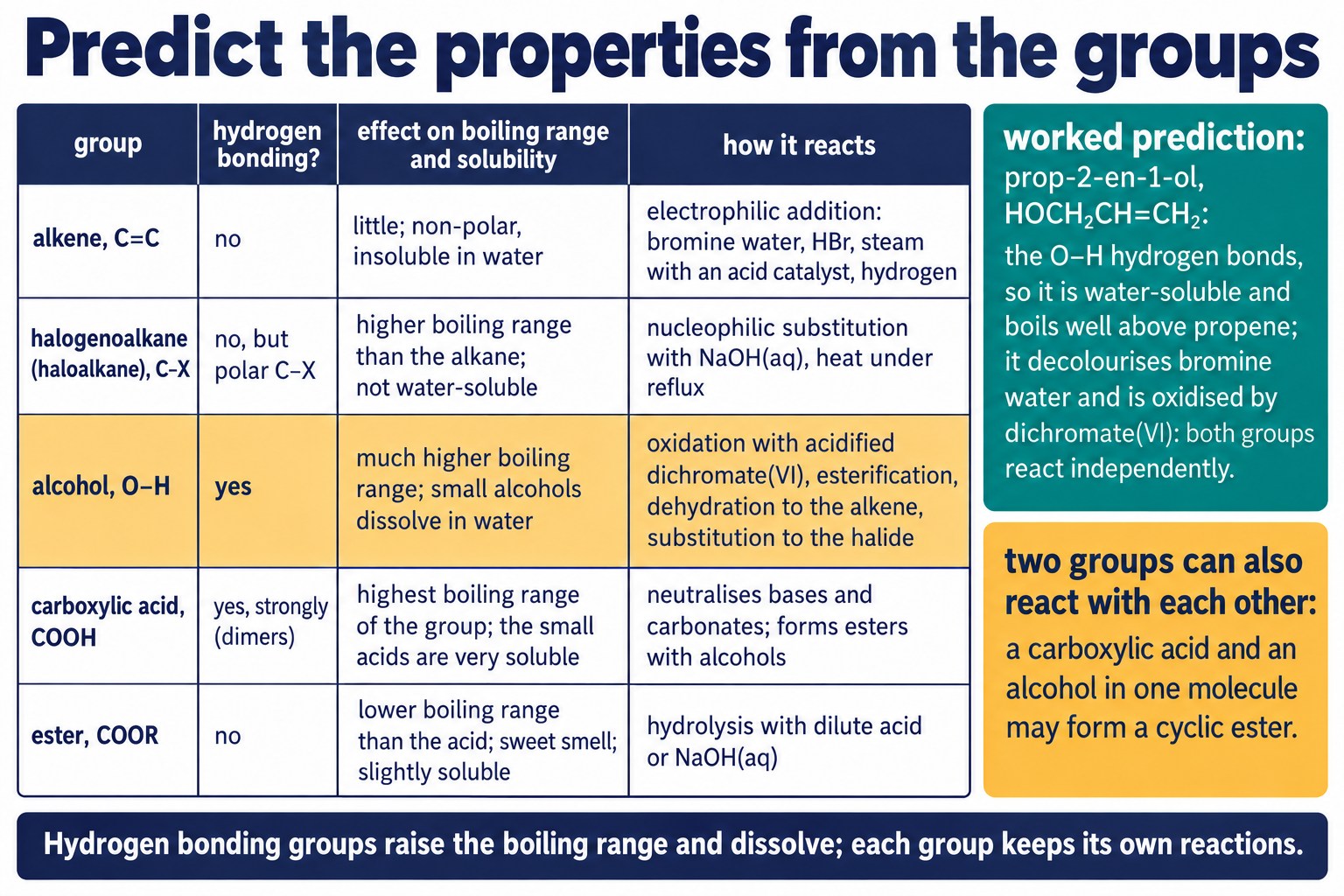
Group by group: the force it brings, the effect on boiling point and water solubility, and the reaction it gives.
Predicting Reactions: Each Group on Its Own
Each group reacts as it would in a simple molecule, with the same reagents and conditions. Predict group by group, then look for interference between the tests.
- 1-Bromopropan-2-ol with NaOH(aq), reflux: the C–Br is substituted to give propane-1,2-diol; the alcohol group is unchanged.
- Prop-2-en-1-ol with HBr: electrophilic addition across the C=C gives a bromoalcohol; the O–H group takes no part.
- 3-Hydroxypropanoic acid with ethanol and concentrated H₂SO₄: the COOH forms an ester; the CH₂OH could esterify with another acid molecule.
- Interference: acidified dichromate(VI) oxidises aldehydes as well as alcohols, and PCl₅ (extension) reacts with acids as well as alcohols. Choose the test only one group gives.
- Groups can interact: an acid and an alcohol in one molecule can join to form a cyclic ester; mention it, no details are needed at AS.
- Order of testing: indicator and carbonate first, then bromine water, then dichromate(VI), then the hydrolysis and silver nitrate test.
Remember: Write the reagent, the group it attacks and the product for each group separately. A molecule with two groups gives two sets of products if both react.
Check: Several Groups and Unfamiliar Compounds
Predict which AS tests a molecule with two groups gives, explain each observation by naming the group responsible, and predict solubility and reactivity from the groups present.
Common Exam Points
- Give reagent, conditions and observation together: “warm with acidified potassium dichromate(VI); orange to green”.
- Bromine water: an alkene turns it from orange to colourless. “Decolourised” alone is not enough; give both colours.
- Haloalkane: warm with NaOH(aq), acidify with HNO₃, add AgNO₃(aq): white, cream or yellow precipitate for Cl, Br or I.
- Acidified dichromate(VI) turns green with primary and secondary alcohols (and aldehydes), never with tertiary alcohols or ketones.
- Carboxylic acids fizz with sodium carbonate and turn universal indicator red; alcohols do neither. PCl₅ and sodium (extension, not OCR) react with both.
- On a molecule with several groups, each group gives its own test result; explain every observation by naming the group responsible.
- Predict properties from the groups: O–H means hydrogen bonding, a high boiling point and water solubility; a hydrocarbon part means London forces only.
FAQs
Use these quick answers to check how to pick out several functional groups in one structure, which test identifies each group, and how to predict the properties and reactions of an unfamiliar molecule.
How do I spot every functional group in a complicated structure?
Work along the carbon skeleton and name each feature in turn: a C=C double bond is an alkene, a halogen on a carbon makes a haloalkane, an O–H on a saturated carbon is an alcohol, a C=O bearing O–H is a carboxylic acid.
How do I test for a haloalkane and tell which halogen is present?
Warm the compound with aqueous sodium hydroxide to release the halide ion, acidify with dilute nitric acid, then add silver nitrate solution. A white precipitate means chloride, cream means bromide and yellow means iodide. The hydrolysis step is essential because covalent halogens give no precipitate.
How do I tell a tertiary alcohol from a primary or secondary one?
Warm each with acidified potassium dichromate(VI). Primary and secondary alcohols are oxidised, turning the solution from orange to green. A tertiary alcohol has no hydrogen on the carbon bearing the O–H group, so it cannot be oxidised and the solution stays orange.
How do I show that a carboxylic acid group is present when the molecule also has an alcohol group?
Add sodium carbonate or sodium hydrogencarbonate solution: the acid fizzes as carbon dioxide forms, which turns limewater cloudy, and its solution has a pH below 7. An alcohol does nothing with carbonate, although both groups react with sodium metal and give hydrogen (extension, not on the OCR specification).
How do I predict the properties of a molecule with more than one functional group?
Each group behaves as it would alone, so every test for a group present is positive.
O–H and N–H groups give hydrogen bonding, raising the boiling point and water solubility. Nearby groups can interact: an acid and an alcohol may form a cyclic ester.

Copyright notice: This OLS revision content, including the explanations, layout, diagrams, tables and embedded learning structure, is authored for Online Learning System by Dr. Mohammed Al-Fatah. It may not be copied, reproduced, redistributed or adapted without written permission.
Keep this note — free
Save your progress across every OCR topic. A free account remembers which topics you have covered, saves your question scores, and syncs across your phone and laptop.
- Track every topic you have finished
- Keep your practice-question scores
- No payment, no card, free forever
Already registered? Log in