5.1.1
How Fast?
Section 5.1.1 covers rate, order, overall order, the rate constant, half-life and the rate-determining step; deducing orders and rate equations from experimental data; calculating k and its units; concentration–time graphs including the constant half-life of a first-order reaction and k = (ln 2) / (t½); rate–concentration graphs; the initial-rates and continuous monitoring techniques including colorimetry; predicting mechanisms from rate equations; and the Arrhenius equation with the graphical determination of Eₐ and A. PAG 10 supplies the rate data.
Revision Notes
7 revision notes, in the order the specification teaches them.

Rate Equations, Orders and the Rate Constant
Rate equations: orders of reaction, the rate constant k, overall order and working out the units of k.
Start revising
Techniques for Measuring Rates
Measuring rates: titration, colorimetry, mass and gas-volume methods, continuous monitoring and the initial-rates method with clock reactions.
Start revising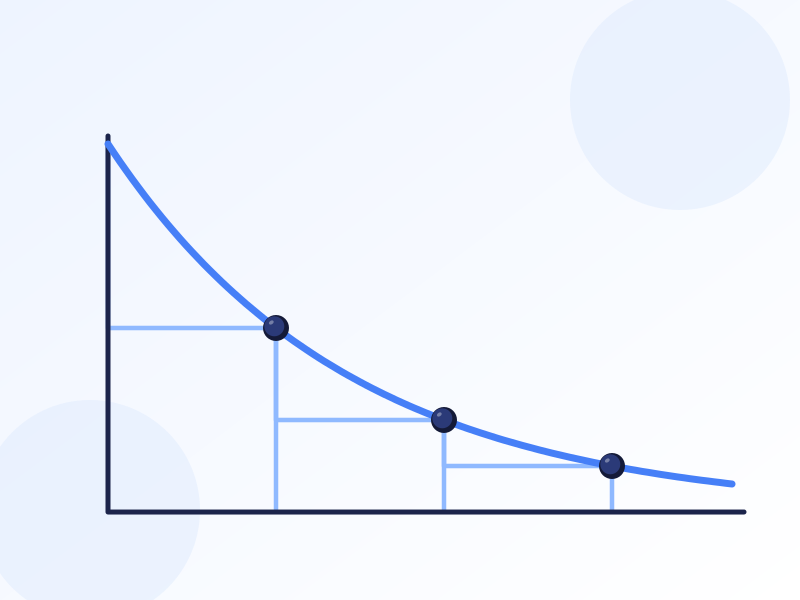
Concentration–Time Graphs and Half-Life
Concentration–time graphs: deducing order from the shape, tangents and rates, half-life and first-order reactions, k from the half-life.
Start revising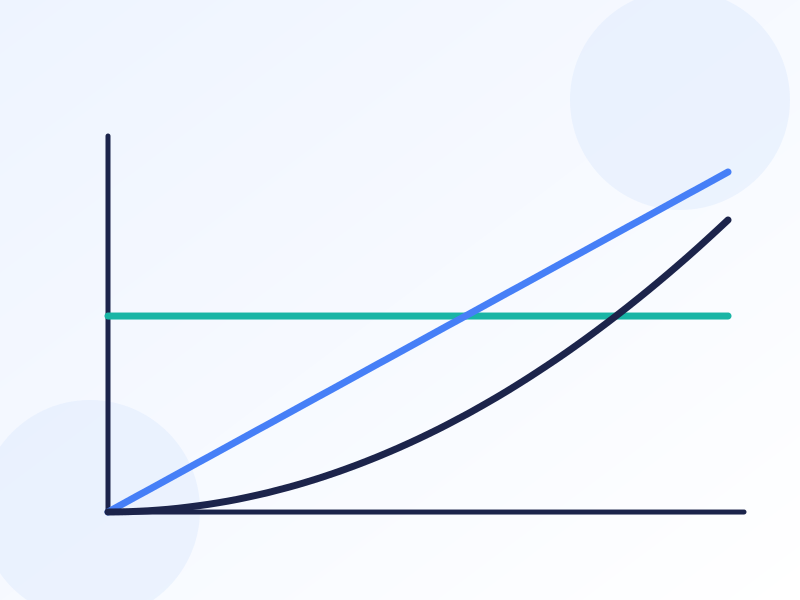
Rate–Concentration Graphs and the Initial-Rates Method
The initial-rates method: rate–concentration graphs, deducing orders from tables of data, writing the rate equation and calculating k.
Start revising
The Iodine–Propanone Reaction
The iodine–propanone reaction: collecting rate data, the orders with respect to iodine, propanone and H⁺, and deducing the mechanism.
Start revising
Rate-Determining Step and Reaction Mechanisms
The rate-determining step: rate equations from mechanisms, mechanisms from rate equations, intermediates, and Sₙ1/Sₙ2 evidence from haloalkanes hydrolysis.
Start revising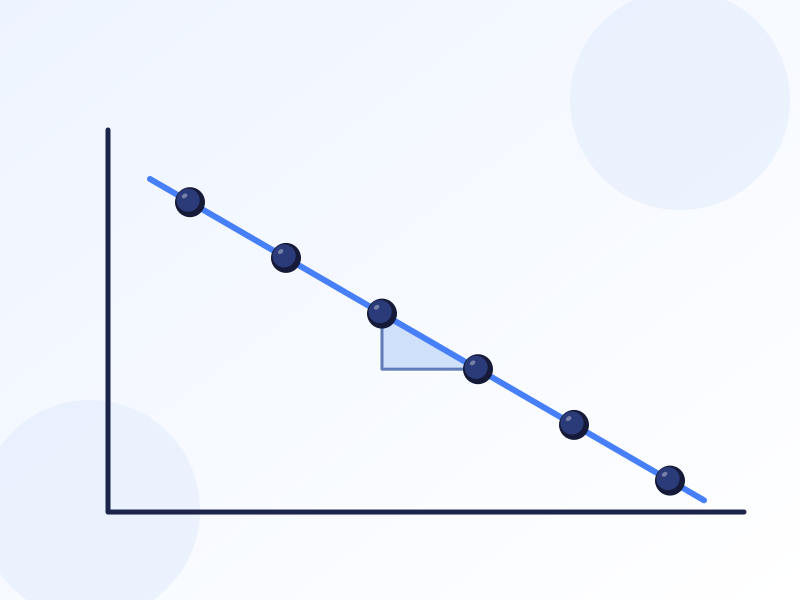
Activation Energy and the Arrhenius Equation
The Arrhenius equation: temperature and the rate constant, ln k against 1/T graphs and finding the activation energy from the gradient.
Start revisingSummary Map
Download, print and revise the key facts of this topic at a glance.
Summary maps
Download, print and revise the key facts of this topic at a glance.

Orders and Rate Equations Map
OCR A Level Chemistry A (H432) · 5.1.1 How fast? · Orders and rate equations
The whole section on one A4 page: measuring a rate, rate equations, units of k, initial rates, graph shapes and half-life, with worked examples.
Mechanisms and Temperature Map
OCR A Level Chemistry A (H432) · 5.1.1 How fast? · Mechanisms and temperature
The whole section on one A4 page: the slow step, mechanisms from rate equations, activation energy and temperature, the Arrhenius equation and plot, and the activation-energy practical.
© 2026 Online Learning System. For personal study: printing is allowed; editing, copying and redistribution are not.
Virtual Lessons
Recorded video lessons that teach the topic step by step.
The Virtual Lessons for 5.1.1 How Fast? are being recorded.
MCQ Bank
Multiple-choice papers on this topic, marked the moment you submit.
The MCQ papers for 5.1.1 How Fast? are being written.
SAQ Bank
Written, drawn and worked exam practice on this topic.
The exam practice papers for 5.1.1 How Fast? are being written.
Revision Game
Match reagents to products, with your board's reagents and conditions.
The revision game for 5.1.1 How Fast? is being built.
Study Cards
Pick a deck, then turn each card to check what you remember.
Specification
Every specification point in this topic, in the exam board's own words. Rate how confident you are with each one.
Self-assessment · 23 points
Sign in to rate how confident you feel about each point. Your ratings are saved to your account, follow you to any device, and appear beside your KASP analytics, kept apart from your marks.
5.1.1
- b (ii)
deduction of a rate equation from orders of the form: rate = k[A]m[B]n, where m and n are 0, 1 or 2
Revise - d (i)
from a concentration–time graph: deduction of the order (0 or 1) with respect to a reactant from the shape of the graph
Revise - d (ii)
from a concentration–time graph: calculation of reaction rates from the measurement of gradients (see also 3.2.2 b)
Revise - e
from a concentration–time graph of a first order reaction, measurement of constant half-life, t1/2
Revise - f
for a first order reaction, determination of the rate constant, k, from the constant half-life, t1/2, using the relationship: k = ln 2/t1/2
Revise - g (i)
from a rate–concentration graph: deduction of the order (0, 1 or 2) with respect to a reactant from the shape of the graph
Revise - g (ii)
from a rate–concentration graph: determination of rate constant for a first order reaction from the gradient
Revise - h i
the techniques and procedures used to investigate reaction rates by the initial rates method (see also 3.2.2 e)
Revise - h ii
the techniques and procedures used to investigate reaction rates by continuous monitoring, including use of colorimetry (see also 3.2.2 e)
Revise - i (i)
for a multi-step reaction, prediction of a rate equation that is consistent with the rate-determining step
Revise - i (ii)
for a multi-step reaction, prediction of possible steps in a reaction mechanism from the rate equation and the balanced equation for the overall reaction
Revise - j
a qualitative explanation of the effect of temperature change on the rate of a reaction and hence the rate constant (see 3.2.2 f–g)
Revise - k (i)
the exponential relationship between the rate constant, k and temperature, T given by the Arrhenius equation, k = Ae^(–Ea/RT)
Revise - k (ii)
determination of Ea and A graphically using: ln k = –Ea/RT + ln A derived from the Arrhenius equation
Revise
Keep this note — free
Save your progress across every OCR topic. A free account remembers which topics you have covered, saves your question scores, and syncs across your phone and laptop.
- Track every topic you have finished
- Keep your practice-question scores
- No payment, no card, free forever
Already registered? Log in