Condensation Polymers: Polyamides and Polyesters
A concise revision guide to condensation polymers: polyamides such as nylon-6,6 from diamines and dicarboxylic acids, polyamides from amino acids, polyesters such as Terylene, drawing repeat units from monomers and monomers from a polymer chain, and the hydrogen bonding between polyamide chains.
Hydrogen Bonding Between Polyamide Chains
Choose a step to watch two nylon-6,6 chains line up, their δ+ and δ− atoms light up, hydrogen bonds form and the chains stack into a fibre.
© Dr. Mohammed Al-Fatah – onlinelearningsystem.net
Before You Start
Condensation polymers are built from monomers that carry two functional groups. The ideas you need come from alkenes, esters and the amide chemistry earlier in this topic.
- Addition polymerisation: alkenes join through their C=C bonds and nothing is lost: Polymerisation Reactions.
- Esters form when a carboxylic acid condenses with an alcohol, losing water, and polyesters such as Terylene are introduced there: Esters, Hydrolysis and Polyesters.
- An acyl chloride or carboxylic acid group condenses with an amine to make the amide link –CONH–: Amines as Nucleophiles and Amides.
- A repeat unit is the shortest section of chain that repeats along the whole polymer.
GCSE Recap: Addition Polymers and Making Esters
Three quick questions on the GCSE ideas this page builds on.
Condensation Polymerisation
In condensation polymerisation monomers join through their functional groups and a small molecule, usually water, is lost each time a link forms.
- Each monomer must have two functional groups, one at each end, so that the chain can grow in both directions.
- The two groups may be on two different monomers (a diamine and a dicarboxylic acid) or on the same monomer (an amino acid).
- A –COOH group with an –NH₂ group gives an amide link, –CONH–, and a polyamide.
- A –COOH group with an –OH group gives an ester link, –COO–, and a polyester.
- One molecule of water is lost for every link made, so the repeat unit has fewer atoms than the monomers.
| Addition polymerisation | Condensation polymerisation | |
|---|---|---|
| monomer | contains a C=C double bond | two functional groups: OH, COOH, NH₂ |
| small molecule lost | none | water |
| repeat unit | same atoms as the monomer | monomer(s) minus the lost molecule |
| chain | carbon atoms only | ester or amide links in the backbone |
| examples | poly(ethene), poly(propene) | nylon-6,6, Terylene, proteins |
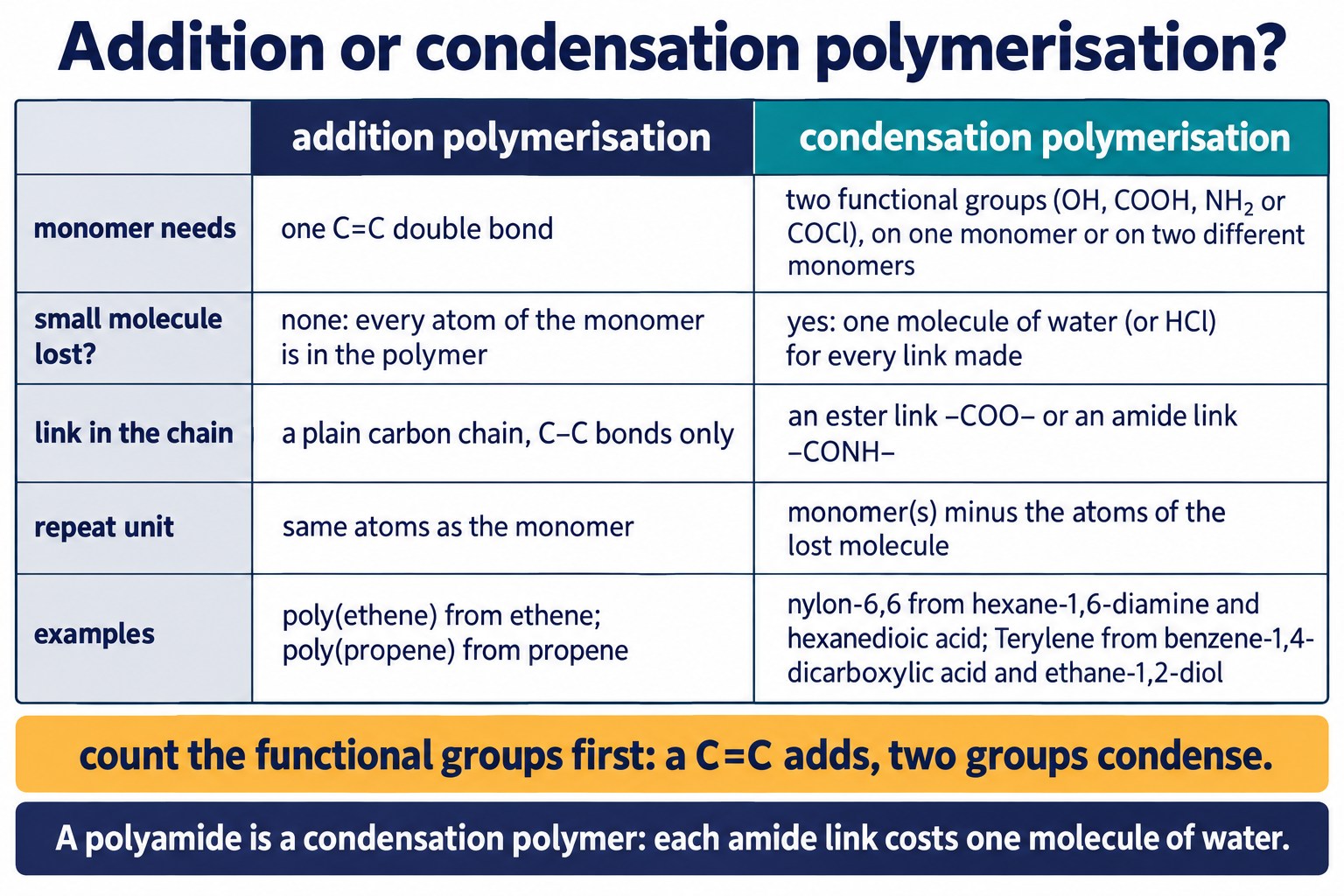
Count the functional groups on the monomer: one C=C means addition, two groups at the ends mean condensation.
Remember: Condensation: two functional groups per monomer, a small molecule lost per link. Addition: one C=C, nothing lost.
Quick Check: Which Polymer Forms?
Look at the functional groups in each new mixture and decide what forms.
Nylon-6,6: a Polyamide from Two Monomers
Nylon-6,6 is made from hexane-1,6-diamine, H₂N(CH₂)₆NH₂, and hexanedioic acid, HOOC(CH₂)₄COOH. Each diamine has six carbons and so does each acid, hence 6,6.
- The –NH₂ of the diamine condenses with the –COOH of the acid: an amide link forms and water is lost.
- Both monomers have a second group at the other end, so the chain keeps growing: acid, diamine, acid, diamine.
- Equation: n H₂N(CH₂)₆NH₂ + n HOOC(CH₂)₄COOH → –[NH(CH₂)₆NH–CO(CH₂)₄CO]–ₙ + 2n H₂O.
- Repeat unit: –NH(CH₂)₆NH–CO(CH₂)₄CO–. It contains two amide links and comes from one molecule of each monomer.
- Two molecules of water are lost per repeat unit, one for each amide link.
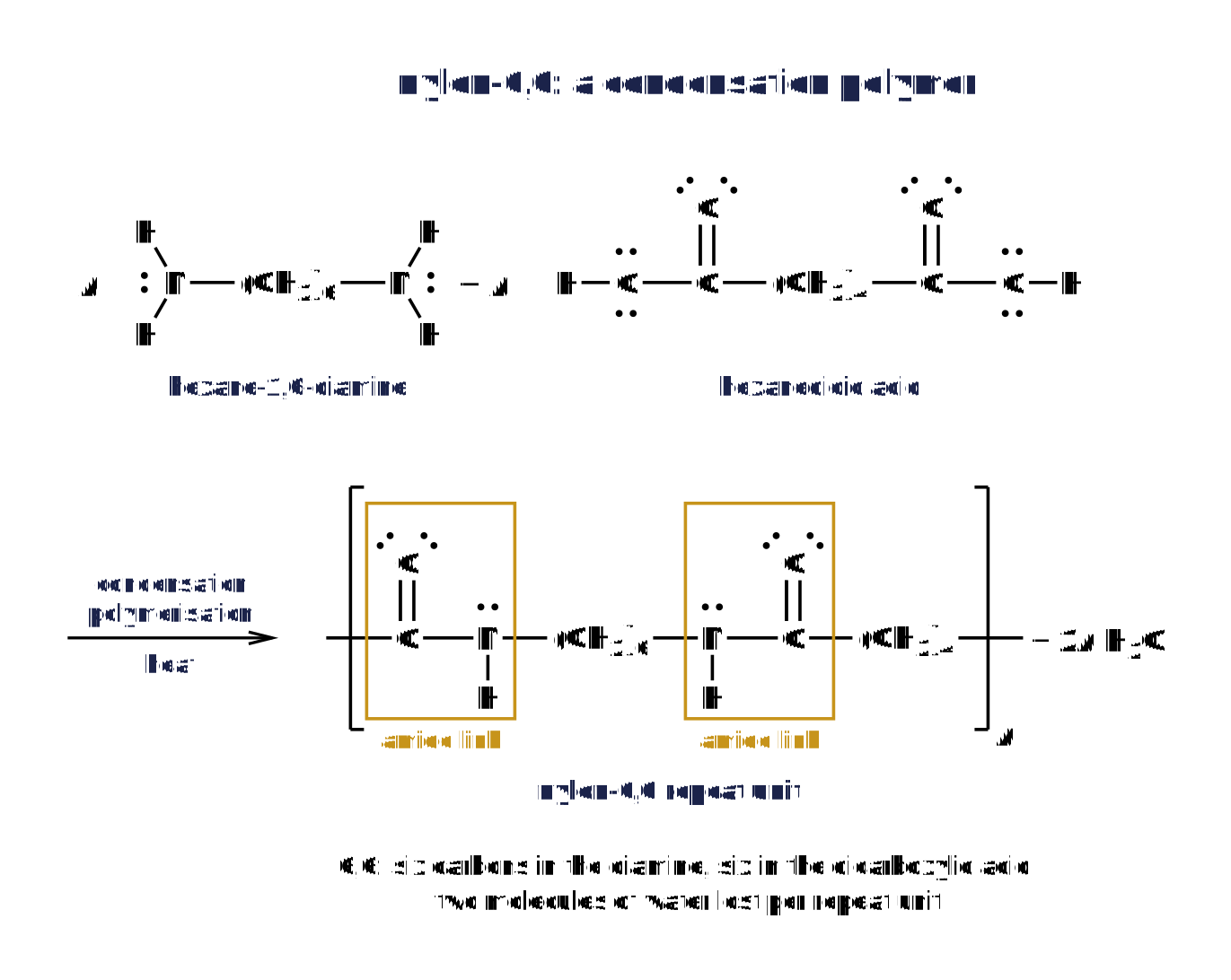
Hexane-1,6-diamine and hexanedioic acid condense to nylon-6,6. The two amide links in the repeat unit are boxed.
Exam focus: Draw the repeat unit with a bond at each end and show both amide links as –CO–NH–. The 6,6 counts carbons: six from the diamine, six from the acid.
Polyamides from One Monomer
A monomer that carries both an –NH₂ group and a –COOH group can condense with itself. Nylon-6 is made from 6-aminohexanoic acid, H₂N(CH₂)₅COOH.
- Equation: n H₂N(CH₂)₅COOH → –[NH(CH₂)₅CO]–ₙ + n H₂O.
- Repeat unit: –NH(CH₂)₅CO–, with one amide link and one molecule of water lost per monomer.
- The name has one number because there is only one monomer, with six carbons.
- A 2-amino acid such as glycine polymerises the same way: its amide links are called peptide links and the polymer is a polypeptide or protein.
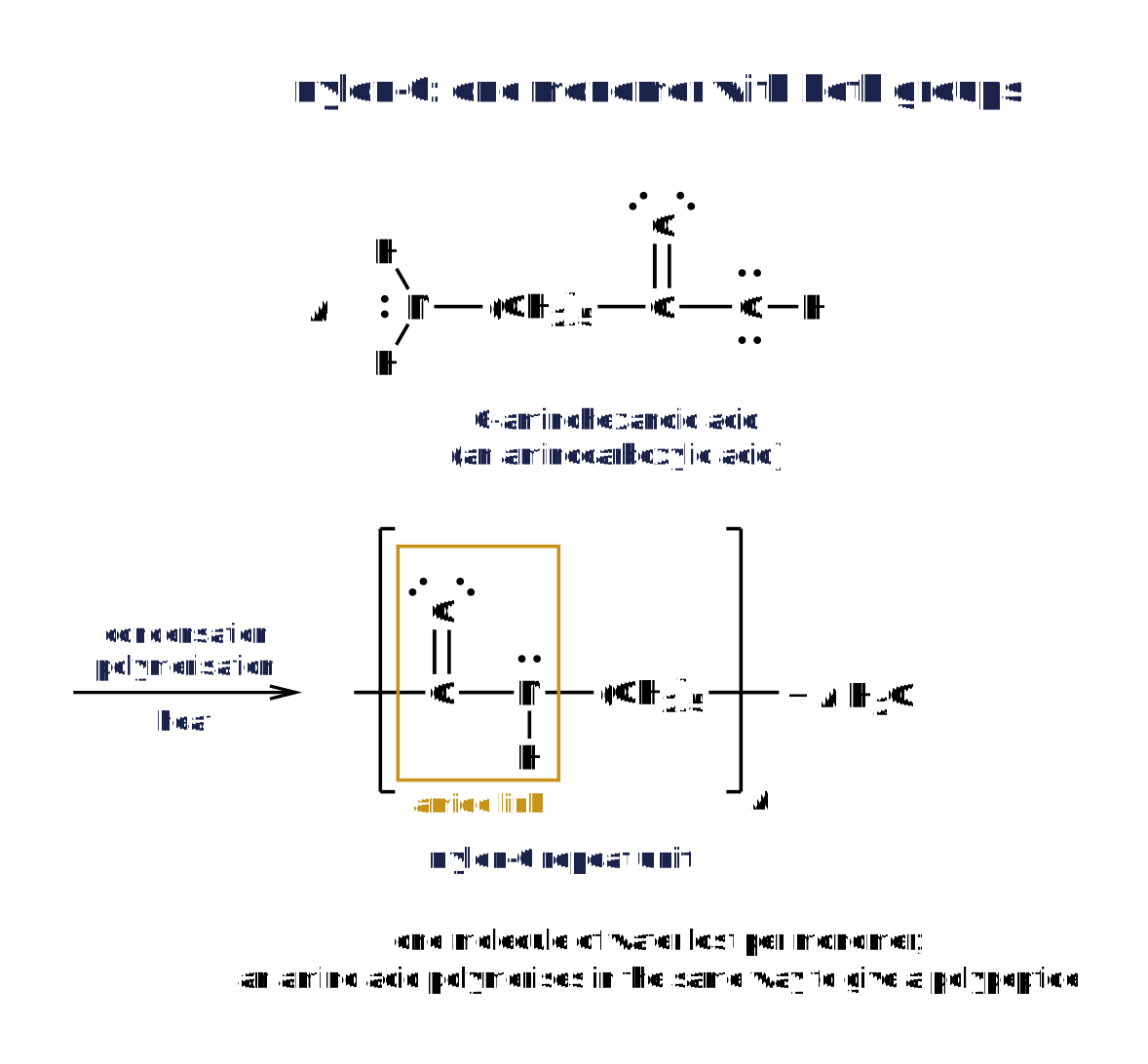
One monomer, both groups: 6-aminohexanoic acid gives nylon-6 with a single amide link in each repeat unit.
Remember: Two monomers, each with two of the same group: nylon-6,6. One monomer with one of each group: nylon-6, or a polypeptide from an amino acid.
Check: Polyamides
Draw repeat units for polyamides made from a diamine with a dicarboxylic acid and from an aminocarboxylic acid, and account for the small molecule lost.
Polyesters: a Recap
Polyesters are condensation polymers too. A dicarboxylic acid condenses with a diol and an ester link, –COO–, forms with loss of water. They are covered in full in Esters, Hydrolysis and Polyesters.
- Terylene (PET) is made from benzene-1,4-dicarboxylic acid, HOOC–C₆H₄–COOH, and ethane-1,2-diol, HOCH₂CH₂OH.
- Repeat unit: –CO–C₆H₄–CO–O–CH₂CH₂–O–, with two ester links; 2n H₂O is lost for n repeat units.
- Uses: clothing fibres, drinks bottles and food packaging.
| Polyester | Polyamide | |
|---|---|---|
| monomers | dicarboxylic acid + diol | dicarboxylic acid + diamine |
| link | ester –COO– | amide –CONH– |
| small molecule lost | water | water |
| example | Terylene | nylon-6,6 |
Remember: Same pattern, different link: OH + COOH makes an ester link; NH₂ + COOH makes an amide link.
Worked Skills: Repeat Units and Monomers
Three skills are examined again and again: draw the repeat unit from the monomers, find the monomers from a section of chain, and decide which type of polymerisation a monomer undergoes.
Worked example: repeat unit from the monomers
Question. Draw the repeat unit of the polymer formed from butanedioic acid, HOOC(CH₂)₂COOH, and propane-1,3-diamine, H₂N(CH₂)₃NH₂.
Worked example: monomers from a section of chain
Step 1. Find the amide links in the section and cut each one between the C=O carbon and the nitrogen.
Step 2. Add OH back to each C=O carbon (making COOH) and H back to each N (making NH₂).
Answer. The fragments are butanedioic acid and propane-1,3-diamine.
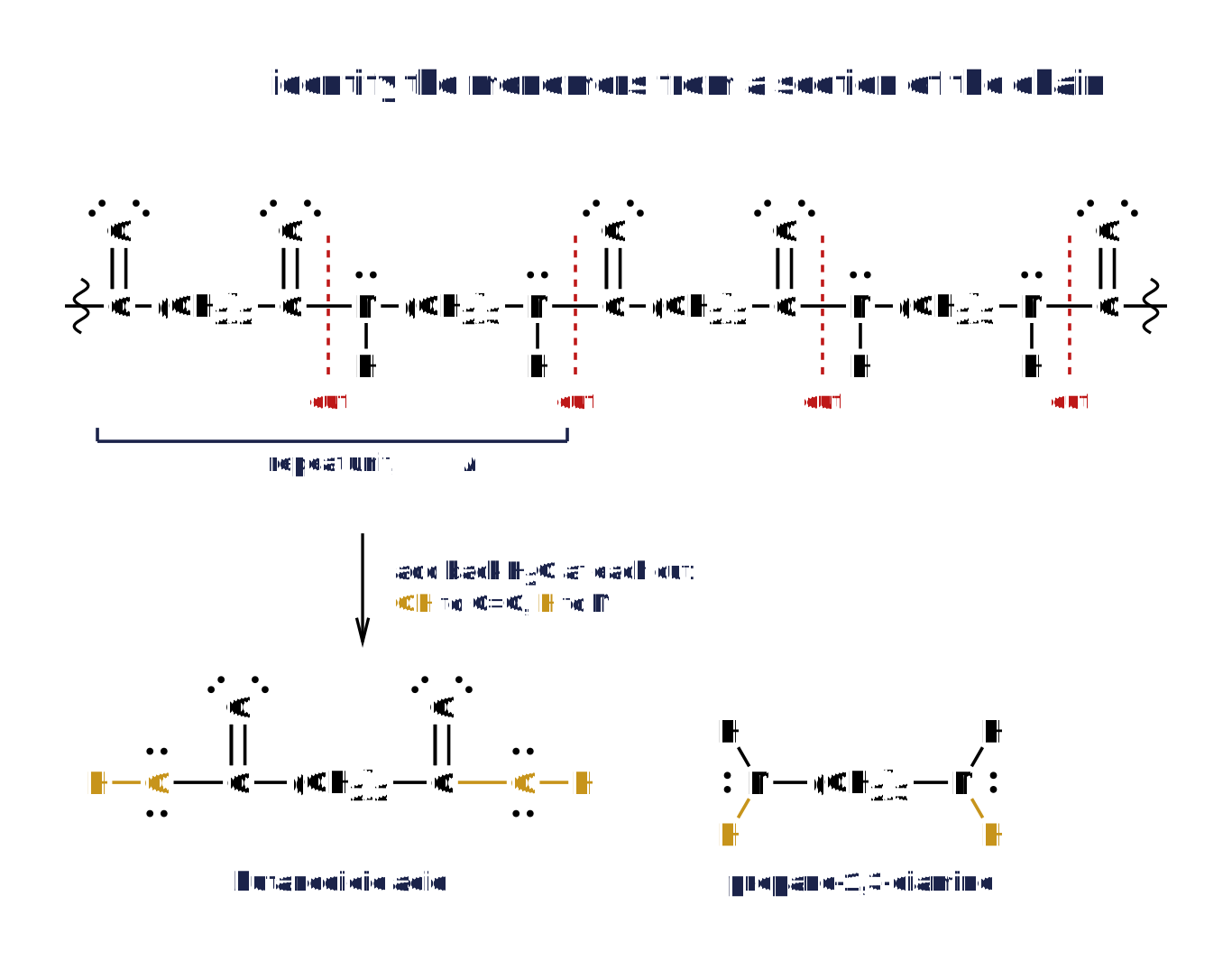
Cut at every amide link, then add back the water: the two monomers are butanedioic acid and propane-1,3-diamine.
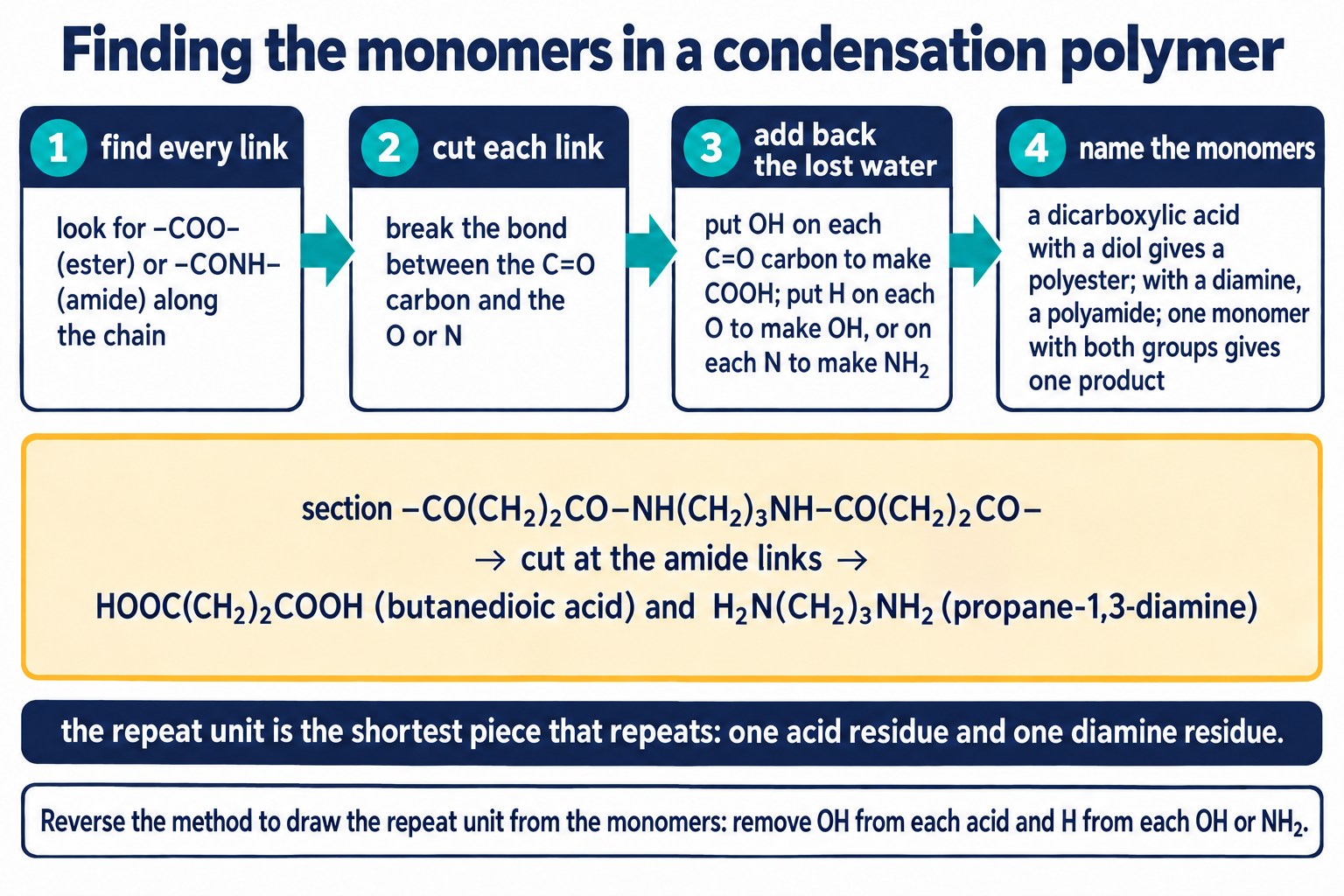
Find the links, cut them, add back the lost water, then name the monomers.
Which type of polymerisation?
| Monomer(s) | Type | Link in the chain |
|---|---|---|
| one monomer with a C=C | addition | none: a carbon chain |
| dicarboxylic acid + diol | condensation | ester |
| dicarboxylic acid + diamine | condensation | amide |
| amino acid (both groups on one molecule) | condensation | amide |
Common mistake: Count the carbons. The acid residue keeps every carbon, including the two carbonyl carbons: hexanedioic acid gives CO(CH₂)₄CO, not CO(CH₂)₆CO.
Check: Repeat Units and Monomers
Work from monomers to repeat unit and back again, and decide whether a given monomer polymerises by addition or by condensation.
Hydrogen Bonding and Properties
The forces between polymer chains decide the strength and melting temperature of the material. Polyamides stand out because their chains are held together by hydrogen bonds.
- Each amide link has an N–H bond (the H is δ+) and a C=O bond (the O is δ−).
- The N–H hydrogen of one chain forms a hydrogen bond to the carbonyl oxygen of a neighbouring chain.
- Many hydrogen bonds act along the chains, so a lot of energy is needed to pull them apart or to melt the solid.
- Nylon forms strong fibres with a high melting temperature, about 265 °C for nylon-6,6.
- Polyesters have no N–H, so their chains attract through permanent dipole-dipole forces between C=O groups: weaker, but still strong fibres.
- Polyalkenes are non-polar: only London forces act between the chains, so they soften at lower temperatures.
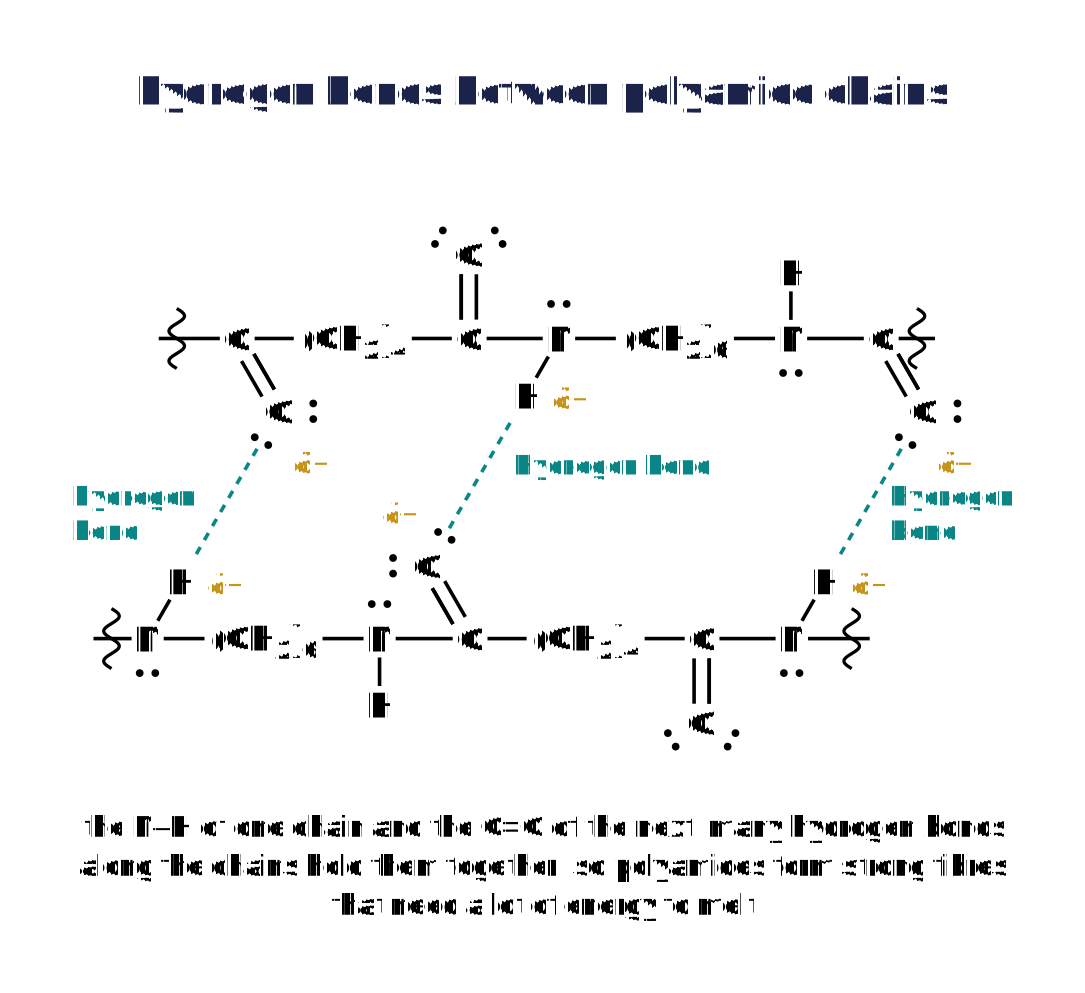
Two nylon-6,6 chains side by side. Each N–H···O=C hydrogen bond is drawn as a dashed line from the δ+ hydrogen to the δ− oxygen.
| Polymer | Force between chains | Melting temperature | Uses |
|---|---|---|---|
| polyamide (nylon) | hydrogen bonds | high | clothing, ropes, carpets |
| polyester (Terylene) | permanent dipole-dipole forces | high | fabrics, bottles |
| polyalkene (poly(ethene)) | London forces only | low | bags, bottles, pipes |
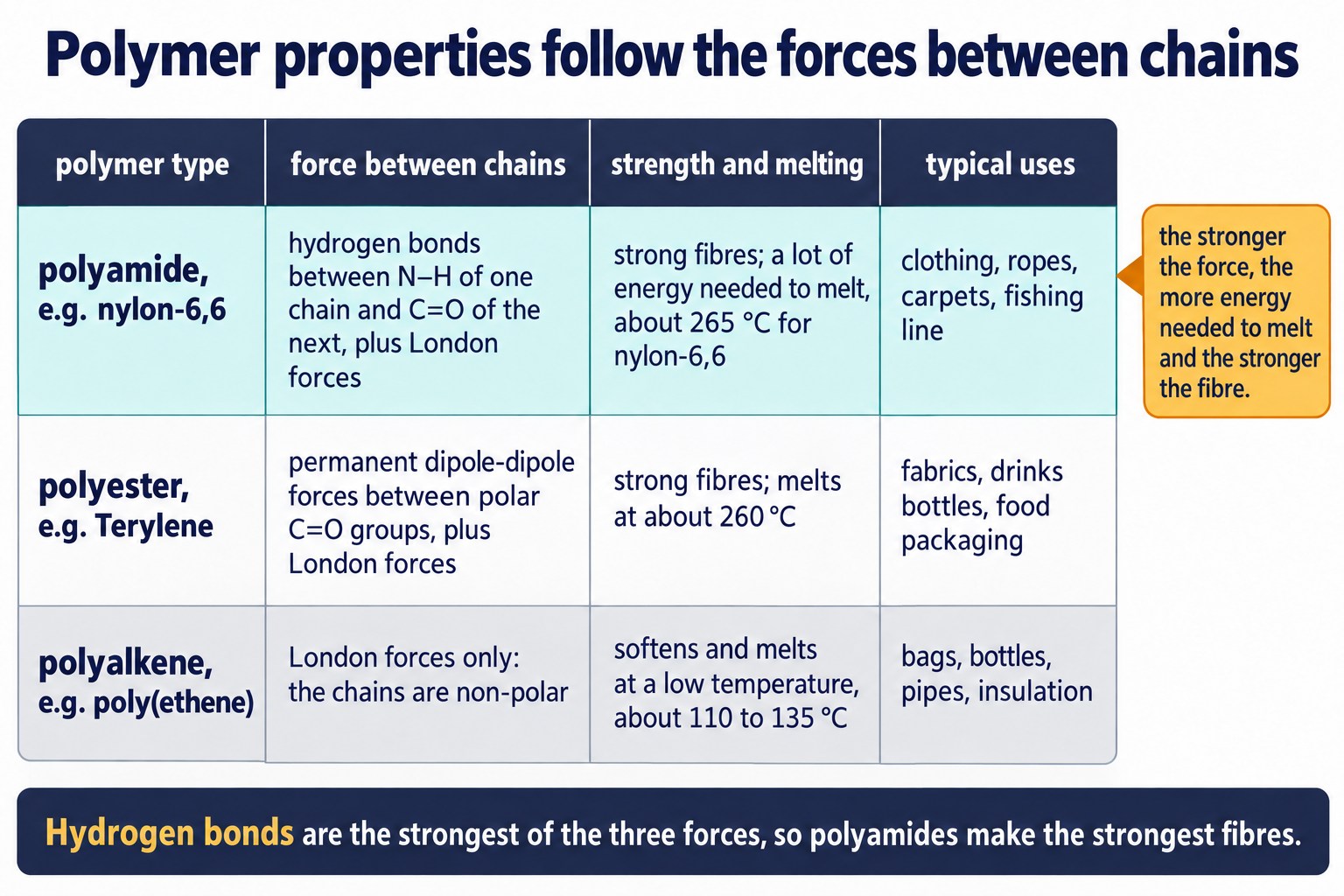
Hydrogen bonds, permanent dipoles, London forces: the stronger the force between chains, the higher the melting temperature and the stronger the fibre.
Exam focus: Name the force and say where it acts: hydrogen bonds between the N–H of one chain and the C=O of the next. Then link it to strength and melting temperature.
Quick Check: Why Does a Longer Monomer Lower the Melting Temperature?
Apply the forces between chains to a nylon with a longer carbon chain, then compare your answer with the model.
Common Exam Points
- Condensation polymerisation: monomers with two functional groups join and a small molecule (water) is lost for every link.
- Nylon-6,6: hexane-1,6-diamine + hexanedioic acid; repeat unit –NH(CH₂)₆NH–CO(CH₂)₄CO–; 2n H₂O lost.
- Nylon-6 from 6-aminohexanoic acid, and polypeptides from 2-amino acids: one monomer carrying both groups.
- Terylene: benzene-1,4-dicarboxylic acid + ethane-1,2-diol; repeat unit –CO–C₆H₄–CO–O–CH₂CH₂–O–.
- To find monomers, cut every ester or amide link and add back OH to the carbonyl carbon and H to the O or N.
- Draw a repeat unit with a bond at each end, and keep every carbon of each monomer.
- Polyamide chains are held by hydrogen bonds between N–H and C=O; polyesters by permanent dipole-dipole forces; polyalkenes by London forces only.
- A monomer with one C=C polymerises by addition; monomers with two functional groups polymerise by condensation.
FAQs
Use these quick answers to check addition versus condensation polymerisation, the naming of nylon-6,6 and nylon-6, drawing repeat units, finding monomers and why nylon forms strong fibres.
What is the difference between addition and condensation polymerisation?
Addition polymerisation joins alkene monomers through their C=C bonds and nothing is lost, so the polymer is the only product. Condensation polymerisation joins monomers with two functional groups, such as a diamine and a dicarboxylic acid, losing water or HCl at every link.
What do the numbers in nylon-6,6 mean?
The first 6 is the number of carbon atoms in the diamine, hexane-1,6-diamine, and the second the number in the dicarboxylic acid, hexanedioic acid. Nylon-6 has one number because it comes from a single monomer, 6-aminohexanoic acid, which carries both groups.
How do I draw the repeat unit of a polyamide from its monomers?
Remove OH from each COOH and H from each NH₂, then join C to N to form –CONH– links.
For butanedioic acid and propane-1,3-diamine the repeat unit is –CO(CH₂)₂CO–NH(CH₂)₃NH–. Put brackets round it with n outside; two water molecules are lost per repeat unit.
How do I find the monomers from a section of polymer chain?
Look for the links first: –CONH– means a polyamide, –COO– a polyester. Cut each link between C and N (or C and O), then add OH back to the C=O to make COOH and H back to the N or O, giving the monomers.
Why does nylon have a high melting point and form strong fibres?
The N–H and C=O groups of neighbouring chains form hydrogen bonds, strong intermolecular forces that hold the chains in line, so a lot of energy is needed to pull them apart. Polyesters have only permanent dipole-dipole forces and polyalkenes only London forces.

Copyright notice: This OLS revision content, including the explanations, layout, diagrams, tables and embedded learning structure, is authored for Online Learning System by Dr. Mohammed Al-Fatah. It may not be copied, reproduced, redistributed or adapted without written permission.
Keep this note — free
Save your progress across every OCR topic. A free account remembers which topics you have covered, saves your question scores, and syncs across your phone and laptop.
- Track every topic you have finished
- Keep your practice-question scores
- No payment, no card, free forever
Already registered? Log in