Polymers: Properties and Disposal
A concise revision guide to the properties and disposal of polymers: why polyalkenes are chemically inert and non-biodegradable, why polyesters and polyamides can be hydrolysed.
Before You Start
What happens to a polymer after use depends on the bonds in its chain. This page compares polyalkenes with polyesters and polyamides.
- Condensation polymers, their ester and amide links and the forces between their chains: Condensation Polymers: Polyamides and Polyesters.
- Addition polymers from alkenes: Polymerisation Reactions.
- The earlier treatment of waste polymers: Processing Waste Polymers.
- Hydrolysis of esters with acids and alkalis: Esters, Hydrolysis and Polyesters.
GCSE Recap: Monomers and Plastics
Three quick questions on the GCSE ideas this page builds on.
Polyesters and Polyamides Can Be Hydrolysed
Condensation polymers carry polar links in the backbone: the ester link –COO– and the amide link –CONH–. These can be hydrolysed, so the chain breaks back into its monomers.
- Polyalkenes, by contrast, have only strong non-polar C–C and C–H bonds and cannot be hydrolysed: they are chemically inert and persist in the environment.
- The C=O, C–O and C–N bonds are polar. The carbonyl carbon is δ+ and is attacked by water or by hydroxide ions.
- Hydrolysis is slow in water alone but fast with hot aqueous acid or alkali.
- Enzymes from bacteria and fungi catalyse the same hydrolysis in soil or compost, so polyesters and polyamides are biodegradable.
- The same chemistry breaks down proteins and the ester links of fats in digestion.
| Polyalkenes | Polyesters and polyamides | |
|---|---|---|
| bonds in the chain | C–C and C–H only | ester or amide links as well |
| polarity | non-polar | polar C=O, C–O and C–N |
| attacked by water or OH⁻? | no | yes, at the δ+ carbonyl carbon |
| hydrolysed by acid or alkali? | no | yes |
| biodegradable? | no | yes |
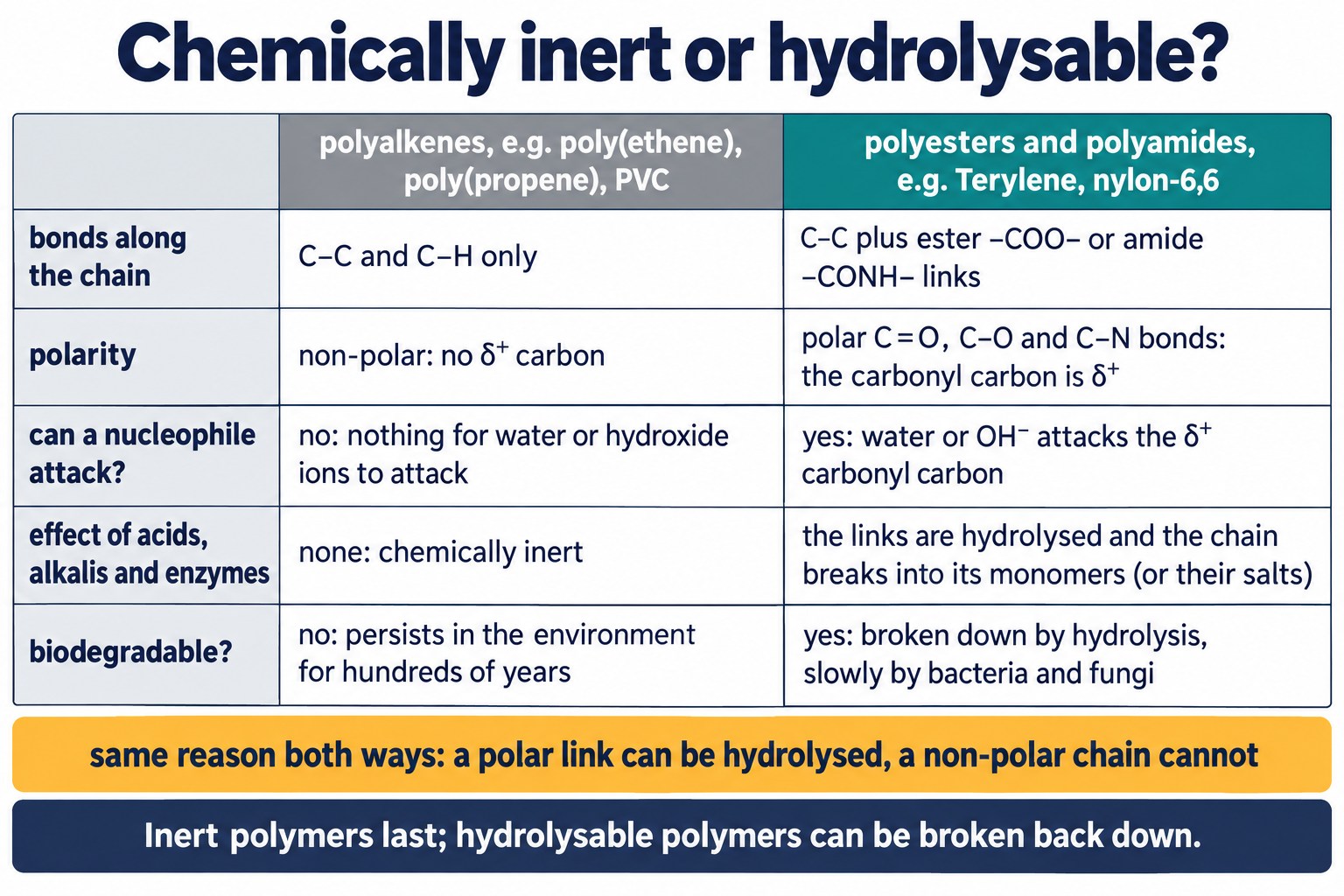
Non-polar C–C and C–H bonds give an inert chain; polar ester and amide links give a chain that water and hydroxide ions can attack.
Exam focus: The explanation is the same both ways: polar links with a δ+ carbon can be attacked and hydrolysed; a non-polar carbon chain cannot.
Check: Inert or Hydrolysable?
Use the polarity of the bonds in a polymer chain to decide whether it resists attack or can be broken down.
Quick Check: Which Chains Can Be Hydrolysed?
Each repeat unit is heated with aqueous sodium hydroxide. Decide what happens to the backbone of the polymer.
Hydrolysis Equations
Hydrolysis reverses the condensation. With acid the monomers are recovered as the acid and the alcohol or the amine salt; with alkali the carboxylic acid ends up as its salt.
Polyesters
- Acid hydrolysis: heat the polyester with dilute H₂SO₄ or HCl under reflux. Each ester link breaks to give the dicarboxylic acid and the diol.
- Terylene → benzene-1,4-dicarboxylic acid, HOOC–C₆H₄–COOH, + ethane-1,2-diol, HOCH₂CH₂OH.
- Base hydrolysis: heat with NaOH(aq) under reflux. The acid forms as its sodium salt and the diol is released.
- Terylene + 2n NaOH → sodium benzene-1,4-dicarboxylate, Na⁺⁻OOC–C₆H₄–COO⁻Na⁺, + ethane-1,2-diol.
Polyamides
- Acid hydrolysis: heat with dilute HCl under reflux. The dicarboxylic acid is released and the diamine is protonated to its salt.
- Nylon-6,6 → hexanedioic acid, HOOC(CH₂)₄COOH, + hexane-1,6-diammonium chloride, ⁺H₃N(CH₂)₆NH₃⁺ 2Cl⁻.
- Base hydrolysis: heat with NaOH(aq) under reflux. The acid forms as its sodium salt and the diamine is released as the free amine.
- Nylon-6,6 + 2n NaOH → sodium hexanedioate, Na⁺⁻OOC(CH₂)₄COO⁻Na⁺, + hexane-1,6-diamine, H₂N(CH₂)₆NH₂.
Worked example
Question. A polyester has the repeat unit –O–CH₂CH₂–O–CO–(CH₂)₂–CO–. Give the products of its hydrolysis with hot sodium hydroxide solution.
Answer. Ethane-1,2-diol, HOCH₂CH₂OH, and sodium butanedioate, Na⁺⁻OOC(CH₂)₂COO⁻Na⁺.
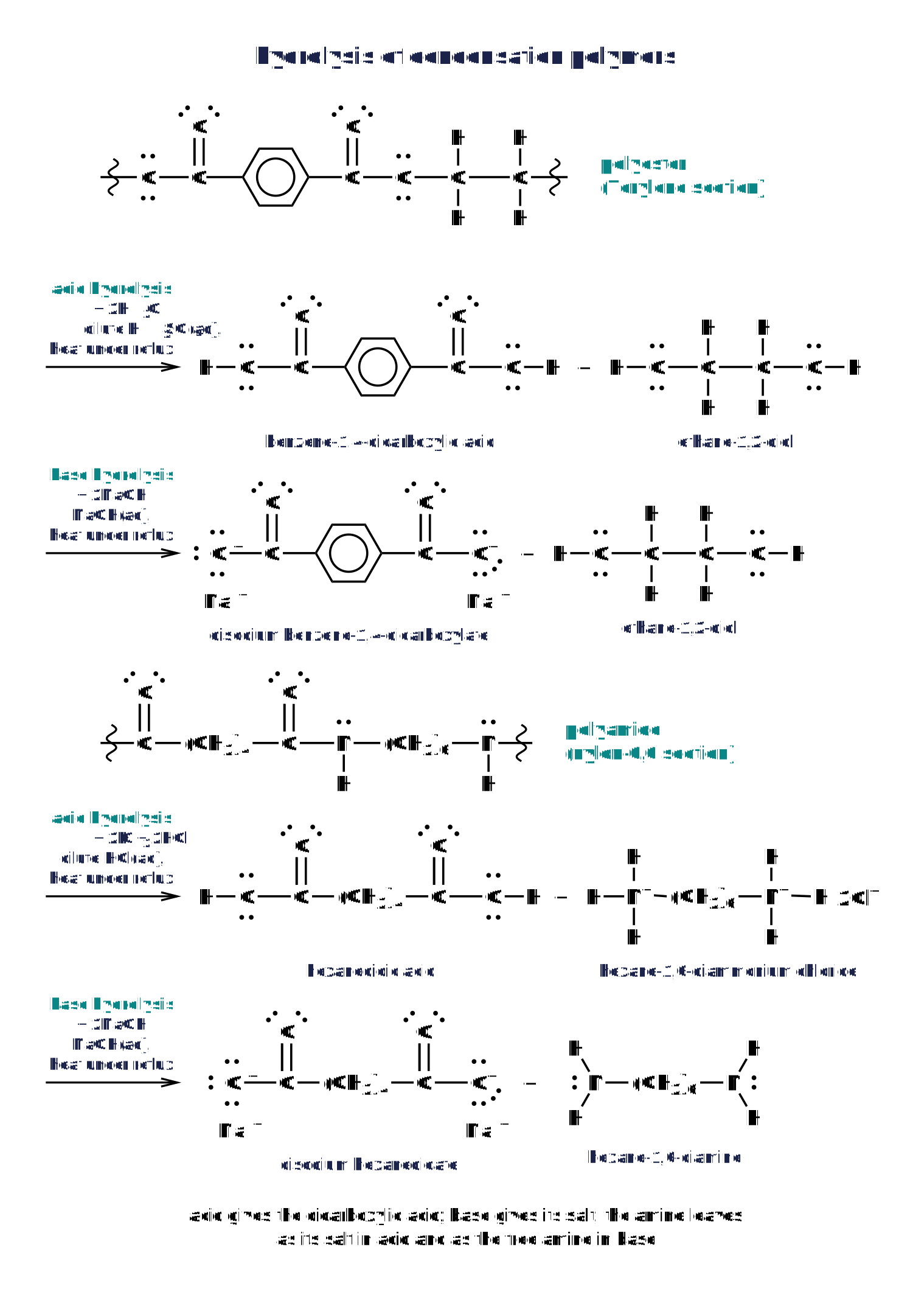
Acid and base hydrolysis of a Terylene section and of a nylon-6,6 section: the acid gives the dicarboxylic acid, the base gives its salt.
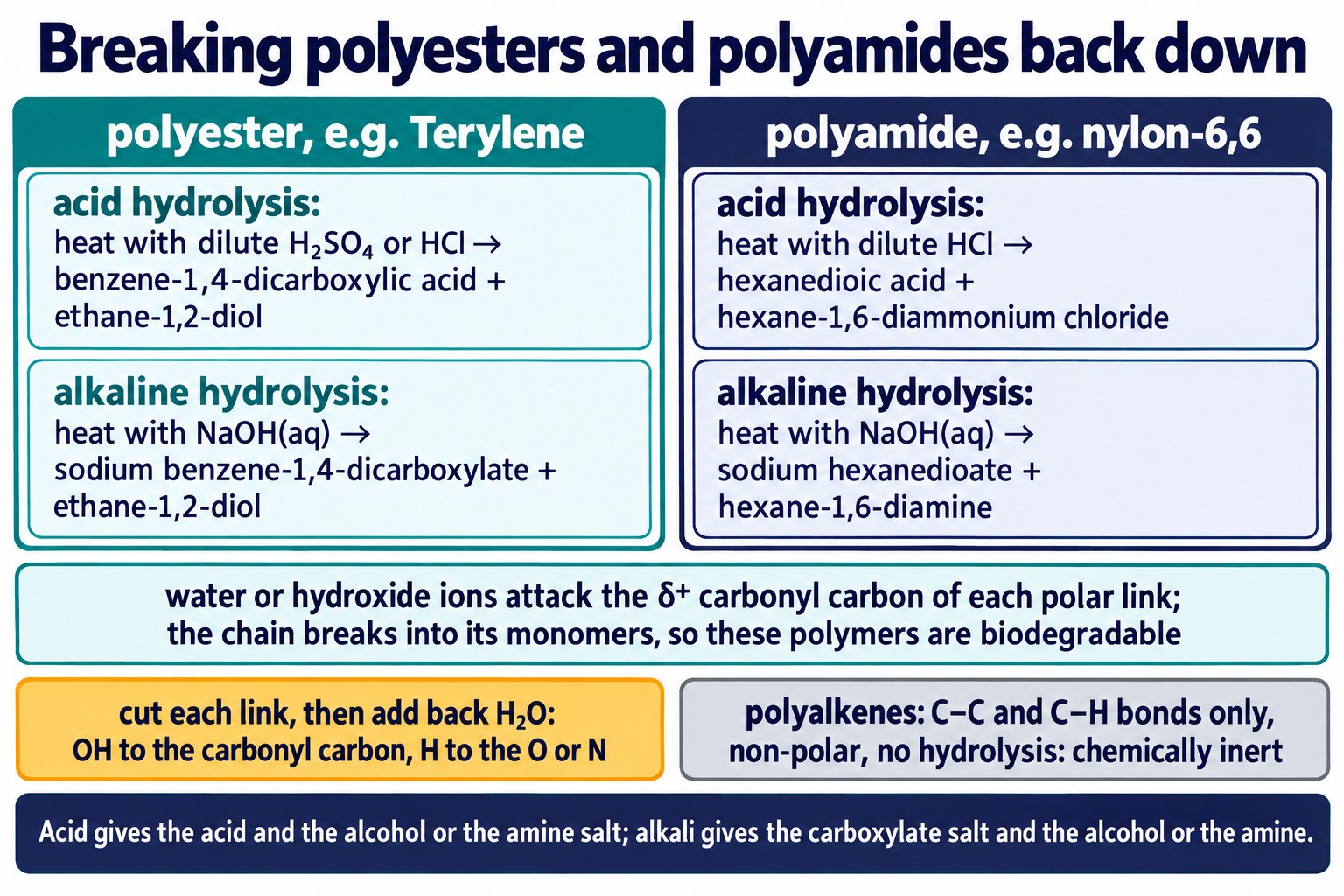
Conditions and products of acid and alkaline hydrolysis for a polyester and a polyamide, and why polyalkenes are untouched.
Remember: Acid: dicarboxylic acid + diol, or dicarboxylic acid + diammonium salt. Alkali: dicarboxylate salt + diol, or dicarboxylate salt + diamine.
Check: Breaking Polymers Down
Decide which polymers can be broken back down to small molecules and which persist, and give the reasons.
Quick Check: Hydrolysing a New Polyamide
Work out the products for a polyamide that is new to this page.
Common Exam Points
- Polyalkenes are chemically inert because their C–C and C–H bonds are strong and non-polar: no δ+ carbon for a nucleophile to attack.
- Polyesters and polyamides have polar C=O, C–O and C–N bonds; water or OH⁻ attacks the δ+ carbonyl carbon, so they can be hydrolysed.
- Hydrolysable polymers are biodegradable; polyalkenes are not.
- Acid hydrolysis gives the dicarboxylic acid with the diol or the diammonium salt; alkaline hydrolysis gives the carboxylate salt with the diol or the diamine.
- Conditions: heat under reflux with dilute acid or with NaOH(aq).
- Explain every answer through the polarity of the bonds in the chain, not through the name of the polymer alone.
FAQs
Use these quick answers to check why polyalkenes are chemically inert, why polyesters and polyamides can be hydrolysed and the products of their hydrolysis.
Why are polyalkenes not biodegradable?
Their backbone is made of strong, non-polar C–C and C–H bonds.
There is no δ+ carbon for a nucleophile such as water or a hydroxide ion to attack, so acids, alkalis and bacteria cannot break the chain. Poly(ethene) and PVC therefore persist for many years.
Why can polyesters and polyamides be hydrolysed?
The ester and amide links contain a polar C=O: the carbonyl carbon is δ+ and open to attack by water, hydroxide ions or acid. Hydrolysis breaks the link and reverses the condensation reaction, so these polymers are biodegradable and bacteria in soil break them down.
What are the products of hydrolysing a polyester?
With hot dilute acid the ester links break to give the dicarboxylic acid and the diol: Terylene gives benzene-1,4-dicarboxylic acid and ethane-1,2-diol. With hot sodium hydroxide the dicarboxylate salt, sodium benzene-1,4-dicarboxylate, forms with the diol.
How is hydrolysing a polyamide different from hydrolysing a polyester?
A polyamide link gives a carboxylic acid group and an amine group. In acid the amine is protonated, so the products are the dicarboxylic acid and the diammonium salt; in alkali they are the dicarboxylate salt and the diamine. A polyester gives a diol instead.
Why is it useful that polyesters can be hydrolysed?
When polyester items are no longer needed they can be broken down by hydrolysis into their monomers, which can be purified and polymerised again, or they can be left to biodegrade. Polyalkenes offer neither route, so a hydrolysable polymer is easier to dispose of responsibly.

Copyright notice: This OLS revision content, including the explanations, layout, diagrams, tables and embedded learning structure, is authored for Online Learning System by Dr. Mohammed Al-Fatah. It may not be copied, reproduced, redistributed or adapted without written permission.
Keep this note — free
Save your progress across every OCR topic. A free account remembers which topics you have covered, saves your question scores, and syncs across your phone and laptop.
- Track every topic you have finished
- Keep your practice-question scores
- No payment, no card, free forever
Already registered? Log in