Esters, Hydrolysis and Polyesters
A concise revision guide to esters: naming and drawing them, making them, and hydrolysis in acidic and alkaline solution, with the formation of polyesters by condensation polymerisation.
- 6.1.3(c)(i)
- 6.1.3(d)(i)
- 6.1.3(d)(ii)
What these spec points say
- 6.1.3(c)(i) esterification of carboxylic acids with alcohols in the presence of an acid catalyst (e.g. concentrated H2SO4)
- 6.1.3(d)(i) hydrolysis of esters in hot aqueous acid to form carboxylic acids and alcohols
- 6.1.3(d)(ii) hydrolysis of esters in hot aqueous alkali to form carboxylate salts and alcohols
Hydrolysing an Ester: Acid or Alkali
Follow every atom as ethyl ethanoate is split by water with an acid catalyst, which reaches an equilibrium, and by sodium hydroxide, which goes to completion; then turn the salt back into the acid.
Making a Polyester: Terylene
Watch benzene-1,4-dicarboxylic acid and ethane-1,2-diol join end to end, losing a water molecule at every ester link, find the repeat unit, then see the chain hydrolysed back to its monomers.
© Dr. Mohammed Al-Fatah – onlinelearningsystem.net
© Dr. Mohammed Al-Fatah – onlinelearningsystem.net
Before You Start
Esters are made from carboxylic acids (see Reactions of Carboxylic Acids) and from acyl chlorides (see Acyl Chlorides). This page covers naming them and breaking them down again.
GCSE Recap: Where Esters Come From
Three quick questions on the GCSE ideas this page builds on.
What an Ester Is and How to Name It
An ester contains the ester link, –COO–: a C=O with a second oxygen joining the same carbon to another carbon chain. The general formula is RCOOR′.
Naming
- Find the chain joined to the single-bonded oxygen. It came from the alcohol and gives the first word, ending in -yl.
- Find the chain that contains the C=O carbon. It came from the acid and gives the second word, ending in -oate.
- Count the C=O carbon as part of the acid chain.
| Ester | Structural formula | Acid | Alcohol |
|---|---|---|---|
| methyl ethanoate | CH₃COOCH₃ | ethanoic acid | methanol |
| ethyl ethanoate | CH₃COOCH₂CH₃ | ethanoic acid | ethanol |
| ethyl propanoate | CH₃CH₂COOCH₂CH₃ | propanoic acid | ethanol |
| propyl methanoate | HCOOCH₂CH₂CH₃ | methanoic acid | propan-1-ol |
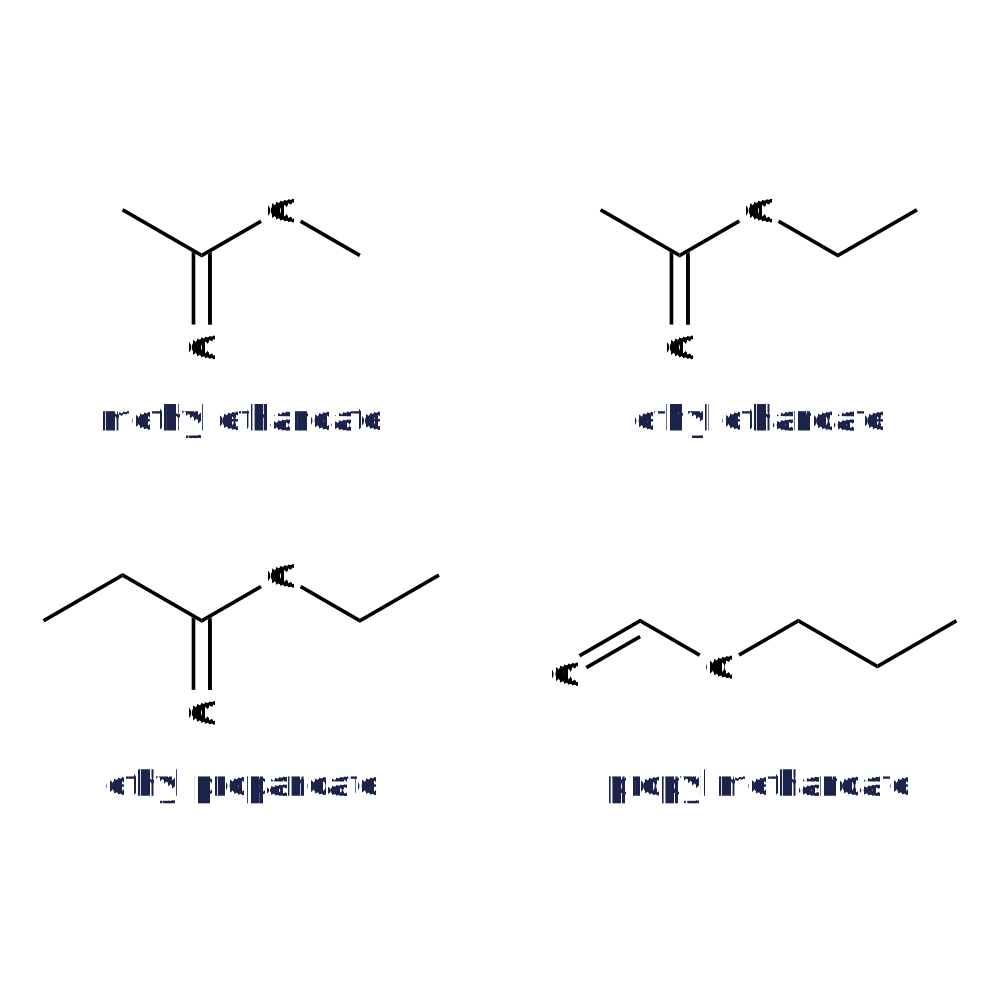
Skeletal formulae of four esters. In each, the part containing C=O comes from the carboxylic acid and the part joined to the single-bonded oxygen comes from the alcohol.
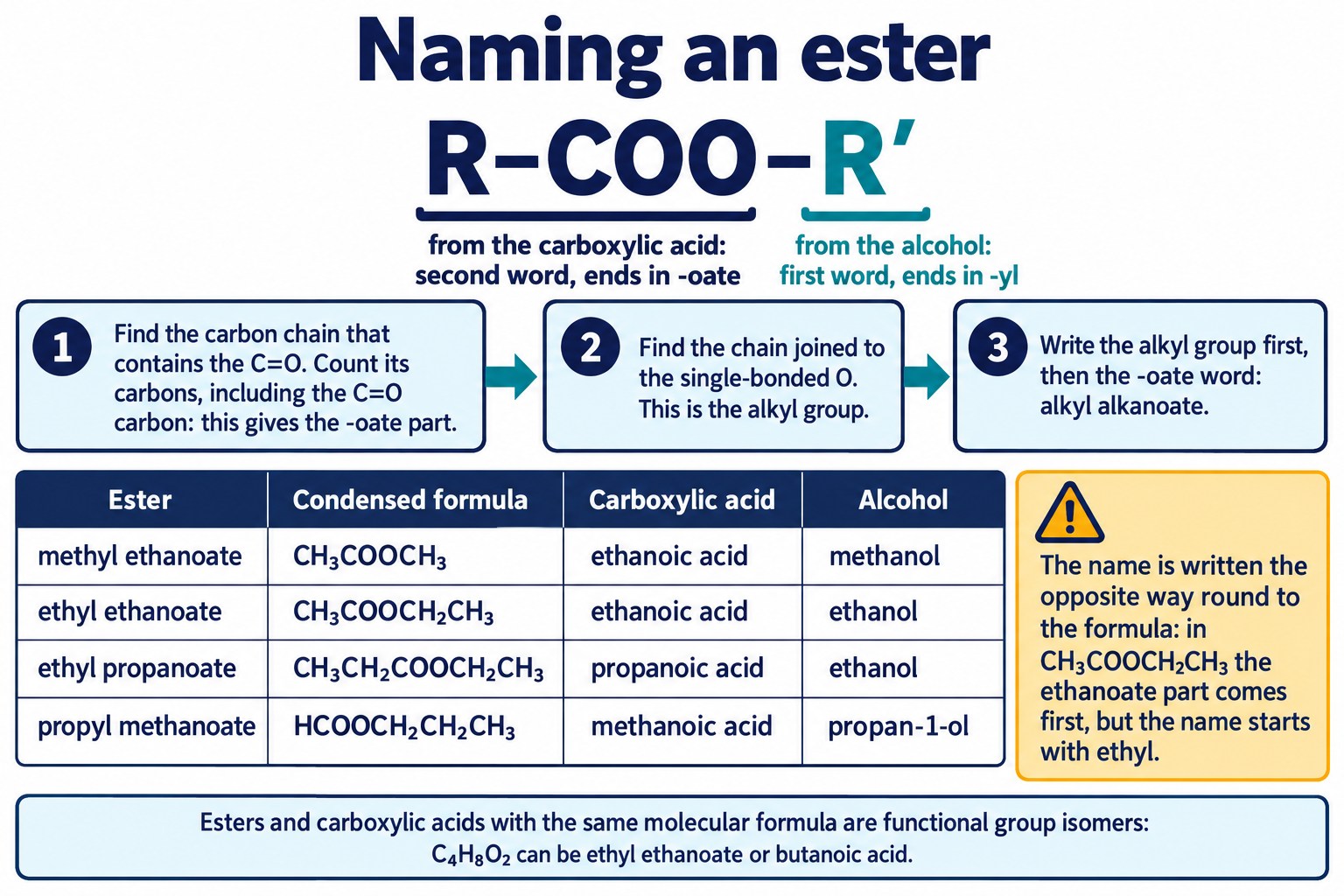
Naming an ester in three steps: the alkyl group from the alcohol is written first, then the -oate word from the acid, with four examples.
Properties
- Ester molecules have no O–H group, so they cannot hydrogen bond with each other.
- Their boiling points are lower than those of the isomeric carboxylic acids: they are volatile liquids.
- Many have sweet, fruity smells.
- Esters and carboxylic acids are isomers: C₄H₈O₂ can be ethyl ethanoate or butanoic acid.
Remember: The name runs opposite to the formula. In CH₃COOCH₂CH₃ the acid part, CH₃COO, is written first, but the name starts with the alcohol part: ethyl ethanoate.
Check: Naming and Drawing Esters
Name esters from their formulae, draw esters from their names and identify the acid and alcohol each is made from, using esters not used on this page.
Making Esters
| Reagents | Conditions | Equation | Comment |
|---|---|---|---|
| carboxylic acid + alcohol | concentrated H₂SO₄ catalyst, heat | CH₃COOH + CH₃CH₂OH ⇌ CH₃COOCH₂CH₃ + H₂O | reversible, slow |
| acyl chloride + alcohol | room temperature | CH₃COCl + CH₃CH₂OH → CH₃COOCH₂CH₃ + HCl | fast, goes to completion |
| acid anhydride + alcohol | warm | (CH₃CO)₂O + CH₃CH₂OH → CH₃COOCH₂CH₃ + CH₃COOH | goes to completion, no HCl |
Every route joins an acyl group, RCO–, to the oxygen atom of an alcohol. The first is a condensation: two molecules join and water is lost.
Hydrolysis of Esters
Hydrolysis is the breaking of a bond by reaction with water. In an ester the bond between the C=O carbon and the single-bonded oxygen breaks, giving back the acid part and the alcohol.
Acid hydrolysis
Heat the ester under reflux with a dilute acid, such as dilute H₂SO₄ or HCl. The acid is a catalyst.
CH₃COOCH₂CH₃ + H₂O ⇌ CH₃COOH + CH₃CH₂OH
- This is the reverse of esterification, so it is reversible and does not go to completion.
- A large excess of water, from the dilute acid, pushes the equilibrium towards the products.
Alkaline hydrolysis
Heat the ester under reflux with aqueous sodium hydroxide. The products are the carboxylate salt and the alcohol.
CH₃COOCH₂CH₃ + NaOH → CH₃COONa + CH₃CH₂OH
- The reaction goes to completion: the carboxylate ion does not react with the alcohol, so there is no reverse reaction.
- Adding a dilute strong acid afterwards gives the carboxylic acid: CH₃COONa + HCl → CH₃COOH + NaCl.
| Acid hydrolysis | Alkaline hydrolysis | |
|---|---|---|
| Reagent | dilute H₂SO₄ or HCl (catalyst) | NaOH(aq) (a reactant) |
| Conditions | heat under reflux | heat under reflux |
| Products | carboxylic acid + alcohol | carboxylate salt + alcohol |
| Reversible? | yes | no: goes to completion |
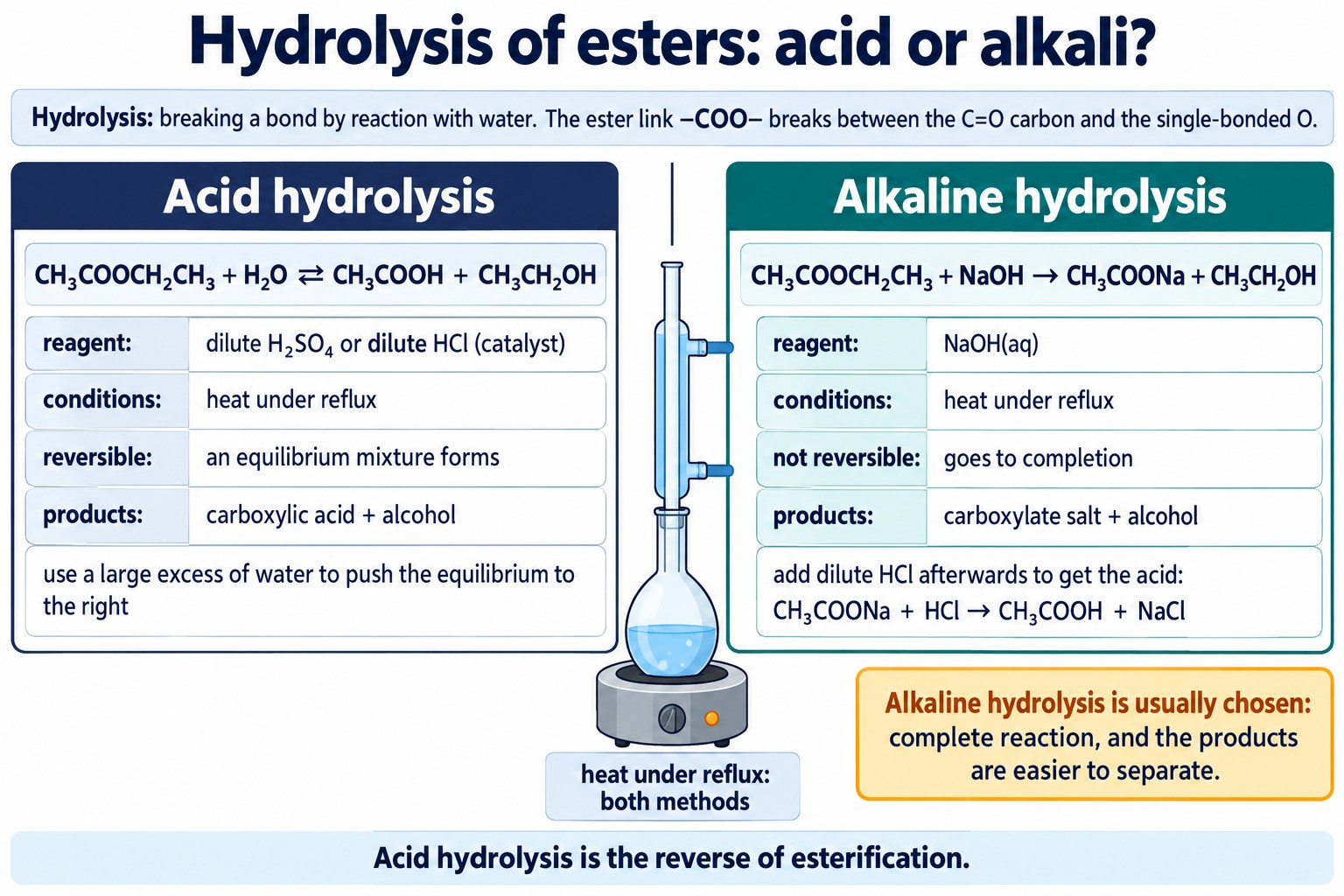
Acid and alkaline hydrolysis of ethyl ethanoate compared: reagents, conditions, products and whether the reaction is reversible.
Worked example
Methyl propanoate is heated under reflux with aqueous potassium hydroxide. Give the equation and name the products.
Step 1. Split the ester at the ester link: CH₃CH₂CO– from the acid and –OCH₃ from the alcohol.
Answer. CH₃CH₂COOCH₃ + KOH → CH₃CH₂COOK + CH₃OH
Exam focus: Acid hydrolysis: reversible, gives the acid. Alkaline hydrolysis: complete, gives the salt. Write a reversible arrow for the first and a single arrow for the second.
Check: Hydrolysis of Esters
Predict the products of acid and alkaline hydrolysis, write the equations and compare the two methods, for esters not used on this page.
Quick Check: Following a Hydrolysis with Numbers
Work out each step on paper, then flip the card to check.
Polyesters: Condensation Polymerisation
In condensation polymerisation monomers join together and a small molecule, such as water or HCl, is lost each time a link forms. A polyester has its monomers joined by ester links.
- One monomer is a diol, with two –OH groups.
- The other is a dicarboxylic acid, with two –COOH groups, or a dioyl dichloride, with two –COCl groups.
- Each end of every monomer reacts, so the chain keeps growing in both directions.
- A dicarboxylic acid releases water at each link; a dioyl dichloride releases HCl.
Terylene (PET)
Terylene is made from ethane-1,2-diol, HOCH₂CH₂OH, and benzene-1,4-dicarboxylic acid, HOOCC₆H₄COOH.
n HOCH₂CH₂OH + n HOOCC₆H₄COOH → H–[OCH₂CH₂OOCC₆H₄CO]ₙ–OH + (2n − 1) H₂O
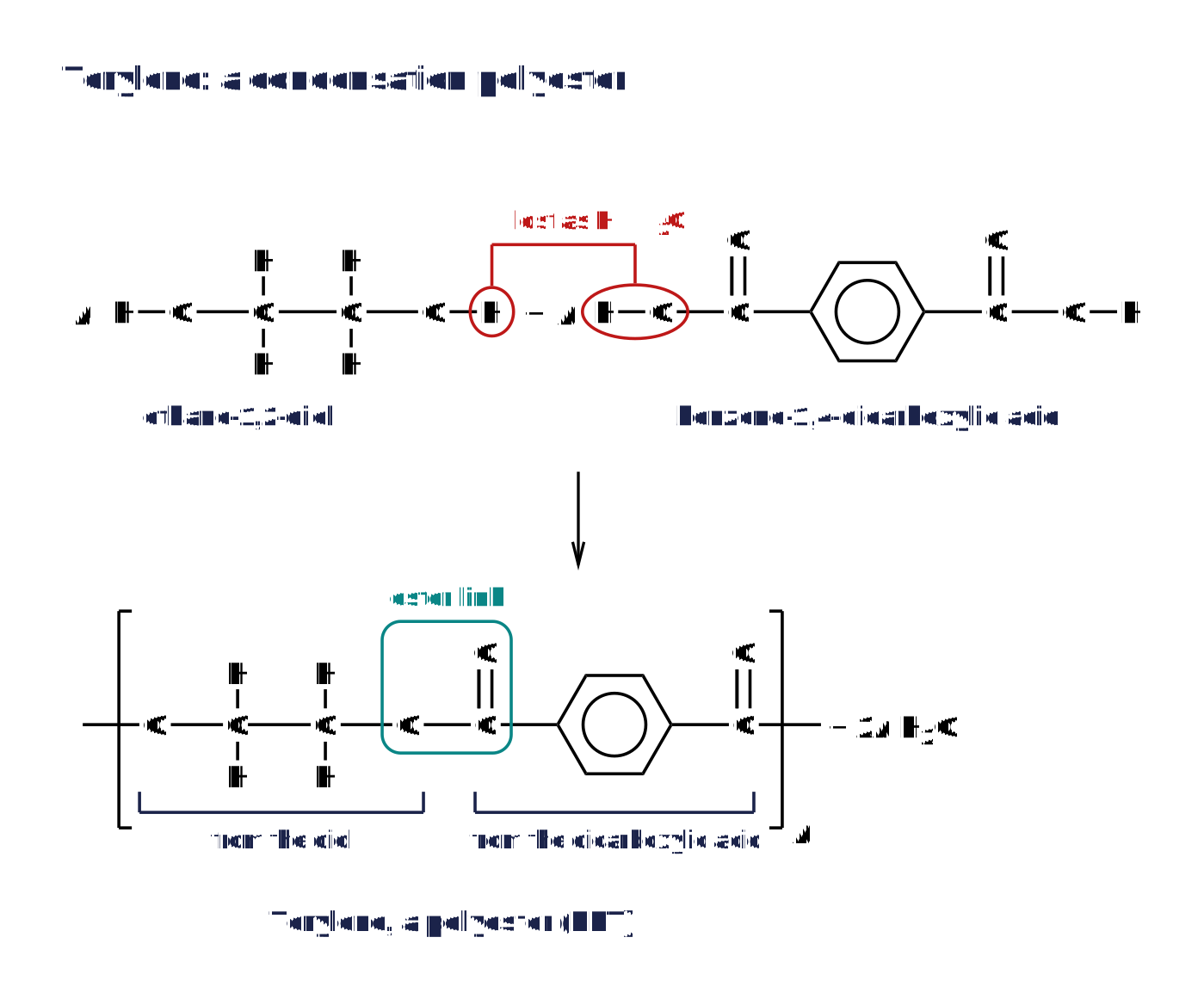
The two monomers of Terylene and its repeat unit. Each ester link forms when an –OH group and a –COOH group react and one molecule of water is lost.
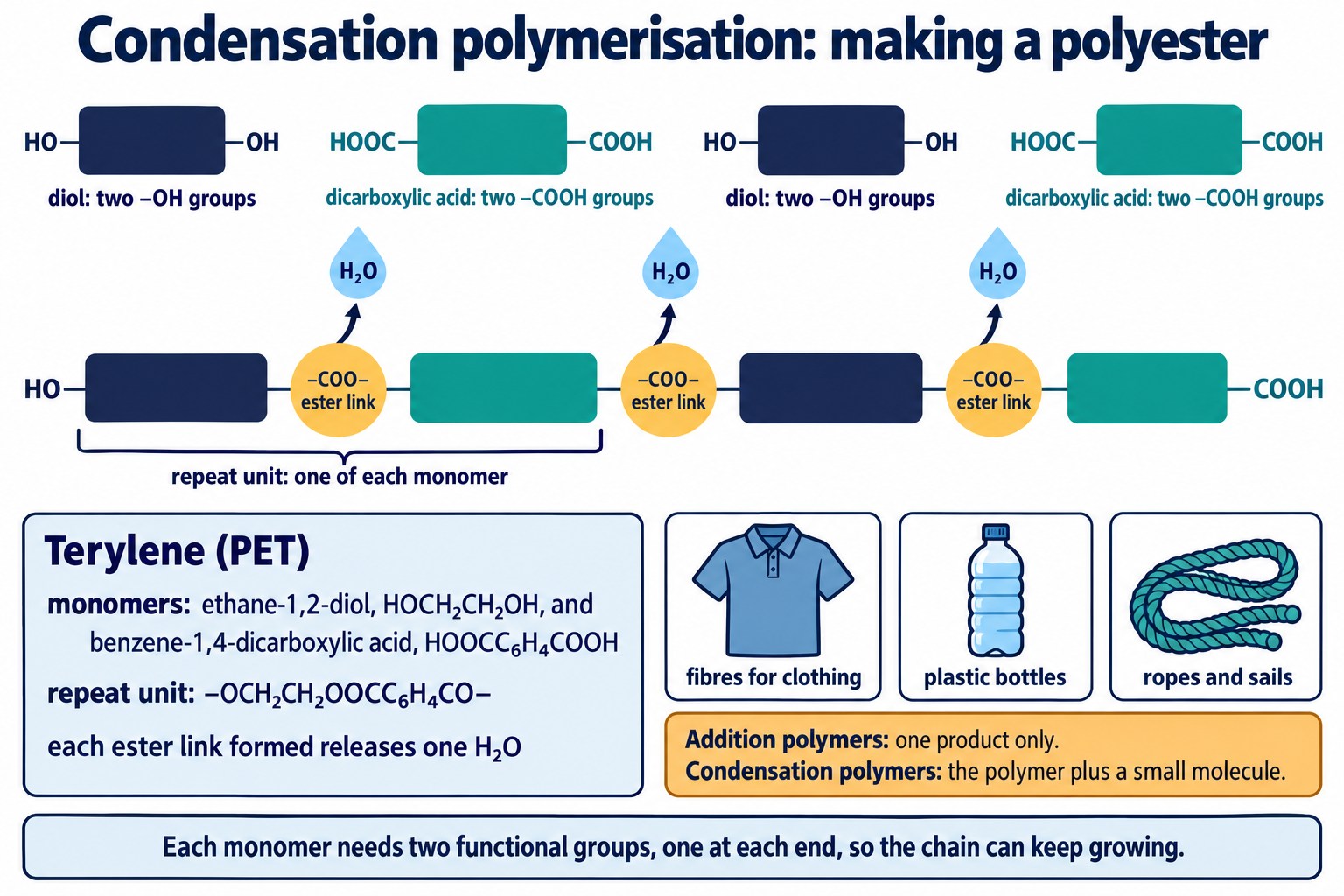
Condensation polymerisation shown with blocks: diol and dicarboxylic acid monomers join alternately through ester links, losing one water molecule at every link.
Worked example
Draw the repeat unit of the polyester formed from propane-1,3-diol and butanedioic acid.
Step 1. Write the monomers: HOCH₂CH₂CH₂OH and HOOCCH₂CH₂COOH.
Step 2. Remove H from each –OH of the diol and –OH from each –COOH of the acid, then join them through an ester link.
Answer. Repeat unit: –OCH₂CH₂CH₂OOCCH₂CH₂CO–, with a trailing bond at each end.
One monomer with both groups
A hydroxycarboxylic acid has an –OH group and a –COOH group in the same molecule, so it can polymerise with itself. 2-Hydroxypropanoic acid (lactic acid), CH₃CH(OH)COOH, gives poly(lactic acid).
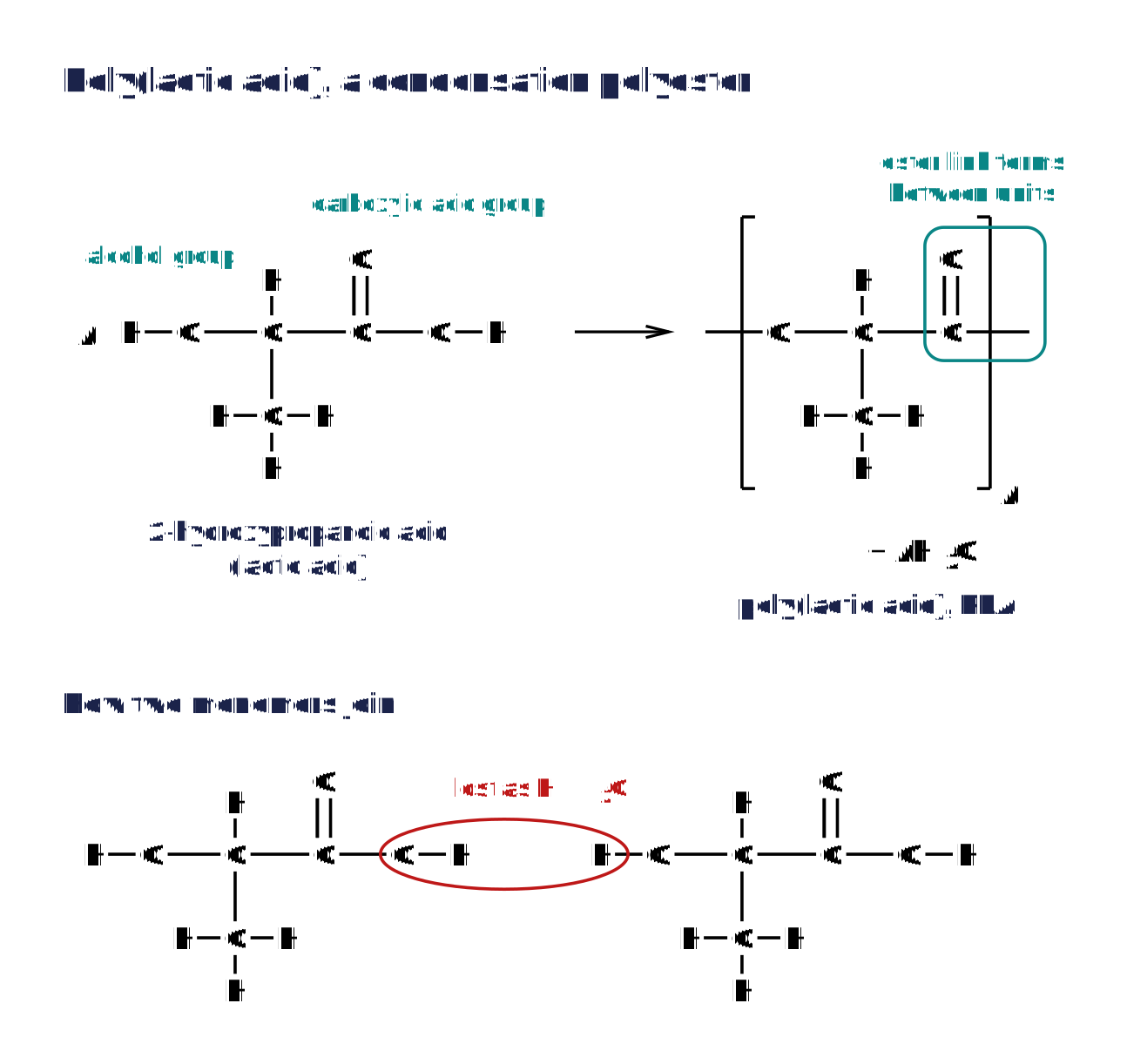
Poly(lactic acid) from one monomer: the –OH group of one 2-hydroxypropanoic acid molecule reacts with the –COOH group of the next, losing water.
Hydrolysis of polyesters
- The ester links of a polyester can be hydrolysed, like those of a simple ester.
- Acid hydrolysis (hot aqueous acid) gives the diol and the dicarboxylic acid.
- Base hydrolysis (hot aqueous alkali) gives the diol and the dicarboxylate salt, for example ⁻OOCC₆H₄COO⁻ with Na⁺ ions.
- This is why polyesters can break down in the environment, unlike addition polymers.
Key idea: To find a repeat unit, remove H from each –OH and OH from each –COOH, then join the monomers. To find the monomers, break each ester link and add the H and OH back.
Quick Check: Predicting a New Polyester
Apply the repeat unit method to a monomer pair that is new to this page.
Common Exam Points
Say
- “Heat under reflux with dilute acid” or “heat under reflux with aqueous sodium hydroxide”.
- “Alkaline hydrolysis goes to completion and gives the carboxylate salt.”
- “A condensation polymer forms with the loss of a small molecule such as water.”
Do not say
- “Alkaline hydrolysis gives the carboxylic acid” (it gives the salt; acidify to obtain the acid).
- “Ethyl ethanoate is made from ethanol and ethanol” (ethyl from ethanol, ethanoate from ethanoic acid).
- “The repeat unit has a double bond” or drawing it without trailing bonds.
Watch for
- Reversed formulae: CH₃CH₂OOCCH₃ is still ethyl ethanoate. Find the C=O to find the acid part.
- Methanoates: HCOO– has a hydrogen, not a carbon chain, on the C=O carbon.
- Repeat units: one of each monomer, ester link in the middle, brackets and n.
Check: Esters From Start to Finish
Link the formation, naming and hydrolysis of esters: identify unknown esters from their hydrolysis products and plan how to make and break them, with compounds not used on this page.
FAQs
Use these quick answers to check esters, their hydrolysis and polyesters.
How do I name an ester?
The first word comes from the alcohol and the second from the acid, ending in -oate. CH₃COOCH₂CH₃, made from ethanoic acid and ethanol, is ethyl ethanoate. Take care: the formula is often written with the acid part first.
What is the difference between acid and alkaline hydrolysis of an ester?
Heating under reflux with dilute acid is reversible and gives the carboxylic acid and the alcohol. Heating under reflux with dilute alkali, such as NaOH(aq), goes to completion and gives the carboxylate salt and the alcohol.
Why does alkaline hydrolysis go to completion?
The carboxylic acid is converted into its carboxylate ion, such as CH₃COO⁻, which does not react with the alcohol. The reverse reaction cannot happen, so no equilibrium is set up. Adding a strong acid afterwards releases the carboxylic acid.
How is a polyester formed?
A diol and a dicarboxylic acid join by condensation polymerisation: each ester link forms with the loss of one water molecule. Terylene (PET) is made from ethane-1,2-diol and benzene-1,4-dicarboxylic acid.
How do I draw the repeat unit of a polyester?
Join one of each monomer through an ester link, COO, removing OH from the acid group and H from the alcohol group. Leave trailing bonds at both ends, put the unit in brackets and add n.

Copyright notice: This OLS revision content, including the explanations, layout, diagrams, tables and embedded learning structure, is authored for Online Learning System by Dr. Mohammed Al-Fatah. It may not be copied, reproduced, redistributed or adapted without written permission.
Keep this note — free
Save your progress across every OCR topic. A free account remembers which topics you have covered, saves your question scores, and syncs across your phone and laptop.
- Track every topic you have finished
- Keep your practice-question scores
- No payment, no card, free forever
Already registered? Log in