Carbon–Carbon Bond Formation
A concise revision guide to lengthening a carbon chain in synthesis: forming C–C≡N by nucleophilic substitution of a haloalkane with cyanide and by nucleophilic addition of HCN to a carbonyl compound, converting the nitrile to an amine or a carboxylic acid, and adding a carbon chain to a benzene ring by Friedel–Crafts alkylation and acylation.
Before You Start
Every reaction on this page is one you have met before. This page puts them to a new use: making the carbon chain longer.
- A haloalkane has a δ+ carbon that nucleophiles attack: nucleophilic substitution. See Nucleophilic Substitution Reactions.
- A carbonyl carbon is δ+ too, so HCN adds across C=O: nucleophilic addition. See Reduction and Nucleophilic Addition.
- Nitriles are reduced to primary amines, R–C≡N + 4[H] → R–CH₂NH₂: see Preparing Amines.
- A benzene ring gains a carbon group by Friedel–Crafts alkylation or acylation: see Friedel–Crafts Alkylation and Acylation.
- The functional group tests and the spectra that identify the products: Identifying Functional Groups by Chemical Tests and Deducing Formulae from Analytical Data.
Why Chain Length Matters
Most reactions in organic chemistry change the functional group but keep the carbon skeleton. A target molecule often has more carbons than the starting material, so one step must make a new C–C bond.
- Converting a group (alcohol → aldehyde → acid, or halide → alcohol → aldehyde) never changes the number of carbons.
- Adding one carbon needs a carbon nucleophile: the cyanide ion, CN⁻.
- Adding a carbon chain to a benzene ring needs an electrophilic carbon: Friedel–Crafts alkylation or acylation with an AlCl₃ halogen carrier.
- Planning when to add the carbon is part of every route: see Planning a Synthetic Route.
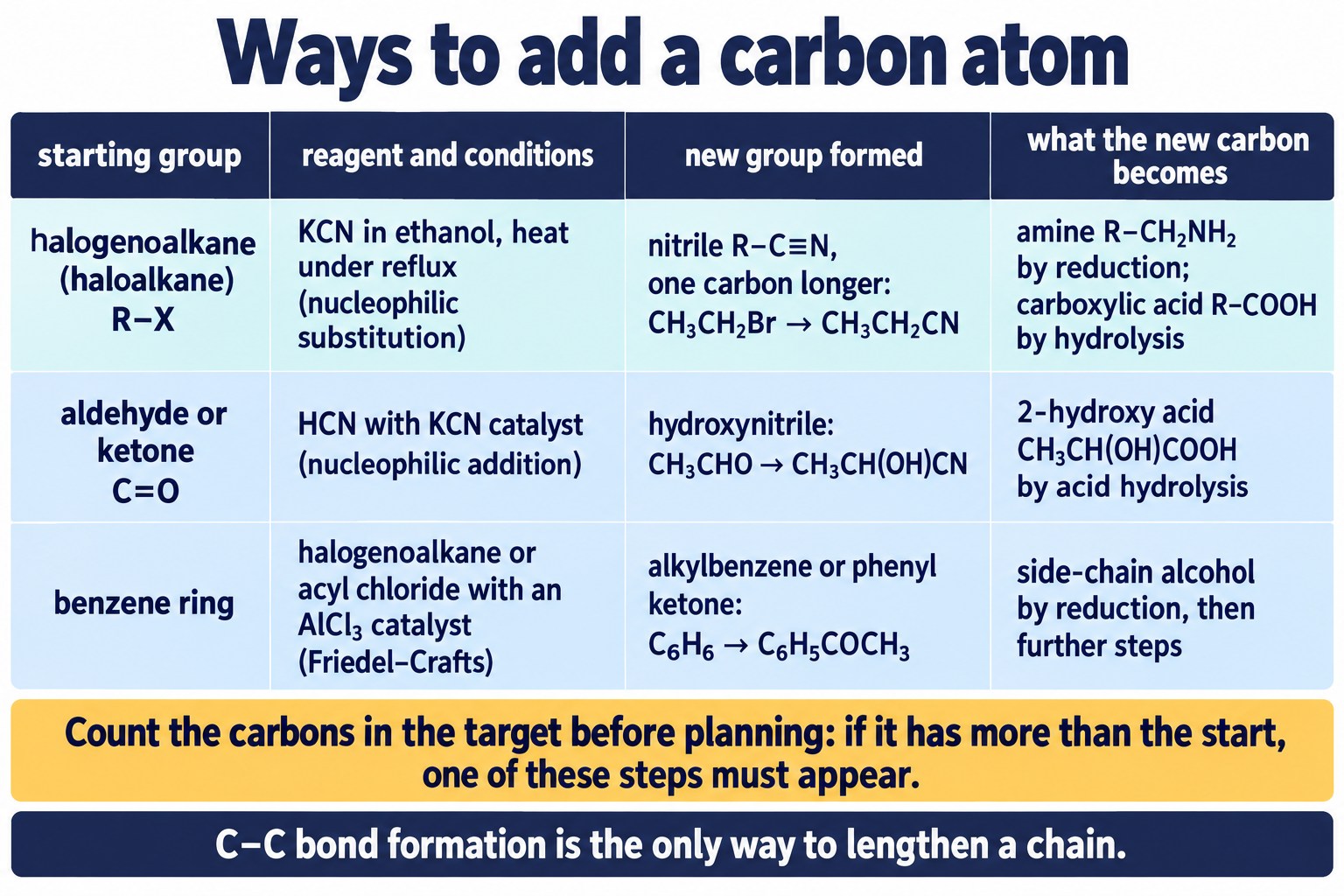
The three ways to add a carbon atom, the conditions for each and what the new carbon can be turned into afterwards.
Exam focus: Count the carbons in the starting material and in the target before you plan anything. A difference of one carbon points to a nitrile step.
The Nitrile Route from a Haloalkane
The cyanide ion is a nucleophile with its lone pair on carbon. It substitutes the halogen of a haloalkane, and the new carbon arrives already bonded to the chain.
| Detail | |
|---|---|
| reagent | potassium cyanide, KCN |
| conditions | dissolved in ethanol, heated under reflux |
| equation | CH₃CH₂Br + CN⁻ → CH₃CH₂CN + Br⁻ (bromoethane → propanenitrile) |
| type of reaction | nucleophilic substitution |
| carbons | two in bromoethane, three in propanenitrile: one added |
- Ethanol is the solvent: in water the hydroxide ions present would compete and give the alcohol.
- Name the nitrile from the whole chain including the C≡N carbon: CH₃CH₂CN is propanenitrile, not ethyl cyanide.
- The C≡N group is then a branching point: it can become an amine or a carboxylic acid (below).
The Mechanisms: Cyanide as a Nucleophile
Both C–C≡N bond-forming reactions start with the same curly arrow: from the lone pair on the carbon of CN⁻ to a δ+ carbon.
Nucleophilic substitution of bromoethane
Nucleophilic addition to ethanal
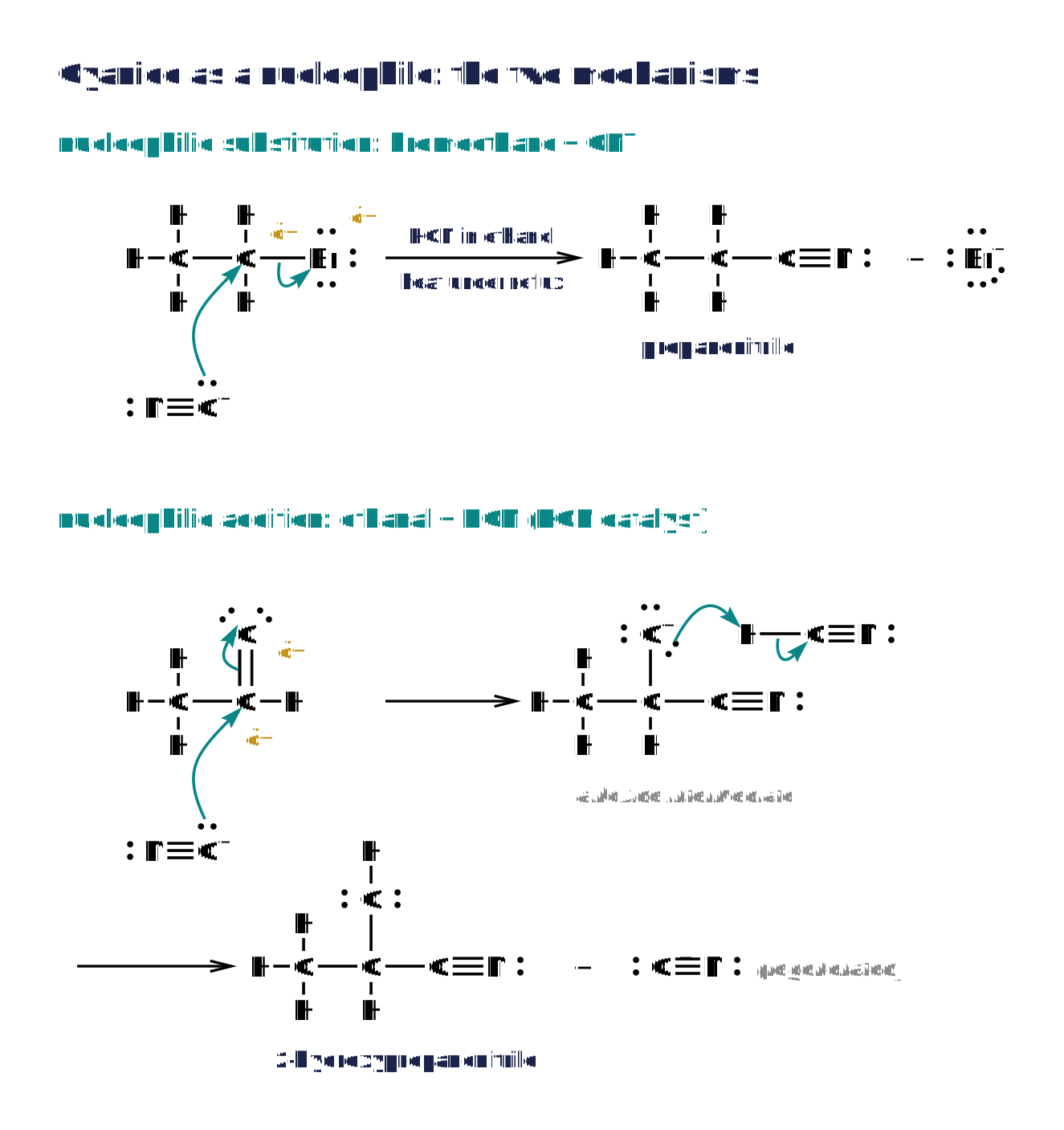
Both mechanisms in two frames each: the substitution of bromoethane and the addition to ethanal, with every lone pair, charge and arrow.
Common mistake: The nucleophile is the carbon of CN⁻, not the nitrogen. Start the arrow on the lone pair of carbon, and never let an arrow land on a lone pair.
Nitriles from Aldehydes and Ketones
Hydrogen cyanide adds across the C=O bond of an aldehyde or ketone. The product is a hydroxynitrile (cyanohydrin), again with one carbon more.
| Detail | |
|---|---|
| reagent | HCN, generated from KCN with a little acid (the CN⁻ ion is the nucleophile) |
| conditions | room temperature, in solution; HCN is toxic, so work in a fume cupboard |
| equation | CH₃CHO + HCN → CH₃CH(OH)CN (ethanal → 2-hydroxypropanenitrile) |
| with a ketone | CH₃COCH₃ + HCN → (CH₃)₂C(OH)CN (propanone → 2-hydroxy-2-methylpropanenitrile) |
| type of reaction | nucleophilic addition |
- The OH and the C≡N finish on the same carbon, the old carbonyl carbon.
- Hydrolysing the nitrile group gives a 2-hydroxycarboxylic acid: CH₃CH(OH)CN → CH₃CH(OH)COOH, 2-hydroxypropanoic acid.
- The mechanism is on the carbonyl page, Reduction and Nucleophilic Addition, and in the card above.
Quick Check: Hydroxynitriles from New Carbonyl Compounds
Pick the one accurate statement in each set.
What the Nitrile Becomes
A nitrile is rarely the target. Its C≡N group is converted in one more step into an amine or a carboxylic acid, each keeping the extra carbon.
| Conversion | Reagents and conditions | Equation |
|---|---|---|
| reduction to a primary amine | H₂ with a nickel catalyst | CH₃CH₂CN + 4[H] → CH₃CH₂CH₂NH₂ (propylamine) |
| acid hydrolysis to a carboxylic acid | dilute hydrochloric acid, heat under reflux | CH₃CH₂CN + 2H₂O + HCl → CH₃CH₂COOH + NH₄Cl (propanoic acid) |
| alkaline hydrolysis to the carboxylate | sodium hydroxide solution, heat under reflux, then add dilute acid | CH₃CH₂CN + H₂O + NaOH → CH₃CH₂COONa + NH₃; then CH₃CH₂COO⁻ + H⁺ → CH₃CH₂COOH |
- The nitrile carbon becomes the CH₂ next to nitrogen in the amine, or the COOH carbon in the acid.
- Acid hydrolysis gives the acid and an ammonium salt; alkaline hydrolysis gives the salt of the acid and ammonia gas.
- In a route, write the hydrolysis as a single step with its reagent and conditions.
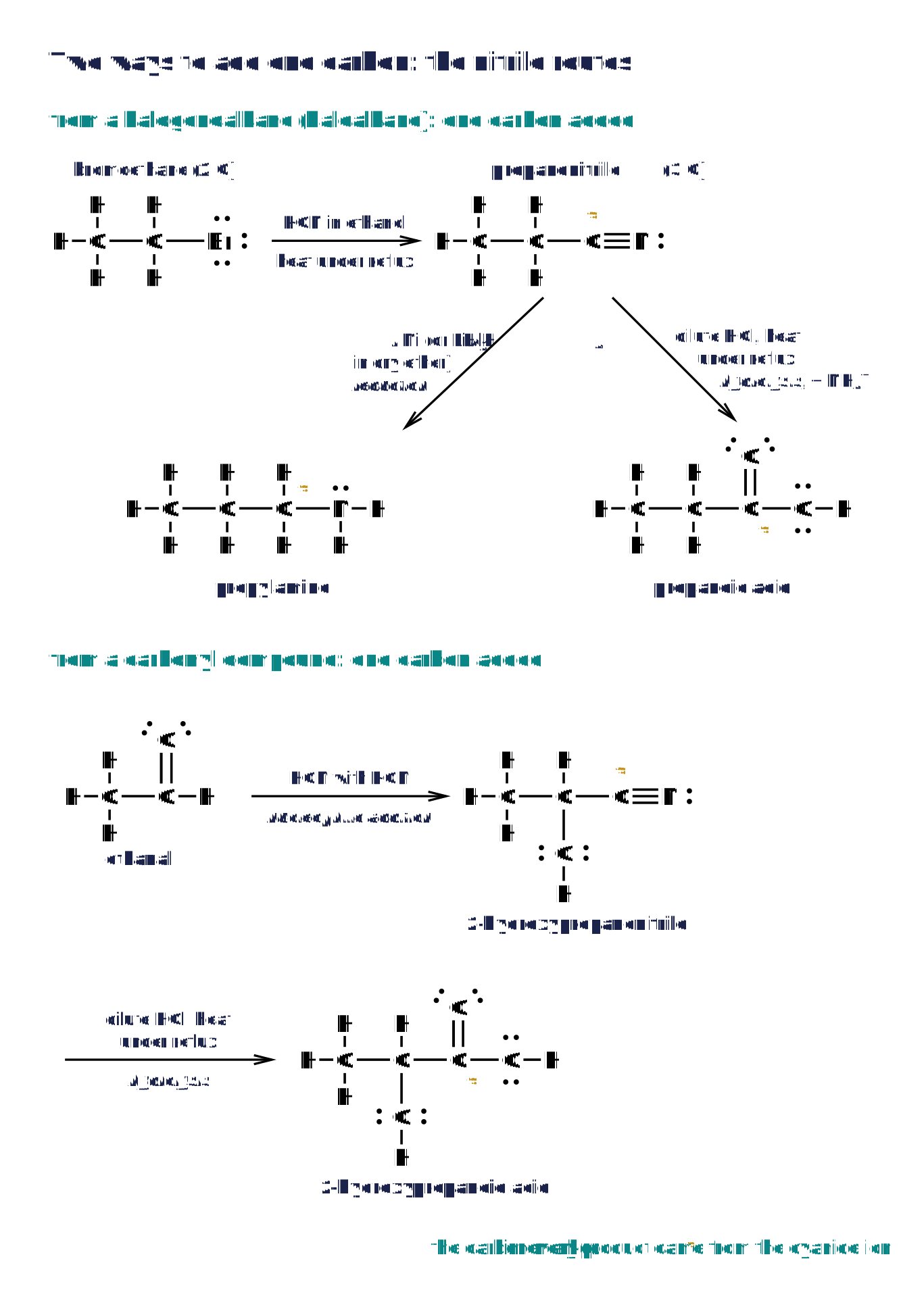
Both nitrile routes as one scheme: bromoethane to propanenitrile and on to propylamine or propanoic acid; ethanal to 2-hydroxypropanenitrile and on to 2-hydroxypropanoic acid.
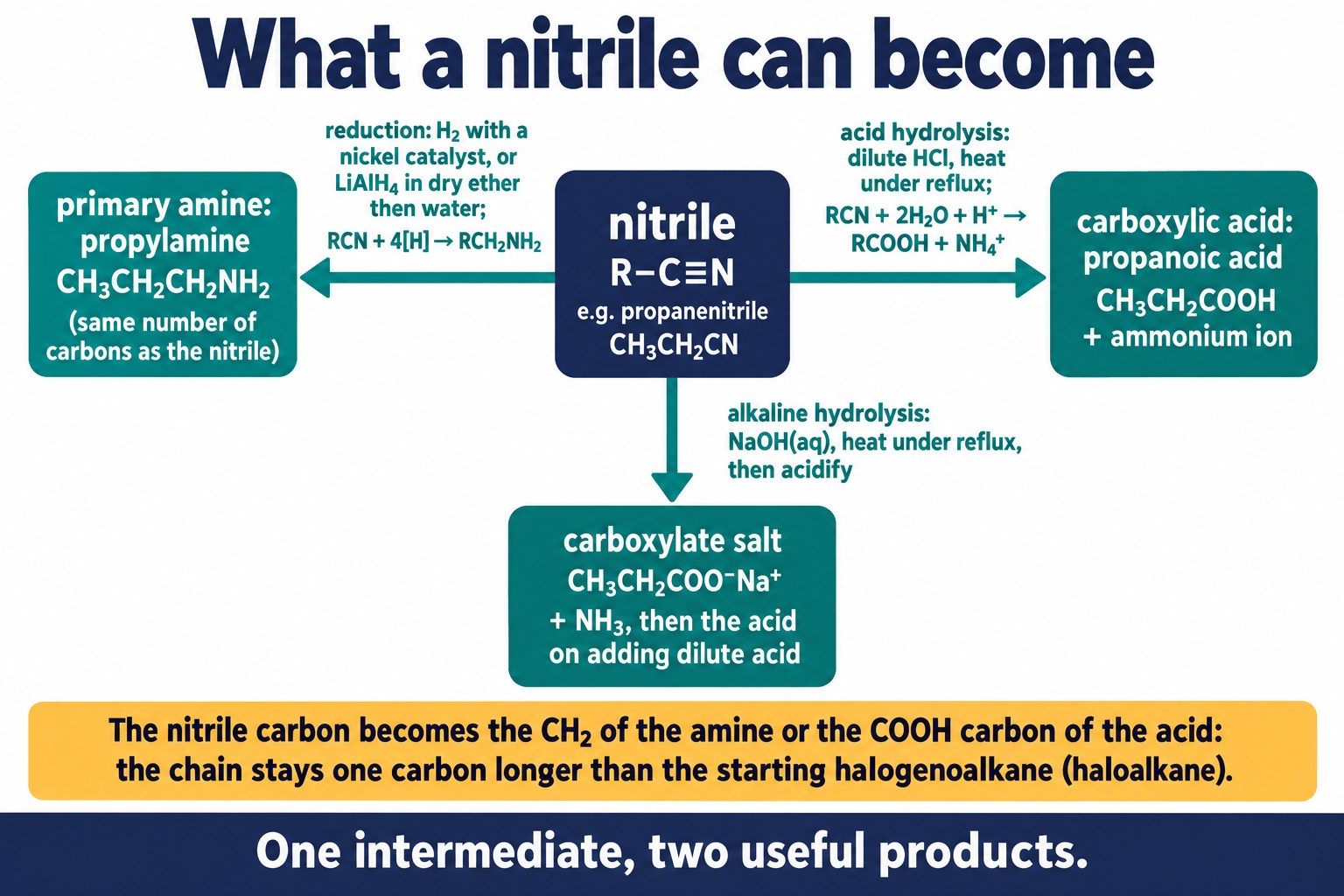
The nitrile as a branching point: reduce it to the amine, or hydrolyse it to the acid with acid or with alkali.
Exam focus: Two steps add one carbon and set the group: haloalkane → nitrile (KCN, ethanol, reflux) → acid (dilute HCl, reflux) or amine H₂/Ni. Give both reagents and both conditions.
Check: The Nitrile Routes
Give the reagents and conditions for turning a haloalkane or a carbonyl compound into a nitrile, count the carbons, and choose the step that converts the nitrile into an amine or an acid.
Quick Check: Choosing the First Step
Count the carbons at both ends of each route, then choose the first step.
Adding Carbons to a Benzene Ring: Friedel–Crafts Reactions
A benzene ring is attacked by electrophiles, not nucleophiles, so a carbon chain is added to it with a δ+ carbon: Friedel–Crafts alkylation and acylation (Friedel–Crafts Alkylation and Acylation).
| Reaction | Reagents and conditions | Product |
|---|---|---|
| alkylation | a haloalkane such as chloroethane with an AlCl₃ halogen carrier, heat under reflux | ethylbenzene, C₆H₅CH₂CH₃ |
| acylation | an acyl chloride such as ethanoyl chloride with an AlCl₃ halogen carrier, heat under reflux | phenylethanone, C₆H₅COCH₃ |
- The AlCl₃ halogen carrier makes the electrophile: CH₃COCl + AlCl₃ → CH₃CO⁺ + AlCl₄⁻ (the acylium ion), or CH₃CH₂⁺ from chloroethane.
- Acylation is preferred in synthesis: it adds exactly one acyl group, and the ketone formed is a handle for further steps.
- Alkylation can go further because the alkyl group activates the ring: polysubstitution lowers the yield of the single product.
Worked route: benzene to 1-phenylethanol
Step 1. Benzene + ethanoyl chloride with an AlCl₃ halogen carrier, heat under reflux → phenylethanone, C₆H₅COCH₃ (Friedel–Crafts acylation: electrophilic substitution).
Step 2. Phenylethanone + NaBH₄ in water or ethanol → 1-phenylethanol, C₆H₅CH(OH)CH₃ (reduction, nucleophilic addition of hydride).
Remember: Chain: cyanide adds a carbon by nucleophilic attack. Ring: Friedel–Crafts adds a carbon by electrophilic substitution with an AlCl₃ halogen carrier.
Check: Choosing the Carbon-Adding Step
Choose the reagent that adds a carbon to a chain or a ring, give its conditions, and work out the product from the starting material and the step that follows.
Common Exam Points
- Haloalkane + KCN in ethanol under reflux → nitrile, one carbon longer: CH₃CH₂Br + CN⁻ → CH₃CH₂CN + Br⁻ (nucleophilic substitution).
- Aldehyde or ketone + HCN (with KCN) → hydroxynitrile by nucleophilic addition: CH₃CHO + HCN → CH₃CH(OH)CN.
- Nitrile + 4[H] (H₂ with a nickel catalyst) → primary amine; nitrile + dilute HCl under reflux → carboxylic acid + NH₄⁺.
- In both C–C≡N mechanisms the first curly arrow starts on the lone pair of the carbon of CN⁻ and ends at a δ+ carbon.
- Friedel–Crafts alkylation or acylation adds a carbon group to a benzene ring with an AlCl₃ halogen carrier: electrophilic substitution.
- Always count carbons: a target with one more carbon than the start needs a C–C bond-forming step somewhere in the route.
FAQs
Use these quick answers to check why a synthesis sometimes needs an extra carbon, how the nitrile route adds one from a haloalkane or a carbonyl compound, and how Friedel–Crafts reactions add a carbon chain to a benzene ring.
Why does chain length matter when I plan a synthesis?
Most reactions keep the carbon skeleton and only change the functional group. If the target has more carbon atoms than the starting material, one step must form a new carbon–carbon bond, and the nitrile route is the simplest way to add exactly one carbon.
How does the nitrile route add one carbon to a haloalkane?
Heat the haloalkane under reflux with potassium cyanide in ethanol: bromoethane gives propanenitrile, CH₃CH₂CN, by nucleophilic substitution. Reduce the nitrile with hydrogen and a nickel catalyst (or LiAlH₄) to propylamine, or heat it with dilute hydrochloric acid to hydrolyse it to propanoic acid.
How does HCN add a carbon to an aldehyde or ketone?
The cyanide ion attacks the δ+ carbonyl carbon in a nucleophilic addition, using KCN with a little acid to supply HCN. Ethanal gives 2-hydroxypropanenitrile, CH₃CH(OH)CN, and hydrolysis of the nitrile with dilute acid then gives the 2-hydroxy acid, 2-hydroxypropanoic acid (lactic acid).
How do Friedel–Crafts reactions add carbon to a benzene ring?
A haloalkane or acyl chloride with an AlCl₃ halogen carrier forms an electrophile, R⁺ or RCO⁺, which substitutes a ring hydrogen.
Benzene and ethanoyl chloride give phenylethanone, C₆H₅COCH₃, which can then be reduced to 1-phenylethanol, so the new side chain carries a useful functional group.
Why is the potassium cyanide dissolved in ethanol rather than water?
Ethanol dissolves both the haloalkane and the cyanide salt, so the two meet and react. In water the haloalkane is almost insoluble and hydroxide ions, present because cyanide is a weak-acid anion, would compete and substitute to give the alcohol instead of the nitrile.

Copyright notice: This OLS revision content, including the explanations, layout, diagrams, tables and embedded learning structure, is authored for Online Learning System by Dr. Mohammed Al-Fatah. It may not be copied, reproduced, redistributed or adapted without written permission.
Keep this note — free
Save your progress across every OCR topic. A free account remembers which topics you have covered, saves your question scores, and syncs across your phone and laptop.
- Track every topic you have finished
- Keep your practice-question scores
- No payment, no card, free forever
Already registered? Log in