Deducing Formulae from Analytical Data
A concise revision guide to working out an unknown compound: the molecular formula from percentage composition and mass spectrometry, then the structure from mass, infrared, carbon-13 and proton NMR spectra, with worked examples that combine every clue.
Recap: Formulae, Moles and Spectra
Five quick questions on what you already know: empirical and molecular formulae, moles from masses, Mr from the molecular ion peak (Mass Spectra of Organic Compounds) and the characteristic infrared absorptions (Infrared Spectroscopy).
Three Formulae, Three Kinds of Data
Working out an unknown compound runs through three formulae in order. Each one needs a different kind of data.
| Formula | What it states | Data that gives it |
|---|---|---|
| empirical formula | the simplest whole-number ratio of atoms, e.g. C₂H₄O | percentage composition by mass |
| molecular formula | the actual number of each atom, e.g. C₄H₈O₂ | the empirical formula plus Mr from the molecular ion peak in the mass spectrum, or given in the question |
| structural formula | how the atoms are joined, e.g. CH₃COOCH₂CH₃ | infrared spectrum, mass spectrum fragments, NMR spectra and chemical tests |
- The molecular formula is a whole-number multiple of the empirical formula: C₄H₈O₂ is 2 × C₂H₄O.
- Several structures share one molecular formula (isomers), so spectra and tests are needed to choose between them.
- Relative atomic masses used throughout: C 12.0, H 1.0, O 16.0, N 14.0.
Remember: Empirical first, molecular second, structural last. A question that gives percentages and an Mr expects all three in that order.
Empirical Formula from Percentage Composition
Percentage by mass is the mass of each element in 100 g of the compound. Divide by Aᵣ to get moles, then find the simplest ratio.
Worked example: unknown Y
Answer. The empirical formula of Y is C₃H₆O (relative mass 36.0 + 6.0 + 16.0 = 58.0).
- If one number comes out as 1.5 or 2.5, multiply every number by 2 to reach whole numbers.
- Oxygen is often not quoted: find its percentage by subtracting the others from 100.
- Round only at the end. 2.97 is 3, but 2.5 is not: it means the ratio needs doubling.
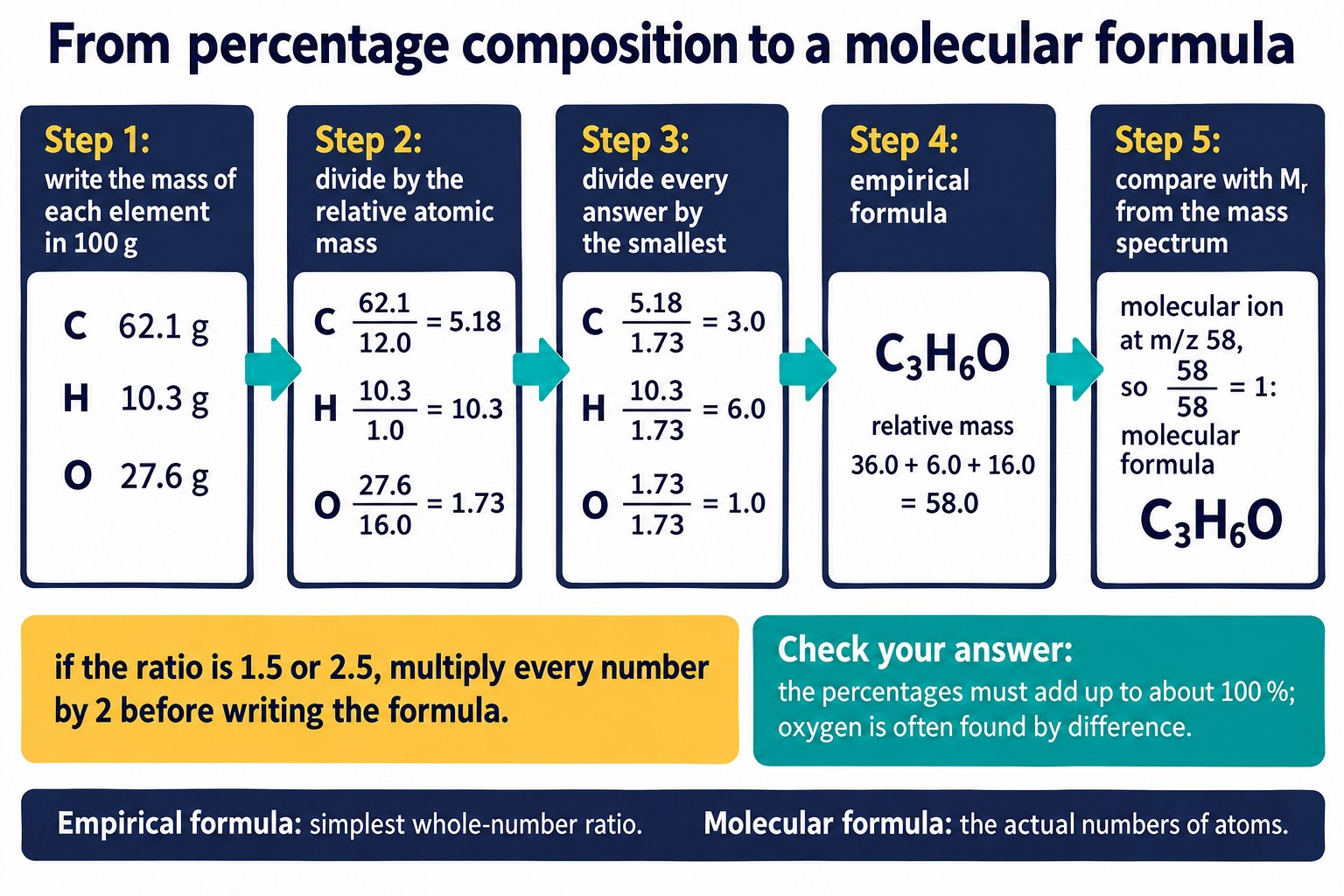
The five steps from percentages to a molecular formula, with the numbers for Y in every box.
Common mistake: Dividing the percentage by the mass number of the whole compound. Divide each element by its own Aᵣ, then compare the answers.
Molecular Formula from Mr
The molecular formula is found by comparing the relative mass of the empirical formula with Mr. Mr comes from the molecular ion peak in the mass spectrum, or given in the question.
- The molecular ion M⁺ is the peak of highest m/z (ignoring the small M+1 peak): Mass Spectra of Organic Compounds.
- Divide Mr by the relative mass of the empirical formula. The whole-number answer multiplies every subscript.
- Y: empirical formula C₃H₆O has relative mass 58.0 and the molecular ion is at m/z 58, so (58) / (58) = 1 and Y is C₃H₆O.
- X: C₂H₄O has relative mass 44.0 and the molecular ion is at m/z 88, so (88) / (44) = 2 and X is C₄H₈O₂.
Remember: A molecular formula with an odd Mr contains an odd number of nitrogen atoms. C, H and O compounds always have an even Mr.
Check: Empirical and Molecular Formulae
Work out empirical formulae from percentage data, scale them to the molecular formula with Mr from the molecular ion, and spot the ratio that needs doubling.
A Systematic Method for an Unknown
Questions give several pieces of evidence at once. Work through them in a fixed order so that nothing is missed.
- Empirical formula from the composition data.
- Molecular formula from Mr: the molecular ion peak.
- Degree of unsaturation (optional): (2C + 2 + N − H − X) / (2) = rings plus double bonds; C₄H₈O₂ gives 1.
- Functional group from the infrared spectrum and from chemical tests (Identifying Functional Groups by Chemical Tests).
- Carbon skeleton from the NMR spectra: how many carbon environments, then how many hydrogen environments, how many hydrogens in each and how many neighbours.
- Check every clue against the final structure, including the mass spectrum fragments.
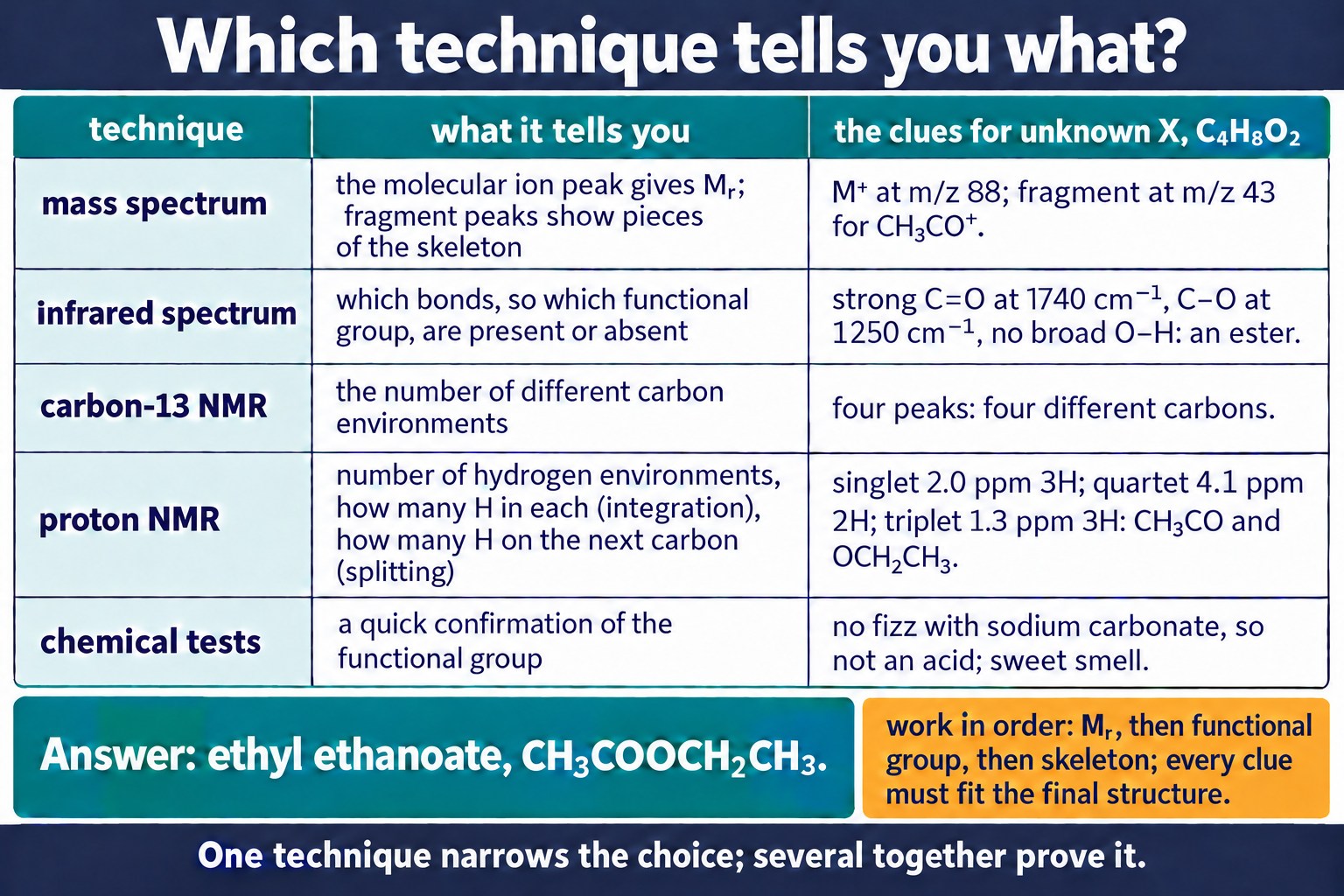
Which technique answers which question, with the clues for X worked in the right-hand column.
Exam focus: Write one sentence per clue: “the strong absorption at 1740 cm⁻¹ shows C=O”. The link between evidence and conclusion is where the marks are.
Structural Formula from Spectra and Tests
Each technique answers a different question. The structure is the one that fits every answer.
| Evidence | What it tells you | Where to revise |
|---|---|---|
| infrared spectrum | which bonds are present: broad O–H 2500 to 3300 cm⁻¹ (acid) or 3200 to 3600 cm⁻¹ (alcohol), C=O 1630 to 1820 cm⁻¹, C–O 1000 to 1300 cm⁻¹; and which are absent | Infrared Spectroscopy |
| mass spectrum | Mr from M⁺; fragments such as m/z 43 (CH₃CO⁺), 29 (C₂H₅⁺ or CHO⁺), 15 (CH₃⁺) | Mass Spectra of Organic Compounds |
| carbon-13 NMR | the number of different carbon environments; a C=O carbon appears at 160 to 220 ppm | Carbon-13 NMR Spectroscopy |
| proton NMR | number of hydrogen environments; integration gives the number of H in each; splitting (n + 1 rule) counts the hydrogens on the next carbon | Proton NMR Spectroscopy |
| chemical tests | functional group confirmed in the test tube: Identifying Functional Groups by Chemical Tests | Identifying Unknown Compounds |
- A singlet means no hydrogens on the neighbouring carbons; a triplet and a quartet together mean an ethyl group, CH₂CH₃.
- The chemical shift of a CH₂ or CH₃ tells you what it is next to: about 2 ppm beside C=O, about 3.5 to 4 ppm beside O.
- Fewer carbon environments than carbons means symmetry: propanone has three carbons but two environments.
Worked Example: X is an Ester
X is C₄H₈O₂. Its infrared spectrum has a strong absorption at 1740 cm⁻¹ and one at 1250 cm⁻¹, but no broad peak between 2500 and 3300 cm⁻¹.
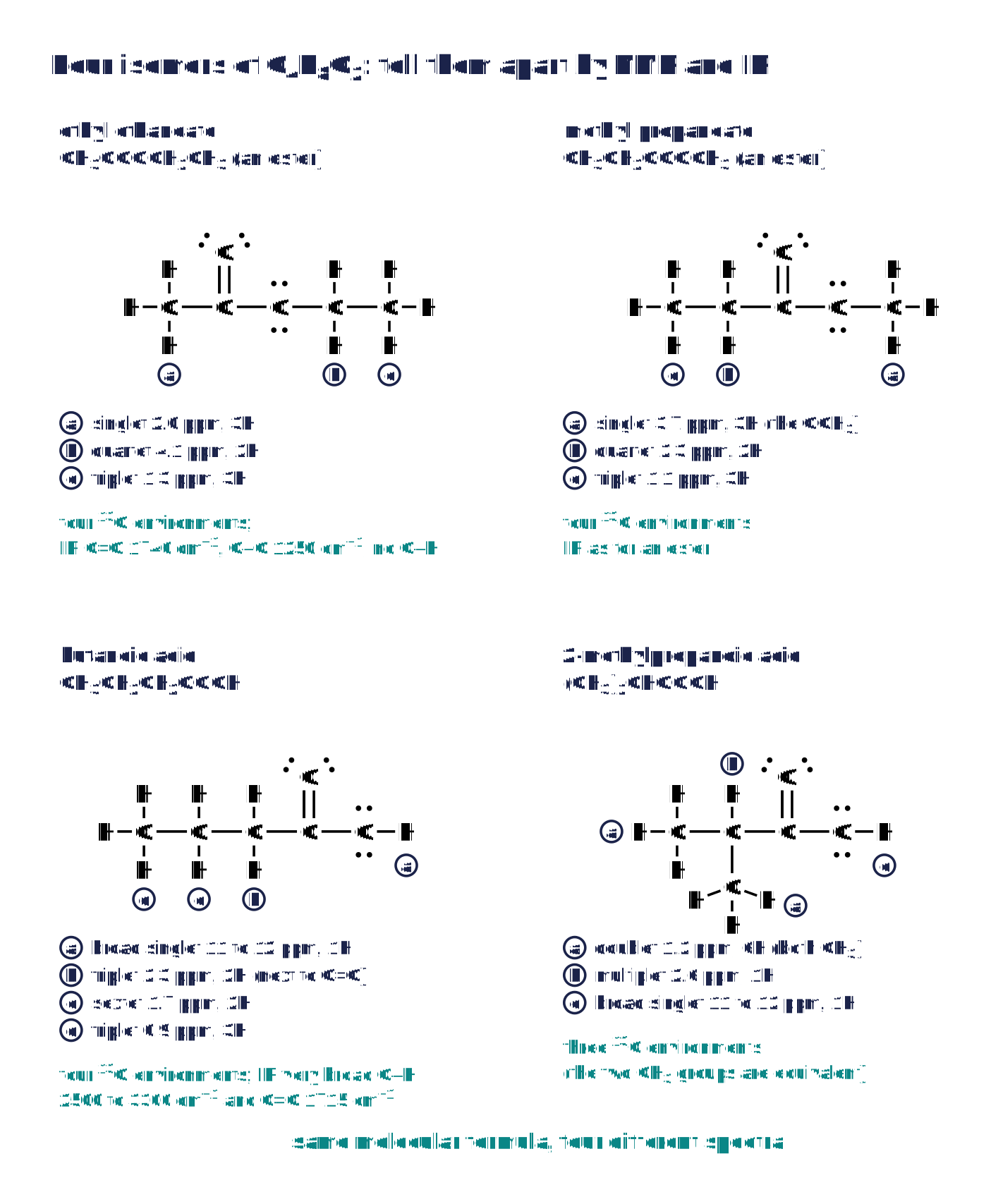
Four isomers of C₄H₈O₂ with every hydrogen environment labelled. Compare the shift of the singlet in the two esters.
Common mistake: Stopping at “an ester”. Methyl propanoate is also a C₄H₈O₂ ester: the shifts (singlet 2.0 against singlet 3.7) are what pick ethyl ethanoate.
Which Isomer? Telling C₄H₈O₂ Compounds Apart
Four common C₄H₈O₂ isomers give four different sets of evidence. One clue is usually enough to separate each pair.
| Compound | Infrared | Proton NMR | Chemical test |
|---|---|---|---|
| ethyl ethanoate, CH₃COOCH₂CH₃ | C=O 1740, C–O 1250, no O–H | singlet 2.0 (3H), quartet 4.1 (2H), triplet 1.3 (3H) | no fizz with Na₂CO₃; sweet smell |
| methyl propanoate, CH₃CH₂COOCH₃ | C=O 1740, C–O, no O–H | singlet 3.7 (3H), quartet 2.3 (2H), triplet 1.1 (3H) | no fizz; sweet smell |
| butanoic acid, CH₃CH₂CH₂COOH | very broad O–H 2500 to 3300, C=O 1715 | broad singlet 11 to 12 (1H), triplet 2.3 (2H), sextet 1.7 (2H), triplet 0.9 (3H) | fizzes with Na₂CO₃; indicator red |
| 2-methylpropanoic acid, (CH₃)₂CHCOOH | very broad O–H, C=O 1715 | doublet 1.2 (6H), multiplet 2.6 (1H), broad singlet 11 to 12 (1H); only three ¹³C environments | fizzes with Na₂CO₃ |
- Infrared separates the acids from the esters: the acids have the very broad O–H absorption.
- Proton NMR separates the two esters: a CH₃ singlet at 3.7 ppm is bonded to oxygen (OCH₃); at 2.0 ppm it is bonded to C=O.
- Carbon-13 NMR separates the two acids: 2-methylpropanoic acid has three environments, butanoic acid four.
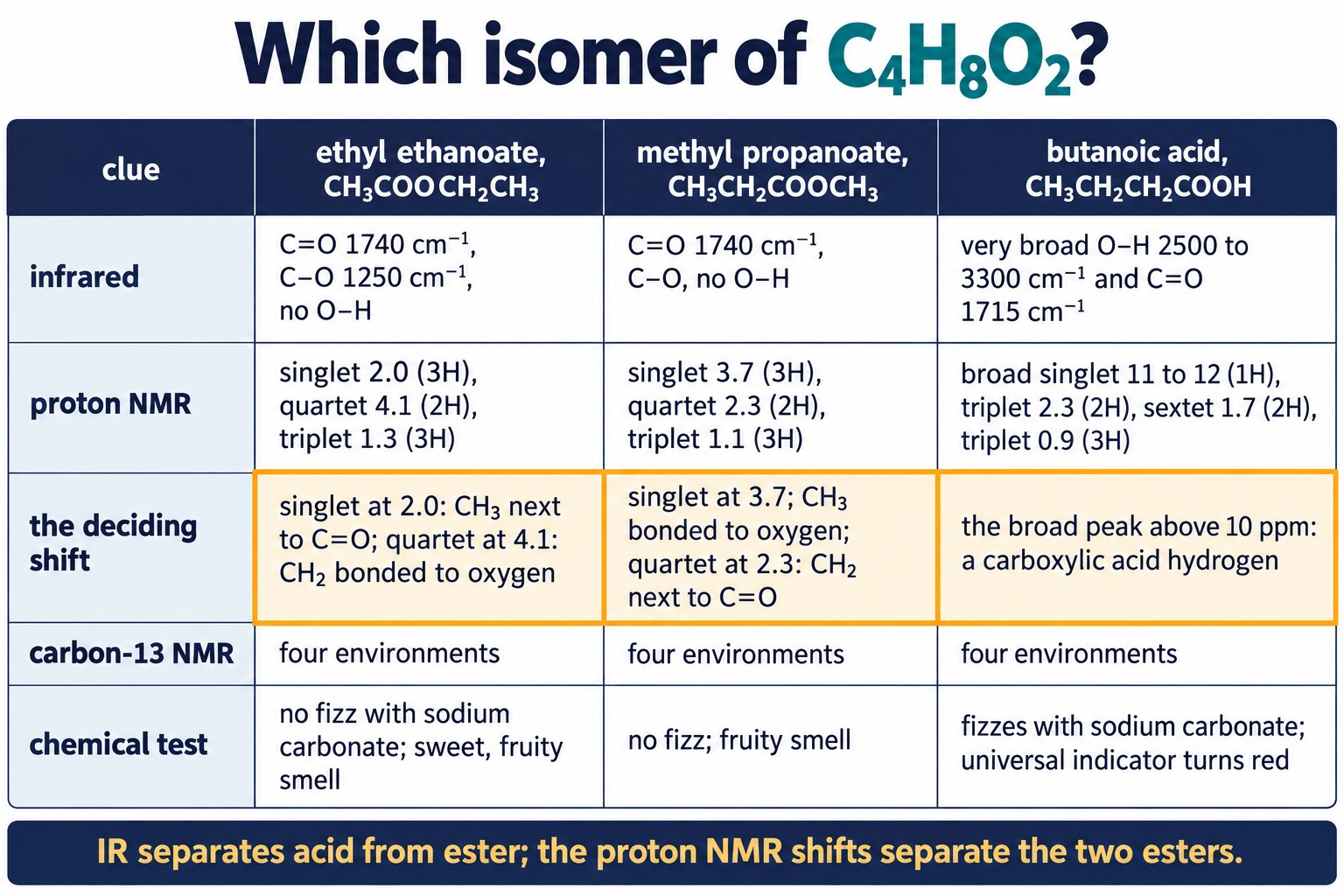
Three of the isomers compared clue by clue, with the deciding evidence picked out.
Quick Check: Identifying an Unknown Ester
Work out each stage yourself, then flip the card to compare.
Worked Example: Y is a Ketone
Y is C₃H₆O. Its infrared spectrum has a strong absorption at 1715 cm⁻¹ and no O–H. It gives no silver mirror with Tollens’ reagent but an orange precipitate with 2,4-DNPH.
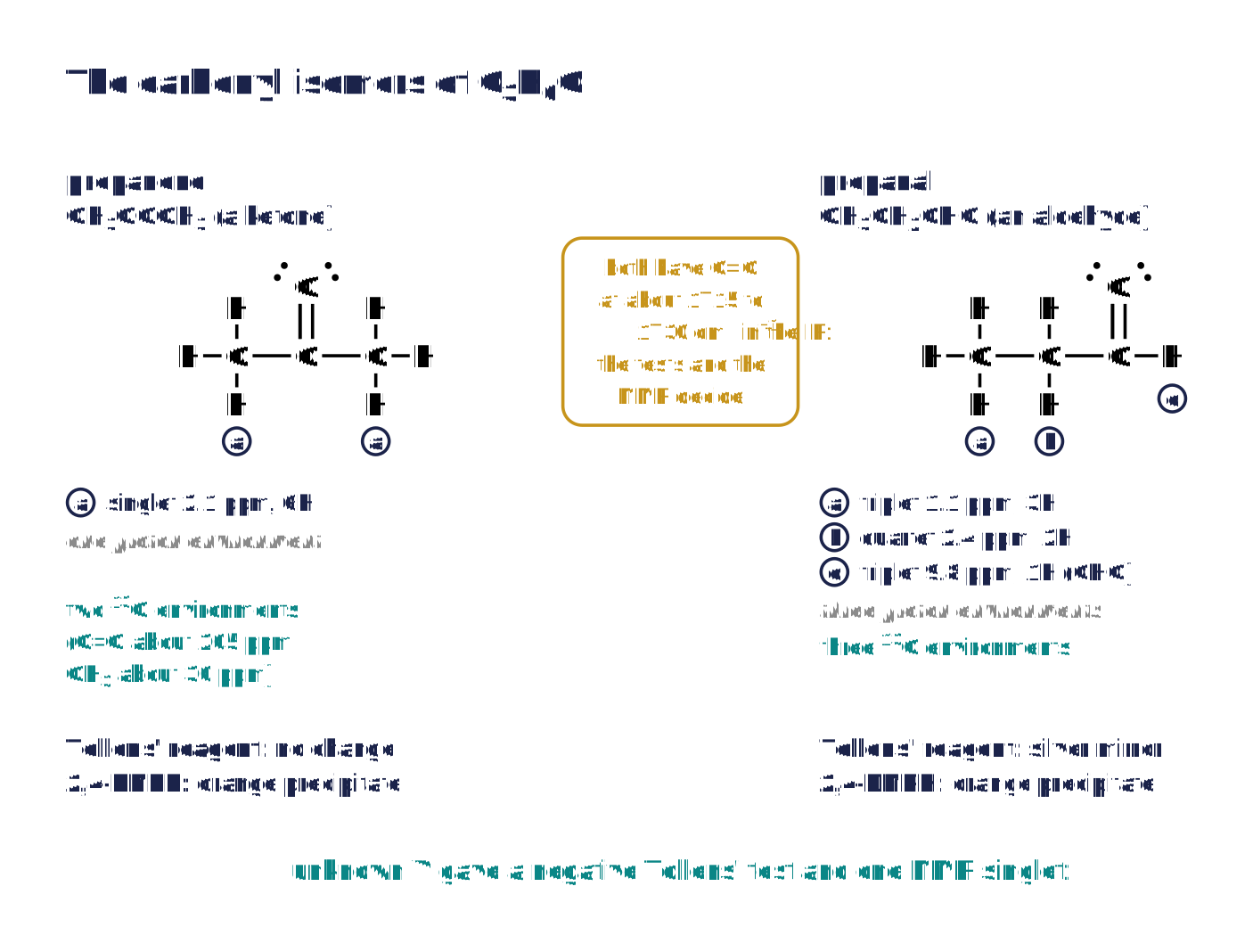
Propanone and propanal: the same C=O absorption, but different test results and different NMR spectra.
Exam focus: Name the test that rules a structure out, not only the one that fits: “no silver mirror, so not propanal” earns the mark.
Check: From Spectra to a Structure
Match infrared absorptions to functional groups, read integration and splitting patterns, and pick the one isomer that fits every clue in a set of data.
Common Exam Points
- Percentage composition: divide each percentage by its own Aᵣ, divide by the smallest, multiply up to whole numbers.
- Molecular formula = empirical formula × (Mr) / (relative mass of the empirical formula); Mr from the molecular ion peak or the question.
- Infrared: broad O–H at 2500 to 3300 cm⁻¹ means an acid; C=O near 1700 cm⁻¹ with no O–H means an aldehyde, ketone or ester.
- Proton NMR: the number of peaks gives the environments, integration gives the ratio of hydrogens, splitting (n + 1) gives the neighbours; carbon-13 gives the carbon environments.
- A CH₃ singlet at about 2.0 ppm is next to C=O; at about 3.7 ppm it is on an oxygen. That shift separates ethyl ethanoate from methyl propanoate.
- Tollens’ reagent (silver mirror) separates an aldehyde from a ketone; 2,4-DNPH shows either.
- Quote the evidence and the conclusion together for every clue, and state which isomers the data rules out.
FAQs
Use these quick answers to check how an empirical formula comes from percentage composition, how Mr gives the molecular formula and how IR, mass and NMR spectra fix the structure.
How do I work out an empirical formula from percentage composition?
Divide each percentage by the Ar of that element, then divide every answer by the smallest. For Y: C (62.1) / (12.0) = 5.18, H (10.3) / (1.0) = 10.3, O (27.6) / (16.0) = 1.73, giving 3 : 6 : 1, so the empirical formula is C₃H₆O.
What is the difference between an empirical and a molecular formula?
The empirical formula is the simplest whole-number ratio of atoms, C₂H₄O for X. The molecular formula gives the actual number of atoms in one molecule, C₄H₈O₂.
They are the same for propanone, C₃H₆O, because its ratio cannot be simplified further.
How do I turn an empirical formula into a molecular formula?
Find Mr from the mass spectrum, where the molecular ion peak M⁺ has the highest m/z apart from the small M+1 peak, or from the question.
Divide Mr by the mass of the empirical unit: (88) / (44) = 2 for X, so C₂H₄O doubles to C₄H₈O₂.
How do I know from the IR spectrum that X is an ester?
A strong, sharp absorption near 1740 cm⁻¹ shows a C=O group, and a strong C–O absorption near 1250 cm⁻¹ fits an ester. There is no broad O–H band between 2500 and 3600 cm⁻¹, so it is not a carboxylic acid or an alcohol.
How do I tell ethyl ethanoate from methyl propanoate when both give a singlet, a quartet and a triplet?
Use the chemical shifts. In ethyl ethanoate the singlet (CH₃CO) is at 2.0 and the quartet (OCH₂, next to oxygen) at 4.1. In methyl propanoate the singlet (OCH₃) is at 3.7 and the quartet (CH₂CO) at 2.3. Integration alone cannot separate them.

Copyright notice: This OLS revision content, including the explanations, layout, diagrams, tables and embedded learning structure, is authored for Online Learning System by Dr. Mohammed Al-Fatah. It may not be copied, reproduced, redistributed or adapted without written permission.
Keep this note — free
Save your progress across every OCR topic. A free account remembers which topics you have covered, saves your question scores, and syncs across your phone and laptop.
- Track every topic you have finished
- Keep your practice-question scores
- No payment, no card, free forever
Already registered? Log in