Preparing and Purifying Organic Solids
A concise revision guide to making and purifying a solid organic product: heating under reflux, filtration under reduced pressure, washing, recrystallisation step by step and why it works, drying, and checking purity by melting temperature, with the preparation of aspirin as the worked example.
Recrystallisation: Why It Works
Choose a step to watch an impure solid dissolve in hot solvent, lose its insoluble impurity on a hot filter and crystallise pure as the solution cools.
© Dr. Mohammed Al-Fatah – onlinelearningsystem.net
Before You Start
Many organic products are solids at room temperature. This page follows one from the reaction flask to a pure, dry, weighed sample, and explains why each step is done.
- Heating under reflux and the apparatus for it: Preparing and Purifying Organic Liquids.
- Esters from acyl chlorides and acid anhydrides, the reaction used in the worked example: Acyl Chlorides.
- Choosing and justifying a procedure: Choosing Procedures and Managing Hazards.
- Filtration and crystallisation were met at GCSE; here the reasons behind each detail are what the examiner wants.
GCSE Recap: Separating and Judging Purity
Three quick questions on the GCSE ideas this page builds on.
The Overall Plan
Preparing a pure organic solid follows the same sequence whatever the compound. Each stage has a purpose, and the exam asks for the purpose as often as the name.
| Stage | What you do | Why |
|---|---|---|
| 1 react | heat under reflux, or warm in a water bath | speeds up a slow reaction without losing volatile reagents |
| 2 crystallise | cool the mixture; add cold water or an ice bath | the product is far less soluble cold, so it separates as a solid |
| 3 filter | filter under reduced pressure | separates the crude solid from the liquid quickly |
| 4 wash | rinse the solid on the filter with a little cold water | removes soluble impurities and leftover reagents |
| 5 recrystallise | dissolve in the minimum hot solvent, cool, filter | removes the impurities that crystallised with the product |
| 6 dry | desiccator, low oven or between filter papers | removes the solvent so the mass and the melting point are those of the product |
| 7 check | measure the melting point; calculate the yield | sharp and matching the data book means pure |
Remember: React, crystallise, filter, wash, recrystallise, dry, check. Say why at every step: solubility is the reason behind most of them.
Making the Solid: Reaction and Crystallisation
The worked example throughout this page is aspirin, made in Practical Activity Groups (PAG 6). 2-Hydroxybenzoic acid reacts with ethanoic anhydride; the phenol OH is esterified and the carboxylic acid group is untouched.
- Equation: C₆H₄(OH)COOH + (CH₃CO)₂O → C₆H₄(OCOCH₃)COOH + CH₃COOH.
- Conditions: a few drops of concentrated sulfuric or phosphoric acid as catalyst; warm in a water bath at about 60 °C for 15 minutes.
- A water bath, not a flame: ethanoic anhydride is flammable and the gentle heat avoids side reactions.
- Ethanoic anhydride is used in excess, so 2-hydroxybenzoic acid is the limiting reagent.
- Add cold water to the cooled mixture: the excess anhydride is hydrolysed to ethanoic acid and the aspirin, insoluble in cold water, crystallises.
- Cooling in an ice bath increases the amount that crystallises, because solubility falls with temperature.
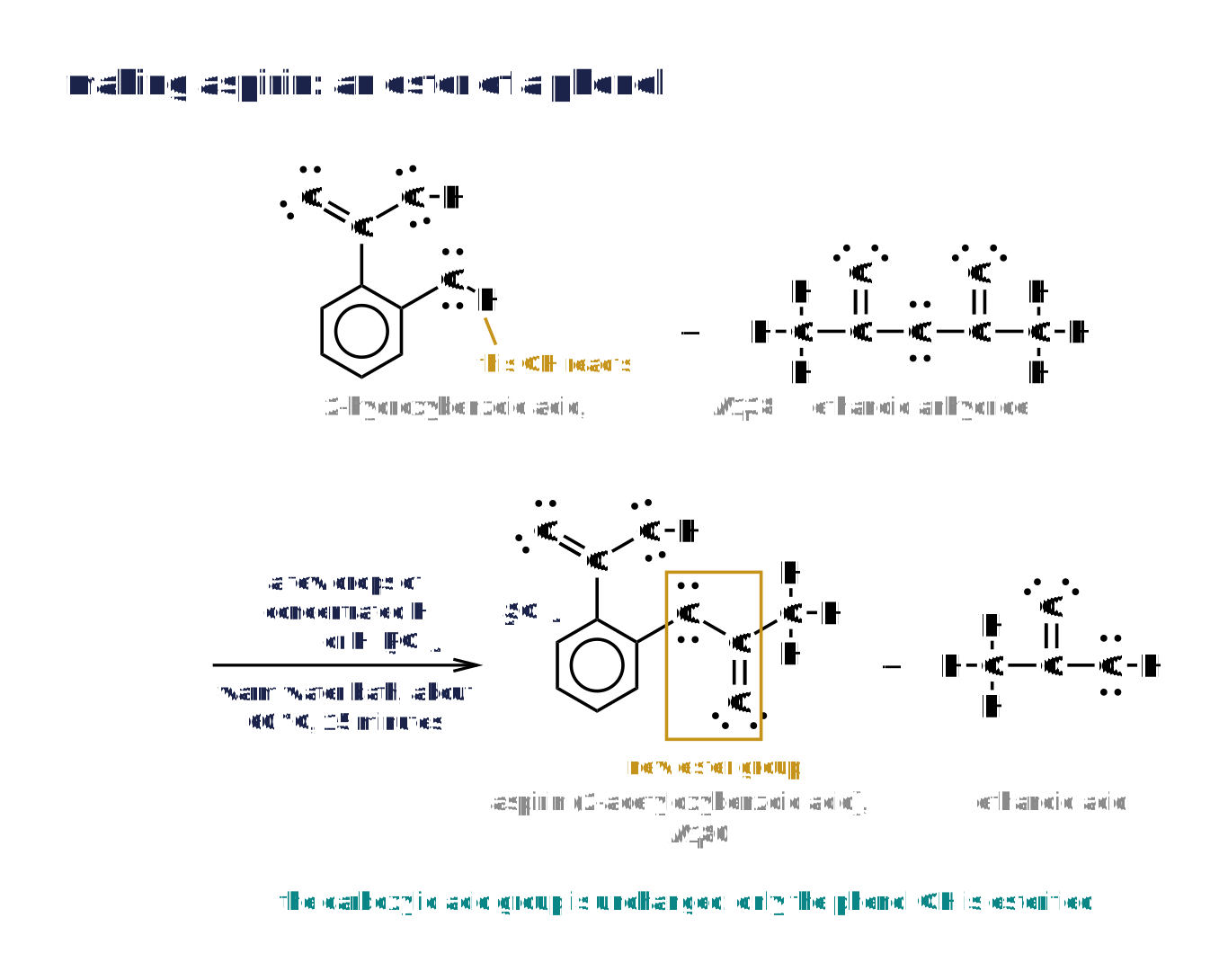
The aspirin equation: the phenol OH of 2-hydroxybenzoic acid is esterified by ethanoic anhydride; ethanoic acid is the by-product.
Exam focus: Crystallisation relies on solubility: the product is soluble in the hot reaction mixture and almost insoluble in cold water, so cooling and adding water bring it out as a solid.
Filtration Under Reduced Pressure
The crude crystals are separated from the liquid by filtration under reduced pressure, a required technique. A Büchner funnel sits in a thick-walled Büchner flask connected to a vacuum pump.
- Wet a flat filter paper in the funnel with a little cold solvent so it seals over the holes.
- Pour the cold mixture into the funnel with the pump running; the liquid is drawn through quickly.
- Wash the crystals on the filter with a little ice-cold water to rinse away soluble impurities.
- Leave the pump running for a few minutes to draw air through and part-dry the crystals.
| Reduced pressure | Gravity | |
|---|---|---|
| speed | fast | slow |
| crystals | left almost dry | stay wet |
| when used | collecting the cold product | hot filtration of a solution |
- Washing with cold water matters: warm water would dissolve some of the product and lower the yield.
- The washings carry away ethanoic acid, the catalyst and any unreacted 2-hydroxybenzoic acid that dissolved.
- The thick walls of the Büchner flask withstand the pressure difference; an ordinary conical flask could implode.
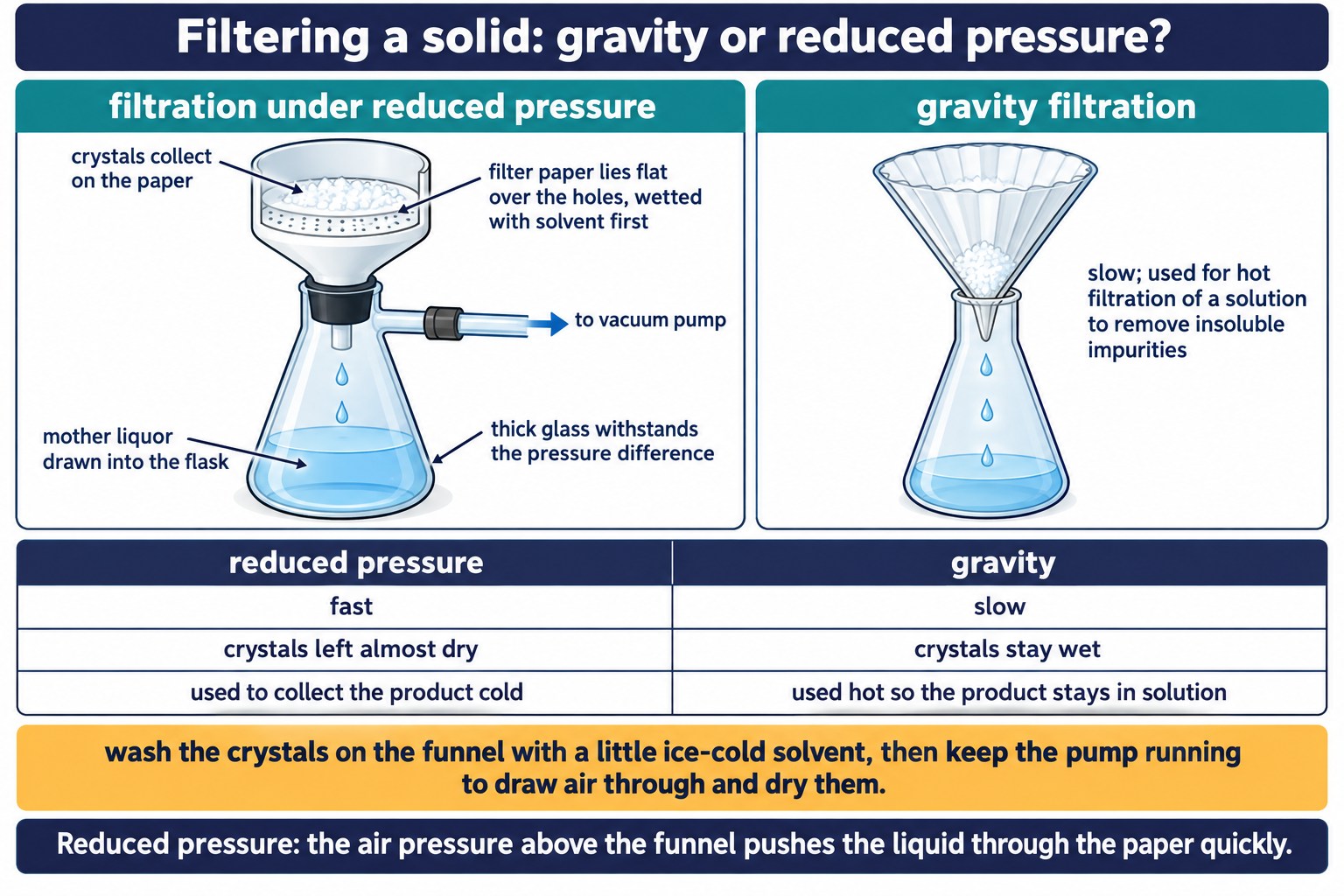
Filtration under reduced pressure beside gravity filtration: the apparatus, and why the vacuum method is used for the cold product.
Exam wording: “Filter under reduced pressure using a Büchner funnel, wash with a little cold water.” Reduced pressure is faster and leaves the crystals drier.
Check: Making and Collecting a Solid
Decide the conditions, the limiting reagent and the filtration and washing steps for solid preparations that are not described on this page.
Recrystallisation: Why It Works
Recrystallisation removes impurities that crystallised alongside the product. It depends on choosing a solvent in which the product is very soluble hot and only sparingly soluble cold.
- Impurities are present in small amounts, so even cold they stay dissolved in the solvent; the product, present in bulk, crystallises out.
- Insoluble impurities are removed by filtering the hot solution; soluble ones stay behind in the cold filtrate, the mother liquor.
- Aspirin is recrystallised from a mixture of ethanol and water: ethanol dissolves it hot, water lowers its solubility on cooling.
| Step | What you do | Why |
|---|---|---|
| 1 dissolve | add the minimum volume of hot solvent to dissolve the solid | the solution is saturated, so the most product crystallises on cooling |
| 2 filter hot | gravity filter the hot solution through fluted paper (only if solid remains) | removes insoluble impurities; hot, so the product stays in solution |
| 3 cool slowly | let the filtrate cool to room temperature, then in ice | slow cooling gives large pure crystals; impurities stay dissolved |
| 4 filter cold | filter under reduced pressure | collects the crystals and draws off the mother liquor holding the impurities |
| 5 wash | rinse with a little ice-cold solvent | removes the last of the mother liquor while dissolving almost no product |
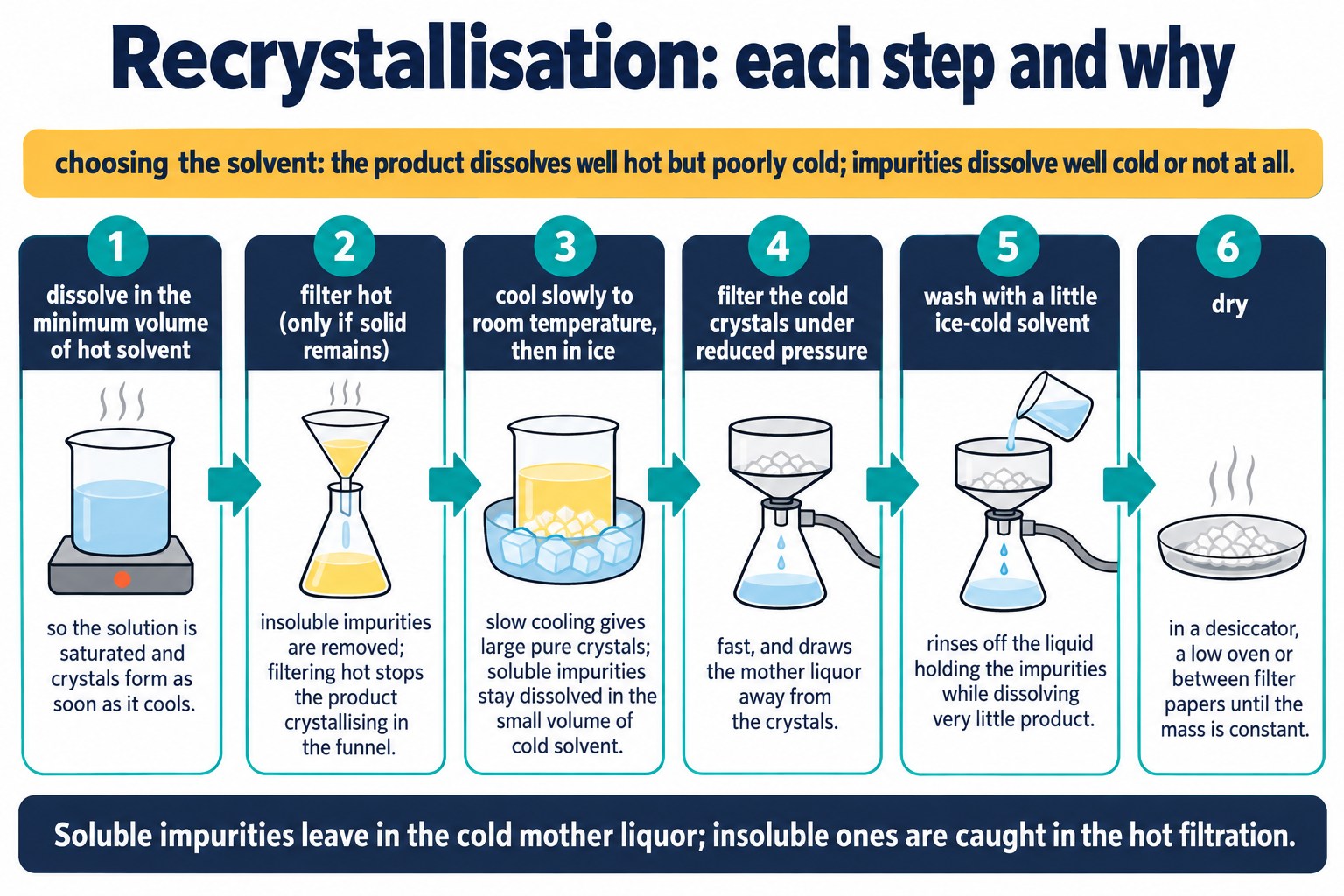
The steps of recrystallisation with the reason for each, and the rule for choosing the solvent.
Common mistake: Too much hot solvent is the classic error: the solution is not saturated on cooling and much of the product stays dissolved, so the yield falls.
Quick Check: Solvent Choice and Recovery
All the solubility figures here are invented for this exercise, so work from the data given.
Drying and Checking Purity: Melting Point
The recrystallised solid is dried and its melting point is measured. A pure solid melts sharply at a characteristic value; impurities lower it and spread it over a range.
Drying
- Press between filter papers, then leave in a desiccator over a drying agent, or in a low-temperature oven well below the melting point.
- Dry to constant mass: weigh, dry further, weigh again until the mass stops falling.
Measuring the melting point
- Tap a little dry powder into the sealed end of a capillary tube.
- Heat it slowly in a melting-point apparatus or a Thiele tube of oil, about 2 °C per minute near the expected value.
- Record the temperature when the first liquid appears and when the last solid melts.
- Compare with the data-book value.
| Pure solid | Impure solid | |
|---|---|---|
| melting behaviour | sharp, within 1 to 2 °C | over a range of several degrees |
| compared with the data book | matches | starts below the listed value |
| aspirin | melts sharply at 135 to 136 °C | crude sample softens from about 128 °C |
- Impurities disrupt the regular lattice, so less energy is needed to break it up: melting starts lower and finishes over a range.
- The same measurement confirms identity: a sharp melting point that matches the data-book value for aspirin.
- If the range is wide, recrystallise again and re-measure.
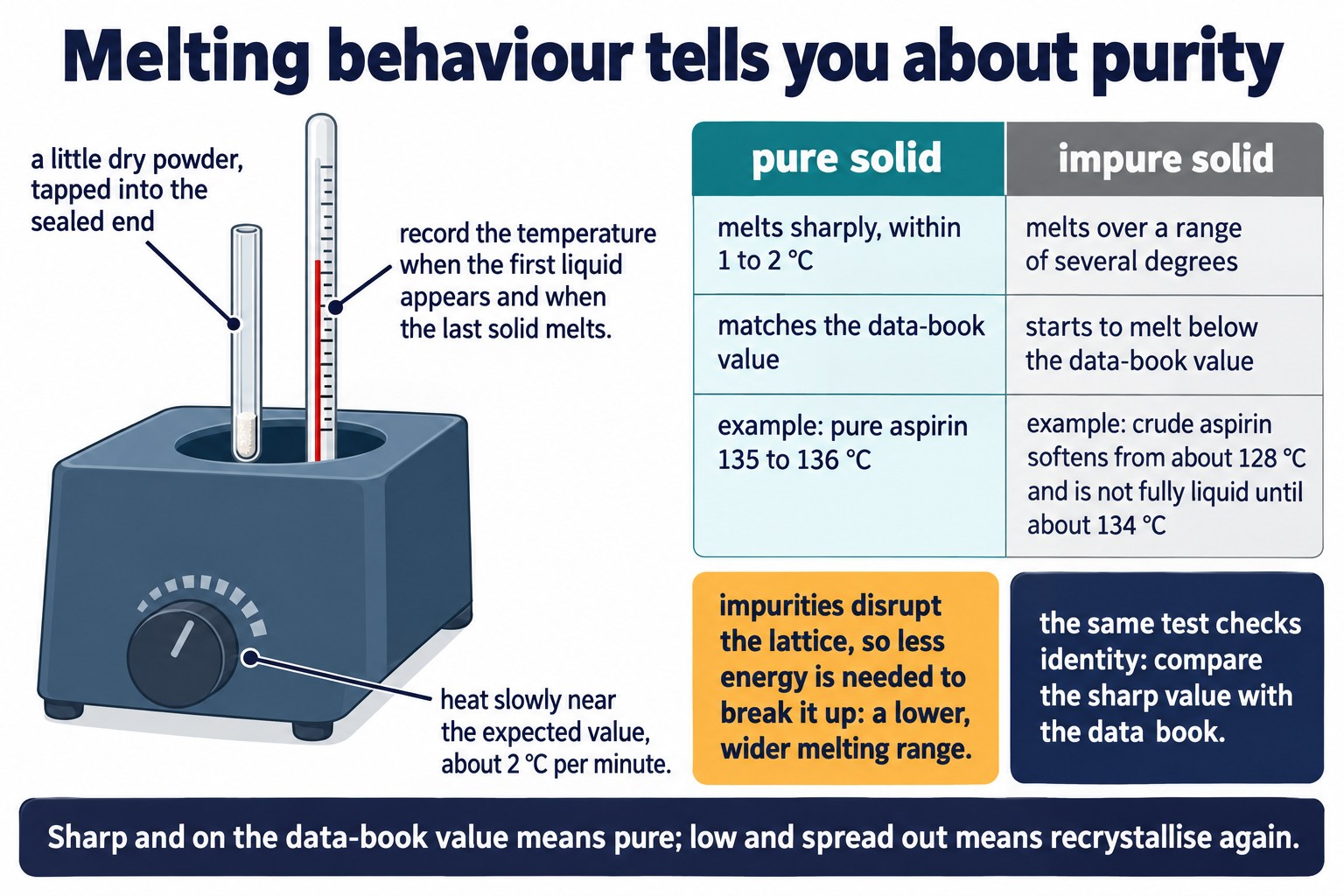
A pure solid melts sharply at the data-book value; an impure one melts lower and over a range. The aspirin values are given.
Exam wording: “Pure: sharp melting point close to the data-book value. Impure: lower and over a range.” Give both halves.
Quick Check: Judging a Sample of Solid Q
Solid Q melts at 146 °C in a data book. This value and the results are invented for this exercise.
Percentage Yield and Where Product Is Lost
The percentage yield compares the mass obtained with the maximum the equation allows from the limiting reagent.
Question. In PAG 6: the preparation of aspirin, 2.00 g of 2-hydroxybenzoic acid (Mr 138) gave 1.85 g of pure aspirin (Mr 180). Calculate the percentage yield.
Answer. Percentage yield = (1.85) / (2.61) × 100 = 70.9 %.
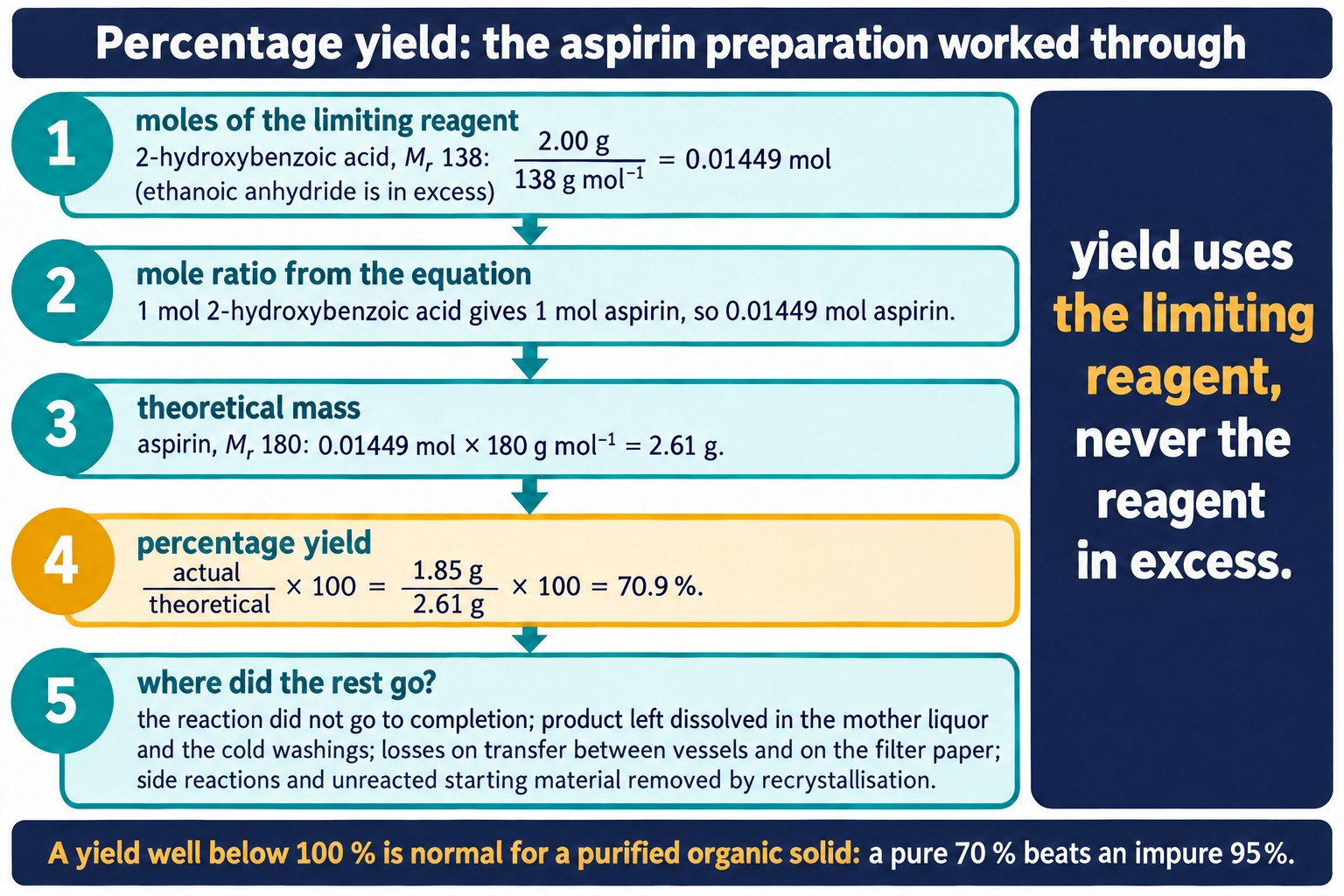
The aspirin yield calculation in four boxes: moles of the limiting reagent, ratio, theoretical mass, percentage yield.
Sources of loss
- The reaction does not go to completion, and some starting material is removed with the impurities.
- Product stays dissolved in the mother liquor and in the washings, more if the solvent was not cold.
- Transfers between vessels and crystals left on the filter paper.
- Side reactions, such as hydrolysis of the product by the water added to crystallise it.
Errors and improvements
- A yield above 100 % means the sample is wet or impure: dry to constant mass and recrystallise.
- Use the minimum hot solvent and ice-cold washes to cut solubility losses.
- Weigh the dry product on the same balance used for the starting material.
Common mistake: Working from the reagent in excess. The yield always comes from the limiting reagent, here 2-hydroxybenzoic acid.
Check: Recrystallisation, Purity and Yield
Explain each recrystallisation step, read melting behaviour and calculate yields for solids and numbers that are not used above.
Common Exam Points
- React under reflux or in a warm water bath; crystallise by cooling and adding cold water; filter under reduced pressure; wash with a little cold water.
- Filtration under reduced pressure is fast and leaves the crystals almost dry; gravity filtration is for the hot solution.
- Recrystallisation solvent: product very soluble hot, sparingly soluble cold; impurities either insoluble hot or soluble cold.
- Minimum hot solvent so the solution is saturated; filter hot to remove insoluble impurities; cool slowly for large pure crystals; wash ice-cold.
- Soluble impurities leave in the cold mother liquor; that is the whole point of the technique.
- Pure solid: sharp melting point matching the data book (aspirin 135 to 136 °C). Impure: lower and over a range.
- Yield = (actual) / (theoretical) × 100, from the limiting reagent: 2.00 g of 2-hydroxybenzoic acid gives 2.61 g of aspirin at most, so 1.85 g is 70.9 %.
- Losses: incomplete reaction, product left in the mother liquor and washings, transfers, side reactions.
- This is the chemistry behind PAG 6: learn the reasons as well as the steps.
FAQs
Use these quick answers to check filtration under reduced pressure, the reasons behind each recrystallisation step, washing, the melting point as a purity check and the yield calculation for the aspirin preparation (PAG 6).
Why do I filter under reduced pressure rather than through a filter funnel?
A Büchner funnel connected to a vacuum pulls the liquid through quickly, so the crystals are collected faster and come out much drier than with gravity filtration. The crystals can then be washed on the funnel with a little cold solvent and drawn dry.
Why must I dissolve the crude solid in the minimum volume of hot solvent?
So the solution is saturated as soon as it cools and the maximum mass of product crystallises. With too much solvent much of the product stays dissolved in the cold mother liquor and the yield falls. The impurities, present in small amounts, stay in solution.
Why are the crystals washed with ice-cold solvent?
Washing rinses away the mother liquor, which carries the soluble impurities, from the surface of the crystals. The solvent is ice-cold because the product is only sparingly soluble when cold, so very little of it dissolves and the yield is barely affected.
How does the melting point show that my solid is pure?
A pure solid melts sharply at a melting point matching the data-book value: pure aspirin melts at 135 to 136 °C. An impure sample melts lower and over a range of several degrees, because impurities disrupt the lattice. Heat the capillary tube slowly.
How do I calculate the percentage yield of aspirin?
Moles of 2-hydroxybenzoic acid = (2.00) / (138) = 0.0145 mol; the equation is 1 : 1, so the theoretical mass of aspirin is 0.0145 × 180 = 2.61 g. Percentage yield = (1.85) / (2.61) × 100 = 70.9 %. Losses come from transfer, filtration and washing.

Copyright notice: This OLS revision content, including the explanations, layout, diagrams, tables and embedded learning structure, is authored for Online Learning System by Dr. Mohammed Al-Fatah. It may not be copied, reproduced, redistributed or adapted without written permission.
Keep this note — free
Save your progress across every OCR topic. A free account remembers which topics you have covered, saves your question scores, and syncs across your phone and laptop.
- Track every topic you have finished
- Keep your practice-question scores
- No payment, no card, free forever
Already registered? Log in