Oxidation Numbers
A concise revision guide to oxidation states: what the number means, the rules for assigning it, working it out in compounds and ions (including peroxides and metal hydrides), Roman numerals in names, and writing formulae from oxidation states.
GCSE Recap: Losing and Gaining Electrons
Three quick questions on the GCSE ideas this page builds on: ions, charges and the reactivity series.
What an Oxidation state Is
An oxidation state is a number given to each atom in a substance that shows how many electrons it has gained, lost or shared compared with the free element. It is a bookkeeping tool: it treats every bond as if it were fully ionic, so the more electronegative atom is given all the shared electrons. Chemists use oxidation states to follow electrons through a reaction without drawing every dot and cross.
The sign matters. A positive oxidation state means the atom has lost control of electrons; a negative oxidation state means it has gained control. In sodium chloride the sodium ion is +1 and the chloride ion is −1, and those are also the real charges. In hydrogen chloride the bond is covalent, but chlorine is more electronegative, so hydrogen is counted as +1 and chlorine as −1 even though neither is a full ion.
Definition: The oxidation state of an atom is the charge it would have if every bond in the substance were ionic, with the shared electrons given to the more electronegative atom.
The Rules for Assigning Them
The rules are applied in order. When two rules seem to clash, the one higher in the list wins, which is why the exceptions for hydrogen and oxygen come last.
| Rule | What it says | Example |
|---|---|---|
| 1 | An atom in an uncombined element has an oxidation state of 0 | Na, O₂, S₈, Cl₂ are all 0 |
| 2 | The oxidation states in a neutral compound add up to 0; in an ion they add up to the charge on the ion | MgCl₂: +2 + 2(−1) = 0; SO₄²⁻: +6 + 4(−2) = −2 |
| 3 | Fluorine is always −1 | F in OF₂ is −1, so O is +2 |
| 4 | Group 1 metals are always +1 and Group 2 metals always +2 | K in KMnO₄ is +1; Ca in CaH₂ is +2 |
| 5 | Hydrogen is +1, except in metal hydrides where it is −1 | H in H₂O is +1; H in NaH is −1 |
| 6 | Oxygen is −2, except in peroxides where it is −1 and in OF₂ where it is +2 | O in H₂O₂ is −1 |
| 7 | Chlorine is −1 unless it is bonded to oxygen or fluorine | Cl in NaCl is −1; Cl in ClO⁻ is +1 |
The peroxide and hydride exceptions are there because the usual value would break rule 2. In hydrogen peroxide, H₂O₂, two hydrogens at +1 leave −2 to be shared by two oxygens, so each is −1. In sodium hydride, NaH, sodium must be +1, so hydrogen has to be −1.
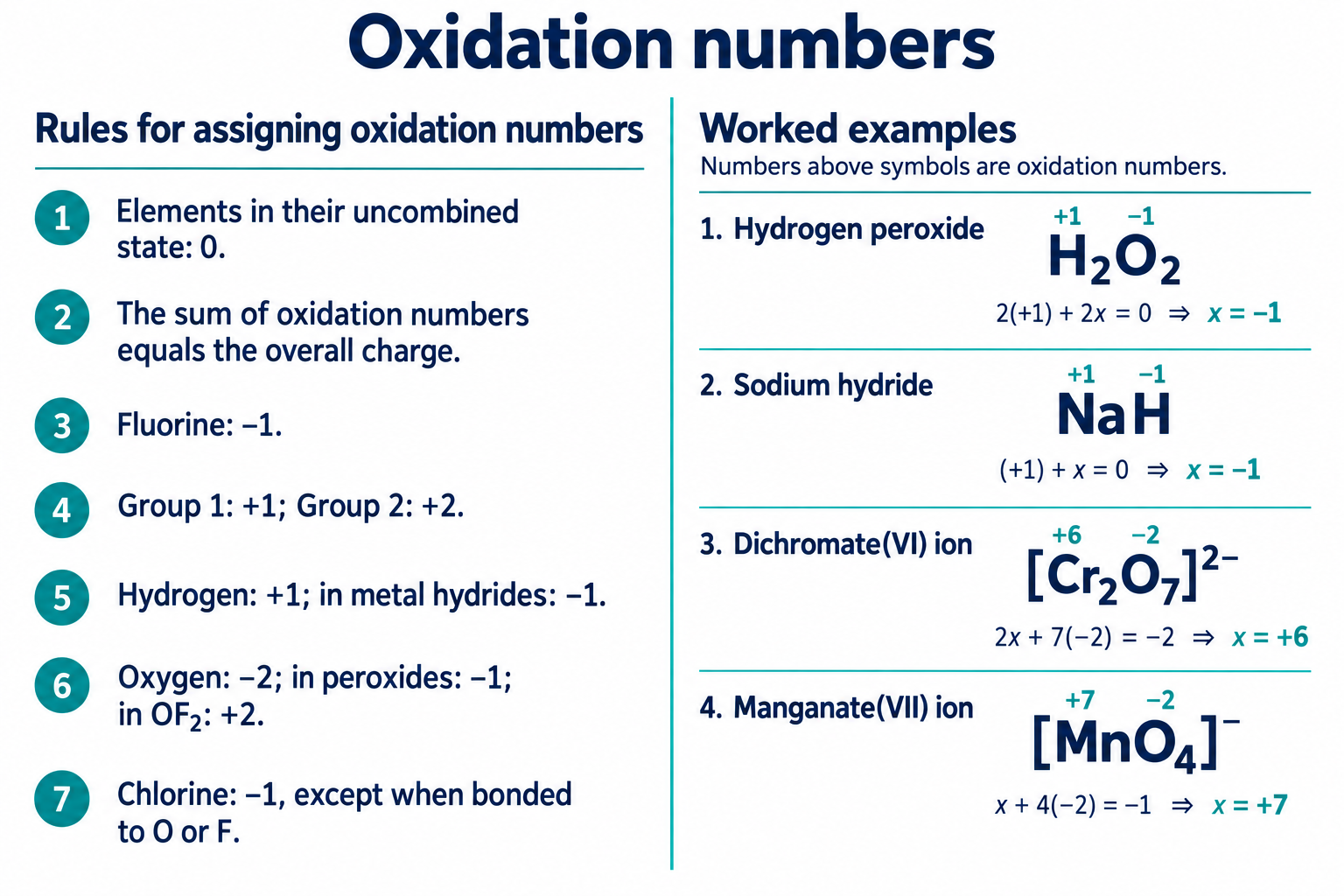
The rules in order, with the four exceptions that questions test most: peroxides, metal hydrides, dichromate(VI) and manganate(VII).
Exam focus: Learn the order. Questions are built around the exceptions, and the reason each exception exists is always “so that the oxidation states add up to the overall charge”.
Check: Assigning the Rules
Decide which rule fixes each atom in a set of compounds and ions you have not met on this page.
Working Out an Oxidation state
To find the oxidation state of one element in a formula, give every other element its usual value and let the unknown make the total come out right.
- Write the oxidation state of every element you are sure of (Group 1, Group 2, fluorine, then oxygen and hydrogen).
- Multiply each value by the number of atoms of that element in the formula.
- Set the total equal to the overall charge (0 for a compound) and solve for the unknown.
Worked example 1: sulfur in sulfuric acid, H₂SO₄. Hydrogen 2 × (+1) = +2, oxygen 4 × (−2) = −8, so +2 + S − 8 = 0 and S = +6.
Worked example 2: chromium in the dichromate(VI) ion, Cr₂O₇²⁻. Oxygen 7 × (−2) = −14, so 2Cr − 14 = −2 and 2Cr = +12, giving Cr = +6. Notice that the answer is the value per chromium atom, not the total.
Worked example 3: nitrogen in the ammonium ion, NH₄⁺. Hydrogen 4 × (+1) = +4, so N + 4 = +1 and N = −3.
Common mistake: Dividing at the wrong point. In Cr₂O₇²⁻ the seven oxygens contribute −14 in total, and the +12 that remains is shared between two chromium atoms. Always quote the oxidation state per atom.
Check: Calculating Oxidation states
Type the oxidation state of the named element in each species. None of them appears in the worked examples above.
Peroxides and Metal Hydrides
These two families are the standard exam traps, so they deserve their own section. A peroxide contains the O₂²⁻ ion or an O–O single bond, and each oxygen is −1. Hydrogen peroxide, H₂O₂, sodium peroxide, Na₂O₂, and barium peroxide, BaO₂, all contain oxygen at −1. Compare barium peroxide with barium oxide, BaO, where oxygen is the usual −2.
A metal hydride is a compound of hydrogen with a reactive metal, such as sodium hydride, NaH, calcium hydride, CaH₂, or lithium aluminium hydride, LiAlH₄. The metal is more electropositive than hydrogen, so hydrogen takes the electron and is −1. These compounds react with water to release hydrogen gas, because the H⁻ ion is a powerful reducing agent.
| Compound | Element | oxidation state | Reason |
|---|---|---|---|
| H₂O₂ | O | −1 | peroxide: two H at +1 leave −2 for two O |
| Na₂O₂ | O | −1 | two Na at +1 leave −2 for two O |
| NaH | H | −1 | Na must be +1 |
| CaH₂ | H | −1 | Ca must be +2, so 2H = −2 |
| OF₂ | O | +2 | fluorine is always −1 |
Remember: A formula with O₂ in it is a peroxide only when the metal is Group 1 or 2 and the oxygen count does not fit the usual −2. Barium peroxide BaO₂ is a peroxide; manganese(IV) oxide MnO₂ is not, because Mn can be +4.
Roman Numerals in Names
Many elements form compounds in more than one oxidation state, so the name shows the value as a Roman numeral in brackets immediately after the element it refers to. Iron(II) chloride is FeCl₂ and iron(III) chloride is FeCl₃. The numeral is written without a sign because it is always positive.
The same convention names ions that contain oxygen. Manganate(VII) is MnO₄⁻, with manganese at +7; chlorate(I) is ClO⁻, with chlorine at +1; chlorate(V) is ClO₃⁻, with chlorine at +5. Sulfate(VI) and sulfate(IV) distinguish SO₄²⁻ from SO₃²⁻, although the older names sulfate and sulfite are still widely used.
| Name | Formula | oxidation state shown |
|---|---|---|
| copper(I) oxide | Cu₂O | Cu +1 |
| copper(II) oxide | CuO | Cu +2 |
| potassium manganate(VII) | KMnO₄ | Mn +7 |
| sodium chlorate(I) | NaClO | Cl +1 |
| potassium dichromate(VI) | K₂Cr₂O₇ | Cr +6 |
| lead(IV) oxide | PbO₂ | Pb +4 |
Exam wording: The numeral refers to the element immediately before the bracket. In potassium manganate(VII) it is manganese that is +7, not potassium.
Writing Formulae from Oxidation states
Given the oxidation states, a formula is written so that the positive and negative values cancel. Find the lowest whole-number ratio of atoms that makes the total zero.
Worked example: the formula of chromium(III) sulfate. Chromium is +3 and the sulfate ion is −2. The lowest common multiple of 3 and 2 is 6, so two chromium ions (+6) balance three sulfate ions (−6): Cr₂(SO₄)₃.
Worked example: the formula of vanadium(V) oxide. Vanadium is +5 and oxygen is −2. Two vanadium atoms (+10) balance five oxygens (−10): V₂O₅.
The reverse question is just as common: “Name the compound PbO₂.” Oxygen is −2 and there are two of them, so lead is +4 and the name is lead(IV) oxide.
Key idea: The ratio in the formula is the ratio that cancels the charges, then simplified. Brackets are needed round a compound ion when there is more than one of it.
Check: Names and Formulae
Match Roman-numeral names to formulae and write formulae from oxidation numbers for compounds not shown above.
Common Exam Points
Deduce the oxidation state of an element in a compound or ion
Give every other element its usual value, multiply by the number of atoms, and make the total equal the overall charge.
Explain why oxygen is −1 in hydrogen peroxide
The two hydrogens are +1 each, so the two oxygens must total −2 to make the compound neutral, which is −1 each.
Give the oxidation state shown by a Roman numeral
The numeral is the oxidation state of the element written immediately before the bracket, and it is always positive.
Do not say
“The oxidation state of chromium in Cr₂O₇²⁻ is +12”; “hydrogen is always +1”; “the oxidation state of an element in a molecule such as O₂ is −2”.
FAQs
Use these quick answers to check the oxidation state rules that come up most often in AQA questions.
What is an oxidation state?
A number that shows how many electrons an atom has gained, lost or shared compared with the free element, counting every bond as if it were ionic. It is a bookkeeping tool, not always a real charge.
Why is hydrogen −1 in sodium hydride?
Sodium must be +1, and the compound is neutral, so hydrogen has to be −1. Hydrogen takes the electron because it is more electronegative than the metal.
Is the oxidation state of chromium in Cr₂O₇²⁻ +12?
No. The two chromium atoms total +12, so each chromium is +6. Always quote the value per atom.
What does the Roman numeral in a name tell me?
The oxidation state of the element written immediately before the bracket. Iron(III) chloride contains iron at +3 and is FeCl₃.
Can an oxidation state be a fraction?
In a few compounds the average value is a fraction, such as sulfur in S₄O₆²⁻ (+2.5), because the atoms are not all in the same environment. Exam questions avoid these unless they say so.
Copyright and author footprint: This OLS revision page was written for Online Learning System by Dr. Mohammed Al-Fatah. It is designed for A Level Chemistry revision and should not be copied or redistributed without permission.
Keep this note — free
Save your progress across every AQA topic. A free account remembers which topics you have covered, saves your question scores, and syncs across your phone and laptop.
- Track every topic you have finished
- Keep your practice-question scores
- No payment, no card, free forever
Already registered? Log in