Redox Classification
A concise revision guide to using oxidation states to decide whether a reaction is redox, disproportionation or neither, applied to s-block and p-block reactions, metals with acids and unfamiliar reactions given as equations.
Using Oxidation states to Classify Reactions
Every reaction can be tested with one question: does the oxidation state of any element change? If it does, the reaction is redox; if nothing changes, it is not. Acid–base reactions, precipitation reactions and thermal decompositions that only rearrange ions are not redox, even when they look dramatic. Combustion, displacement, the reactions of metals with acids and every reaction of an element are redox.
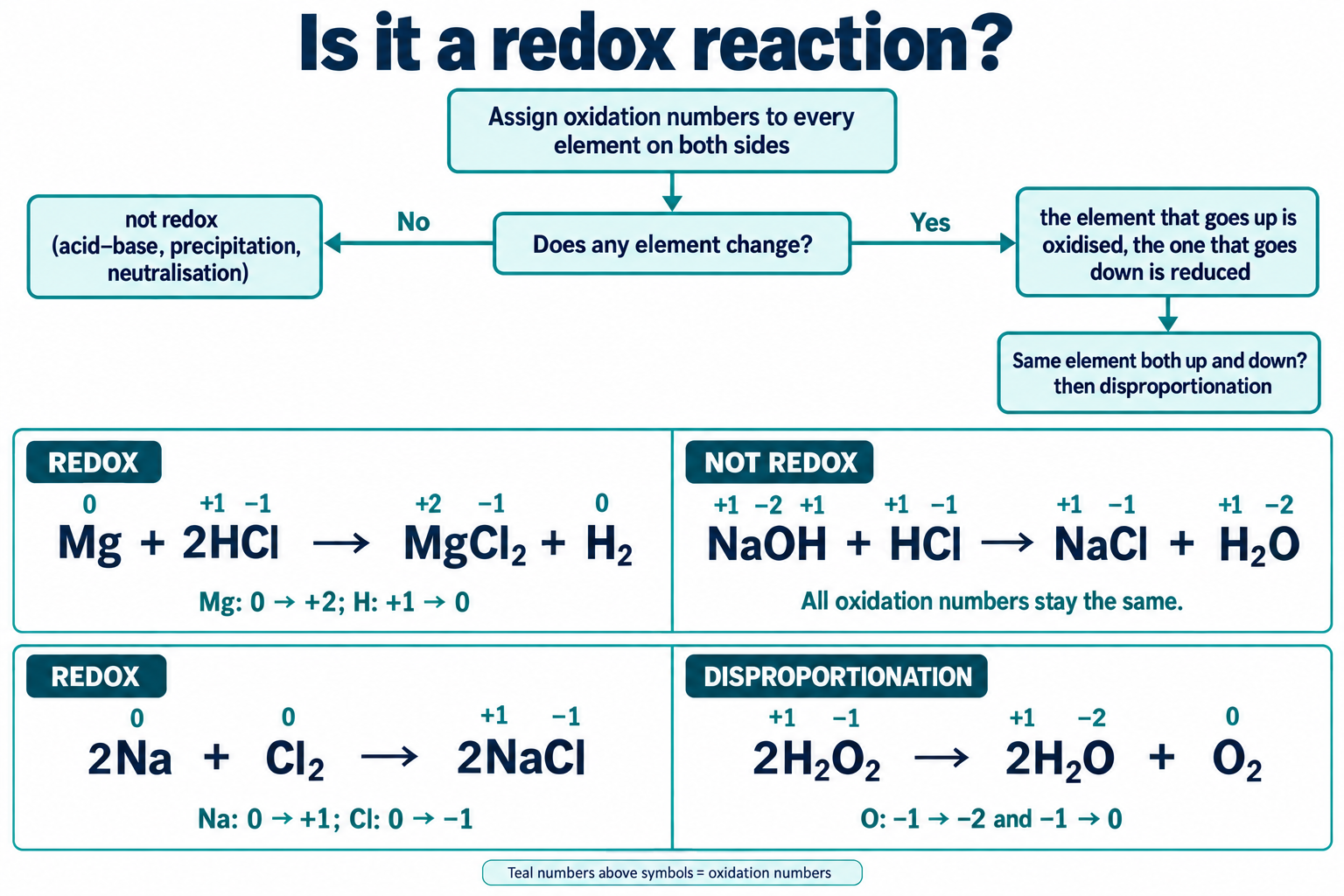
The flowchart asks one question first, then names the element oxidised and the element reduced, then checks whether they are the same element.
The second use of the test is to sort redox reactions into ordinary redox, where two different elements change, and disproportionation, where one element goes both ways. The flowchart handles both.
Key idea: Assign oxidation states to every element on both sides before deciding anything. A quick look at the equation is not enough: the reaction of chlorine with water looks like a simple addition until the numbers are written in.
Check: Redox or Not?
Sort a set of equations you have not met on this page into redox and not redox by assigning oxidation states.
Redox in the s-Block
The Group 1 and Group 2 metals have low ionisation energies, so their reactions are all oxidations of the metal. When calcium reacts with water, Ca + 2H₂O → Ca(OH)₂ + H₂, calcium rises from 0 to +2 and is oxidised. Hydrogen in the water falls from +1 to 0 and is reduced; the oxygen stays at −2 throughout. Calcium is the reducing agent and water is the oxidising agent.
When sodium burns in oxygen, 4Na + O₂ → 2Na₂O, sodium rises from 0 to +1 and oxygen falls from 0 to −2. The same sentences describe magnesium burning, lithium in chlorine and barium in water: the metal is oxidised, the non-metal is reduced.
Exam sentence: Calcium is oxidised because its oxidation state increases from 0 to +2; hydrogen is reduced because its oxidation state decreases from +1 to 0.
Redox in the p-Block
The p-block non-metals are usually the oxidising agents. Chlorine displacing bromine from bromide ions, Cl₂ + 2Br⁻ → 2Cl⁻ + Br₂, reduces chlorine (0 to −1) and oxidises bromine (−1 to 0). Sulfur burning, S + O₂ → SO₂, oxidises sulfur (0 to +4) and reduces oxygen. Carbon reducing iron(III) oxide in a blast furnace, Fe₂O₃ + 3CO → 2Fe + 3CO₂, oxidises carbon (+2 to +4) and reduces iron (+3 to 0).
The p-block also provides the reactions that are not redox. Sulfur dioxide dissolving in water to give sulfurous acid keeps sulfur at +4. Phosphorus(V) chloride hydrolysing keeps phosphorus at +5. In both, atoms are rearranged but no electrons move.
| Reaction | Element up | Element down | Classification |
|---|---|---|---|
| 2Al + 3Cl₂ → 2AlCl₃ | Al, 0 to +3 | Cl, 0 to −1 | redox |
| SO₂ + H₂O → H₂SO₃ | none | none | not redox |
| 2NO₂ + H₂O → HNO₃ + HNO₂ | N, +4 to +5 | N, +4 to +3 | disproportionation |
| Cl₂ + 2KI → 2KCl + I₂ | I, −1 to 0 | Cl, 0 to −1 | redox |
| CaCO₃ → CaO + CO₂ | none | none | not redox |
Common mistake: Assuming that any reaction with oxygen in it is redox. Thermal decomposition of a carbonate moves oxygen atoms around without changing any oxidation state.
Metals Reacting with Acids
A metal reacting with a dilute acid to form a salt and hydrogen is a redox reaction in which the metal is oxidised and the hydrogen ions are reduced. For zinc in hydrochloric acid the full equation is Zn + 2HCl → ZnCl₂ + H₂ and the ionic equation is Zn + 2H⁺ → Zn²⁺ + H₂. The chloride ions are spectators and their oxidation state does not change.
The half-equations make the electron transfer explicit: Zn → Zn²⁺ + 2e⁻ (oxidation) and 2H⁺ + 2e⁻ → H₂ (reduction). Magnesium with sulfuric acid, iron with hydrochloric acid and aluminium with any dilute acid follow the same pattern; only the charge on the metal ion, and so the number of electrons, changes.
Exam focus: Write the ionic equation with state symbols and be ready to say which species is the oxidising agent. In Zn + 2H⁺ → Zn²⁺ + H₂ the oxidising agent is H⁺, because the hydrogen ions gain the electrons.
Check: Metals, Acids and Half-Equations
Write the ionic equation and half-equations for a metal and acid combination not used on this page, and name the oxidising agent.
Unfamiliar Redox Reactions
Exam questions often give an equation for a reaction that has never been taught and ask for the oxidation states, the species oxidised and reduced, and the oxidising and reducing agents. The method is always the same and does not need the chemistry to be recognised.
- Assign oxidation states to every element on both sides.
- Find the element whose value rises: it has been oxidised, and the species containing it is the reducing agent.
- Find the element whose value falls: it has been reduced, and the species containing it is the oxidising agent.
- Check that the total rise equals the total fall; if it does not, the equation is not balanced.
Worked example: 3Cu + 8HNO₃ → 3Cu(NO₃)₂ + 2NO + 4H₂O. Copper rises from 0 to +2 (oxidised, so copper is the reducing agent). Nitrogen in HNO₃ is +5; in NO it is +3, so two of the eight nitrogen atoms have been reduced. Nitric acid is the oxidising agent. Total rise 3 × 2 = 6; total fall 2 × 3 = 6, so the equation balances.
Technique point: Not every atom of the oxidising agent is reduced. Six of the eight nitrate ions here are spectators that end up in copper(II) nitrate; only the two that form NO change.
Check: An Unfamiliar Equation
Work through an equation for a reaction you have not studied and identify the oxidising and reducing agents.
Common Exam Points
State whether a reaction is redox and explain
Yes or no, then the element and its change: “redox, because copper changes from 0 to +2 and nitrogen from +5 to +3”.
Identify the reducing agent
The species containing the element that is oxidised, named as the whole species, for example “copper” or “iodide ions”.
Do not say
“The reaction is redox because oxygen is involved”; “the reducing agent is reduced”; “nitrogen is reduced” without giving the values.
FAQs
Use these quick answers to check how reactions are classified with oxidation states.
How do I know if a reaction is redox?
Assign oxidation states to every element on both sides. If any value changes, the reaction is redox; if none changes, it is not.
Is neutralisation a redox reaction?
No. Hydrogen stays at +1, oxygen at −2 and the other elements unchanged, so no electrons are transferred.
What is the oxidising agent when magnesium reacts with acid?
The hydrogen ions, H⁺, because they gain the electrons that magnesium loses and are reduced to hydrogen gas.
Does every atom of the oxidising agent get reduced?
Not always. In copper reacting with nitric acid only some of the nitrate ions are reduced to nitrogen monoxide; the rest end up unchanged in copper(II) nitrate.
How do I check an unfamiliar redox equation is balanced?
The total increase in oxidation state must equal the total decrease, and the charges on each side must be equal.
Copyright and author footprint: This OLS revision page was written for Online Learning System by Dr. Mohammed Al-Fatah. It is designed for A Level Chemistry revision and should not be copied or redistributed without permission.
Keep this note — free
Save your progress across every AQA topic. A free account remembers which topics you have covered, saves your question scores, and syncs across your phone and laptop.
- Track every topic you have finished
- Keep your practice-question scores
- No payment, no card, free forever
Already registered? Log in