Trends Down Groups 1 and 2
A concise revision guide to the trends down Groups 1 and 2: electron configurations, atomic radius, first and second ionisation energies and melting points, and why reactivity increases down each group. Group 2 is the examined group; Group 1 is kept for comparison.
GCSE Recap: The Alkali Metals
Three quick questions on what you already know about Group 1: their electron configurations, their ions and why potassium is more reactive than lithium.
Where This Sits in Your Specification
OCR 3.1.2 examines Group 2 only. The Group 1 metals are kept in the tables for comparison, because the same reasoning explains both groups, but questions will be set on magnesium to barium.
Electron Configurations and the Ions Formed
Every Group 1 element has one electron in its outer s sub-shell (ns¹) and every Group 2 element has two (ns²). Sodium is 1s² 2s² 2p⁶ 3s¹ and magnesium is 1s² 2s² 2p⁶ 3s². Losing those outer electrons leaves the stable configuration of the noble gas before, so the metals form M⁺ and M²⁺ ions in every compound and their chemistry is a series of oxidations.
Both groups are the s-block, and their reactions are alike because the same outer electrons are lost each time. The differences between the two groups come from the number of electrons lost, and the differences down each group come from how far those electrons sit from the nucleus.
Key idea: Group 1 loses one electron to give +1 ions; Group 2 loses two to give +2 ions. Every reaction of these metals is an oxidation of the metal.
Atomic Radius
Atomic radius increases down each group because each element has one more occupied shell than the one above it. The extra inner shells also shield the outer electron from the nucleus, so the rise in nuclear charge does not pull the outer shell in.
| Element | Atomic radius / pm | Element | Atomic radius / pm |
|---|---|---|---|
| Li | 152 | Be | 112 |
| Na | 186 | Mg | 160 |
| K | 227 | Ca | 197 |
| Rb | 248 | Sr | 215 |
| Cs | 265 | Ba | 222 |
Atomic and Ionic Radii Across Period 3 and Down Group 1
Every sphere is drawn to scale against the 0.1 nm ruler, so the sizes can be compared directly. Drag to rotate, scroll or pinch to zoom.
© Dr. Mohammed Al-Fatah – onlinelearningsystem.net
Exam wording: “More shells” and “more shielding” are both needed. A larger atom is one whose outer electrons are in a higher energy level, further from the nucleus.
First and Second Ionisation Energies
First ionisation energy decreases down each group. The outer electron is further from the nucleus and shielded by more inner shells, so the attraction holding it is weaker and less energy is needed to remove it. The increase in nuclear charge is outweighed by the extra distance and shielding.
| Element | 1st IE / kJ mol⁻¹ | Element | 1st IE / kJ mol⁻¹ | 2nd IE / kJ mol⁻¹ |
|---|---|---|---|---|
| Li | 520 | Be | 900 | 1757 |
| Na | 496 | Mg | 738 | 1451 |
| K | 419 | Ca | 590 | 1145 |
| Rb | 403 | Sr | 550 | 1064 |
| Cs | 376 | Ba | 503 | 965 |
For Group 2 the second ionisation energy matters too, because both outer electrons are lost. It is larger than the first, because the second electron is removed from a positive ion, but it follows the same downward trend for the same reasons. The sum of the first two ionisation energies is what decides how easily a Group 2 metal forms its 2+ ion.
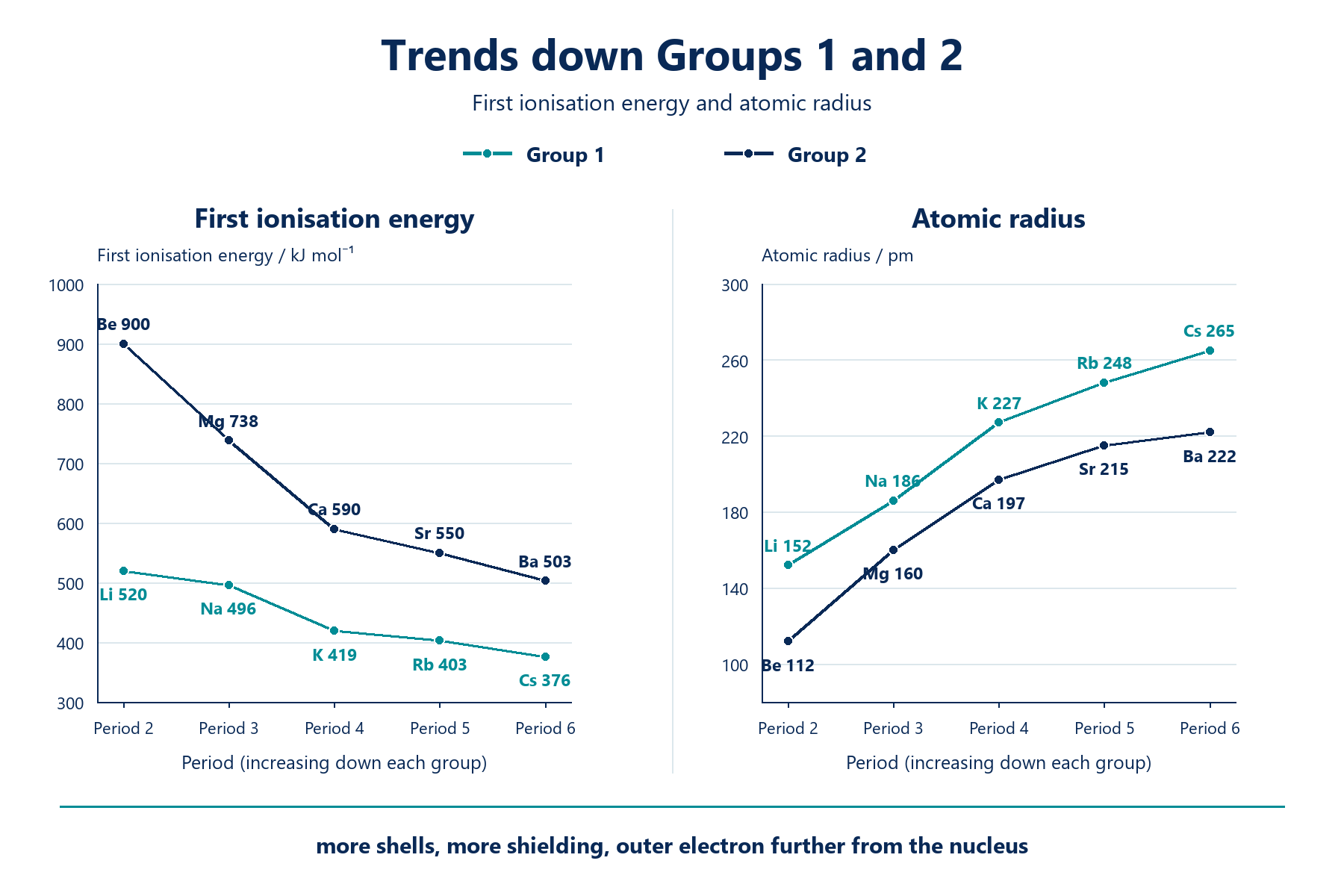
Both groups show the same pattern: ionisation energy falls and atomic radius rises down the group, because each step adds a shell.
Common mistake: Saying the outer electron is “less attracted because there are more electrons”. The reason is distance and shielding; the number of electrons on its own is not an explanation.
Check: Explaining the Ionisation Energy Trend
Choose the complete explanation for a Group 2 data set and identify the flawed reasons in others.
Melting Points
The s-block metals are held together by metallic bonding: positive ions in a sea of delocalised electrons. Down each group the ions get larger, so the delocalised electrons are further from the nuclei and the attraction between them is weaker. Melting points therefore generally fall down the group. Group 1 shows a smooth fall (lithium 181 °C, sodium 98 °C, potassium 63 °C, rubidium 39 °C, caesium 28 °C). Group 2 falls overall (beryllium 1287 °C, barium 727 °C) but not smoothly, because magnesium adopts a different crystal structure from the metals below it.
Group 2 metals melt at much higher temperatures than their Group 1 neighbours because each ion contributes two electrons to the sea and carries a 2+ charge, so the metallic bonding is much stronger.
Exam focus: Explain metallic melting points in terms of the charge on the ion, the size of the ion and the number of delocalised electrons per ion. Never mention covalent bonds or intermolecular forces for a metal.
Check: Metallic Bonding Down a Group
Rank and explain melting points for metals from a data set that is not the one printed above.
Why Reactivity Increases Down the Group
Every reaction of these metals starts with the loss of the outer electrons, so reactivity increases down the group as ionisation energy falls. Potassium reacts more violently with water than lithium because its outer electron is further from the nucleus, more shielded and more easily lost. Barium reacts with cold water where magnesium barely does, for the same reason.
This is a trend in the ease of forming the ion, not in the stability of the compounds formed. Once formed, Mg²⁺ and Ba²⁺ compounds are all stable ionic solids.
Exam sentence: Reactivity increases down Group 2 because the outer electrons are further from the nucleus and more shielded, so the first and second ionisation energies decrease and the electrons are lost more easily.
Check: Predicting Reactivity
Apply the ionisation energy argument to predict and explain the behaviour of an s-block metal you have not been given data for.
Common Exam Points
Explain the trend in first ionisation energy down Group 2
Atomic radius increases and shielding increases, so the outer electron is less strongly attracted to the nucleus and less energy is needed to remove it, even though the nuclear charge increases.
Explain why calcium is more reactive than magnesium
The outer electrons of calcium are further from the nucleus and more shielded, so the first and second ionisation energies are lower and the electrons are lost more easily.
Explain the trend in melting point
Larger ions with the same charge and the same number of delocalised electrons give weaker metallic bonding.
Do not say
“The atom is bigger so it is more reactive” without mentioning ionisation energy; “more electrons means more shielding” as the whole answer.
FAQs
Use these quick answers to check the Group 2 trends.
Why does atomic radius increase down the group?
Each element has one more occupied shell than the one above it, so the outer electrons are further from the nucleus.
Why does first ionisation energy decrease down the group?
The outer electron is further from the nucleus and shielded by more inner shells, so it is less strongly attracted and easier to remove, even though the nuclear charge is larger.
Why do Group 2 metals have higher melting points than Group 1 metals?
Each Group 2 ion is 2+ and gives two delocalised electrons, so the metallic bonding is much stronger.
Why is barium more reactive than magnesium?
Its outer electrons are further from the nucleus and more shielded, so its first and second ionisation energies are lower and the electrons are lost more easily.
Why is the second ionisation energy of magnesium larger than the first?
The second electron is removed from a positive ion, so it is held more strongly by the same nuclear charge.
Copyright and author footprint: This OLS revision page was written for Online Learning System by Dr. Mohammed Al-Fatah. It is designed for A Level Chemistry revision and should not be copied or redistributed without permission.
Keep this note — free
Save your progress across every OCR A topic. A free account remembers which topics you have covered, saves your question scores, and syncs across your phone and laptop.
- Track every topic you have finished
- Keep your practice-question scores
- No payment, no card, free forever
Already registered? Log in