Halogens as Oxidising Agents
A concise revision guide to the halogens as oxidising agents: displacement reactions of chlorine, bromine and iodine with halide ions, colours in water and in a non-polar solvent, reactions with metals and with hydrogen, and the trend in oxidising power explained.
Displacement Reactions
A more reactive halogen displaces a less reactive one from a solution of its halide ions. Chlorine water added to potassium bromide solution turns it orange, because bromine is formed; added to potassium iodide it turns brown, because iodine is formed. Bromine displaces iodide ions but cannot displace chloride ions, and iodine displaces nothing.
Cl₂ + 2Br⁻ → 2Cl⁻ + Br₂ Cl₂ + 2I⁻ → 2Cl⁻ + I₂ Br₂ + 2I⁻ → 2Br⁻ + I₂
Each is a redox reaction. The halogen is reduced (0 to −1) and acts as the oxidising agent; the halide ion is oxidised (−1 to 0). The order of oxidising power is Cl₂ > Br₂ > I₂, so a halogen can only oxidise the halide ions of an element below it in the group.
Definition: A halogen higher in the group is a stronger oxidising agent, so it takes electrons from the halide ions of a halogen lower in the group.
Colours in Water and in an Organic Solvent
The product is identified by its colour. In water the colours are similar, so an organic solvent such as cyclohexane is added and the tube is shaken: the halogen dissolves in the upper organic layer and shows a distinctive colour.
| Halogen | Colour in water | Colour in cyclohexane |
|---|---|---|
| Chlorine | pale green | pale green |
| Bromine | orange (yellow when dilute) | orange-red |
| Iodine | brown | purple |
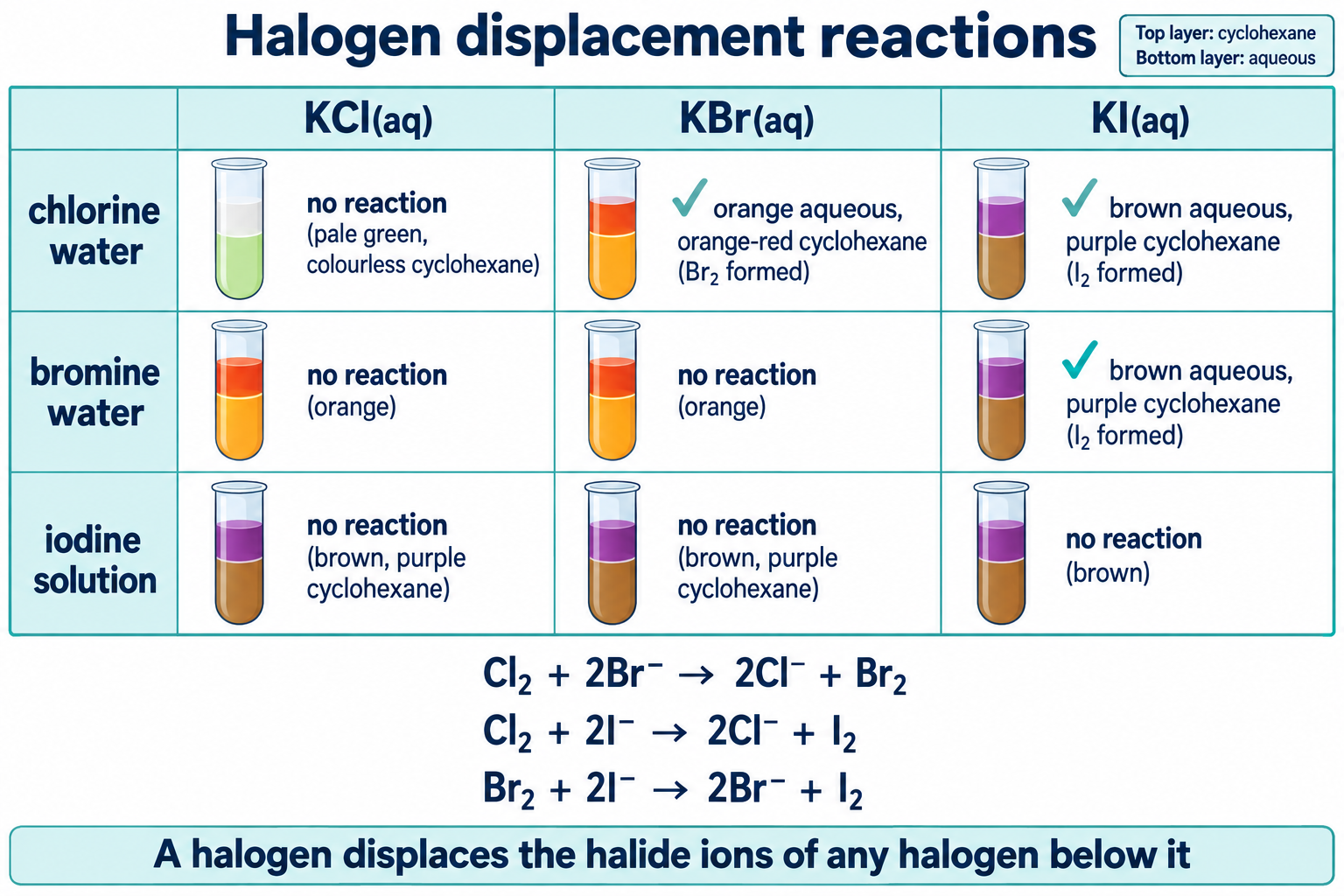
Ticks appear only where the halogen added is higher in the group than the halide in the solution; the cyclohexane layer makes the product easy to name.
Iodine dissolves poorly in water on its own; it dissolves in potassium iodide solution as the brown triiodide ion, I₃⁻, which is what is usually seen in the aqueous layer.
Exam wording: “The solution turns from colourless to brown, and the cyclohexane layer turns purple, showing that iodine has been displaced.”
Check: Predicting Displacement
Predict the observations, in water and in cyclohexane, for halogen and halide combinations not listed above, and write the ionic equations.
Explaining the Trend in Oxidising Power
The trend in oxidising power follows the trend in electronegativity. Chlorine attracts an extra electron strongly because its outer shell is close to the nucleus and only lightly shielded. Iodine’s outer shell is further away and shielded by three more inner shells, so it attracts an incoming electron much less strongly and is the weakest oxidising agent of the three.
Fluorine is stronger still, but it reacts with water, so displacement reactions are not carried out with fluorine in solution.
Exam sentence: Chlorine is a stronger oxidising agent than bromine because a chlorine atom is smaller and its outer shell is less shielded, so it attracts an electron from a bromide ion more strongly.
Reactions with Metals
The halogens oxidise metals to form ionic halides, the halogen being reduced from 0 to −1. Heated sodium burns in chlorine with a yellow flame and white smoke of sodium chloride; magnesium burns in bromine vapour to give magnesium bromide; iron wool glows in chlorine to give iron(III) chloride.
2Na + Cl₂ → 2NaCl Mg + Br₂ → MgBr₂ 2Fe + 3Cl₂ → 2FeCl₃ 2K + I₂ → 2KI
The vigour of the reaction falls down the group, so chlorine reacts violently, bromine steadily and iodine only on strong heating. With iron the choice of halogen even changes the product: chlorine gives iron(III) chloride, but iodine, the weaker oxidising agent, can only reach iron(II) iodide.
Key idea: In every reaction of a halogen with a metal the halogen is the oxidising agent and its oxidation number falls from 0 to −1.
Check: Halogens and Metals
Write the equation and describe the redox changes for a metal and halogen pair not shown above.
Common Exam Points
State what is seen when chlorine water is added to potassium iodide solution
The solution turns brown; if cyclohexane is added and the tube shaken, the upper layer turns purple.
Explain why bromine cannot displace chloride ions
Bromine is a weaker oxidising agent than chlorine, so it cannot take electrons from chloride ions.
Identify the oxidising agent in a displacement
The halogen molecule, because its oxidation number falls from 0 to −1.
Do not say
“Chlorine is more reactive so it displaces” without explaining why; “iodine turns the cyclohexane brown”; “the halide ion is reduced”.
FAQs
Use these quick answers to check the displacement reactions and the halogens as oxidising agents.
Which halogen displaces which?
A halogen displaces the ions of any halogen below it in the group: chlorine displaces bromide and iodide, bromine displaces iodide only, iodine displaces neither.
What is oxidised and what is reduced in a displacement?
The halide ion is oxidised (−1 to 0) and the halogen molecule is reduced (0 to −1), so the halogen is the oxidising agent.
Why add cyclohexane?
The halogen formed dissolves in the organic layer and shows a clearer colour: orange-red for bromine and purple for iodine.
Why is chlorine a stronger oxidising agent than iodine?
A chlorine atom is smaller and its outer shell is less shielded, so it attracts an electron much more strongly than iodine does.
Can iodine oxidise chloride ions?
No. Iodine is a weaker oxidising agent than chlorine, so it cannot take electrons from chloride ions.
Copyright and author footprint: This OLS revision page was written for Online Learning System by Dr. Mohammed Al-Fatah. It is designed for A Level Chemistry revision and should not be copied or redistributed without permission.
Keep this note — free
Save your progress across every OCR A topic. A free account remembers which topics you have covered, saves your question scores, and syncs across your phone and laptop.
- Track every topic you have finished
- Keep your practice-question scores
- No payment, no card, free forever
Already registered? Log in