Thermodynamic and Kinetic Stability
A concise revision guide to the difference between a reaction that cannot happen and one that is feasible but too slow to notice: thermodynamic stability, kinetic stability, why a large activation energy stops a feasible reaction, and the limits of predictions made from entropy and Gibbs energy.
- 13B.21
- 13B.22
What these spec points say
- 13B.21 understand why a reaction for which the ΔG value is negative may not occur in practice
- 13B.22 know that reactions that are thermodynamically feasible may be inhibited by kinetic factors
Feasible Does Not Mean Fast
A positive ΔS_total tells you that a reaction can happen. It says nothing about how fast it happens.
The difference between the two questions is one of the most examined ideas in this topic.
| Example | Why it should happen | What is seen at room temperature |
|---|---|---|
| A mixture of hydrogen and oxygen | ΔG = −474 kJ mol⁻¹ for 2H₂(g) + O₂(g) → 2H₂O(l), about as feasible as a reaction gets | the mixture can be kept for years without any water forming |
| Petrol in an open can in the air | burning in air is feasible | it does not burn |
| Diamond | slightly higher Gibbs energy than graphite: ΔG = −3 kJ mol⁻¹ for diamond → graphite at 298 K | every diamond should be turning into graphite, and none noticeably does |
In each case the reaction is feasible but so slow at room temperature that it does not appear to happen at all.
The energy barrier
The reason is the activation energy, Eₐ. ΔS_total and ΔG compare the reactants with the products; they say nothing about the energy barrier between them.
For hydrogen and oxygen:
- The molecules must collide with enough energy to break the H–H and O=O bonds before any water can form.
- At room temperature almost no collisions have that energy.
- A spark supplies it locally, and the heat released then supplies it for the rest: the mixture explodes.
Thermodynamics said the reaction could happen; kinetics decided when.
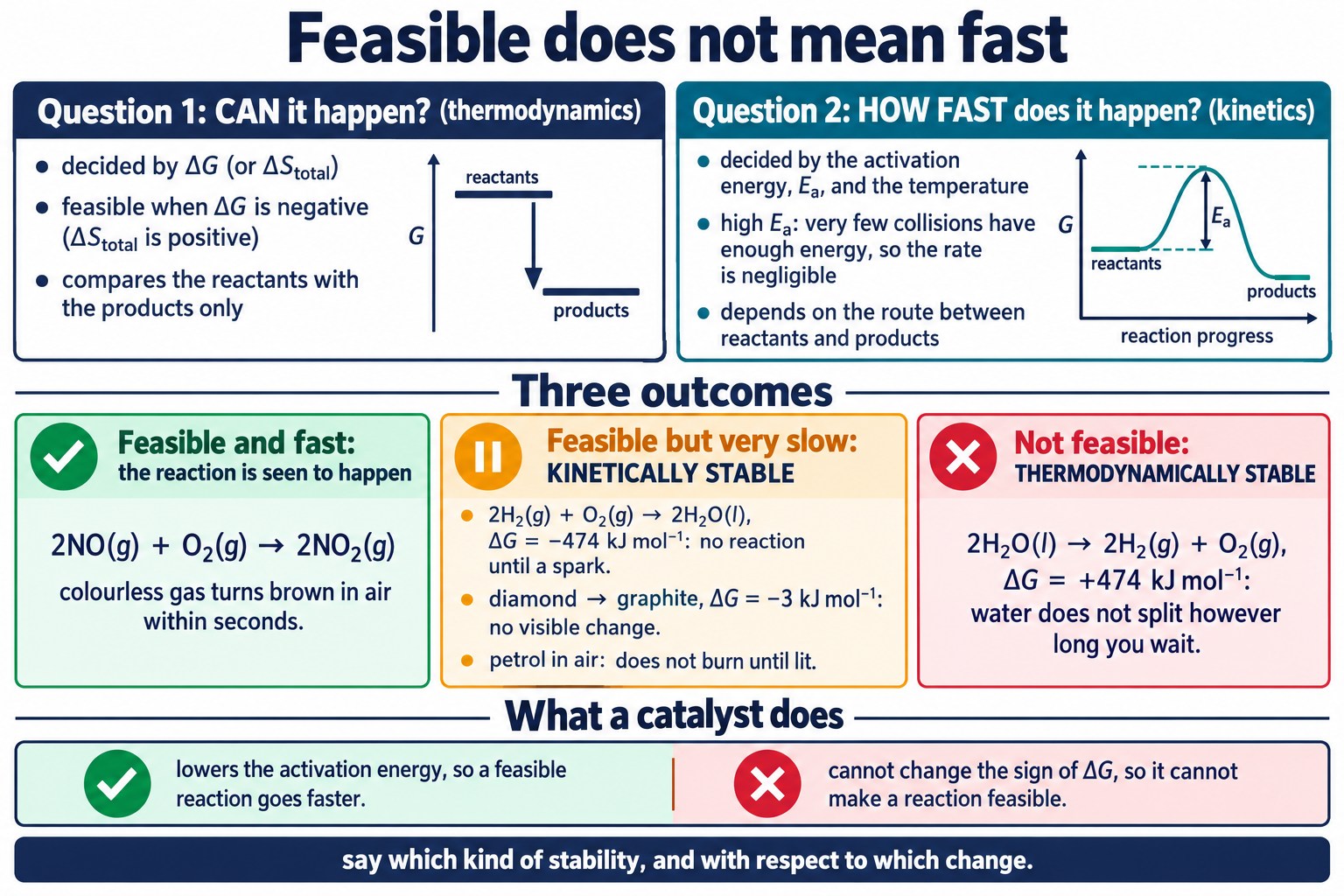
Two separate questions about any reaction: is it feasible (thermodynamics) and is it fast (kinetics), with the three possible outcomes and what a catalyst can and cannot change.
Key idea: ΔS_total tells you whether a reaction is feasible, not how fast it goes. Rate depends on the activation energy and the temperature, which do not appear in ΔS_total.
Thermodynamic Stability and Kinetic Stability
These two situations are described with two different words, and an exam question expects you to choose the right one.
Definition: A substance or mixture is thermodynamically stable with respect to a particular change when that change is not feasible: ΔS_total is negative (ΔG is positive) at that temperature, so the change cannot happen however long you wait.
Definition: A substance or mixture is kinetically stable when the change is feasible (ΔS_total positive, ΔG negative) but so slow that it does not occur at a noticeable rate, because the activation energy is too high for the temperature.
| Substance and change | Thermodynamically | Kinetically | Reason |
|---|---|---|---|
| Water at room temperature, splitting into hydrogen and oxygen | stable | not relevant: the change is not feasible | ΔG for 2H₂O(l) → 2H₂(g) + O₂(g) is +474 kJ mol⁻¹ |
| A mixture of hydrogen and oxygen, forming water | unstable | stable | feasible, but with an activation energy so high that the rate at 298 K is effectively zero |
| Diamond, turning into graphite | unstable | stable | turning one giant covalent lattice into another needs a huge number of strong C–C bonds to break |
| Petrol, paper, wood and the glucose in the body, in air | unstable | stable | the same reason: a high activation energy |
- For water, no catalyst or waiting time will change the positive ΔG. Only a supply of energy, such as electricity, can split it.
- The word stable on its own is not enough in an answer: say which kind, and with respect to what change.
The link with AS kinetics
The link with the AS kinetics idea is direct. A reaction profile shows both quantities:
- The height of the hump above the reactants is Eₐ, which controls the rate.
- The gap between reactants and products is the enthalpy change, which (with the entropy change) controls feasibility.
- A very exothermic reaction can have a very high Eₐ, and a small activation energy can sit on a reaction that is not feasible at all.
- Raising the temperature or adding a catalyst changes how many collisions cross the barrier; it does not change whether the products are lower than the reactants.
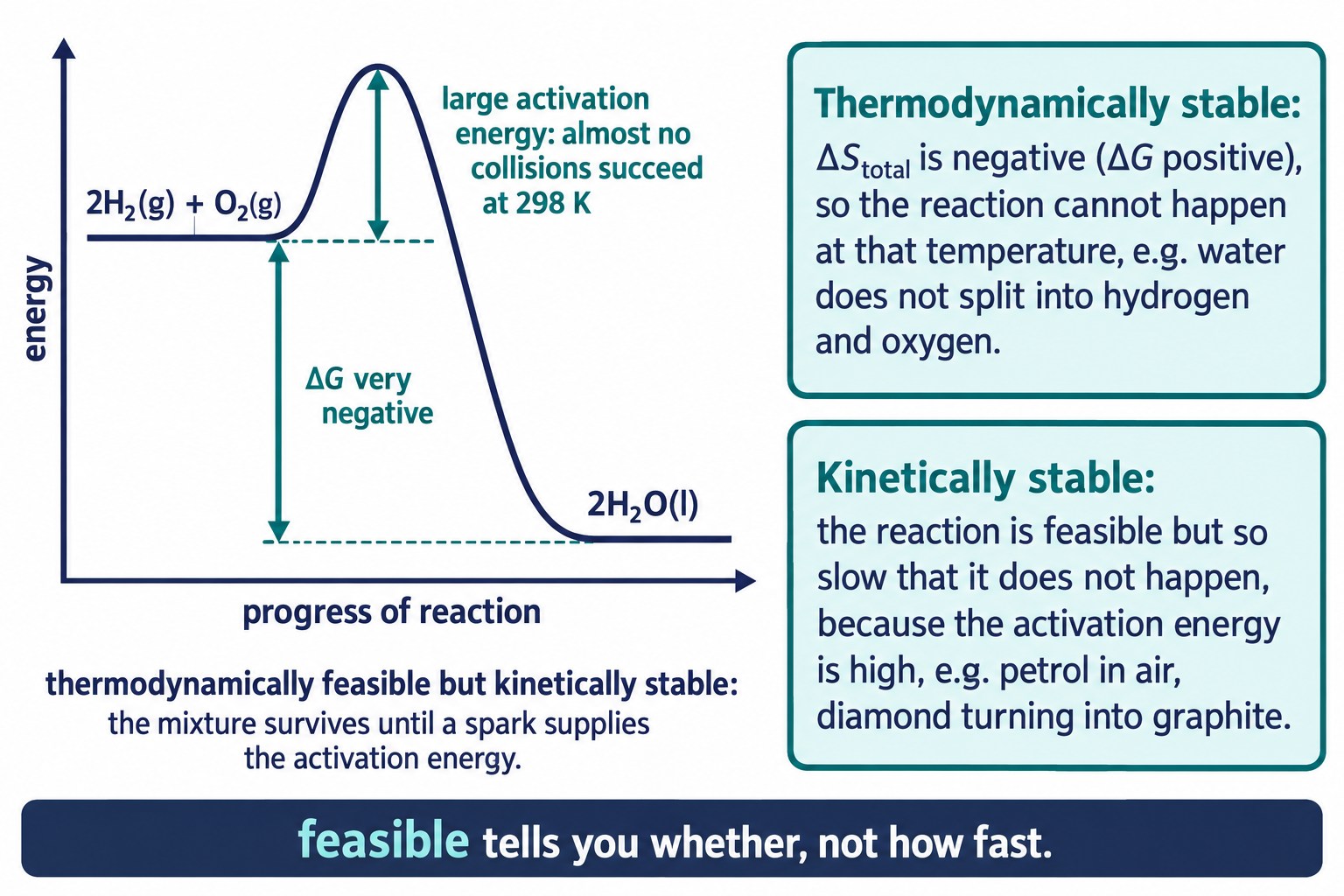
A reaction profile for hydrogen and oxygen at room temperature, feasible (large negative ΔG) but kinetically stable (very large activation energy), beside definitions of the two kinds of stability.
Exam wording: “The reaction is thermodynamically feasible because ΔG is negative, but the activation energy is very high, so at room temperature the rate is negligible: the mixture is kinetically stable.”
Check: Which Kind of Stability?
Classify substances and mixtures not used on this page as thermodynamically stable or kinetically stable with respect to a given change, and justify the choice.
The Limits of the Prediction
The specification asks you to understand why a reaction with a negative ΔG may not occur in practice, and the activation energy is the main answer. There are three more limits to keep in mind.
1. The values are for standard conditions
- The values are for standard conditions: 298 K, 100 kPa and concentrations of 1 mol dm⁻³.
- A ΔG calculated from standard data describes the reaction under those conditions. At other concentrations or pressures the actual Gibbs energy change is different.
- A reaction that is just not feasible under standard conditions may become feasible if the products are removed as they form.
- One that is feasible may stop if the product concentration builds up.
- This is what the link ΔG = −RT ln K expresses: ΔG fixes the position of equilibrium, not a one-way street.
2. ΔH and ΔS drift with temperature
- ΔS_total is calculated assuming ΔH and ΔS keep their standard values at the temperature used.
- That is a good approximation over a few hundred kelvin, but the values do drift.
- So a calculated crossing temperature is an estimate rather than an exact figure.
3. Nothing is said about the mechanism
- ΔS_total says nothing about the mechanism.
- A feasible reaction may need a catalyst to provide a route with a lower activation energy, as the synthesis of ammonia does (feasible at 298 K, but immeasurably slow without iron).
- A feasible overall change may go through an intermediate step that is itself not feasible. The direct route is then blocked and the change does not happen in that way at all.
- The thermodynamic prediction is a statement about the start and the end, and only that.
Exam focus: Reasons a reaction with a favourable ΔS_total may not occur: a high activation energy (the reaction is kinetically stable); non-standard conditions; the absence of a catalyst or a suitable mechanism. The most common expected answer is the first.
Common Exam Points
Say
- “The reaction is feasible, but the activation energy is high, so the rate is very low at this temperature.”
- “Thermodynamically unstable but kinetically stable.”
- “ΔS_total predicts feasibility, not rate.”
Do not say
- “The reaction does not happen because ΔG is negative” (a negative ΔG makes it feasible).
- “The substance is stable” (stable with respect to what, and in which sense?).
- “A catalyst makes the reaction feasible” (a catalyst changes the rate; it cannot change the sign of ΔS_total).
Watch for
- Questions that give a negative ΔG and ask why nothing is observed: activation energy every time.
- Questions that give a positive ΔG and ask why a catalyst does not help: the reaction is not feasible, so no route will make it go.
- Questions on standard conditions: point out that concentrations other than 1 mol dm⁻³ change the actual ΔG.
Check: Why a Feasible Reaction Does Not Happen
Explain why feasible reactions not used on this page are not observed, using activation energy and the other limits of the prediction.
FAQs
Use these quick answers to check the difference between thermodynamic and kinetic stability.
Why is diamond still around if graphite is more stable?
Diamond is thermodynamically unstable with respect to graphite, because the change has a negative ΔG, but it is kinetically stable. Converting it needs a huge number of strong C–C bonds to be broken and remade, so the activation energy is enormous and the rate at room temperature is effectively zero.
What is the difference between thermodynamically stable and kinetically stable?
Thermodynamically stable means the reaction is not feasible: ΔG is positive, so no amount of waiting will make it go. Kinetically stable means the reaction is feasible but so slow, because of a high activation energy, that nothing happens on any useful timescale. Petrol in air is kinetically stable; it needs a spark.
If a reaction is feasible, why does adding a catalyst not change how far it goes?
A catalyst lowers the activation energy and so speeds the reaction up, but it does not alter ΔH or ΔS of the reaction, so it cannot make an infeasible reaction feasible or change the equilibrium position. It only lets a feasible reaction reach equilibrium faster.
How can I tell from a question whether a reaction is limited by thermodynamics or by kinetics?
Work out the sign of ΔG first. If the reaction is not feasible, that is the whole explanation. If it is feasible but does not happen, the answer is a high activation energy: the reactants are kinetically stable, and heating or a catalyst may set the reaction off.
Does a feasible reaction always give a high yield?
No. Feasibility only says the reaction can go; a ΔG close to zero means an equilibrium mixture with substantial amounts of both reactants and products. A large negative ΔG suggests the equilibrium lies far to the right, but even then the rate can be too slow to obtain any product.
Copyright and author footprint: This OLS revision page was written for Online Learning System by Dr. Mohammed Al-Fatah. It is designed for A Level Chemistry revision and should not be copied or redistributed without permission.
Keep this note — free
Save your progress across every Edexcel topic. A free account remembers which topics you have covered, saves your question scores, and syncs across your phone and laptop.
- Track every topic you have finished
- Keep your practice-question scores
- No payment, no card, free forever
Already registered? Log in