Feasibility, Gibbs Energy and Temperature
A concise revision guide to what makes a reaction feasible: the balance between the enthalpy change and the entropy change, the Gibbs equation ΔG = ΔH − TΔS, the sign of ΔG, how temperature changes the balance and how to calculate the temperature at which a reaction becomes feasible.
- 23.4.1
- 23.4.2
- 23.4.3
- 23.4.4
What these spec points say
- 23.4.1 state and use the Gibbs equation ΔG⦵ = ΔH⦵ – TΔS⦵
- 23.4.2 perform calculations using the equation ΔG⦵ = ΔH⦵ – TΔS⦵
- 23.4.3 state whether a reaction or process will be feasible by using the sign of ΔG⦵
- 23.4.4 predict the effect of temperature change on the feasibility of a reaction, given standard enthalpy and entropy changes
The Balance Between Enthalpy and Entropy
Whether a reaction is feasible depends on two things:
- the enthalpy change, which decides what happens to the entropy of the surroundings
- the entropy change of the system
The table shows the four possible combinations of signs.
| ΔH | ΔS | ΔG = ΔH − TΔS | Feasible? | Example |
|---|---|---|---|---|
| negative (exothermic) | positive | always negative | at all temperatures | combustion of a hydrocarbon, which makes more gas |
| positive (endothermic) | negative | always positive | never | the reverse of a combustion |
| negative (exothermic) | negative | negative only at low T | below a certain temperature | water freezing, N₂ + 3H₂ → 2NH₃ |
| positive (endothermic) | positive | negative only at high T | above a certain temperature | ice melting, CaCO₃ decomposing |
- In two of the rows the two factors pull the same way, so the outcome is the same at every temperature.
- In the other two they pull against each other, and the temperature decides which wins.
- The reason is that the surroundings term −ΔH/T shrinks as T rises, while ΔS does not change much.
The two temperature-dependent rows
These are the interesting ones.
| Reaction | Feasible when | Why |
|---|---|---|
| Exothermic with a negative ΔS | cold | at low temperature the heat given out raises the entropy of the surroundings by a great deal |
| Endothermic with a positive ΔS | hot | at high temperature the heat it takes in costs the surroundings little entropy |
This is why endothermic reactions can occur spontaneously at room temperature: their positive ΔS outweighs the small enthalpy cost.
Key idea: Feasibility depends on the balance between ΔH and ΔS. When their effects oppose each other the temperature decides, because the influence of ΔH on the surroundings falls as T rises.
The Gibbs Equation
The balance between enthalpy and entropy is written as a single quantity, the Gibbs energy change, ΔG:
ΔG = ΔH − TΔS
- A reaction is feasible when ΔG is negative or zero.
- A positive ΔG means the reaction cannot happen of its own accord at that temperature.
- ΔG = 0 marks the point at which it just becomes feasible.
- The term −TΔS carries the entropy change of the system in energy units, so the equation compares the enthalpy change with the entropy change directly, on the same scale, kJ mol⁻¹.
Units: the source of most errors
ΔH is in kJ mol⁻¹ and ΔS in J K⁻¹ mol⁻¹, so divide the entropy by 1000 before substituting, and use T in kelvin.
Worked example: nitrogen monoxide and oxygen at 298 K
For the oxidation of nitrogen monoxide, 2NO(g) + O₂(g) → 2NO₂(g), ΔH = −114 kJ mol⁻¹ and ΔS = −146 J K⁻¹ mol⁻¹.
Step 1. Convert the entropy: ΔS = −146 J K⁻¹ mol⁻¹ = −0.146 kJ K⁻¹ mol⁻¹.
Step 2. Substitute: ΔG = −114 − (298 × −0.146) = −114 + 43.5.
Answer. ΔG = −70.5 kJ mol⁻¹. ΔG is negative, so the reaction is feasible at room temperature.
- Nitrogen monoxide turns brown in air within seconds.
- The entropy of the system falls (three moles of gas become two), but the heat given out more than compensates.
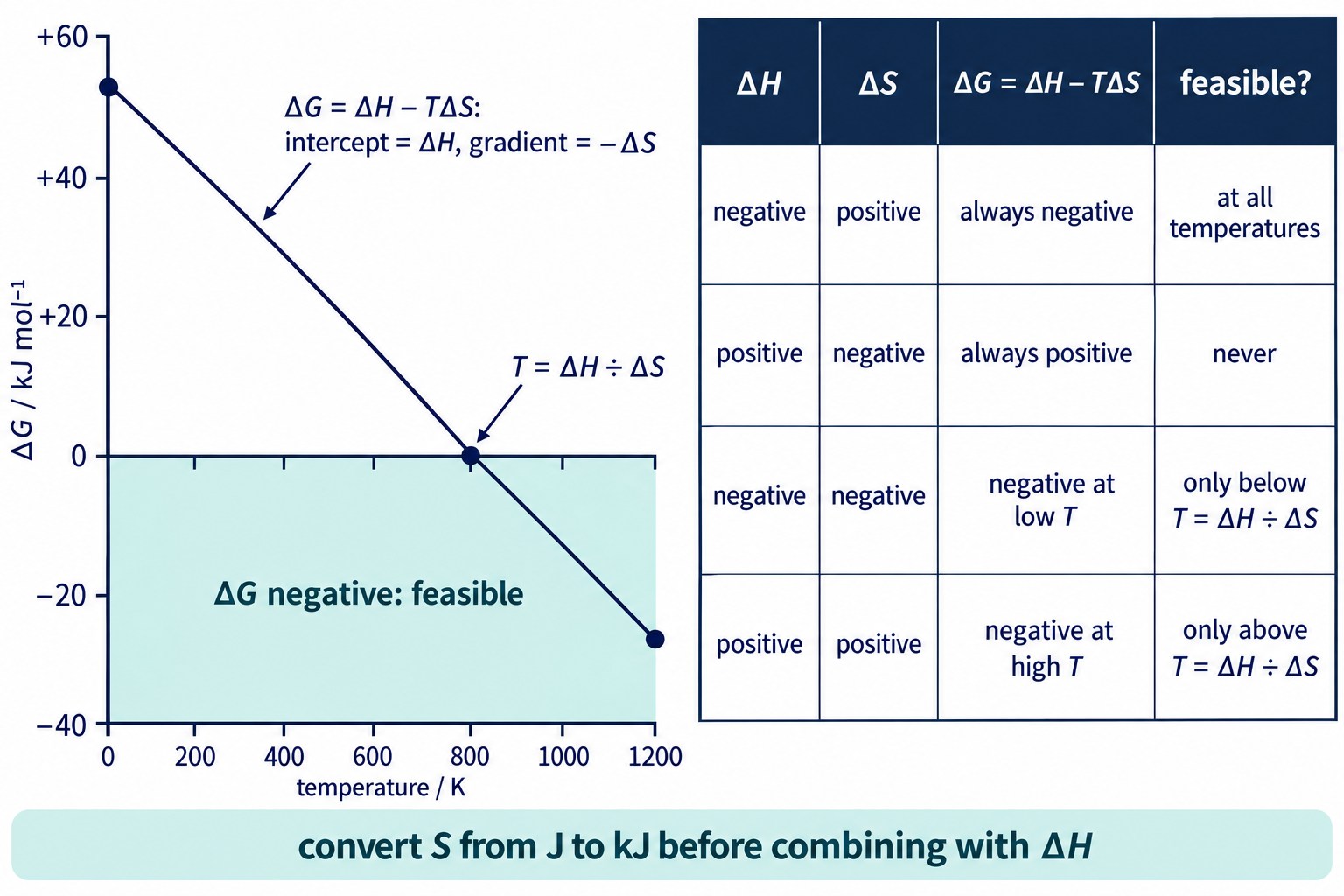
ΔG against temperature as a straight line with gradient −ΔS and intercept ΔH, the feasible region below zero, beside the four sign combinations and when each is feasible.
Worked example: 2NO(g) + O₂(g) → 2NO₂(g), ΔH = −114 kJ mol⁻¹, ΔS = −146 J K⁻¹ mol⁻¹. At 298 K: ΔG = −114 − (298 × −0.146) = −70.5 kJ mol⁻¹. Negative, so feasible. Convert the entropy to kJ first.
Check: Sign Combinations and ΔG
Decide when reactions are feasible from the signs of ΔH and ΔS, and calculate ΔG at a given temperature, for reactions not used on this page.
How Temperature Changes Feasibility
Over the range of temperatures met in a question, ΔH and ΔS hardly change. So ΔG = ΔH − TΔS is the equation of a straight line when ΔG is plotted against T.
- The intercept on the ΔG axis (at T = 0) is ΔH.
- The gradient is −ΔS.
| Sign of ΔS | The line | Feasibility |
|---|---|---|
| Positive | slopes downwards | the reaction becomes feasible above a certain temperature |
| Negative | slopes upwards | the reaction stops being feasible above a certain temperature |
Where the line crosses ΔG = 0 the reaction is just feasible. Setting ΔH − TΔS = 0 gives that temperature:
T = ΔH ÷ ΔS
Both quantities must be in the same units (both in kJ, or both in J).
Worked example: the nitrogen monoxide reaction
Step 1. ΔS is negative, so the line slopes upwards: the reaction becomes less feasible as the temperature rises.
Step 2. T = 114 ÷ 0.146.
Answer. The reaction stops being feasible above 781 K.
Worked example: calcium carbonate from page 2
Step 1. Both ΔH and ΔS are positive, so the line slopes downwards: the reaction becomes feasible on heating.
Step 2. T = 178 ÷ 0.1604.
Answer. The reaction becomes feasible above 1110 K, which is why a lime kiln is run at over 1100 K.
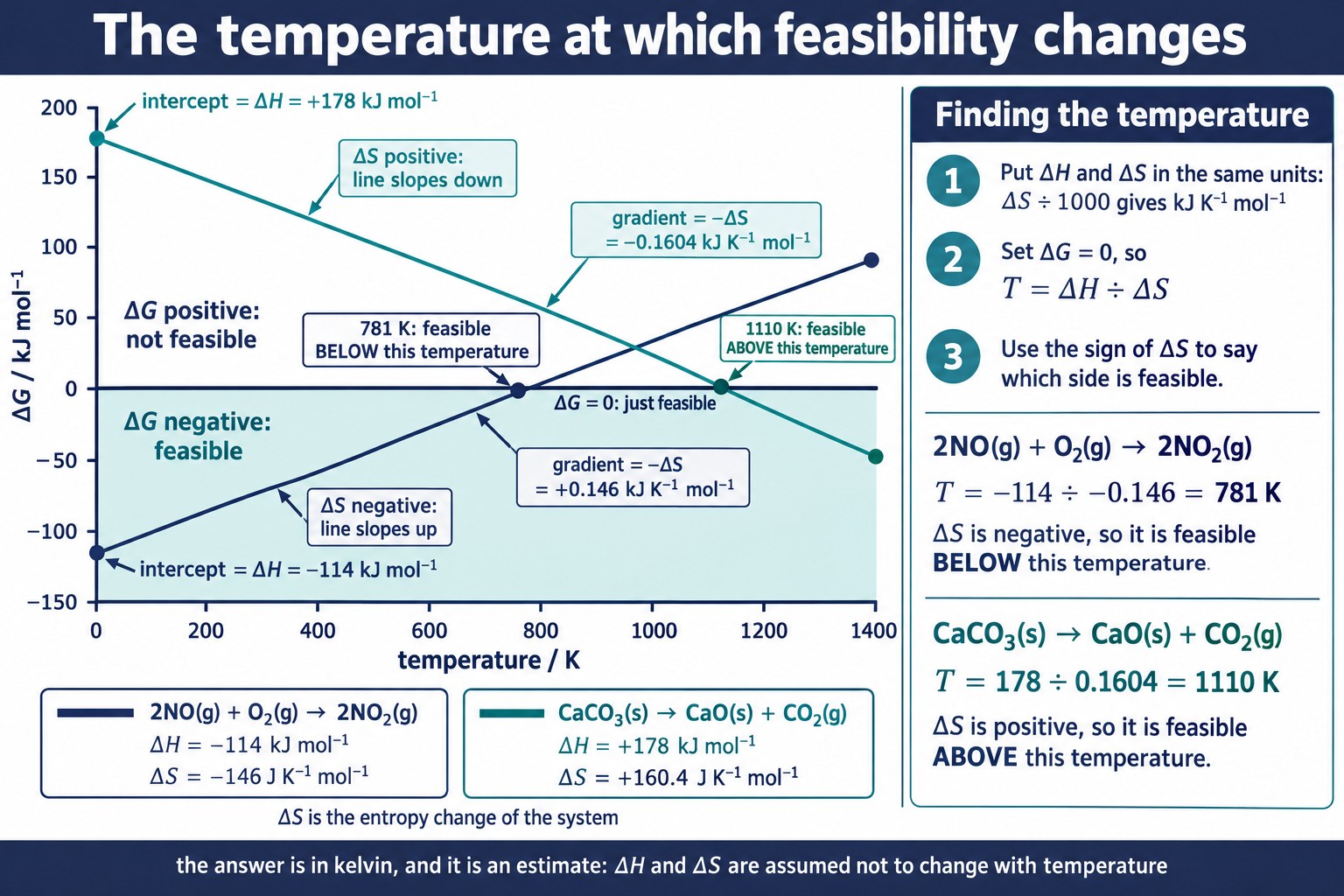
Two ΔG against temperature lines: one rising and crossing zero at 781 K, one falling and crossing zero at 1110 K, with the three steps for finding the temperature at which feasibility changes.
Why temperature has this effect
- The physical reason is that the heat exchanged with the surroundings matters less at high temperature, so the −TΔS term counts for more.
- A large positive ΔS therefore favours reactions at high temperatures and a large negative ΔS favours them at low temperatures, whatever the sign of ΔH.
Worked example: For 2NO + O₂ → 2NO₂, T = ΔH ÷ ΔS = −114 ÷ −0.146 = 781 K. Below 781 K ΔG is negative (feasible); above it ΔG is positive. Quote the temperature and the side on which the reaction is feasible.
Check: The Temperature of Feasibility
Calculate the temperature at which a reaction becomes, or stops being, feasible, for reactions not used on this page.
Common Exam Points
Say
- “ΔG = ΔH − TΔS; the reaction is feasible when ΔG ≤ 0.”
- “T = ΔH ÷ ΔS = … K, so the reaction is feasible above this temperature.”
- “The gradient of the ΔG against T graph is −ΔS and the intercept is ΔH.”
Do not say
- “ΔG = −114 − 298 × −146” (units mixed: convert ΔS to kJ K⁻¹ mol⁻¹).
- “Exothermic reactions are always feasible” (not if ΔS is negative and T is high).
- “T = 25 °C” in the equation (use 298 K).
Watch for
- Graph questions: read ΔH from the intercept and ΔS from minus the gradient, and identify the feasible range as the temperatures at which the line is below zero.
- Questions that give ΔG at two temperatures and ask why it differs: the answer is the −TΔS term.
- A question may say “explain why the reaction becomes feasible on heating”: it wants the sign of ΔS and the growing size of the TΔS term.
Check: ΔG Against T and Mixed Calculations
Interpret ΔG against temperature graphs and combine ΔH, ΔS and ΔG in calculations for reactions not used on this page.
FAQs
Use these quick answers to check the feasibility ideas and the Gibbs equation.
Does ΔG negative mean the reaction will definitely happen?
No. A negative ΔG means the reaction is thermodynamically feasible, so it can happen, not that it will happen at a useful rate. Many reactions with a large negative ΔG, such as the combustion of methane at room temperature, do not go because the activation energy is too high.
What does T = ΔH/ΔS actually tell me?
It is the temperature at which ΔG is exactly zero, so the reaction is on the point of becoming feasible. For an endothermic reaction with a positive ΔS the reaction is feasible above that temperature; for an exothermic reaction with a negative ΔS it is feasible below it. Remember that ΔH and ΔS must be in the same energy unit before you divide.
Why does the sign of ΔG change with temperature for some reactions but not others?
It only changes when ΔH and ΔS have the same sign, because then the ΔH and TΔS terms pull in opposite directions and temperature decides which wins. If ΔH is negative and ΔS positive the reaction is feasible at all temperatures; if ΔH is positive and ΔS negative it is never feasible.
Why is a reaction with a positive ΔG not impossible?
Because a positive ΔG only means that the equilibrium lies well over to the reactants, not that nothing forms at all. There will always be a small amount of product, and the reaction can be driven forward by removing a product, coupling it to another reaction or changing the temperature so that ΔG becomes negative.
Why do we assume ΔH and ΔS do not change with temperature?
Because both change only slightly with temperature compared with the size of the T in the TΔS term, so treating them as constant gives an answer close enough for exam work. Questions will tell you to make this assumption; it breaks down badly only if a substance changes state between the two temperatures.
Copyright and author footprint: This OLS revision page was written for Online Learning System by Dr. Mohammed Al-Fatah. It is designed for A Level Chemistry revision and should not be copied or redistributed without permission.
Keep this note — free
Save your progress across every Cambridge topic. A free account remembers which topics you have covered, saves your question scores, and syncs across your phone and laptop.
- Track every topic you have finished
- Keep your practice-question scores
- No payment, no card, free forever
Already registered? Log in