Hazard & Risk
A concise revision guide to the difference between hazards and risks in practical chemistry, including common laboratory hazards and how risk can be reduced during experiments.
What Is a Hazard?
A hazard is a substance or procedure that has the potential to cause harm.
In chemistry, a hazard might be linked to a chemical substance, a piece of apparatus, a flame, a sharp object, a hot surface, pressure build-up or a practical procedure.
Definition: A hazard is something that could cause harm. It describes the possible danger before considering how likely that harm is to happen.
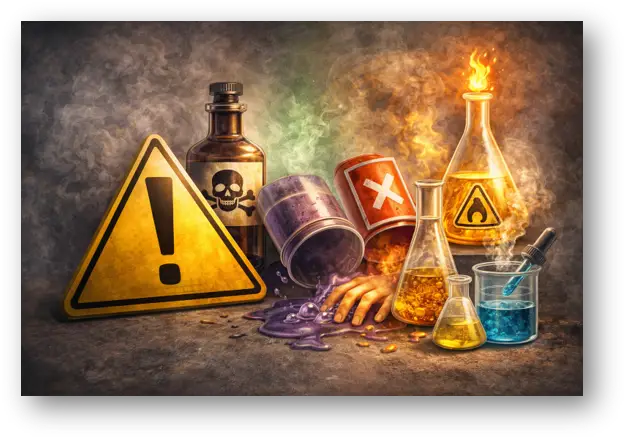
Hazards may come from the chemical itself, such as toxicity or flammability, or from how the substance or equipment is used.
Common Laboratory Hazards
Laboratory chemicals are often labelled according to the type of hazard they present. These labels help students and teachers decide what precautions are needed before practical work begins.
Important: The hazard describes the potential for harm. It does not automatically tell you how likely harm is under the exact practical conditions used.
What Is Risk?
Risk is the likelihood or chance that harm will occur as a result of using a hazardous substance or carrying out a procedure.
This means a hazardous substance can sometimes pose a lower risk if it is used in a low concentration, in a small amount, or with suitable safety precautions.
Definition: Risk describes how likely harm is to occur in a specific situation. It depends on the hazard, the quantity, the concentration, the method and the precautions used.
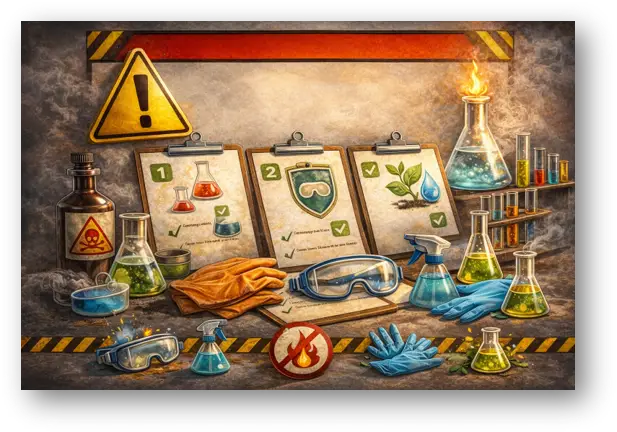
Risk is reduced by controlling how hazardous substances are handled, stored and used during practical work.
Hazard Compared with Risk
Students often confuse hazard and risk. A hazard is the possible source of harm. Risk is the chance that the harm will actually happen under the conditions used.
| Term | Meaning | Example in the laboratory |
|---|---|---|
| Hazard | A substance or procedure with the potential to cause harm. | Concentrated acid is corrosive because it can damage living tissue. |
| Risk | The likelihood that harm will occur in a particular situation. | The risk is lower if dilute acid is used in small amounts while wearing eye protection. |
Exam focus: If a question asks how to reduce risk, give a practical control measure, not just the name of the hazard.
How Risks Can Be Reduced
Risks can be reduced by changing the scale of the experiment, changing the method or using precautions specific to the hazard.
| Method of reducing risk | What this means | Why it works |
|---|---|---|
| Work on a smaller scale | Use smaller amounts of the hazardous substance. | Less material is available to spill, burn, react or release harmful vapour. |
| Use specific precautions | Choose safety measures that match the hazard. | The control measure directly reduces the chance of harm from that particular hazard. |
| Use an alternative method | Use a safer procedure or less hazardous substance where possible. | Replacing the hazard, or reducing its severity, reduces the overall risk. |
| Hazard type | Suitable precaution |
|---|---|
| Irritant substances | Wear safety goggles, especially when using dilute acids and alkalis. |
| Corrosive substances | Wear goggles when handling strong acids and alkalis. |
| Flammable substances | Keep away from naked flames. |
| Toxic substances | Wear gloves, avoid skin contact and wash hands after use. |
| Oxidising substances | Keep away from flammable or easily oxidised materials. |
Common Exam Mistakes
- Do not define hazard as the chance of harm. That is risk.
- Do not define risk as simply “danger”. Risk is the likelihood that harm will occur.
- Do not give vague precautions such as “be careful”. Give a specific safety measure linked to the hazard.
- Do not assume a hazardous chemical always has high risk. Concentration, amount and precautions affect risk.
Check Your Understanding
Use these short activities to check the difference between hazard, risk and risk reduction before moving on.
Master Organic Chemistry and Alkanes for Edexcel International A Level Chemistry
Continue from these free revision notes into the full Topic 4A/B Organic Chemistry and Alkanes course, with guided video teaching, diagnostic MCQ practice, teacher-marked short-answer questions and a specification assignment with a personalised progress report.
Guided video teaching
Learn the chemistry and exam technique through structured video lessons with worked examples and walkthroughs.
Instant MCQ feedback
Auto-marked MCQ quizzes provide immediate diagnostic feedback for every answer choice.
Teacher-marked SAQs
Submit written exam responses and receive chemistry specialist feedback with improvement guidance.
Progress tracking
Identify strengths and weaknesses across the full Topic 4A/B specification with targeted reporting.
See how the course works
Click play to start the course preview animation.
Some ionic radii are shown.
| Ion | Ionic radius / nm |
|---|---|
| Na+ | 0.102 |
| K+ | 0.138 |
| F− | 0.133 |
| Cl− | 0.180 |
Which compound has the strongest ionic bonding?
Explain why the metallic bonding in magnesium is much stronger than that in sodium.
Copyright notice: This OLS revision content, including the explanations, layout, diagrams, tables and embedded learning structure, is authored for Online Learning System by Dr. Mohammed Al-Fatah. It may not be copied, reproduced, redistributed or adapted without written permission.