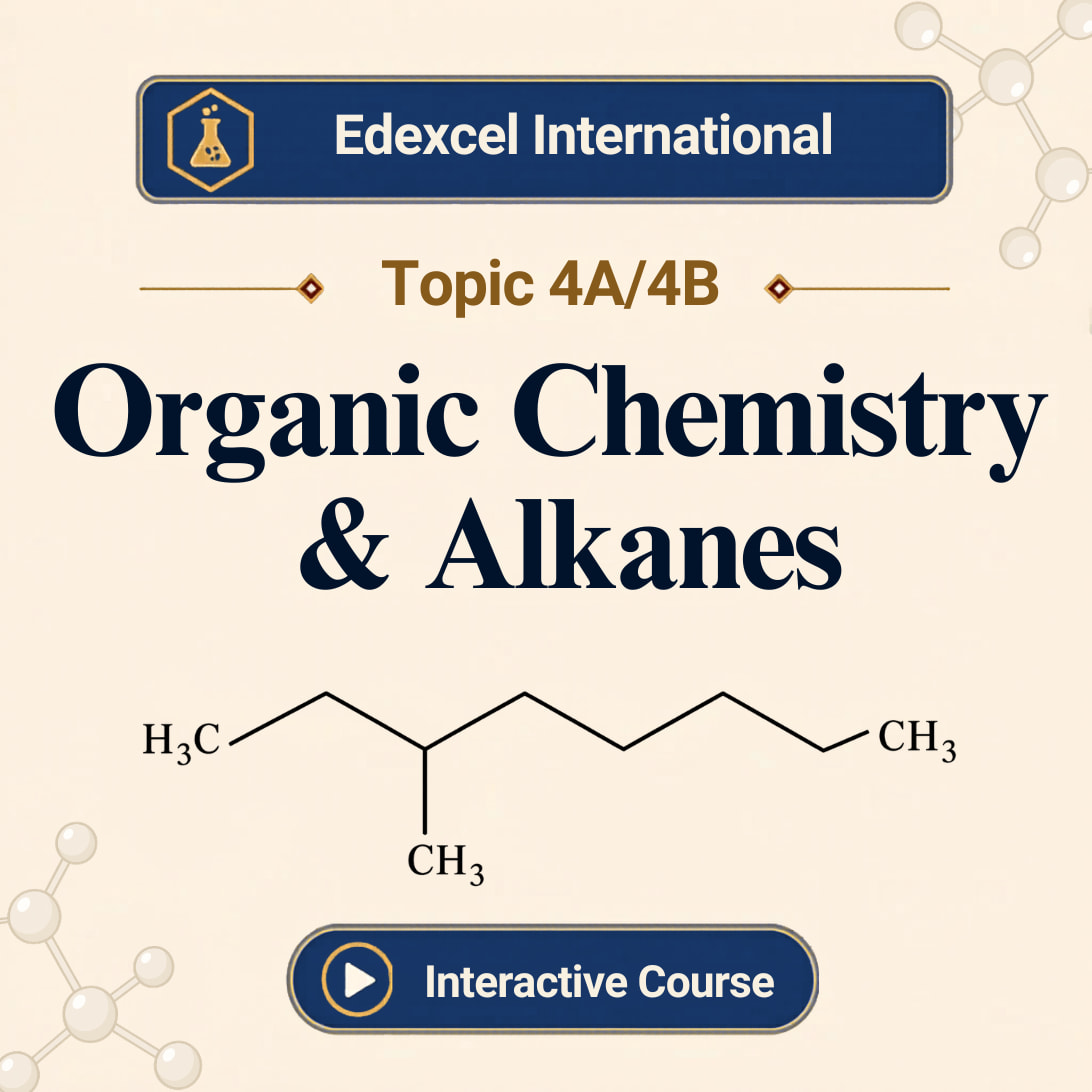
Organic Chemistry and Alkanes – Topic 4A\4B

£34.99

Organic Chemistry and Alkanes Topic 4A/4B

The Topic 4A/4B course on Edexcel International A Level Chemistry provides approximately 25 hours of guided learning. Students work through six recorded video lessons, 198 marks of auto-marked MCQ practice, 338 marks of teacher-marked written questions, and a personalised spec-point progress report.

Guided Learning
25 Hours
total study time
Video Lessons
432 mins
6 recorded lessons
MCQ Assessments
198 Marks
9 quizzes
SAQ Assessments
338 Marks
13 quizzes

How the 25 guided learning hours are worked out

Guided learning hours are calculated from the actual contents of the course, not estimated. Video time is counted at its true running length, MCQs at 1.5 minutes per question, written answers at 1.5 minutes per mark, and time is allowed for reading the feedback returned on every quiz.

ComponentTime
Virtual lesson video432 min
MCQ practice (198 questions × 1.5 min)297 min
MCQ feedback review (9 quizzes × 10 min)90 min
SAQ practice (338 marks × 1.5 min)507 min
SAQ feedback review (13 quizzes × 15 min)195 min
Total1521 min ≈ 25 hours

The six recorded lessons

The virtual lesson is delivered as six recorded lessons totalling 432 minutes. Students pause during exam-practice sections, attempt questions independently, then review the worked explanations and the mark-scheme approach.

LessonRunning time
1. Organic Chemistry and Alkanes – Part 1111 min
2. Organic Chemistry and Alkanes – Part 2106 min
3. Alkanes from Crude Oil45 min
4. Alkanes as Fuels39 min
5. Alternative Fuels51 min
6. Substitution Reactions of Alkanes80 min
Total video432 min

Course preview

A short walkthrough of how the course is taught and how the assessment fits together.

At a glance

What you get in this course

432 minutes of guided video

Six recorded lessons covering Topic 4A and Topic 4B in full, with worked exam questions and mark-scheme strategy built into the teaching.

198 marks of MCQ practice

9 auto-marked quizzes of 22 questions each, with diagnostic feedback on every option. One attempt per quiz, so your scores track real progress.

338 marks of written practice

13 written-answer quizzes (173 questions) marked by a chemistry specialist, with per-mark feedback returned the following Monday.

Complete spec-point coverage

All 61 assessable Edexcel IAL spec points across Topic 4A and Topic 4B carry questions in the bank – 22 in 4A, 39 in 4B.

Exam-technique baked in

The lessons teach the chemistry and the exam wording. You learn what Edexcel actually rewards, not just the content.

Personalised progress report

A one-click PDF report shows your level on every spec point in colour-coded form.
What is KASP Analytics?

KASP (Knowledge Analytics & Spec-point Platform) tracks your progress at the level of individual specification points, not just whole quizzes. Every question on this course is mapped to the Edexcel IAL spec point it assesses, so you always know exactly which parts of the specification you have mastered and which need another look.

Spec points tracked
61
Topic 4A
22 spec points
Topic 4B
39 spec points
Questions tagged
371
Every assessable spec point is covered

All 61 assessable Edexcel IAL spec points in Topic 4A and Topic 4B carry at least one question in this course – there are no untested spec points. Across the 198 MCQ and 173 SAQ questions, most spec points are assessed several times over, in both question styles.

Your topic dashboard

Every topic you have worked through is summarised here. At a glance you see how many questions you have attempted, what is still waiting to be marked, your total marks scored, and an overall score percentage. The dashboard below is an example, filled with the real topic structure of this course.

Hello, Sara – here is how you are doing

Edexcel IAL Chemistry
TopicQuestions attemptedPendingMarks (scored / available)Score
Topic 4A: Introduction to Organic Chemistry24 / 28438.00 / 52.0073%
Topic 4B: Alkanes31 / 40644.50 / 74.0060%

Spec-point breakdown for a topic

Click into any topic and you see the full spec-point breakdown. Each row is a single Edexcel IAL spec point with its official wording, how many questions the bank holds against it, your score, and a colour that tells you immediately where to focus. The spec points and question counts below are the real ones from this course; the scores are an example.

Spec tagDescriptionAttemptedIn bankMarksScore
4.4-aunderstand the concept of homologous series4 / 4138.00 / 8.00100.0%
4.5ibe able to apply IUPAC nomenclature rules to name compounds relevant to this specification5 / 5329.00 / 11.0081.8%
4.5ii-cbe able to apply IUPAC nomenclature rules to draw skeletal formulae of compounds encountered in the specification6 / 6107.00 / 12.0058.3%
4.10-bbe able to draw structural isomers of organic molecules given their molecular formula3 / 3134.00 / 6.0066.7%
4.17iunderstand the reactions of alkanes with: oxygen in the air (combustion)4 / 4165.00 / 9.0055.6%
4.18iiunderstand the mechanism of the free radical substitution reaction between an alkane and a halogen: showing the initiation step of the mechanism, with curly half-arrows for free radical formation3 / 4173.00 / 8.0037.5%
4.18iii-aunderstand the propagation steps of the free radical substitution reaction between an alkane and a halogen2 / 3172.00 / 7.0028.6%
4.18iii-bunderstand the termination steps of the free radical substitution reaction between an alkane and a halogen0 / 320Not yet attempted
■ Green 70–100%: secure mastery■ Orange 40–69%: some gaps■ Red 0–39%: needs attention■ Grey: not yet assessed

Printable progress report

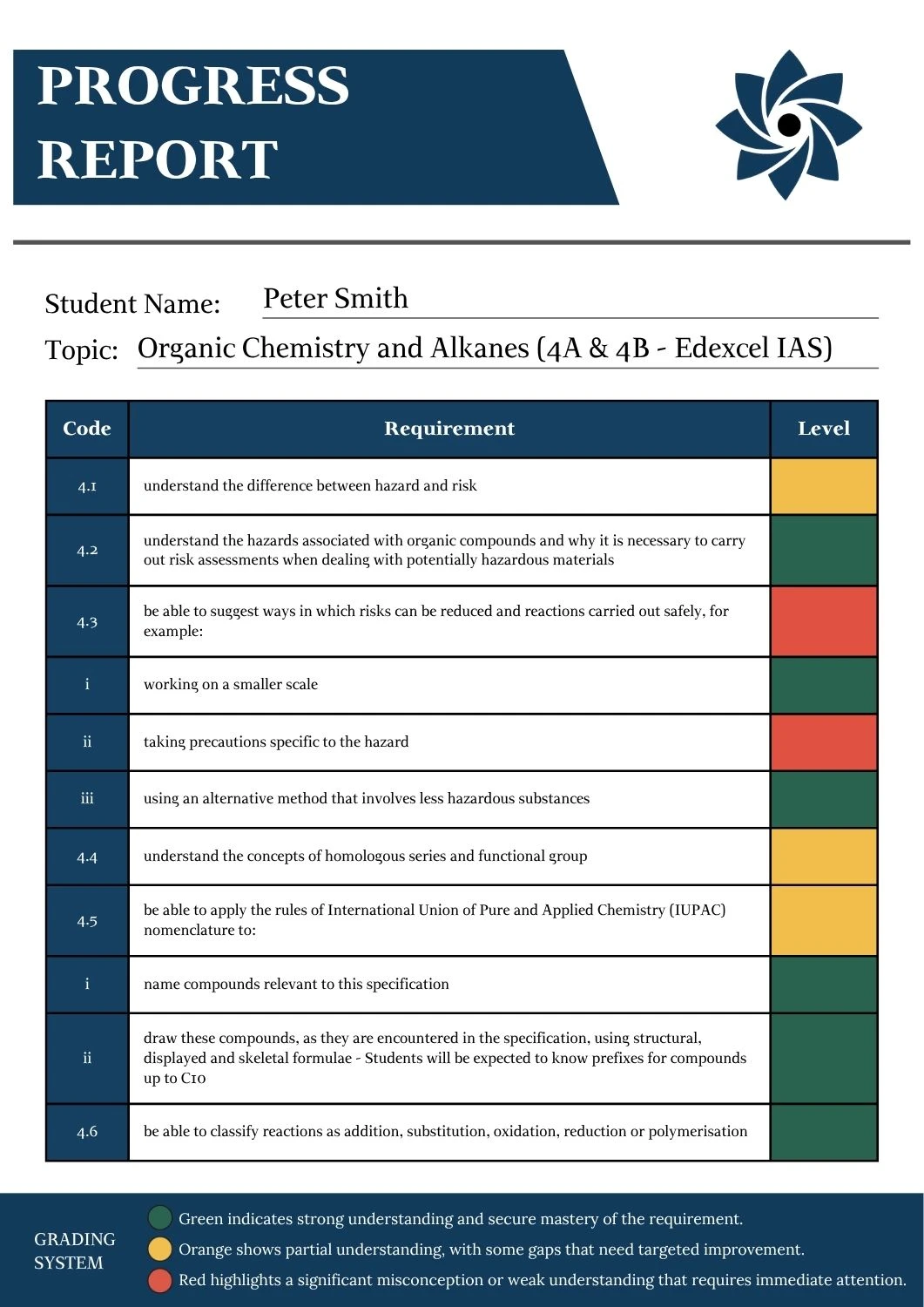
One click and you can download a clean, branded Progress Report PDF for the topic. Useful for your own revision folder, for parents to see at a glance, or for tutors to plan focused sessions. Every spec point in the topic appears with its code and full requirement text, and the level column is colour-coded green through red.

A Level Chemistry progress report for Organic Chemistry and Alkanes showing student performance across specification points with colour coded levels for understanding
At a glance

What you get with KASP Analytics

Spec-point level tracking

Every question is tagged to the exact Edexcel IAL spec point it assesses, so your scores roll up cleanly to the specification.

Updates automatically

Submit a quiz and your dashboard updates right away. Short-answer questions appear as pending until they have been marked.

Built for Edexcel IAL

Wording, codes and topic structure follow the Edexcel International A Level Chemistry specification exactly, so your scores line up with the document you will be examined on.

Printable report

One-click PDF Progress Report per topic, in the same colour system, ready for your folder or for a tutor session.

Both question styles counted

MCQ and written answers feed the same spec point. With 198 MCQ and 173 SAQ questions tagged, a weak area shows up whether you miss it under multiple choice or in writing.

Progress over time

A simple line chart shows how your overall score has trended across the days you have been studying.

What is the MCQ Bank?

The MCQ Bank for Topic 4A/4B is an auto-marked, instant-feedback practice engine built from past Edexcel IAL paper questions. It runs to 9 quizzes, 198 questions and 198 marks. Every question is tagged to a specific Edexcel IAL spec point, every option carries diagnostic feedback explaining the chemistry, and every quiz attempt feeds directly into your KASP Analytics dashboard.

Quizzes
9
Questions
198
Marks
198
Attempts
1 per quiz

Try a real Topic 4A/4B MCQ

This is a genuine question from the bank, reproduced exactly as it appears in the course. Click any option to reveal the diagnostic feedback for that choice, then expand the panel at the bottom for the full walkthrough.

Termination steps in free radical substitution

4.18iii-b (Edexcel IAL)1 mark

The reaction of butane with chlorine is a free radical substitution. Which termination step does not occur?

Click an option to see feedback

AC4H9• + C4H9• → C8H18
Incorrect

Incorrect. This termination step does occur. Butyl radicals (C4H9•) are present as chain carriers throughout the reaction and can combine with each other to form octane, a by-product of this reaction.

BC4H9• + Cl• → C4H9Cl
Incorrect

Incorrect. This termination step does occur. Both C4H9 and Cl• are present as chain carriers, so they can combine to form chlorobutane, which is one of the main products of this reaction.

CC4H9• + H• → C4H10
Correct

Correct. This step does not occur because H• radicals are never produced at any stage of the chlorination of butane. Only C4H9• and Cl• are generated in this mechanism, so no hydrogen radical is available to participate in a termination step.

DCl• + Cl• → Cl2
Incorrect

Incorrect. This termination step does occur. Chlorine radicals (Cl•) are present as chain carriers and can combine with each other to reform Cl2, ending two chain-carrying radicals at once.

Show correct answer & full explanation →
General feedback

Termination steps occur when two radicals combine to produce a stable, non-radical molecule. Only radicals that are actually generated during the reaction can take part in termination steps. In the chlorination of butane, the only radicals present are C4H9 and Cl•.

  • C4H9• + C4H9• → C8H18: this does occur; butyl radicals are present as chain carriers and can combine to give octane.
  • C4H9• + Cl• → C4H9Cl: this does occur; both radicals are present and combine to give chlorobutane, one of the main products.
  • C4H9• + H• → C4H10: this does not occur. H• radicals are never produced at any stage of this mechanism; there is no source of hydrogen radicals in the chlorination of butane.
  • Cl• + Cl• → Cl2: this does occur; chlorine radicals are present and can recombine to reform Cl2.

The correct answer is therefore C.

9 quizzes, 198 marks of MCQ practice

The MCQ Bank is split across the two halves of the topic. Quizzes hold 22 questions worth one mark each, and each quiz is a single auto-marked attempt. Because every spec point is tested across several quizzes, your KASP scores reveal real improvement as you work through them.

Topic 4A: Introduction to Organic Chemistry

4 quizzes · 88 marks
MCQ A
22
questions & marks
MCQ B
22
questions & marks
MCQ C
22
questions & marks
MCQ D
22
questions & marks

Topic 4B: Alkanes

5 quizzes · 110 marks
MCQ A
22
questions & marks
MCQ B
22
questions & marks
MCQ C
22
questions & marks
MCQ D
22
questions & marks
MCQ E
22
questions & marks
198 total marks198 questions in totalOne attempt per quizAuto-marked on submit
At a glance

What you get with the MCQ Bank

198 marks across 9 quizzes

4 quizzes on Topic 4A and 5 on Topic 4B, 22 questions each, giving balanced coverage of every spec point in the topic pair.

Instant auto-marking

Submit and the result is back in your hands inside a second. No waiting, no manual checking.

Diagnostic feedback per option

Every wrong option carries a tailored explanation of the misconception, not just a generic ‘incorrect’, plus a full walkthrough on every question.

Spec-point tagged

Each question is mapped to the Edexcel IAL spec point it assesses, so your score flows straight into KASP Analytics.

Track improvement across quizzes

One attempt per quiz, but the same spec points appear across the set. Your scores from quiz to quiz show genuine progress, not repeat-attempt inflation.

Built from past papers

Every MCQ is sourced from genuine Edexcel IAL past papers, with the wording polished for clarity and the chemistry verified.

What is the SAQ Bank?

The SAQ Bank for Topic 4A/4B is a written-answer practice engine marked by a real chemistry specialist. It runs to 13 quizzes, 173 questions and 338 marks. You attempt one quiz per week, submit your full written response, and your teacher returns mark-by-mark feedback the following Monday. Every comment is targeted at the exam wording you need to use.

Quizzes
13
Questions
173
Marks
338
Marks per quiz
26

A submitted SAQ and the feedback it gets

This is a genuine question from the bank with its real mark scheme. The submitted answer below is an example of a typical response at this standard. Expand the panel to see how it was marked.

Homolytic fission of the Br–Br bond

4.7i (Edexcel IAL)4 marks

When a mixture of an alkane and bromine is exposed to ultraviolet light, the Br–Br bond breaks homolytically.

Explain why the Br–Br bond breaks homolytically rather than heterolytically, write an equation for this bond breaking, and state what the species produced are called.

Submitted answer

Both atoms in the Br–Br bond are bromine atoms, so they have exactly the same electronegativity and the bond is non-polar. Because neither atom pulls the bonding pair towards itself more strongly than the other, the pair splits evenly when the bond breaks, with one electron going to each atom. The two particles formed are called free radicals because each one has an unpaired electron.

View returned feedback →
Returned by your chemistry specialist3 / 4 · 75%
Mark scheme
Criterion
States the Br-Br bond is non-polar because the atoms are identical / equal electronegativity.
Awarded – you identified both that the atoms are identical and that the bond is therefore non-polar.
Explains that neither atom attracts the pair more, so the electrons split evenly.
Awarded – the ‘one electron each’ wording is exactly what the mark scheme wants.
Gives the equation Br2 -> 2Br. with the dots shown.
Not awarded. You described the bond breaking in words but never wrote the equation. Write Br2 → 2Br•, and make sure the dot is visible on the product – the dot is what earns the mark.
Names the products as free radicals, each with an unpaired electron.
Awarded – correctly named, and you justified it with the unpaired electron.
Teacher comment

Strong explanation, Sara. The bonding reasoning is secure: you have the non-polar bond, the equal electronegativity, and the even split, and you named the products correctly with a justification. The mark you have left on the table is the simplest one in the question – the equation. When a question says ‘write an equation’, write it out even if you have already explained the same thing in words, and always show the dot on a radical. Bank Br2 → 2Br• for next time.

A predictable weekly rhythm over 13 weeks

One quiz per week across the 13 quizzes, so the SAQ Bank runs as a 13-week programme. Submit anywhere from Monday to Friday, marking happens over the weekend, and you receive your feedback by the following Monday. The rhythm is the same every week so you always know when to expect a return.

Mon
Submit
Tue
Submit
Wed
Submit
Thu
Submit
Fri
Submit
Sat
Marking
Sun
Marking
Mon
Returned

One attempt per quiz, one quiz submitted per week. Because the same spec points reappear across the 13 quizzes, your scores over the programme show genuine improvement – not repeat-attempt inflation. The weekly cap also keeps the marking load manageable so your feedback stays genuinely thorough.

13 quizzes, 338 marks of written practice

The SAQ Bank holds 173 questions and 338 marks between its 13 quizzes. Every quiz is worth 26 marks, and runs to between 10 and 17 questions depending on how the marks fall, with the parts of any one original exam question kept together in the same quiz. They draw from past Edexcel IAL written-paper questions across the whole topic pair.

Topic 4A: Introduction to Organic Chemistry

3 quizzes · 78 marks
SAQ A
26
marks · 13 questions
SAQ B
26
marks · 14 questions
SAQ C
26
marks · 11 questions

Topic 4B: Alkanes

10 quizzes · 260 marks
SAQ A
26
marks · 11 questions
SAQ B
26
marks · 10 questions
SAQ C
26
marks · 17 questions
SAQ D
26
marks · 15 questions
SAQ E
26
marks · 11 questions
SAQ F
26
marks · 16 questions
SAQ G
26
marks · 13 questions
SAQ H
26
marks · 14 questions
SAQ I
26
marks · 13 questions
SAQ J
26
marks · 15 questions
338 total marks173 questions1 quiz per week, over 13 weeksReturned the following Monday

What the written questions ask you to do

The bank is not all prose. Alongside written explanations you are asked to draw structures and mechanisms and to work through calculations, all marked by hand against the same mark scheme.

Question styleQuestionsWhat it asks for
Written answer135Explanations, descriptions, equations and definitions, marked against the exam mark scheme point by point.
Drawing26Structural and displayed formulae, skeletal structures and mechanism steps, drawn on screen and marked by the specialist.
Calculation12Quantitative work shown in full, so method marks can be awarded even when the final answer is wrong.
Total173
At a glance

What you get with the SAQ Bank

338 marks across 13 quizzes

3 quizzes on Topic 4A and 10 on Topic 4B, holding 173 questions between them at 26 marks per quiz.

Marked by a chemistry specialist

Not auto-graded, not AI-scored. A subject specialist reads your answer end-to-end and writes the comments by hand.

Per-mark feedback

Every mark in the scheme is checked off explicitly. You see exactly which marks you earned and what wording the missed ones needed.

Predictable weekly turnaround

Submit by Friday, marked over the weekend, feedback returned by Monday. One quiz per week; one attempt per quiz; 13 weeks end to end.

Exam-board wording focus

Feedback teaches the precise language the Edexcel mark scheme rewards, so the next time the topic appears you write to score.

Feeds your KASP dashboard

Every SAQ is spec-point tagged. Once marked, your scores flow into KASP Analytics alongside your MCQ results.

Exam Board Alignment

Organic Chemistry and Alkanes Topic 4A/B Edexcel International

This course covers the following Edexcel International A Level Chemistry specification points:

4.1
understand the difference between hazard and risk
4.2
understand the hazards associated with organic compounds and why it is necessary to carry out risk assessments when dealing with potentially hazardous materials
4.3
be able to suggest ways in which risks can be reduced and reactions carried out safely, for example:
i
working on a smaller scale
ii
taking precautions specific to the hazard
iii
using an alternative method that involves less hazardous substances
4.4
understand the concepts of homologous series and functional group
4.5
be able to apply the rules of International Union of Pure and Applied Chemistry (IUPAC) nomenclature to:
i
name compounds relevant to this specification
ii
draw these compounds, as they are encountered in the specification, using structural, displayed and skeletal formulae
iii
Students will be expected to know prefixes for compounds up to C10
4.6
be able to classify reactions as addition, substitution, oxidation, reduction or polymerisation
4.7
understand that bond breaking can be:
i
homolytic, to produce free radicals
ii
heterolytic, to produce ions
4.8
know definitions of the terms 'free radical' and 'electrophile'
4.9
know the general formula of alkanes and cycloalkanes, and understand that they are hydrocarbons (compounds of carbon and hydrogen only) which are saturated (contain single bonds only)
4.10
understand the term 'structural isomerism' and be able to draw the structural isomers of organic molecules, given their molecular formula
4.11
be able to draw and name the structural isomers of alkanes and cycloalkanes with up to six carbon atoms
4.12
know that alkanes are used as fuels and obtained from the fractional distillation, cracking and reforming of crude oil, and be able to write equations for these reactions
4.13
know that pollutants, including carbon monoxide, oxides of nitrogen and sulfur, carbon particulates and unburned hydrocarbons, are emitted during the combustion of alkane fuels
4.14
understand the problems arising from pollutants from the combustion of alkane fuels, limited to the toxicity of carbon monoxide and why it is toxic, and the acidity of oxides of nitrogen and sulfur
4.15
be able to discuss the reasons for developing alternative fuels in terms of sustainability and reducing emissions, including the emission of CO2 and its relationship to climate change
4.16
be able to apply the concept of carbon neutrality to different fuels, such as petrol, bioethanol and hydrogen
4.17
understand the reactions of alkanes with:
i
oxygen in the air (combustion)
ii
halogens
4.18
understand the mechanism of the free radical substitution reaction between an alkane and a halogen:
i
using free radicals, which are species with an unpaired electron, represented by a single dot
ii
showing the initiation step of the mechanism, with curly half-arrows for free radical formation
iii
showing the propagation and termination steps of the mechanism
iv
having limited use in synthesis because of further substitution reactions
Practical
Further suggested practical: Cracking alkanes by thermal decomposition, including liquid paraffin using aluminium oxide as a catalyst
Specification Coverage

Students will be assessed on their ability to:

The following specification points outline the knowledge and skills students are expected to demonstrate.

4.1
understand the difference between hazard and risk
4.2
understand the hazards associated with organic compounds and why it is necessary to carry out risk assessments when dealing with potentially hazardous materials
4.3
be able to suggest ways in which risks can be reduced and reactions carried out safely, for example:
i
working on a smaller scale
ii
taking precautions specific to the hazard
iii
using an alternative method that involves less hazardous substances
4.4
understand the concepts of homologous series and functional group
4.5
be able to apply the rules of International Union of Pure and Applied Chemistry (IUPAC) nomenclature to:
i
name compounds relevant to this specification
ii
draw these compounds, as they are encountered in the specification, using structural, displayed and skeletal formulae. Students will be expected to know prefixes for compounds up to C10
4.6
be able to classify reactions as addition, substitution, oxidation, reduction or polymerisation
4.7
understand that bond breaking can be:
i
homolytic, to produce free radicals
ii
heterolytic, to produce ions
4.8
know definitions of the terms ‘free radical’ and ‘electrophile’
4.9
know the general formula of alkanes and cycloalkanes, and understand that they are hydrocarbons (compounds of carbon and hydrogen only) which are saturated (contain single bonds only)
4.10
understand the term ‘structural isomerism’ and be able to draw the structural isomers of organic molecules, given their molecular formula
4.11
be able to draw and name the structural isomers of alkanes and cycloalkanes with up to six carbon atoms
4.12
know that alkanes are used as fuels and obtained from the fractional distillation, cracking and reforming of crude oil, and be able to write equations for these reactions
4.13
know that pollutants, including carbon monoxide, oxides of nitrogen and sulfur, carbon particulates and unburned hydrocarbons, are emitted during the combustion of alkane fuels
4.14
understand the problems arising from pollutants from the combustion of alkane fuels, limited to the toxicity of carbon monoxide and why it is toxic, and the acidity of oxides of nitrogen and sulfur
4.15
be able to discuss the reasons for developing alternative fuels in terms of sustainability and reducing emissions, including the emission of CO2 and its relationship to climate change
4.16
be able to apply the concept of carbon neutrality to different fuels, such as petrol, bioethanol and hydrogen
4.17
understand the reactions of alkanes with:
i
oxygen in the air (combustion) and halogens
4.18
understand the mechanism of the free radical substitution reaction between an alkane and a halogen:
i
using free radicals, which are species with an unpaired electron, represented by a single dot
ii
showing the initiation step of the mechanism, with curly half-arrows for free radical formation
iii
showing the propagation and termination steps of the mechanism
iv
having limited use in synthesis because of further substitution reactions
Complete Topic Package

Learn the content, practise exam questions, and identify exactly where marks are being lost.

This course combines guided video teaching, diagnostic MCQs, teacher-marked written assessment, and detailed specification reporting for Edexcel International A Level Chemistry.

Exam-focused learning with clear performance feedback