Aliphatic, Alicyclic and Aromatic Compounds
A concise OCR A Level Chemistry A revision guide to the terms used to classify organic compounds in 4.1.1(c): aliphatic, alicyclic and aromatic, and the full OCR meaning of saturated and unsaturated, which includes triple bonds and benzene rings.
GCSE Recap: Saturated and Unsaturated Hydrocarbons
Before you meet the new words, check what you already know about saturated and unsaturated hydrocarbons.
Three Families of Organic Compound
OCR groups every organic compound into one of three families according to the shape of its carbon skeleton. The terms appear in exam questions as instructions (“draw an alicyclic isomer”) and as definitions to state, so learn the wording exactly.
| Term | OCR definition | Examples |
|---|---|---|
| Aliphatic | A compound containing carbon and hydrogen joined together in straight chains, branched chains or non-aromatic rings | Butane, 2-methylpropane, cyclohexane, ethanol |
| Alicyclic | An aliphatic compound arranged in non-aromatic rings, with or without side chains | Cyclohexane, cyclopentene, methylcyclohexane |
| Aromatic | A compound containing a benzene ring | Benzene, methylbenzene, phenol |
Notice that alicyclic compounds are a subset of aliphatic compounds: a ring that is not a benzene ring is aliphatic and alicyclic at the same time. The only compounds that are not aliphatic are the aromatic ones.
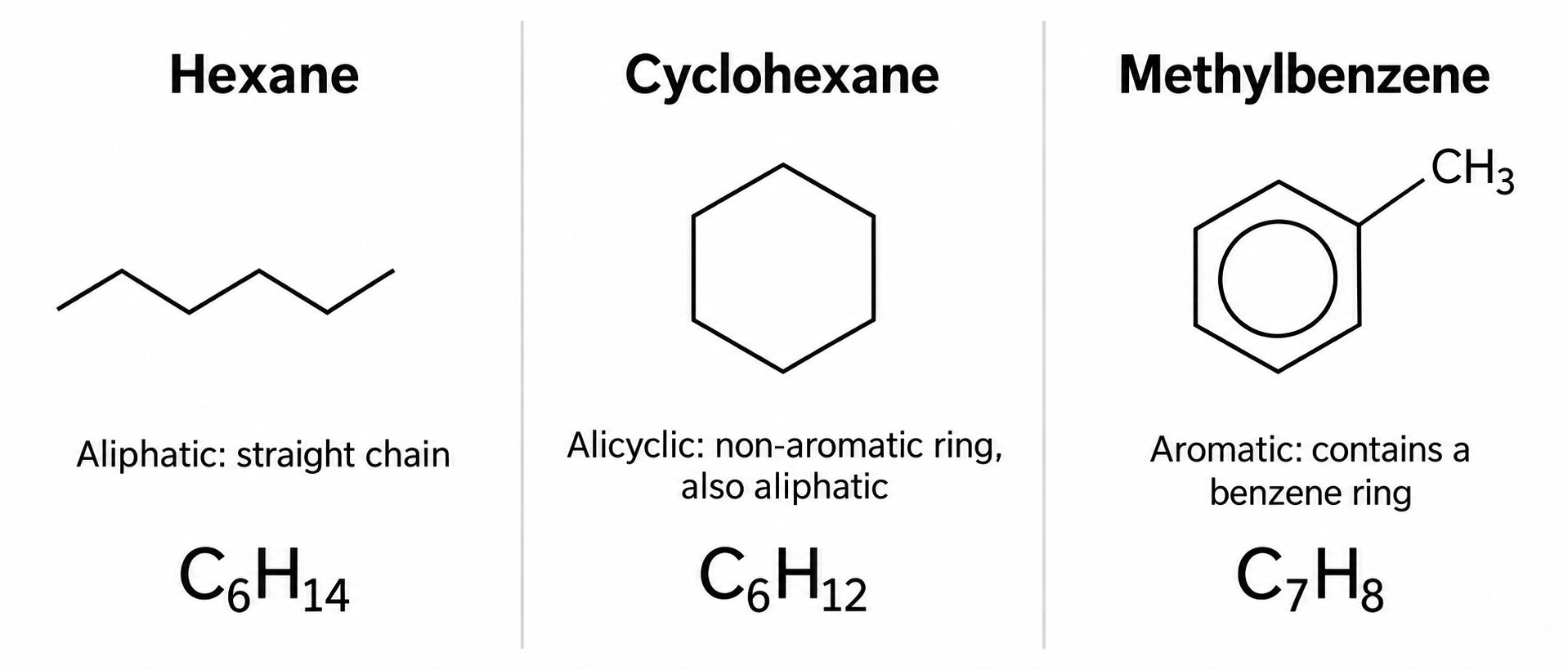
The three families: hexane is aliphatic, cyclohexane is alicyclic (and therefore aliphatic), methylbenzene is aromatic.
Exam sentence: An alicyclic compound contains carbon atoms arranged in a non-aromatic ring; an aromatic compound contains a benzene ring.
Quick Check: Put Three New Compounds in a Family
Drag the words into the gaps to classify three compounds that are not used above.
Quick Check: Which One Is Alicyclic?
Only one of these four compounds has its carbon atoms in a non-aromatic ring.
Saturated and Unsaturated: The OCR Wording
Most courses define an unsaturated compound as one with a C=C double bond. OCR uses a wider definition that you must reproduce in full:
- Saturated: single carbon-carbon bonds only.
- Unsaturated: the presence of multiple carbon-carbon bonds, including C=C, C≡C and aromatic rings.
| Compound | Carbon-carbon bonds present | Saturated or unsaturated? | Family |
|---|---|---|---|
| Propane | Single only | Saturated | Aliphatic |
| Cyclopentane | Single only (in a ring) | Saturated | Alicyclic |
| But-2-ene | One C=C | Unsaturated | Aliphatic |
| Cyclohexene | One C=C in a ring | Unsaturated | Alicyclic |
| Ethyne | One C≡C | Unsaturated | Aliphatic |
| Benzene | Delocalised aromatic ring | Unsaturated | Aromatic |
Exam focus: A ring on its own does not make a compound unsaturated. Cyclohexane is saturated; cyclohexene and benzene are unsaturated. Saturation is about the carbon-carbon bond order, not about whether there is a ring.
Quick Check: Spot the Unsaturated Compounds
Click every compound in the list that is unsaturated, using the full definition.
Why the Classification Matters
The family a compound belongs to predicts how it reacts, which is why OCR introduces the terms before any reactions are studied.
| Family | Typical reactivity | Where you meet it |
|---|---|---|
| Saturated aliphatic (alkanes, cycloalkanes) | Unreactive; only radical substitution and combustion | 4.1.2 Alkanes |
| Unsaturated aliphatic (alkenes) | Electrophilic addition across the π bond | 4.1.3 Alkenes |
| Aromatic (benzene and its derivatives) | Electrophilic substitution, not addition, because the delocalised ring is stable | 6.1.1 Aromatic compounds (A Level) |
The bromine water test illustrates the difference. An unsaturated aliphatic compound such as cyclohexene decolourises bromine water at once, but benzene, although unsaturated, does not react under the same conditions because addition would destroy its stable delocalised ring.
Key idea: Classify first, then predict: saturated aliphatic compounds substitute, unsaturated aliphatic compounds add, aromatic compounds substitute while keeping the ring.
Quick Check: Predict What Each Compound Does
In each round, choose the one statement that is accurate.
Common Exam Mistakes
- Calling cyclohexane “aromatic” because it is a six-membered ring. Aromatic means it contains a benzene ring.
- Saying an alicyclic compound is not aliphatic. Alicyclic compounds are aliphatic compounds in rings.
- Defining unsaturated as “contains a C=C bond” only. OCR also includes C≡C and aromatic rings.
- Describing a cycloalkane as unsaturated because it has “fewer hydrogens than the alkane”. Saturation depends on bond order, not on the general formula.
Exam sentence: Aliphatic compounds have carbon atoms in chains or non-aromatic rings; those in non-aromatic rings are alicyclic; aromatic compounds contain a benzene ring.
Master Basic Concepts of Organic Chemistry and Alkanes for OCR A Level Chemistry A
Continue from these free revision notes into the full 4.1.1 and 4.1.2 Basic Concepts of Organic Chemistry and Alkanes course. The guided video lessons are ready now; the OCR A MCQ bank, teacher-marked short-answer questions and KASP spec-point report are being written, and the course opens for enrolment as soon as they are complete.
Guided video teaching
Learn the chemistry and exam technique through structured video lessons with worked examples and walkthroughs.
Instant MCQ feedback
Auto-marked MCQ quizzes provide immediate diagnostic feedback for every answer choice.
Teacher-marked SAQs
Submit written exam responses and receive chemistry specialist feedback with improvement guidance.
Progress tracking
Identify strengths and weaknesses across the full 4.1.1 and 4.1.2 specification with targeted reporting.
See how the course works
Click play to start the course preview animation.
Some ionic radii are shown.
| Ion | Ionic radius / nm |
|---|---|
| Na+ | 0.102 |
| K+ | 0.138 |
| F− | 0.133 |
| Cl− | 0.180 |
Which compound has the strongest ionic bonding?
Explain why the metallic bonding in magnesium is much stronger than that in sodium.
Copyright notice: This OLS revision content, including the explanations, layout, diagrams, tables and embedded learning structure, is authored for Online Learning System by Dr. Mohammed Al-Fatah. It may not be copied, reproduced, redistributed or adapted without written permission.
Keep this note — free
Save your progress across every OCR A topic. A free account remembers which topics you have covered, saves your question scores, and syncs across your phone and laptop.
- Track every topic you have finished
- Keep your practice-question scores
- No payment, no card, free forever
Already registered? Log in