Functional Groups in the Cambridge Table
A concise Cambridge International AS Level Chemistry revision guide to the full table of functional groups in the 9701 syllabus (13.1.3): the classes not covered on the individual naming pages, how each group dictates the properties of its compounds, and the extra naming rules for esters and nitriles (13.1.5).
GCSE Recap: Homologous Series and the Groups You Know
Before you start, check the groups you can already recognise and why members of one series behave alike.
The Cambridge Functional-Group Table
Cambridge 13.1.3 states that the compounds in the syllabus table contain a functional group which dictates their physical and chemical properties, and 13.1.4 asks you to interpret and use the general, structural, displayed and skeletal formulae of every class in that table. The individual naming pages cover alkenes, halogenoalkanes, alcohols, aldehydes, ketones, carboxylic acids and esters. This page completes the table.
| Class | Functional group | General formula | Naming | Example |
|---|---|---|---|---|
| Alkane | None (C-C and C-H only) | CnH2n+2 | Suffix -ane | Propane, CH3CH2CH3 |
| Alkene | C=C | CnH2n | Suffix -ene | But-1-ene |
| Halogenoalkane | C-X (X = F, Cl, Br, I) | CnH2n+1X | Prefix fluoro-, chloro-, bromo-, iodo- | 2-Bromopropane |
| Alcohol | C-OH | CnH2n+1OH | Suffix -ol | Propan-2-ol |
| Aldehyde | CHO | CnH2nO | Suffix -al | Butanal |
| Ketone | C=O (within the chain) | CnH2nO | Suffix -one | Pentan-3-one |
| Carboxylic acid | COOH | CnH2n+1COOH | Suffix -oic acid | Propanoic acid |
| Ester | COOR | RCOOR′ | Alkyl + -oate | Ethyl propanoate |
| Amine | NH2 | CnH2n+1NH2 | Suffix -amine (or prefix amino-) | Propylamine |
| Nitrile | C≡N | CnH2n+1CN | Suffix -nitrile | Propanenitrile |
| Amide | CONH2 | CnH2n+1CONH2 | Suffix -amide | Ethanamide |
| Acyl chloride | COCl | CnH2n+1COCl | Suffix -oyl chloride | Propanoyl chloride |
| Hydroxynitrile | C(OH)CN | – | Prefix hydroxy- with suffix -nitrile | 2-Hydroxypropanenitrile |
| Arene | Benzene ring, C6H5– | C6H5R | Named as benzene derivatives | Methylbenzene |
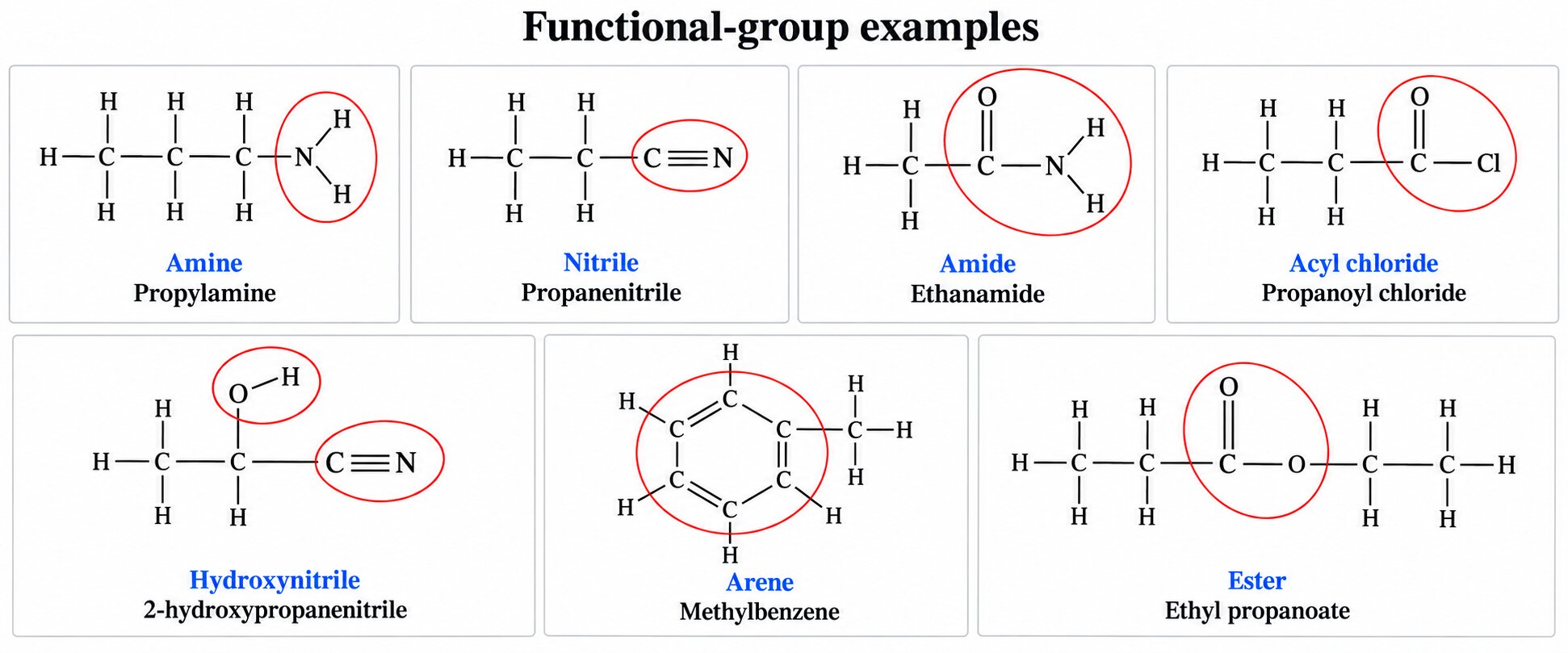
The classes that complete the Cambridge table, each with its functional group highlighted.
Key idea: The functional group decides the chemistry: every compound in a class undergoes the same characteristic reactions, which is why Cambridge asks you to recognise each group from a formula and to name compounds from it.
Quick Check: Name the Class from the Formula
Drag a class name into each gap; one compound needs two of them.
The Nitrogen-Containing Groups
Four of the classes contain nitrogen. They are met in Topic 19 (nitrogen compounds) and in the synthesis routes of Topic 21, but you must recognise and name them from Topic 13 onwards.
| Class | What to look for | Naming rule | Watch out |
|---|---|---|---|
| Amine | An NH2 group on a carbon chain | Name the alkyl group then add -amine: ethylamine, butylamine | Not to be confused with an amide, which has C=O next to the nitrogen |
| Amide | CONH2: a carbonyl carbon bonded to NH2 | Replace -oic acid with -amide: propanoic acid gives propanamide | The carbonyl carbon is counted in the chain |
| Nitrile | C≡N at the end of a chain | Count the nitrile carbon in the chain and add -nitrile: CH3CH2CN is propanenitrile, not ethanenitrile | Cambridge restricts nitrile naming to straight chains |
| Hydroxynitrile | OH and CN on the same carbon | Number from the nitrile carbon: CH3CH(OH)CN is 2-hydroxypropanenitrile | Formed when HCN adds to an aldehyde or ketone |
Exam focus: The nitrile carbon is part of the chain. CH3CN has two carbon atoms and is ethanenitrile; CH3CH2CH2CN has four and is butanenitrile.
Quick Check: The Nitrogen Classes
Five quick questions on compounds the page has not used; classify first, then name.
Acyl Chlorides and Arenes
Acyl chlorides contain the COCl group: a carbonyl carbon bonded to chlorine. They are named from the parent acid by replacing -oic acid with -oyl chloride, so CH3COCl is ethanoyl chloride and CH3CH2COCl is propanoyl chloride. They are very reactive derivatives of carboxylic acids and appear in Topic 18.
Arenes contain a benzene ring, C6H6, drawn as a hexagon with a circle to show the delocalised electrons. Substituted arenes are named as derivatives of benzene: methylbenzene, C6H5CH3, and chlorobenzene, C6H5Cl. When the benzene ring is a substituent on a chain it is called a phenyl group, as in phenylethene. Arenes are studied in detail at A Level (Topic 30), but their formulae appear in AS questions on functional groups.
Key idea: A benzene ring is unsaturated, but it does not undergo the addition reactions of alkenes; its stability comes from the delocalised electrons.
Quick Check: A Ring and a Double Bond in One Molecule
Decide which part of phenylethene reacts with bromine, and why the other does not.
Naming Esters: Six Plus Six
Cambridge 13.1.5 allows ester names with up to six carbon atoms in each part. An ester is named in two words: the alkyl group from the alcohol first, then the acid part with -oate.
- Find the C=O carbon. The chain it belongs to came from the acid and gives the second word: methanoate, ethanoate, propanoate, butanoate, pentanoate, hexanoate.
- The alkyl group on the single-bonded oxygen came from the alcohol and gives the first word: methyl, ethyl, propyl, butyl, pentyl, hexyl.
| Ester | Alcohol part (first word) | Acid part (second word) | Structural formula |
|---|---|---|---|
| Propyl ethanoate | Propyl, from propan-1-ol | Ethanoate, from ethanoic acid | CH3COOCH2CH2CH3 |
| Methyl butanoate | Methyl, from methanol | Butanoate, from butanoic acid | CH3CH2CH2COOCH3 |
| Hexyl hexanoate | Hexyl, from hexan-1-ol | Hexanoate, from hexanoic acid | CH3(CH2)4COO(CH2)5CH3 |
Exam focus: Write the formula the way the name reads, acid part first with its C=O: CH3CH2COOCH3 is methyl propanoate. Students often swap the two parts.
Quick Check: Name Four New Esters
Work out both words of each name, then type it in.
Quick Check: Pick the Accurate Statement
In each round, choose the one statement that reads the formula correctly.
Common Exam Mistakes
- Naming CH3CH2CN as ethanenitrile. The nitrile carbon counts, so it is propanenitrile.
- Confusing amines (C-NH2) with amides (C(=O)NH2). Look for the carbonyl group next to the nitrogen.
- Swapping the two parts of an ester name, or writing the alkyl group on the wrong oxygen.
- Treating a benzene ring as an alkene and predicting addition reactions.
- Giving a general formula for a hydroxynitrile: the syllabus expects the group C(OH)CN to be recognised, not a general formula.
Exam sentence: Each class in the Cambridge table is defined by its functional group; the group is named by a suffix or prefix, and the nitrile and carbonyl carbons are counted as part of the chain.
Master Introduction to Organic Chemistry and Alkanes for Cambridge International AS & A Level Chemistry
Continue from these free revision notes into the full Topics 13 and 14.1 Introduction to Organic Chemistry and Alkanes course. The guided video lessons are ready now; the Cambridge International MCQ bank, teacher-marked short-answer questions and KASP spec-point report are being written, and the course opens for enrolment as soon as they are complete.
Guided video teaching
Learn the chemistry and exam technique through structured video lessons with worked examples and walkthroughs.
Instant MCQ feedback
Auto-marked MCQ quizzes provide immediate diagnostic feedback for every answer choice.
Teacher-marked SAQs
Submit written exam responses and receive chemistry specialist feedback with improvement guidance.
Progress tracking
Identify strengths and weaknesses across the full Topics 13 and 14.1 specification with targeted reporting.
See how the course works
Click play to start the course preview animation.
Some ionic radii are shown.
| Ion | Ionic radius / nm |
|---|---|
| Na+ | 0.102 |
| K+ | 0.138 |
| F− | 0.133 |
| Cl− | 0.180 |
Which compound has the strongest ionic bonding?
Explain why the metallic bonding in magnesium is much stronger than that in sodium.
Free Radical Substitution FAQs
These questions summarise the core exam points on alkane substitution and free radicals.
Why are alkanes usually unreactive?
Alkanes are usually unreactive because they contain strong C-C and C-H bonds. These bonds require a large amount of energy to break.
What condition is needed for alkanes to react with chlorine?
Ultraviolet light is needed. UV light provides enough energy to break the Cl-Cl bond by homolytic fission, forming chlorine radicals.
What is a free radical?
A free radical is a species with an unpaired electron. The unpaired electron is usually represented using a dot, such as Cl•.
Why is the reaction called substitution?
It is called substitution because a hydrogen atom in the alkane is replaced by a halogen atom.
Why can a mixture of products form?
After the first substitution, the haloalkane product can undergo further substitution. This can replace more hydrogen atoms and produce a mixture of chlorinated products.
Copyright notice: This OLS revision content, including the explanations, layout, diagrams, tables and embedded learning structure, is authored for Online Learning System by Dr. Mohammed Al-Fatah. It may not be copied, reproduced, redistributed or adapted without written permission.
Keep this note — free
Save your progress across every Cambridge topic. A free account remembers which topics you have covered, saves your question scores, and syncs across your phone and laptop.
- Track every topic you have finished
- Keep your practice-question scores
- No payment, no card, free forever
Already registered? Log in