Optical Isomerism
A concise Cambridge International AS Level Chemistry revision guide to optical isomerism (13.4.2 and 13.4.4): stereoisomerism and its two divisions, chiral centres and enantiomers, how to identify chiral centres in chain and cyclic molecules (13.4.5), and how to deduce all the isomers of a molecular formula (13.4.6).
Stereoisomerism and Its Two Divisions
Stereoisomers have the same molecular formula and the same structural formula, but their atoms are arranged differently in space. Cambridge 13.4.2 divides stereoisomerism into two types.
| Type | Cause | What differs | Example |
|---|---|---|---|
| Geometrical (cis/trans) isomerism | Restricted rotation about a C=C bond or a ring | Which side of the double bond or ring the groups lie on | cis- and trans-but-2-ene (see the Geometric Isomerism page) |
| Optical isomerism | A chiral centre: a carbon atom bonded to four different groups | The two isomers are non-superimposable mirror images of each other | The two enantiomers of butan-2-ol |
Key idea: Structural isomers differ in how the atoms are bonded together; stereoisomers are bonded in the same order but arranged differently in three dimensions.
Quick Check: Which Kind of Stereoisomerism?
Five molecules, one decision each: does it show geometrical isomerism, optical isomerism, both or neither?
Chiral Centres and Enantiomers
A chiral centre is a carbon atom bonded to four different atoms or groups. Because the four groups are arranged tetrahedrally, a molecule with a chiral centre and its mirror image cannot be superimposed, in the same way that a left hand cannot be superimposed on a right hand. The two mirror-image forms are called enantiomers (optical isomers).
Take butan-2-ol, CH3CH(OH)CH2CH3. Carbon 2 is bonded to H, OH, CH3 and CH2CH3: four different groups, so it is a chiral centre and butan-2-ol exists as two enantiomers. Butan-1-ol has no carbon with four different groups (carbon 1 carries two hydrogens), so it has no optical isomers.
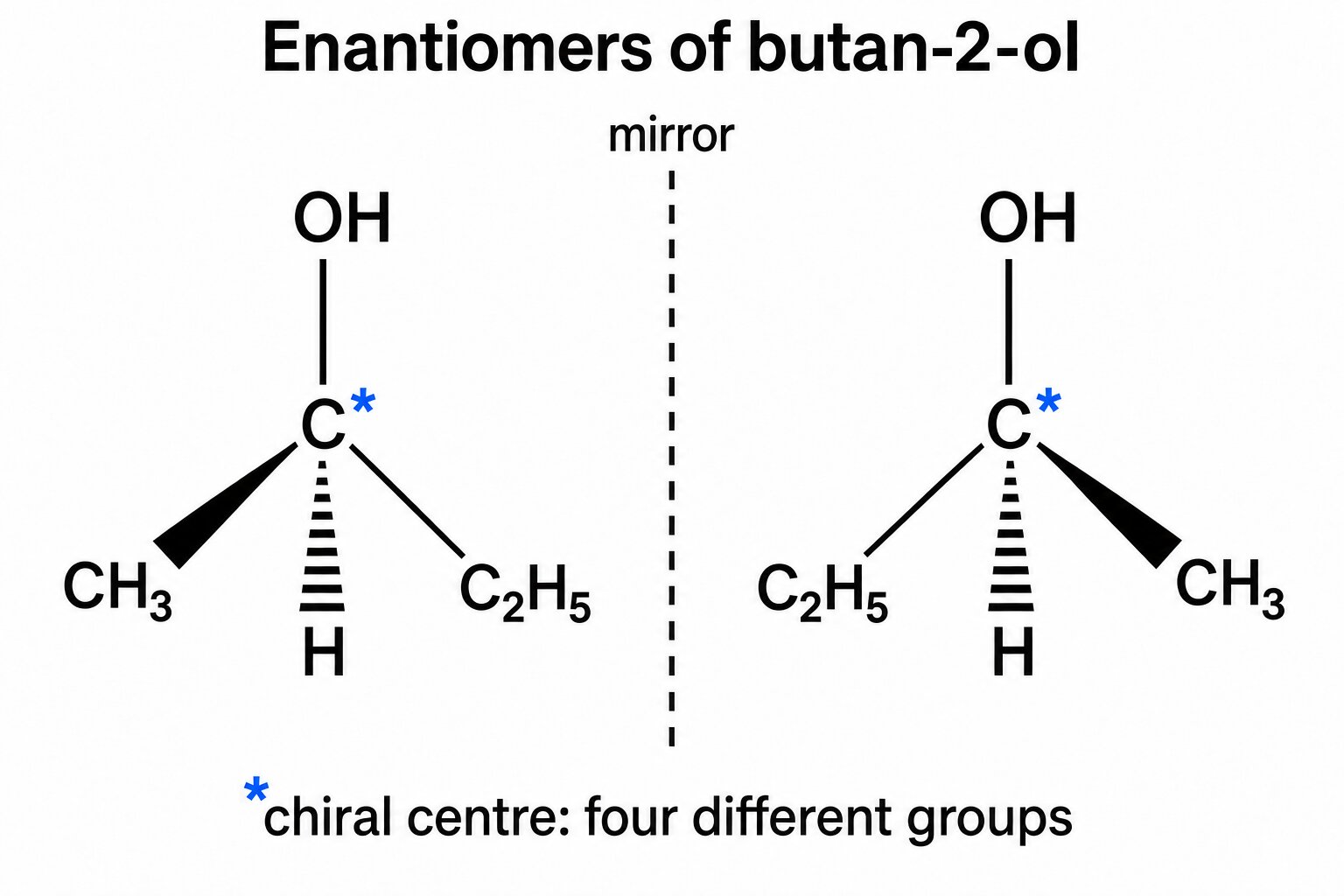
The enantiomers of butan-2-ol are mirror images that cannot be superimposed; the chiral centre is marked with an asterisk.
Enantiomers have identical physical properties except for one: they rotate the plane of plane-polarised light in opposite directions, which is why the phenomenon is called optical isomerism. Their chemical reactions are identical unless they react with another chiral molecule, which is why enantiomers of a drug can behave differently in the body.
Exam sentence: A chiral centre is a carbon atom attached to four different groups; it gives rise to two optical isomers, called enantiomers, which are non-superimposable mirror images of each other.
Quick Check: Explain the Two Carvones
Write a short explanation, then compare it with the mark points and the model answer.
Identifying Chiral Centres
Cambridge 13.4.5 asks you to identify chiral centres in a given structural formula, including cyclic compounds. Check every carbon that carries four single bonds and ask whether all four groups are different. A carbon with two hydrogens, two methyl groups, or any repeated group is not chiral.
| Molecule | Carbon checked | Four groups | Chiral? |
|---|---|---|---|
| 2-Bromobutane | C2 | H, Br, CH3, CH2CH3 | Yes |
| 2-Bromopropane | C2 | H, Br, CH3, CH3 | No: two methyl groups |
| 2-Hydroxypropanoic acid (lactic acid) | C2 | H, OH, CH3, COOH | Yes |
| 3-Methylcyclohexene | C3 | H, CH3, and the two ring arms which differ (one leads to C=C, the other to CH2) | Yes |
| Methylcyclohexane | C1 | H, CH3, and two identical ring arms | No |
In a ring, the two “arms” of the ring count as two of the four groups. They are different only if going round the ring in each direction meets different atoms, as in 3-methylcyclohexene where one direction reaches the double bond first.
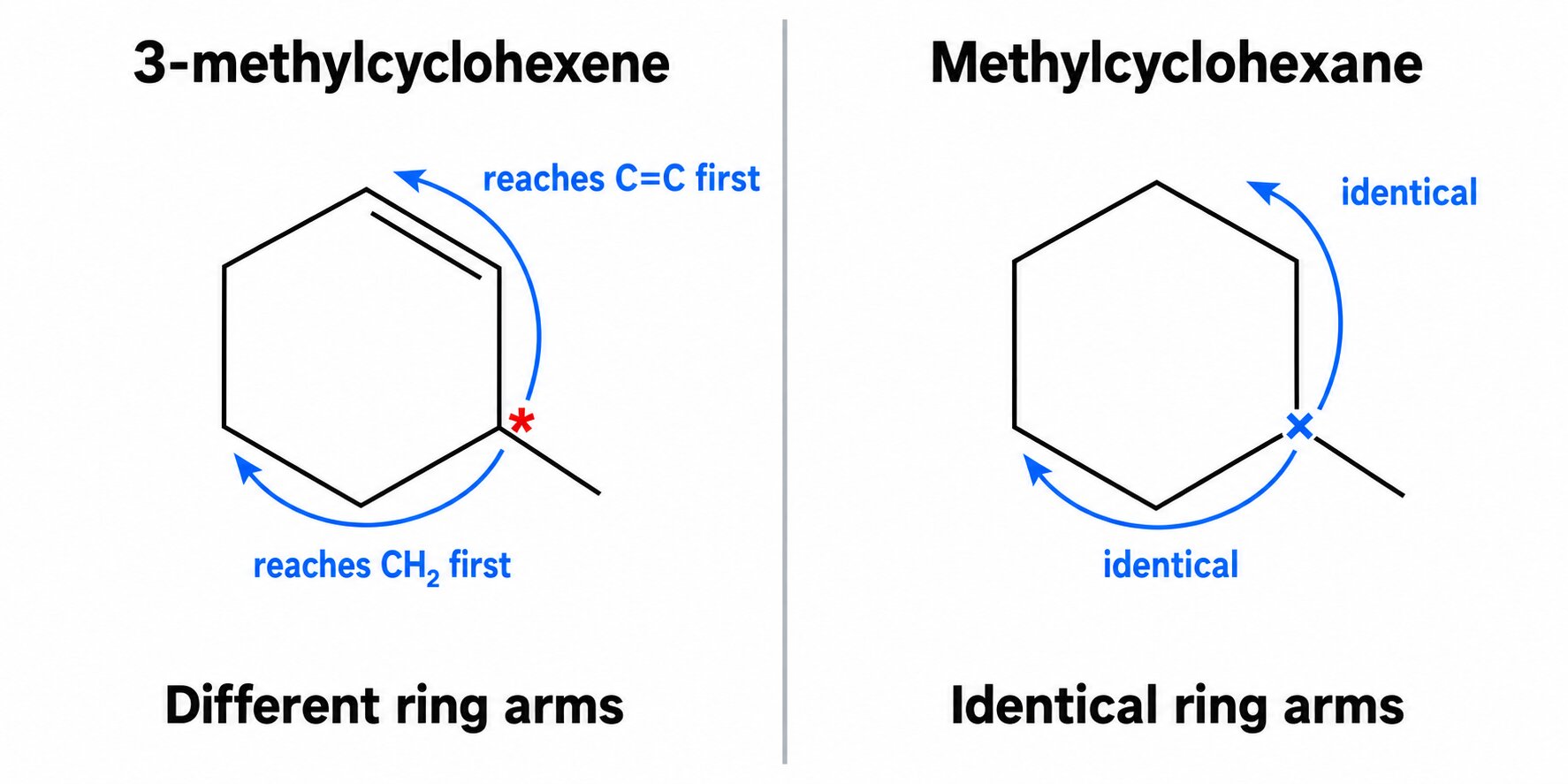
Checking a ring carbon: the two ring arms are different groups only if the ring is different in each direction.
Exam focus: Mark chiral centres with an asterisk on the structure. Molecules with one chiral centre have two optical isomers; you are not expected to assign R and S labels at AS Level.
Quick Check: Find the Chiral Centres
Click every formula that contains a carbon bonded to four different groups.
Quick Check: Chiral Centres in Rings
Trace each ring in both directions before you choose.
Deducing All the Isomers of a Formula
Cambridge 13.4.6 asks you to deduce the possible isomers for a molecule of known molecular formula. Work through the types in order so that none is missed.
- Chain isomers: draw every carbon skeleton, straight then branched.
- Positional isomers: move the functional group or multiple bond to each distinct position.
- Functional group isomers: check whether a different class fits the formula (for example an alkene and a cycloalkane, or an aldehyde and a ketone).
- Geometrical isomers: for each C=C with two different groups on each carbon, draw cis and trans.
- Optical isomers: mark any chiral centre; each gives a pair of enantiomers.
For C4H9Br: the chain isomers give 1-bromobutane, 2-bromobutane, 1-bromo-2-methylpropane and 2-bromo-2-methylpropane; there are no C=C bonds, so no geometrical isomers; 2-bromobutane has a chiral centre, so it exists as two enantiomers. That makes five isomers in total.
Exam sentence: To find every isomer, list the structural isomers (chain, positional, functional group) first, then check each one for geometrical and optical isomerism.
Quick Check: Count the Isomers
Work each count out on paper, then flip the card to check your working.
Quick Check: Pick the Accurate Statement
In each round, choose the one statement that is accurate.
Common Exam Mistakes
- Calling any carbon with four bonds a chiral centre. The four groups must all be different.
- Treating the two arms of a ring as automatically different, or automatically the same. Trace the ring in both directions.
- Saying enantiomers have different boiling points or reactivity. They differ only in the direction they rotate plane-polarised light and in reactions with other chiral molecules.
- Forgetting the optical isomers when counting the isomers of a formula, or counting them for a molecule with no chiral centre.
Exam sentence: Optical isomers arise from a chiral centre, a carbon bonded to four different groups, and exist as two non-superimposable mirror images called enantiomers.
Master Introduction to Organic Chemistry and Alkanes for Cambridge International AS & A Level Chemistry
Continue from these free revision notes into the full Topics 13 and 14.1 Introduction to Organic Chemistry and Alkanes course. The guided video lessons are ready now; the Cambridge International MCQ bank, teacher-marked short-answer questions and KASP spec-point report are being written, and the course opens for enrolment as soon as they are complete.
Guided video teaching
Learn the chemistry and exam technique through structured video lessons with worked examples and walkthroughs.
Instant MCQ feedback
Auto-marked MCQ quizzes provide immediate diagnostic feedback for every answer choice.
Teacher-marked SAQs
Submit written exam responses and receive chemistry specialist feedback with improvement guidance.
Progress tracking
Identify strengths and weaknesses across the full Topics 13 and 14.1 specification with targeted reporting.
See how the course works
Click play to start the course preview animation.
Some ionic radii are shown.
| Ion | Ionic radius / nm |
|---|---|
| Na+ | 0.102 |
| K+ | 0.138 |
| F− | 0.133 |
| Cl− | 0.180 |
Which compound has the strongest ionic bonding?
Explain why the metallic bonding in magnesium is much stronger than that in sodium.
Free Radical Substitution FAQs
These questions summarise the core exam points on alkane substitution and free radicals.
Why are alkanes usually unreactive?
Alkanes are usually unreactive because they contain strong C-C and C-H bonds. These bonds require a large amount of energy to break.
What condition is needed for alkanes to react with chlorine?
Ultraviolet light is needed. UV light provides enough energy to break the Cl-Cl bond by homolytic fission, forming chlorine radicals.
What is a free radical?
A free radical is a species with an unpaired electron. The unpaired electron is usually represented using a dot, such as Cl•.
Why is the reaction called substitution?
It is called substitution because a hydrogen atom in the alkane is replaced by a halogen atom.
Why can a mixture of products form?
After the first substitution, the haloalkane product can undergo further substitution. This can replace more hydrogen atoms and produce a mixture of chlorinated products.
Copyright notice: This OLS revision content, including the explanations, layout, diagrams, tables and embedded learning structure, is authored for Online Learning System by Dr. Mohammed Al-Fatah. It may not be copied, reproduced, redistributed or adapted without written permission.
Keep this note — free
Save your progress across every Cambridge topic. A free account remembers which topics you have covered, saves your question scores, and syncs across your phone and laptop.
- Track every topic you have finished
- Keep your practice-question scores
- No payment, no card, free forever
Already registered? Log in