Non-Polar & Polar Molecules
A concise revision guide to molecular polarity, bond dipole cancellation, symmetrical molecules, lone pair effects and the charged rod experiment used to test polar liquids.
GCSE Recap: Shared Pairs and Charges
Before you start, check three GCSE ideas that this page builds on.
What Makes a Molecule Polar?
A polar molecule has an overall dipole. This means there is a permanent separation of charge across the whole molecule.
Molecular polarity depends on two linked ideas: the polarity of the individual bonds and the 3D shape of the molecule.
A molecule can contain polar bonds but still be non-polar overall if the bond dipoles cancel out.
Definition: A polar molecule has an uneven distribution of electron density, giving one side of the molecule a partial negative character and another side a partial positive character.
Key idea: Do not decide molecular polarity from bond polarity alone. Always check the 3D shape and whether the bond dipoles cancel.
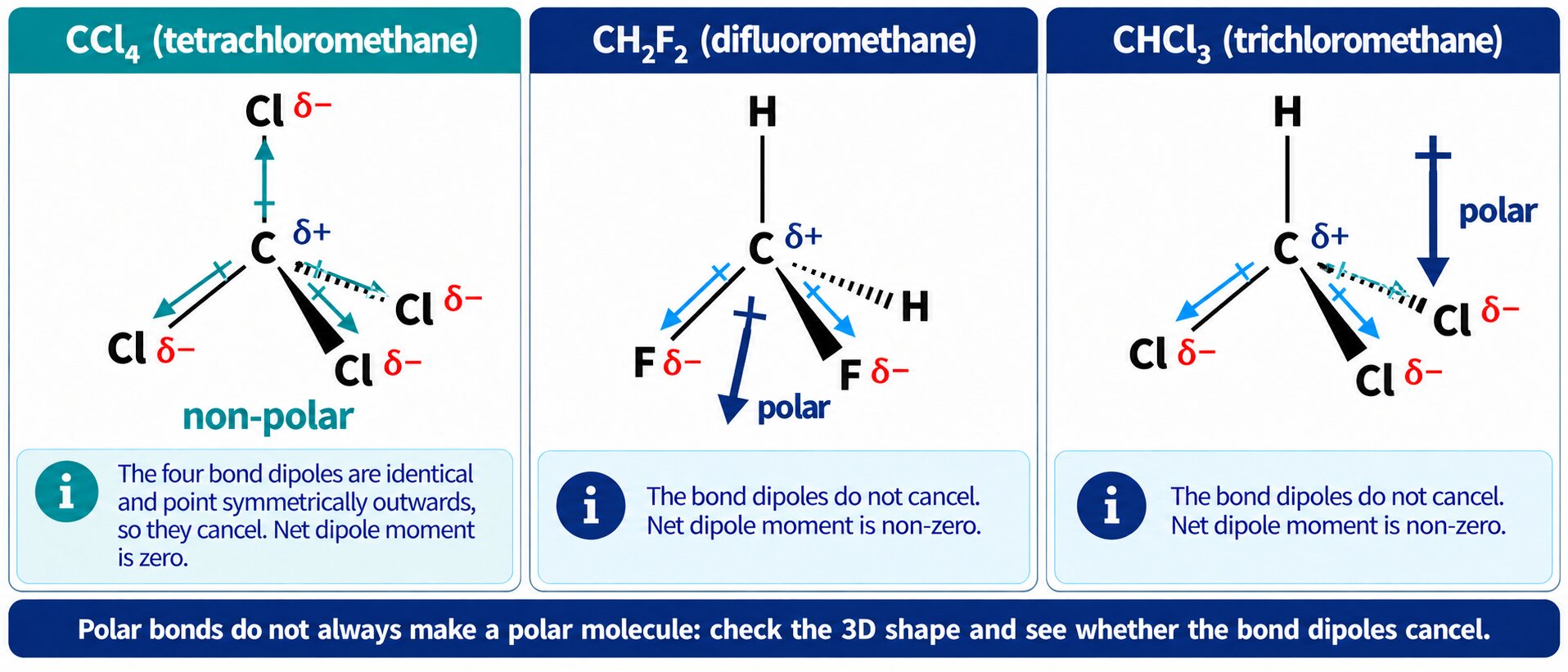
Overall polarity depends on whether the bond dipoles cancel in the 3D structure.
When Polar Bonds Cancel Out
Some molecules contain polar covalent bonds but are non-polar molecules overall.
This happens when the molecule is symmetrical, the same atoms or groups are arranged evenly around the central atom, and there are no lone pairs causing an uneven shape.
The bond dipoles point in different directions and cancel, leaving no overall dipole moment.
Symmetry cancels equal dipoles
If equal polar bonds are arranged symmetrically in 3D, the molecule has no net dipole.
Shape matters
Dipoles cancel in three dimensions, not just on a flat paper diagram.
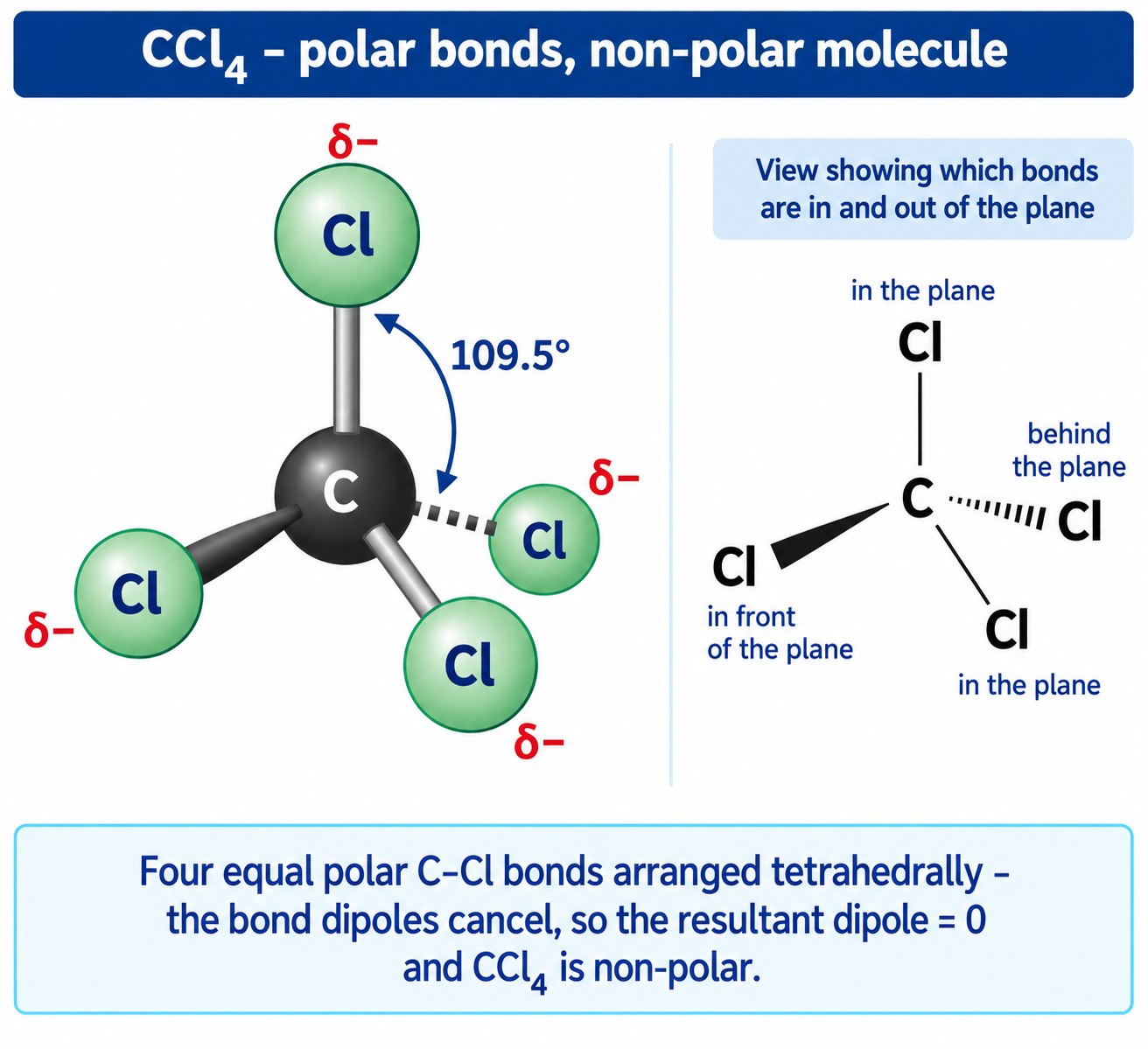
CCl4 has four polar C-Cl bonds, but the tetrahedral arrangement makes the dipoles cancel.
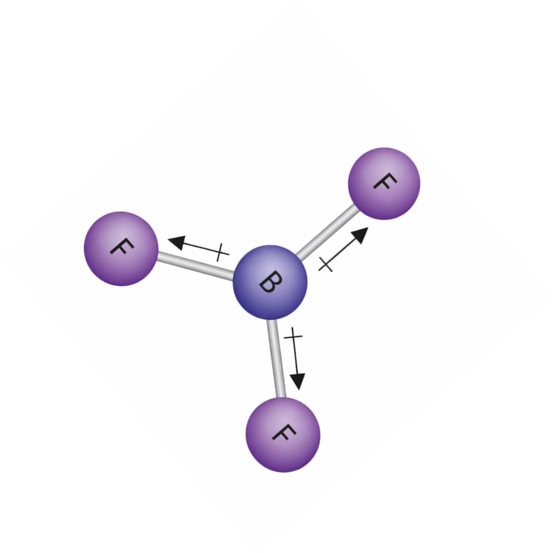
BF3 is trigonal planar and symmetrical, so the B-F bond dipoles cancel.
Quick Check: Where Do the Dipoles Cancel?
All four molecules contain polar bonds, so use the shapes to find the one that is non-polar overall.
Bond Dipoles and Polar Molecules
See how electronegativity makes bonds polar, then add the bond dipoles head to tail to find out whether the whole molecule is polar.
© Dr. Mohammed Al-Fatah – onlinelearningsystem.net
When a Molecule Is Polar Overall
A molecule becomes polar when the individual bond dipoles do not cancel out.
This commonly happens when the molecule is not symmetrical, or when lone pairs create an uneven distribution of electron density.
If the polar bonds point roughly towards the same side of a molecule, there will be a net dipole across the molecule.
Partial charges are written as δ+ and δ−. In H-Cl, chlorine is the more electronegative atom, so chlorine is δ− and hydrogen is δ+. A dipole arrow points from the δ+ end towards the δ− end.
Worked example: in ammonia, NH3, each N-H bond is polar, with nitrogen δ− and hydrogen δ+. The molecule is trigonal pyramidal, so the three bond dipoles do not cancel. The overall dipole points from the hydrogen atoms towards the nitrogen atom and its lone pair, so NH3 is polar.
Exam focus: Explain both parts: the molecule has polar bonds, and the shape means the dipoles do not cancel.
Quick Check: Polar or Non-Polar Tetrahedral Molecules
Click every tetrahedral molecule whose bond dipoles do not cancel.
Lone Pairs Can Make Polarity Trickier
Some molecules are polar even when their bonds are weakly polar or treated as essentially non-polar at this level.
The reason is that lone pairs occupy regions of electron density and can make the overall electron distribution uneven.
PH3 is a useful tricky example: the P-H electronegativity difference is very small, but the molecule is trigonal pyramidal with a lone pair on phosphorus, so it has a small overall dipole.
Important distinction: Bond polarity is about individual bonds. Molecular polarity is about the overall electron distribution across the entire molecule.
Quick Check: Pick the Accurate Statement
In each round, choose the one statement about polarity that is accurate.
How to Decide if a Molecule Is Polar
Use a step-by-step approach rather than guessing from the formula.
| Step | What to check | Exam conclusion |
|---|---|---|
| 1 | Decide whether the individual bonds are polar using electronegativity differences. | More electronegative atoms attract bonding electrons more strongly. |
| 2 | Work out the 3D shape of the molecule, including lone pairs. | The same formula drawn flat can hide the real direction of the dipoles. |
| 3 | Check whether the dipoles cancel due to symmetry. | If the dipoles cancel, the molecule is non-polar overall. |
| 4 | If the dipoles do not cancel, identify the direction of the overall dipole. | If there is a net dipole, the molecule is polar. |
Quick Check: Carbon Dioxide and Sulfur Dioxide
Drag the words into place to work through the four steps for two similar-looking molecules.
Experiment: Charged Rod and Polar Liquids
A simple demonstration of molecular polarity uses a charged rod brought close to a thin jet of liquid flowing from a burette.
If the liquid is polar, its molecules contain permanent dipoles. These dipoles align in the electric field from the charged rod, causing the jet of liquid to be attracted and deflected. Water is the liquid shown here.
The jet is attracted whichever charge the rod carries. The molecules in a liquid are free to rotate, so each one turns until its oppositely charged end faces the rod: the δ+ end faces a negative rod and the δ− end faces a positive rod. The jet bends towards the rod in both cases and is never repelled.
The stronger the overall dipole in the liquid molecules, the greater the deflection of the liquid jet. Non-polar liquids show little or no significant deflection.
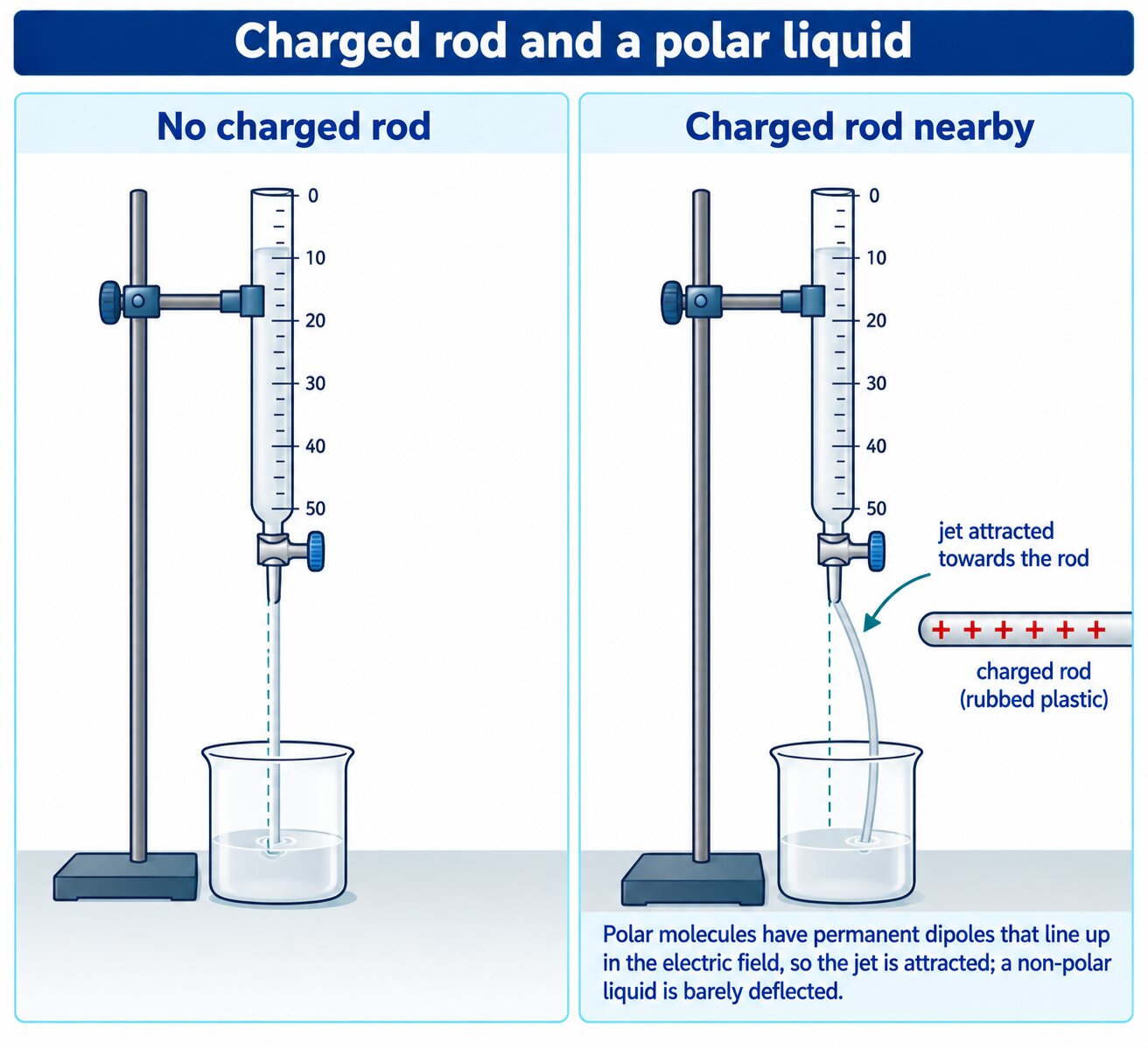
A polar liquid can be attracted towards a charged rod because its molecular dipoles align with the electric field.
Quick Check: Predict the Charged Rod Test
Answer three questions about what the charged rod experiment shows.
Common Exam Points
Strong answers use the words polar bonds, 3D shape, symmetrical, dipoles cancel and overall dipole accurately.
Do not stop at “the bonds are polar”
A molecule with polar bonds may still be non-polar overall if the dipoles cancel.
Use cancellation language
For CCl4 and BF3, state that the bond dipoles cancel because the molecule is symmetrical.
Mention lone pairs where relevant
Lone pairs can distort the shape or make electron density uneven, so the molecule may have an overall dipole.
Experimental deflection
A polar liquid is attracted to a charged rod because permanent dipoles align with the electric field.
QuickSnap
Molecular polarity is decided by both bond polarity and molecular shape. Symmetrical molecules can contain polar bonds but be non-polar overall because the dipoles cancel. Unsymmetrical molecules, or molecules with lone pair effects that create uneven electron density, can be polar overall.
Polar molecule
Has an overall dipole due to uneven electron density across the molecule.
Non-polar molecule
Has no overall dipole because the bond dipoles cancel or the bonds are non-polar.
Symmetry
Equal bond dipoles arranged symmetrically cancel in three dimensions.
Charged rod test
Polar liquids are deflected because their permanent dipoles align with the charged rod.
Master Covalent Bonding and Shapes of Molecules for Cambridge International AS & A Level Chemistry
Continue from these free revision notes into the full Topic 3 Covalent Bonding and Shapes of Molecules course. The guided video lessons are ready now; the Cambridge International MCQ bank, teacher-marked short-answer questions and KASP spec-point report are being written, and the course opens for enrolment as soon as they are complete.
Guided video teaching
Learn the chemistry and exam technique through structured video lessons with worked examples and walkthroughs.
Instant MCQ feedback
Auto-marked MCQ quizzes provide immediate diagnostic feedback for every answer choice.
Teacher-marked SAQs
Submit written exam responses and receive chemistry specialist feedback with improvement guidance.
Progress tracking
Identify strengths and weaknesses across the full Topic 3 specification with targeted reporting.
See how the course works
Click play to start the course preview animation.
Some ionic radii are shown.
| Ion | Ionic radius / nm |
|---|---|
| Na+ | 0.102 |
| K+ | 0.138 |
| F− | 0.133 |
| Cl− | 0.180 |
Which compound has the strongest ionic bonding?
Explain why the metallic bonding in magnesium is much stronger than that in sodium.
FAQs
Use these quick answers to check the common polarity misconceptions that appear in A Level Chemistry questions.
Can a molecule have polar bonds but be non-polar overall?
Yes. If the molecule is symmetrical, the individual bond dipoles can cancel out, leaving no overall dipole. CCl4 and BF3 are common examples.
Why is CHCl3 polar?
CHCl3 has three polar C-Cl bonds and one C-H bond arranged tetrahedrally. The molecule is not symmetrical, so the bond dipoles do not cancel and there is an overall dipole towards the chlorine-rich side.
Why is CCl4 non-polar even though C-Cl bonds are polar?
CCl4 is tetrahedral and symmetrical. The four equal C-Cl bond dipoles point in different directions and cancel in three dimensions.
How does a charged rod show that a liquid is polar?
A polar liquid contains molecules with permanent dipoles. These dipoles align with the electric field from the charged rod, so the liquid jet is attracted and bends towards the rod.
Why can lone pairs affect molecular polarity?
Lone pairs occupy regions of electron density and can make the electron distribution uneven. This can create an overall dipole even when the bond polarity is weak.
Copyright and author footprint: This OLS revision page was written for Online Learning System by Dr. Mohammed Al-Fatah. It is designed for A Level Chemistry revision and should not be copied or redistributed without permission.
Keep this note — free
Save your progress across every Cambridge topic. A free account remembers which topics you have covered, saves your question scores, and syncs across your phone and laptop.
- Track every topic you have finished
- Keep your practice-question scores
- No payment, no card, free forever
Already registered? Log in