Electronegativity Trends and Bond Type
A concise Cambridge International AS Level Chemistry revision guide to 3.1.2 to 3.1.4: the three factors that control the electronegativity of an element, why the values rise across a period and fall down a group, and how to use differences in Pauling values to predict whether a bond will be ionic or covalent.
GCSE Recap: Taking, Giving and Sharing Electrons
Before you start, check the GCSE ideas this page builds on: which atoms take electrons, which share them, and how many shells an atom has.
The Three Factors That Control Electronegativity
Electronegativity is the power of an atom to attract the bonding pair of electrons in a covalent bond towards itself. How strongly a nucleus can pull on a shared pair that sits in the outer shell depends on three things.
| Factor | Effect on electronegativity | Reason |
|---|---|---|
| Nuclear charge | More protons increase electronegativity | A larger positive charge attracts the bonding pair more strongly |
| Atomic radius | A smaller atom has a higher electronegativity | The bonding pair is closer to the nucleus, so the attraction is stronger |
| Shielding by inner shells | More inner shells lower electronegativity | Inner electrons repel the bonding pair and cancel part of the nuclear charge |
The three factors combine into one idea: what matters is the effective attraction felt by the bonding pair, which rises with nuclear charge but falls with distance and with shielding.
Exam sentence: Electronegativity depends on nuclear charge, atomic radius and shielding by inner shells; the bonding pair is attracted more strongly by a high nuclear charge acting over a short distance with little shielding.
Trend Across a Period
Across Period 3 the Pauling values rise steadily: Na 0.9, Mg 1.2, Al 1.5, Si 1.8, P 2.1, S 2.5, Cl 3.0. Each step adds one proton to the nucleus, but the extra electron goes into the same outer shell, so shielding stays almost constant. The bigger nuclear charge pulls the outer electrons in, the atomic radius shrinks, and the bonding pair is attracted more strongly.
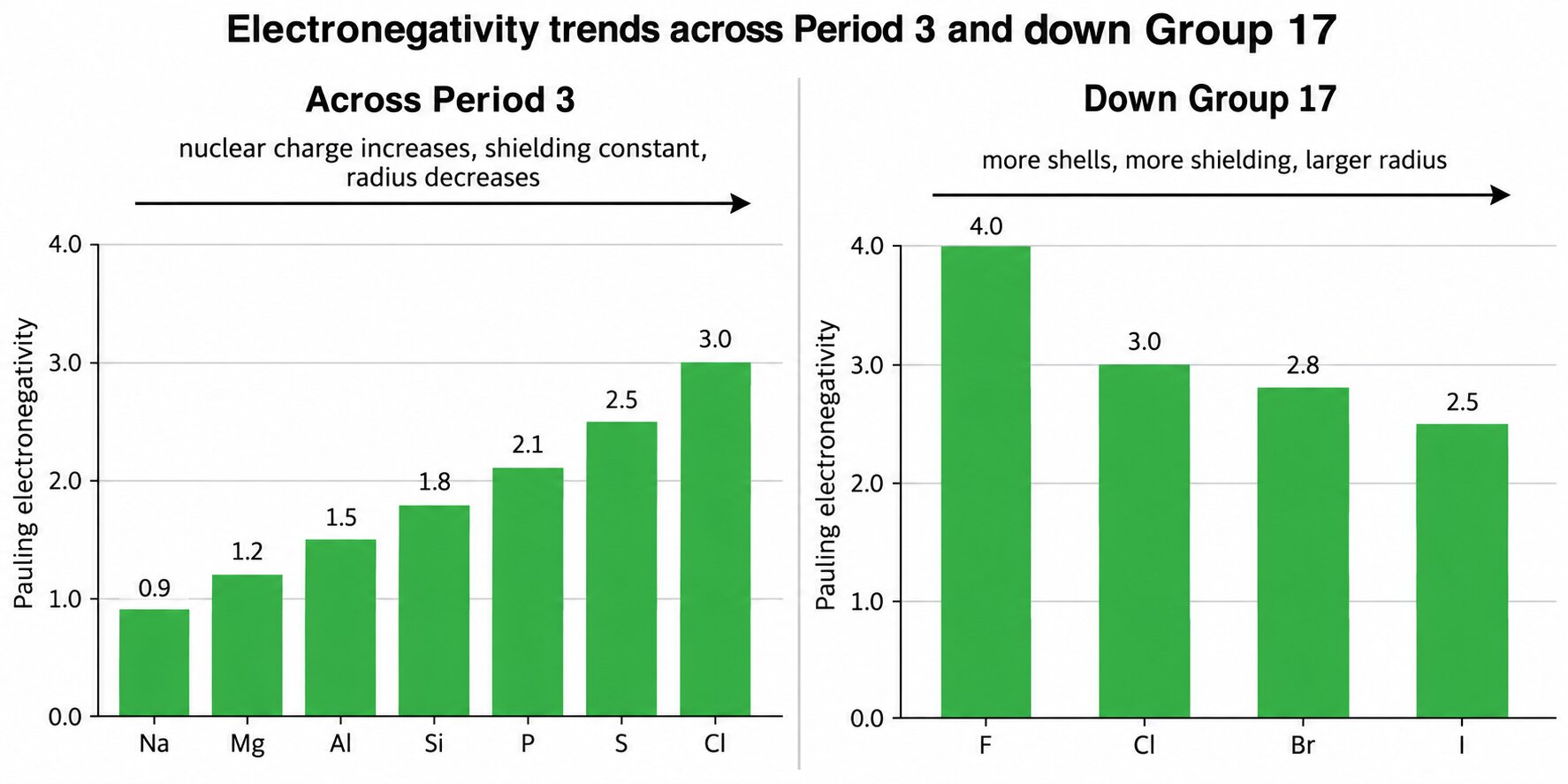
Electronegativity increases across a period and decreases down a group.
Exam sentence: Across a period electronegativity increases because the nuclear charge increases while shielding stays the same and the atomic radius decreases, so the bonding pair is attracted more strongly.
Quick Check: Beryllium and Oxygen
Drag the words and numbers into place to build the comparison.
Trend Down a Group
Down Group 17 the values fall: F 4.0, Cl 3.0, Br 2.8, I 2.5. The nuclear charge does increase, but each element has one more inner shell than the one above it. The extra shell adds shielding and pushes the outer shell further from the nucleus, and these two effects outweigh the extra protons. The bonding pair is further from a more heavily shielded nucleus, so it is attracted less strongly.
Fluorine, at the top right of the Periodic Table, is the most electronegative element; caesium and francium at the bottom left are the least electronegative. Noble gases are not given values because they rarely form bonds.
Exam sentence: Down a group electronegativity decreases because the atomic radius and the shielding by inner shells both increase, which outweighs the increase in nuclear charge.
Quick Check: Put Six Elements in Order
Use the two trends, one step at a time, to rank the elements from least electronegative.
Quick Check: Explain Nitrogen and Sulfur
Write a short explanation, then compare it with the mark points and the model answer.
Predicting Bond Type from Pauling Differences
Cambridge asks you to use the difference between the Pauling values of two atoms to predict how they bond. A large difference means one atom pulls the electrons almost completely away from the other, giving ions. A small difference means the pair is shared and the bond is covalent, becoming more polar as the difference grows.
| Difference in Pauling values | Prediction | Example |
|---|---|---|
| About 0 to 0.4 | Non-polar covalent | C-H (0.4), Cl-Cl (0) |
| About 0.4 to 1.7 | Polar covalent | H-Cl (0.9), C-O (1.0), O-H (1.4) |
| Greater than about 1.7 | Ionic | Na-Cl (2.1), Mg-O (2.3), K-F (3.2) |
The boundaries are guides, not laws. Aluminium chloride has a difference of 1.5 and is covalent, while lithium iodide (1.5) is treated as ionic with covalent character. Use the difference together with what you know about the elements: a metal bonded to a non-metal with a large difference is ionic; two non-metals are covalent.
Exam focus: Show the subtraction in your answer. “Electronegativity difference = 3.5 – 1.2 = 2.3, which is large, so magnesium oxide is ionic” earns the marks; “MgO is ionic” alone does not.
Quick Check: When the Guideline Fails
Decide what to make of a difference that sits on the wrong side of the boundary.
Quick Check: Classify Five Bonds
Subtract the two values in your head, then classify each bond.
Common Exam Mistakes
- Explaining the trend across a period using shielding. Shielding is roughly constant across a period; it is the nuclear charge and the smaller radius that change.
- Explaining the trend down a group using nuclear charge only. The nuclear charge does increase down a group, but the extra shielding and larger radius outweigh it.
- Confusing electronegativity with electron affinity or ionisation energy. Electronegativity is about attracting a bonding pair in a bond.
- Using a single Pauling value to decide bond type. Bond type depends on the difference between the two atoms.
- Giving electronegativity a unit. The Pauling scale is relative and has no units.
Exam sentence: Up and to the right on the Periodic Table means higher electronegativity; a difference above about 1.7 predicts an ionic bond.

Master Covalent Bonding and Shapes of Molecules for Cambridge International AS & A Level Chemistry
Continue from these free revision notes into the full Topic 3 Covalent Bonding and Shapes of Molecules course. The guided video lessons are ready now; the Cambridge International MCQ bank, teacher-marked short-answer questions and KASP spec-point report are being written, and the course opens for enrolment as soon as they are complete.
Guided video teaching
Learn the chemistry and exam technique through structured video lessons with worked examples and walkthroughs.
Instant MCQ feedback
Auto-marked MCQ quizzes provide immediate diagnostic feedback for every answer choice.
Teacher-marked SAQs
Submit written exam responses and receive chemistry specialist feedback with improvement guidance.
Progress tracking
Identify strengths and weaknesses across the full Topic 3 specification with targeted reporting.
See how the course works
Click play to start the course preview animation.
Some ionic radii are shown.
| Ion | Ionic radius / nm |
|---|---|
| Na+ | 0.102 |
| K+ | 0.138 |
| F− | 0.133 |
| Cl− | 0.180 |
Which compound has the strongest ionic bonding?
Explain why the metallic bonding in magnesium is much stronger than that in sodium.
Copyright and author footprint: This OLS revision page was written for Online Learning System by Dr. Mohammed Al-Fatah. It is designed for A Level Chemistry revision and should not be copied or redistributed without permission.
Keep this note — free
Save your progress across every Cambridge topic. A free account remembers which topics you have covered, saves your question scores, and syncs across your phone and laptop.
- Track every topic you have finished
- Keep your practice-question scores
- No payment, no card, free forever
Already registered? Log in