Structure Types
A concise revision guide to the four types of solid lattice, giant ionic, giant metallic, giant covalent and simple molecular: which particles they contain, what holds them together, and how that decides melting point, conductivity, solubility and the energy changes on melting and boiling.
The Four Types of Solid Lattice
Every crystalline solid is a regular, repeating arrangement of particles: a lattice. What decides a solid’s properties is not the lattice pattern itself but which particles sit at the lattice points and which forces hold them there. There are four cases to know.
| Lattice type | Particles | Forces holding the lattice together | Examples |
|---|---|---|---|
| Giant ionic | Positive and negative ions | Strong electrostatic attraction between oppositely charged ions, acting in all directions | NaCl, MgO, CaF2 |
| Giant metallic | Positive metal ions and delocalised electrons | Strong electrostatic attraction between the ions and the sea of delocalised electrons | Mg, Cu, Na |
| Giant covalent (macromolecular) | Atoms | Strong covalent bonds throughout the whole structure | Diamond, graphite, SiO2 |
| Simple molecular | Molecules | Weak intermolecular forces between molecules (the covalent bonds inside each molecule are strong but are not broken on melting) | I2, ice, C60, CO2 |
The word giant means the bonding continues throughout the crystal, so there is no separate molecule to point to. In a simple molecular solid there are two different forces: strong covalent bonds within each molecule and weak forces between them, and only the weak forces are overcome when the solid melts.
The four lattice types side by side: rotate each to see what sits at the lattice points and what holds them together.
Key idea: Three giant lattices, one molecular lattice. Melting a giant lattice breaks strong bonds; melting a molecular lattice only overcomes weak intermolecular forces.
Melting Point Follows the Force That Must Be Overcome
Melting a solid means giving the particles enough energy to break free from their lattice positions. The energy needed depends on the force holding them, so melting points fall into two clear bands.
| Substance | Lattice type | What must be overcome on melting | Melting point / °C |
|---|---|---|---|
| Sodium chloride | Giant ionic | Strong electrostatic attraction between ions | 801 |
| Magnesium | Giant metallic | Strong attraction between ions and delocalised electrons | 650 |
| Diamond | Giant covalent | Strong covalent bonds | above 3500 (sublimes) |
| Iodine | Simple molecular | Weak London forces between I2 molecules | 114 |
| Ice | Simple molecular | Hydrogen bonds between H2O molecules | 0 |
Within a band the details matter. Among ionic compounds a higher charge and a smaller ionic radius give stronger attraction and a higher melting point (MgO melts at 2852 °C, NaCl at 801 °C). Among metals more delocalised electrons per ion and a smaller ion give a higher melting point (Mg above Na). Among simple molecular substances the strength of the intermolecular force decides: hydrogen bonds above permanent dipoles above London forces, and larger molecules have stronger London forces.
Exam sentence: Sodium chloride has a high melting point because a lot of energy is needed to overcome the strong electrostatic attraction between oppositely charged ions in the giant lattice; iodine has a low melting point because only weak London forces between I2 molecules need to be overcome.
Electrical Conductivity Needs Mobile Charged Particles
A substance conducts electricity only if it contains charged particles that are free to move. Apply that one test to each lattice type in each state.
| Lattice type | Solid | Molten or dissolved | Reason |
|---|---|---|---|
| Giant ionic | Does not conduct | Conducts | Ions are fixed in the solid lattice; when molten or in solution they are free to move and carry charge |
| Giant metallic | Conducts | Conducts | Delocalised electrons are free to move through the lattice in both states |
| Giant covalent | Does not conduct (except graphite) | Does not conduct | All outer electrons are held in localised covalent bonds; graphite alone has one delocalised electron per carbon |
| Simple molecular | Does not conduct | Does not conduct | Molecules are neutral and there are no delocalised electrons or ions |
The ionic case is the one examiners test most: the solid is an insulator, the melt is a conductor, and the reason is the mobility of the ions, not whether ions exist.
Exam focus: Never write “ionic compounds conduct electricity”. Write “ionic compounds conduct when molten or aqueous because the ions are free to move; in the solid the ions are held in fixed positions”.
Solubility and Hardness
- Giant ionic: many dissolve in water because the polar water molecules attract the ions and hydrate them; insoluble in non-polar solvents. Hard but brittle, because shifting a layer brings like charges together and the layers repel.
- Giant metallic: insoluble in all common solvents; malleable and ductile because layers of ions slide past each other while the electron sea keeps the attraction.
- Giant covalent: insoluble in everything; very hard (diamond) or soft and slippery (graphite, where layers slide).
- Simple molecular: soft, easily crushed; solubility follows polarity (“like dissolves like”): iodine dissolves in hexane, not in water; ice melts into water and sugar dissolves in it because they hydrogen bond.
Key idea: Solubility is about the forces between solute and solvent; hardness is about how easily the lattice can be deformed without the forces breaking.
Energy Changes on Changes of State
When a solid melts or a liquid boils, energy is absorbed to overcome the forces between particles while the temperature stays constant: the enthalpy of fusion and enthalpy of vaporisation. The size of each depends on the lattice type.
| Change | Giant lattices | Simple molecular |
|---|---|---|
| Melting | Large energy input: strong ionic, metallic or covalent bonds are partly broken | Small energy input: some weak intermolecular forces are overcome |
| Boiling | Very large: the remaining strong bonds are broken so the particles separate completely | Small: all the remaining intermolecular forces are overcome; the covalent bonds inside the molecules survive |
| Sign of the enthalpy change | Endothermic (positive) | Endothermic (positive) |
| Reverse change (freezing, condensing) | Exothermic: the same amount of energy is released as the forces re-form | Exothermic |
On a heating curve the two flat plateaus are melting and boiling: the energy supplied is going into overcoming forces, not into raising the temperature. The plateaus are longer and sit at higher temperatures for giant lattices than for simple molecular substances.
Energy supplied during a plateau overcomes forces between particles; the temperature does not rise until they are overcome.
Exam sentence: During melting the temperature stays constant because the energy supplied is used to overcome the forces between the particles rather than to increase their kinetic energy.
Deducing the Structure from Data
Exam questions often give a table of properties for unnamed substances and ask for the structure and bonding. Work through the tests in order.
| Question to ask | If yes | If no |
|---|---|---|
| Does it conduct as a solid? | Metallic (or graphite) | Go on |
| Does it conduct when molten but not as a solid? | Giant ionic | Go on |
| Is the melting point very high (above about 1000 °C) with no conduction in any state? | Giant covalent | Go on |
| Is the melting point low and there is no conduction? | Simple molecular | Re-check the data |
Then confirm with solubility: ionic solids often dissolve in water, molecular solids dissolve in solvents of similar polarity, giant covalent and metallic solids dissolve in neither.
Exam focus: State the structure, then justify it with two properties from the data, naming the particles and the forces each time.
Common Exam Mistakes
- Saying a simple molecular solid melts when “the covalent bonds break”. Only the intermolecular forces are overcome; the molecules stay intact.
- Saying ionic compounds conduct electricity without stating the condition (molten or aqueous) and the reason (ions free to move).
- Calling the attraction in a metal “between atoms” or “between ions”. It is between positive ions and delocalised electrons.
- Describing diamond as a molecule. It is a giant covalent lattice with no separate molecules.
- Explaining a high melting point by “strong bonds” alone. Name the type of bond or force and the particles it acts between.
Exam sentence: Particles, force between them, consequence: every structure-and-bonding answer follows that pattern.
Where This Sits in the Edexcel International Specification
Topic 3 asks you to describe ionic crystals as giant lattices of ions (3.4), metals as giant lattices of metal ions in a sea of delocalised electrons (3.20) and the giant covalent structures of graphite, diamond and graphene (3.12), and to use these models to interpret physical properties (3.22). This page compares the four lattice types in one place, which is how they are examined.
Exam focus: A giant lattice needs strong bonds broken to melt it; a simple molecular lattice needs only weak intermolecular forces overcome. Say which, and name the particles.
Check Your Understanding
Use these short activities to test the four lattice types on substances that are not used as examples on this page.
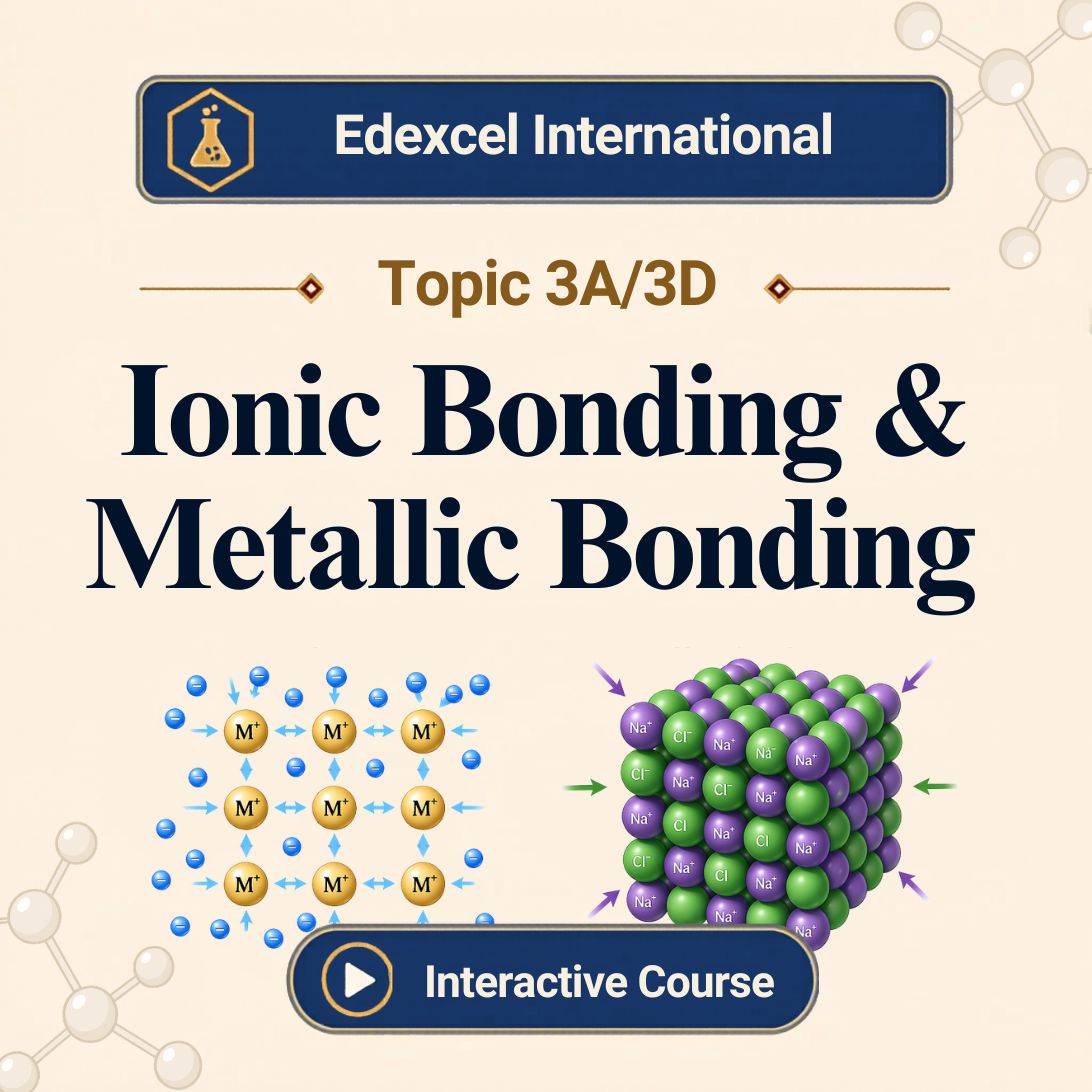
Master Ionic Bonding and Metallic Bonding for Edexcel International A Level Chemistry
Continue from these free revision notes into the full Topic 3A/D Ionic Bonding and Metallic Bonding course, with guided video teaching, diagnostic MCQ practice, teacher-marked short-answer questions and a specification assignment with a personalised progress report.
Guided video teaching
Learn ions, ionic lattices, polarisation and metallic bonding through structured video lessons with worked examples and walkthroughs.
Instant MCQ feedback
Auto-marked MCQ quizzes provide immediate diagnostic feedback for every answer choice.
Teacher-marked SAQs
Submit written exam responses and receive chemistry specialist feedback with improvement guidance.
Progress tracking
Identify strengths and weaknesses across ions, ionic bonding, ionic radii, polarisation and metallic bonding with targeted reporting.
See how the course works
Click play to start the course preview animation.
Some ionic radii are shown.
| Ion | Ionic radius / nm |
|---|---|
| Na+ | 0.102 |
| K+ | 0.138 |
| F− | 0.133 |
| Cl− | 0.180 |
Which compound has the strongest ionic bonding?
Explain why the metallic bonding in magnesium is much stronger than that in sodium.
Copyright notice: This OLS revision content, including the explanations, layout, diagrams, tables and embedded learning structure, is authored for Online Learning System by Dr. Mohammed Al-Fatah. It may not be copied, reproduced, redistributed or adapted without written permission.