Ions and Ionic Formulae
A concise Cambridge International AS Level Chemistry revision guide to predicting the charge on a simple ion from its group, the nine named ions including zinc, silver, hydrogencarbonate and phosphate, formulae from oxidation numbers shown as Roman numerals, and constructing the formula of any ionic compound (2.3.1).
GCSE Recap: Losing and Gaining Electrons
Before you start, check the GCSE picture of how ions are formed.
Predicting the Charge on a Simple Ion
A metal atom in Groups 1, 2 or 13 loses its outer electrons to reach the electron configuration of the previous noble gas; a non-metal atom in Groups 15, 16 or 17 gains electrons to reach the next. The number of electrons lost or gained is the charge on the ion, and it can be read straight from the group number.
| Group | Electrons lost or gained | Ion charge | Examples |
|---|---|---|---|
| 1 | Lose 1 | 1+ | Li+, Na+, K+ |
| 2 | Lose 2 | 2+ | Mg2+, Ca2+, Ba2+ |
| 3 | Lose 3 | 3+ | Al3+ |
| 5 | Gain 3 | 3- | N3-, P3- |
| 6 | Gain 2 | 2- | O2-, S2- |
| 7 | Gain 1 | 1- | F–, Cl–, Br–, I– |
| Transition metals | Variable | Given in the name | Fe2+ in iron(II), Fe3+ in iron(III) |
Key idea: Metals form positive ions with the charge equal to the group number; non-metals form negative ions with the charge equal to 8 minus the group number.
Quick Check: Charges from a Neighbour
Five rapid questions; each one names an element in the same group to work from.
The Compound Ions You Must Know
Some ions are groups of atoms covalently bonded together that carry an overall charge. Cambridge names five that you must be able to write from memory.
| Ion | Formula | Charge | Typical compound |
|---|---|---|---|
| Sulfate | SO42- | 2- | MgSO4 |
| Hydroxide | OH– | 1- | Ca(OH)2 |
| Nitrate | NO3– | 1- | KNO3 |
| Carbonate | CO32- | 2- | Na2CO3 |
| Ammonium | NH4+ | 1+ | NH4Cl |
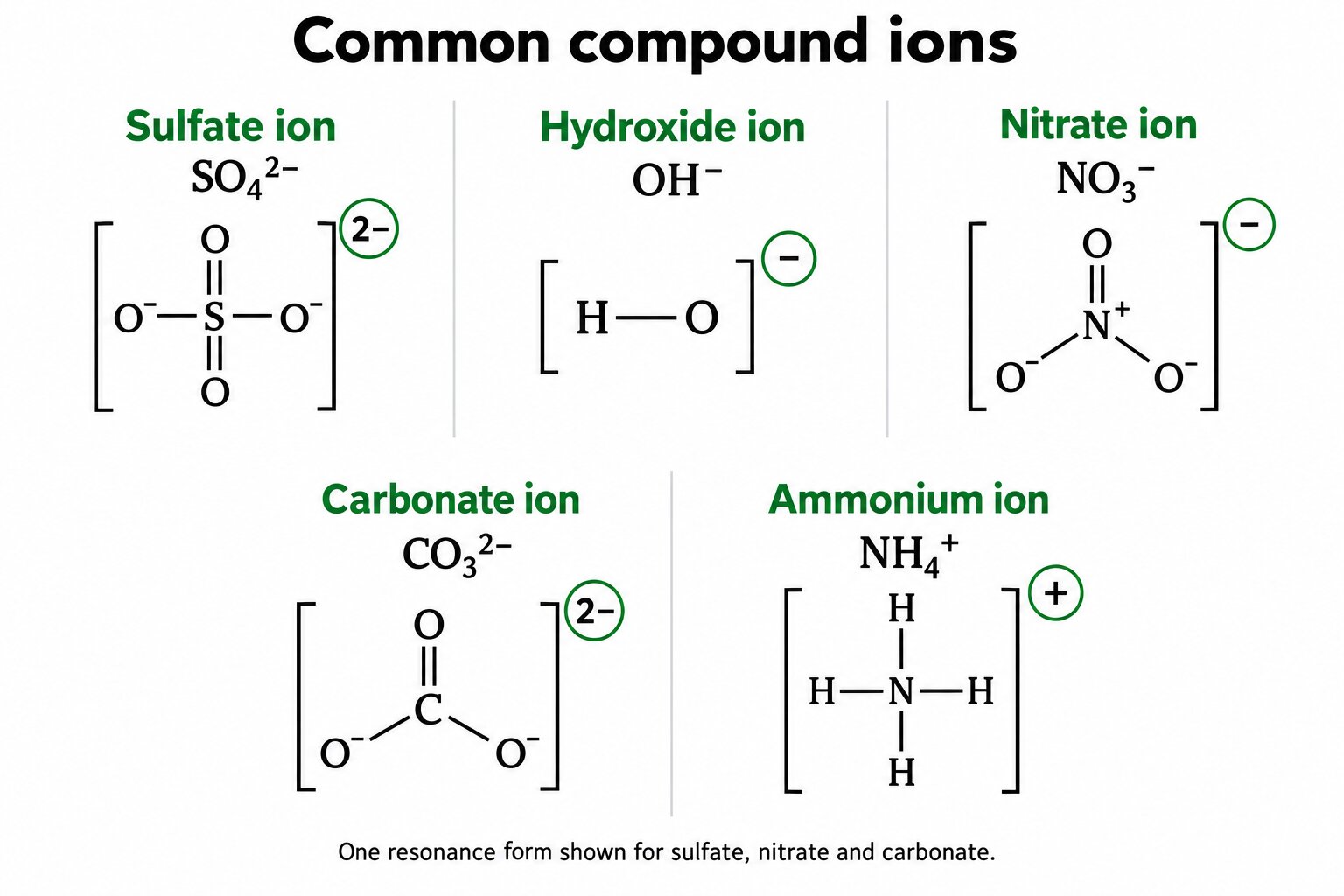
The five compound ions Cambridge expects you to recall.
Exam focus: Ammonium is the only common positive compound ion. Sulfate and carbonate are 2-; hydroxide and nitrate are 1-.
Quick Check: Inside a Compound Ion
Decide whether the statement about ammonium nitrate is true or false.
Constructing the Formula of an Ionic Compound
An ionic compound is neutral overall, so the positive and negative charges must cancel. Use the charge-balance method: write the ions, find the lowest number of each that makes the total charge zero, and write the formula with those numbers as subscripts. Brackets go round a compound ion when more than one is needed.
| Compound | Ions | Balance the charges | Formula |
|---|---|---|---|
| Magnesium chloride | Mg2+, Cl– | One 2+ needs two 1- | MgCl2 |
| Aluminium oxide | Al3+, O2- | Two 3+ (6+) balance three 2- (6-) | Al2O3 |
| Calcium nitrate | Ca2+, NO3– | One 2+ needs two nitrates; bracket the compound ion | Ca(NO3)2 |
| Ammonium sulfate | NH4+, SO42- | Two 1+ balance one 2- | (NH4)2SO4 |
| Iron(III) hydroxide | Fe3+, OH– | One 3+ needs three 1- | Fe(OH)3 |
A quick check: the total positive charge equals the total negative charge, and the subscripts are the smallest whole numbers that achieve that. The “swap the charges” shortcut gives the same answer but simplify afterwards: Mg2+ with O2- is MgO, not Mg2O2.
Exam sentence: The formula of an ionic compound shows the simplest whole-number ratio of ions that gives no overall charge.
Quick Check: Build Four Formulae
Drag the correct formula into each blank; the ion charges are given for you.
Quick Check: Which Formulae Are Wrong?
Click every formula in the list that has been written incorrectly.
Common Exam Mistakes
- Writing NaCl2 or MgCl. Check that the charges cancel: Na+ needs one Cl–, Mg2+ needs two.
- Leaving out brackets: CaNO32 instead of Ca(NO3)2.
- Giving sulfate as SO4– or carbonate as CO3–. Both carry a 2- charge.
- Writing a molecular formula for a giant lattice. NaCl is a ratio of ions, not a molecule of one sodium and one chlorine.
- Forgetting the Roman numeral: iron chloride is ambiguous; FeCl2 is iron(II) chloride and FeCl3 is iron(III) chloride.
Exam sentence: Charges cancel, smallest ratio, brackets round repeated compound ions.
Quick Check: Read a Formula Backwards
Work out the charge on the metal ion from the formula you are given.
The Nine Named Ions and Roman-Numeral Formulae
Cambridge adds four ions to the five above and asks for formulae written from oxidation numbers.
| Ion | Formula | Example compound |
|---|---|---|
| Zinc | Zn²⁺ | ZnSO₄ |
| Silver | Ag⁺ | AgNO₃ |
| Hydrogencarbonate | HCO₃⁻ | NaHCO₃, Ca(HCO₃)₂ |
| Phosphate | PO₄³⁻ | Na₃PO₄, Ca₃(PO₄)₂ |
Roman numerals give the charge. In a name such as iron(III) chloride or copper(II) sulfate, the numeral is the oxidation number of the metal, which for a simple ion equals its charge. Iron(III) is Fe³⁺, so iron(III) chloride is FeCl₃; iron(II) is Fe²⁺, so iron(II) chloride is FeCl₂. Copper(II) sulfate is CuSO₄; manganese(IV) oxide is MnO₂ because Mn⁴⁺ balances two O²⁻.
| Name | Metal ion | Anion | Formula |
|---|---|---|---|
| Iron(III) sulfate | Fe³⁺ | SO₄²⁻ | Fe₂(SO₄)₃ |
| Copper(I) oxide | Cu⁺ | O²⁻ | Cu₂O |
| Lead(II) nitrate | Pb²⁺ | NO₃⁻ | Pb(NO₃)₂ |
| Chromium(III) hydroxide | Cr³⁺ | OH⁻ | Cr(OH)₃ |
Exam sentence: The Roman numeral in a name is the oxidation number of the metal, which gives the charge on its ion; balance that charge against the anion to write the formula.
Quick Check: The Extra Ions and Roman Numerals
Four rapid questions on the ions added by this card.
Where This Sits in the Cambridge Syllabus
Cambridge 2.3.1 asks you to write the formulae of ionic compounds from ionic charges and from oxidation numbers shown as Roman numerals, and to recall the nitrate, carbonate, sulfate, hydroxide, ammonium, zinc, silver, hydrogencarbonate and phosphate ions. This page covers the charges, the nine ions and the balancing method.
Copyright notice: This OLS revision content, including the explanations, layout, diagrams, tables and embedded learning structure, is authored for Online Learning System by Dr. Mohammed Al-Fatah. It may not be copied, reproduced, redistributed or adapted without written permission.
Keep this note — free
Save your progress across every Cambridge topic. A free account remembers which topics you have covered, saves your question scores, and syncs across your phone and laptop.
- Track every topic you have finished
- Keep your practice-question scores
- No payment, no card, free forever
Already registered? Log in