Hess’s Law and Enthalpy Cycles
A concise revision guide to Hess’s law: building enthalpy cycles, calculating enthalpy changes from formation and combustion data, and using unfamiliar cycles, for AQA A Level Chemistry.
Hess’s Law
Hess’s law states that the total enthalpy change for a reaction is independent of the route taken, provided the starting and finishing conditions are the same. It follows from the conservation of energy: if two routes between the same reactants and products gave different energy changes, energy could be created by going round the cycle.
This allows enthalpy changes that cannot be measured directly, such as the enthalpy change of formation of methane or the hydration of an anhydrous salt, to be calculated from values that can be measured.
Definition: Hess’s law: the enthalpy change for a reaction is independent of the route taken from reactants to products.
Building an Enthalpy Cycle
An enthalpy cycle links the reaction you want to a set of reactions whose enthalpy changes are known. Draw the target reaction across the top, then an alternative route through a common intermediate.
- Write the balanced target equation across the top with an arrow labelled with the unknown ΔH.
- Choose the connecting species: the elements when you have enthalpies of formation, or the combustion products when you have enthalpies of combustion.
- Draw arrows from each side to the connecting box and label them with the known values, multiplied by the number of moles in the equation.
- Go round the cycle the long way: follow an arrow and add its value; go against an arrow and subtract it.
Formation arrows point up from the elements; combustion arrows point down to the combustion products. The direction decides whether each value is added or subtracted.
Exam focus: Show the cycle and the working. A correct final answer with no cycle scores less than a cycle with one arithmetic slip.
Using Enthalpy Changes of Formation
When the data are enthalpy changes of formation, the cycle reduces to one rule:
ΔrH⦵ = ΣΔfH⦵(products) − ΣΔfH⦵(reactants)
Worked example. Calculate the enthalpy change for the thermal decomposition of sodium hydrogencarbonate.
2NaHCO₃(s) → Na₂CO₃(s) + H₂O(l) + CO₂(g)
| Substance | ΔfH⦵ / kJ mol⁻¹ |
|---|---|
| NaHCO₃(s) | −951 |
| Na₂CO₃(s) | −1131 |
| H₂O(l) | −286 |
| CO₂(g) | −394 |
- ΣΔfH⦵(products) = −1131 + (−286) + (−394) = −1811 kJ mol⁻¹
- ΣΔfH⦵(reactants) = 2 × (−951) = −1902 kJ mol⁻¹
- ΔrH⦵ = −1811 − (−1902) = +91 kJ mol⁻¹
Common mistake: Forgetting to multiply by the coefficient (2 × NaHCO₃) or giving elements a non-zero value. Elements in their standard states have an enthalpy change of formation of zero.
Using Enthalpy Changes of Combustion
When the data are enthalpy changes of combustion, the arrows point the other way, so the rule is reversed:
ΔrH⦵ = ΣΔcH⦵(reactants) − ΣΔcH⦵(products)
Worked example. Calculate the enthalpy change of formation of propane from the enthalpies of combustion of carbon (−394), hydrogen (−286) and propane (−2220 kJ mol⁻¹).
3C(s) + 4H₂(g) → C₃H₈(g)
- ΣΔcH⦵(reactants) = 3 × (−394) + 4 × (−286) = −1182 − 1144 = −2326 kJ mol⁻¹
- ΣΔcH⦵(products) = −2220 kJ mol⁻¹
- ΔfH⦵(C₃H₈) = −2326 − (−2220) = −106 kJ mol⁻¹
This is exactly the kind of value that cannot be measured directly, because carbon and hydrogen do not react to give propane alone.
Key idea: Formation: products minus reactants. Combustion: reactants minus products. If you draw the cycle, you never need to remember which.
Unfamiliar Cycles and Practical Hess
Exam questions often give a cycle you have not seen before. The method does not change: identify the route, follow the arrows, reverse the sign of any step you travel against, and multiply by the moles.
A classic practical use is finding the enthalpy change for the hydration of anhydrous copper(II) sulfate, CuSO₄(s) + 5H₂O(l) → CuSO₄·5H₂O(s), which cannot be measured directly because the solid cannot be given exactly five moles of water without dissolving. Instead, the enthalpy changes of solution of the anhydrous and hydrated salts are measured separately, and Hess’s law combines them.
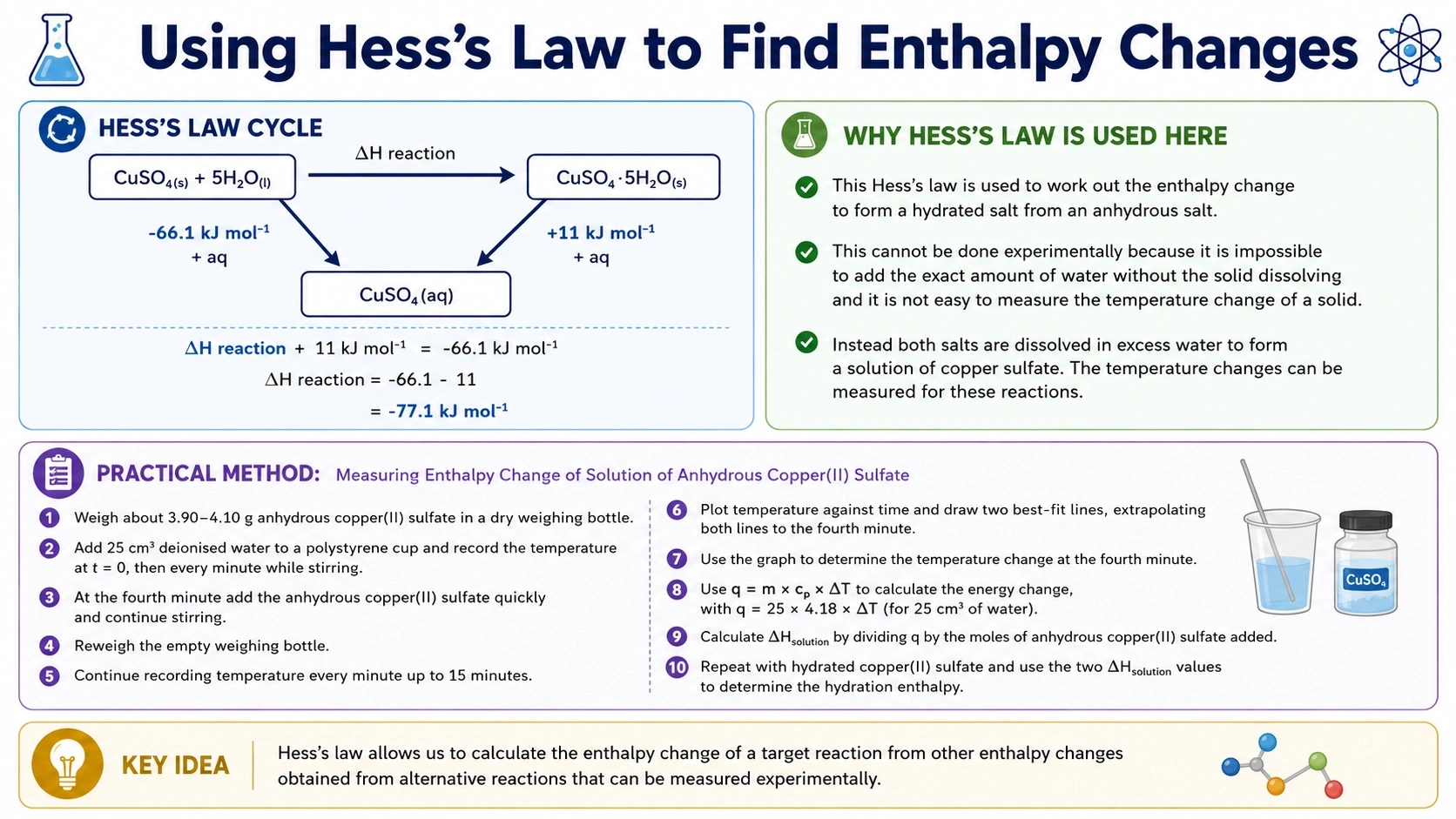
Hess’s law applied in the laboratory: two measurable enthalpy changes of solution give the hydration enthalpy that cannot be measured directly.
Exam sentence: The enthalpy change cannot be measured directly, so Hess’s law is used: the enthalpy changes of two reactions that can be measured are combined, because the total enthalpy change is independent of the route.
Common Exam Points
State Hess’s law
The enthalpy change for a reaction is independent of the route taken, provided the initial and final conditions are the same.
Calculate an enthalpy change from formation data
Products minus reactants, each multiplied by its coefficient; elements count as zero.
Calculate an enthalpy change from combustion data
Reactants minus products, each multiplied by its coefficient.
Explain why a value must be found indirectly
The reaction does not happen cleanly on its own, or gives other products, so it cannot be measured by experiment.
Check Your Understanding
Use cycles for reactions and data that do not appear in the worked examples.
FAQs
Use these quick answers to check the Hess’s law methods AQA questions test.
What does Hess’s law say?
The enthalpy change for a reaction is independent of the route taken, provided the starting and finishing conditions are the same.
When do I use products minus reactants?
When the data are enthalpy changes of formation, because the arrows point up from the elements to both sides.
When do I use reactants minus products?
When the data are enthalpy changes of combustion, because the arrows point down from both sides to carbon dioxide and water.
What happens to the sign when I go against an arrow?
It is reversed. Going against a step is the reverse reaction, so its enthalpy change has the opposite sign.
Why use Hess cycles at all?
Many enthalpy changes cannot be measured directly because the reaction does not happen cleanly, so they are calculated from values that can be measured.
Copyright and author footprint: This OLS revision page was written for Online Learning System by Dr. Mohammed Al-Fatah. It is designed for A Level Chemistry revision and should not be copied or redistributed without permission.
Keep this note — free
Save your progress across every AQA topic. A free account remembers which topics you have covered, saves your question scores, and syncs across your phone and laptop.
- Track every topic you have finished
- Keep your practice-question scores
- No payment, no card, free forever
Already registered? Log in