Bond Enthalpies
A concise revision guide to bond enthalpies: what mean bond enthalpy means, why reactions are exothermic or endothermic, calculating ΔH from bond enthalpies, and why the answers differ from Hess’s law values, for AQA A Level Chemistry.
What Bond Enthalpy Means
The bond enthalpy is the energy needed to break one mole of a given covalent bond in molecules in the gaseous state. Breaking a bond always needs energy, so bond enthalpies are always positive; making the same bond releases the same amount of energy.
For a diatomic molecule such as H₂ the value is exact. For bonds that appear in many compounds, such as C–H, the value quoted is a mean bond enthalpy: the average energy needed to break that type of bond, taken over a range of compounds.
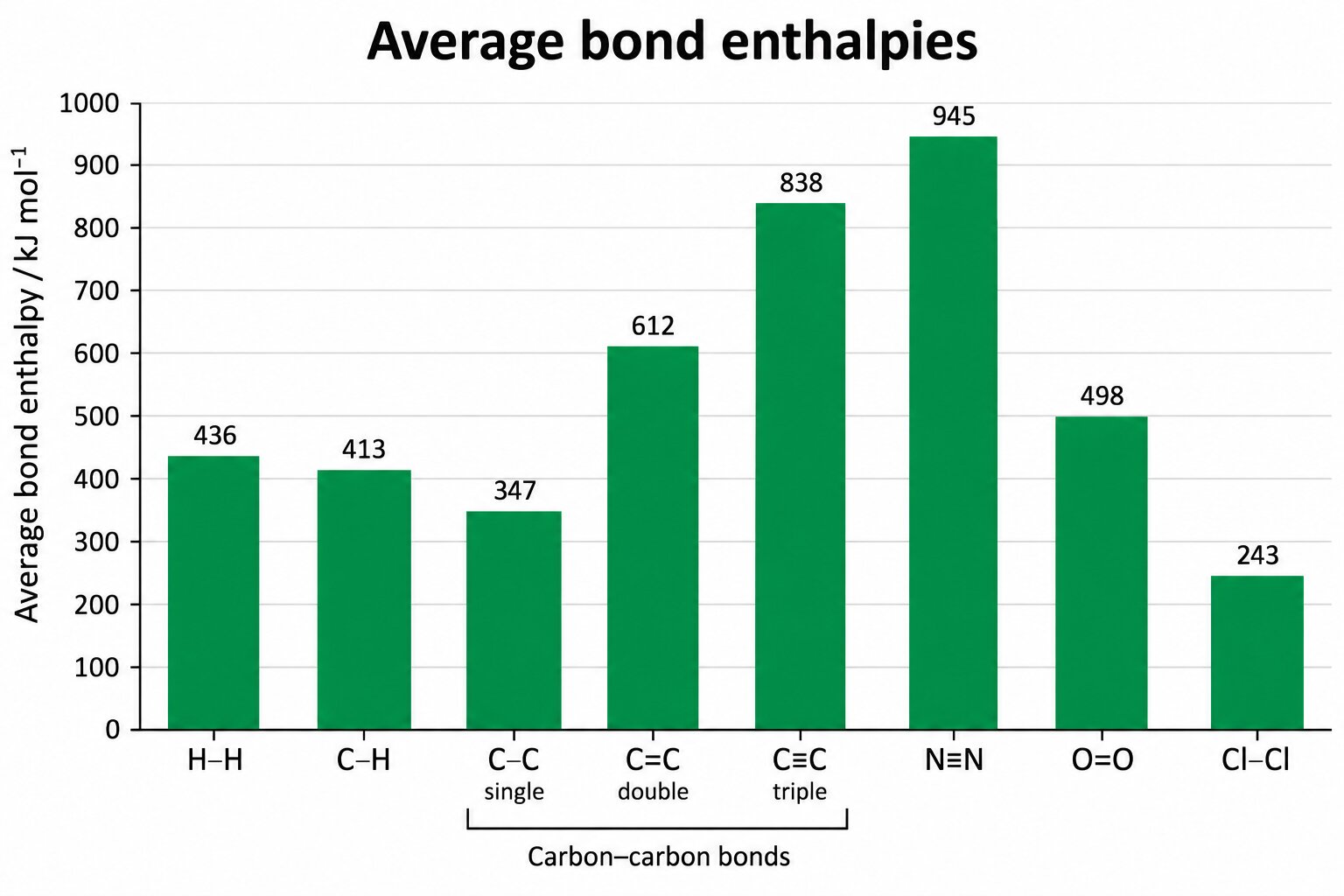
Bond enthalpies for common bonds: multiple bonds are stronger than single bonds between the same atoms, and N≡N is the strongest shown.
Definition: Mean bond enthalpy is the energy needed to break one mole of a given type of bond in gaseous molecules, averaged over a range of compounds.
Why Reactions Are Exothermic or Endothermic
Every reaction breaks some bonds and makes others. Bond breaking is endothermic and bond making is exothermic. The overall enthalpy change depends on which is larger:
- If more energy is released making the bonds in the products than is absorbed breaking the bonds in the reactants, the reaction is exothermic.
- If more energy is absorbed breaking bonds than is released making them, the reaction is endothermic.
Burning methane: breaking C–H and O=O bonds absorbs less energy than forming C=O and O–H bonds releases, so the reaction is exothermic.
Key idea: ΔH = energy absorbed breaking bonds − energy released making bonds. A negative answer means the products are held by stronger bonds overall.
Calculating ΔH from Bond Enthalpies
Key equation: ΔH = Σ(bond enthalpies of bonds broken) − Σ(bond enthalpies of bonds made)
Worked example. Calculate the enthalpy change for the combustion of methane, CH₄(g) + 2O₂(g) → CO₂(g) + 2H₂O(g), using C–H 413, O=O 498, C=O 805 and O–H 464 kJ mol⁻¹.
| Bonds | Number | Energy / kJ |
|---|---|---|
| Broken: C–H | 4 | 4 × 413 = 1652 |
| Broken: O=O | 2 | 2 × 498 = 996 |
| Total broken | +2648 | |
| Made: C=O | 2 | 2 × 805 = 1610 |
| Made: O–H | 4 | 4 × 464 = 1856 |
| Total made | 3466 |
ΔH = 2648 − 3466 = −818 kJ mol⁻¹
Exam focus: Draw out the displayed formulae first and count every bond. Most lost marks come from missing a bond, not from the arithmetic.
Why Bond Enthalpy Values Differ from Hess Values
The data book enthalpy change of combustion of methane is −890 kJ mol⁻¹, but the bond enthalpy calculation gives −818 kJ mol⁻¹. There are two reasons:
- Mean values are used. The C–H value is an average over many compounds, not the exact value for methane, and the same is true of C=O and O–H.
- Everything is assumed to be gaseous. Bond enthalpies apply to gaseous molecules, but standard enthalpy changes of combustion form liquid water. Condensing the water releases extra energy that the calculation leaves out.
Exam sentence: Values calculated from bond enthalpies are less accurate than those from Hess’s law because bond enthalpies are averages over many compounds and apply only to substances in the gaseous state.
Finding a Mean Bond Enthalpy from ΔH
The same equation can be rearranged to find one unknown bond value when ΔH and the others are known.
Worked example. H₂(g) + Cl₂(g) → 2HCl(g), ΔH = −184 kJ mol⁻¹. Using H–H 436 and Cl–Cl 243 kJ mol⁻¹, find the H–Cl value.
- ΔH = (436 + 243) − 2E(H–Cl)
- −184 = 679 − 2E(H–Cl)
- 2E(H–Cl) = 863, so E(H–Cl) = 432 kJ mol⁻¹ (3 significant figures)
Remember: Two moles of HCl form, so two H–Cl bonds are made. Divide by the number of bonds of the unknown type at the end.
Common Exam Points
Define mean bond enthalpy
The energy needed to break one mole of a given type of bond in gaseous molecules, averaged over a range of compounds.
Calculate ΔH from bond enthalpies
Bonds broken minus bonds made; count every bond from the displayed formulae.
Explain why the answer differs from the data book value
Bond enthalpies are averages, and the calculation assumes all species are gases.
Do not say
“Bond making needs energy”; “bond enthalpies are exact for every molecule”.
Check Your Understanding
Calculate and explain using molecules other than those in the notes.
FAQs
Use these quick answers to check the bond enthalpies ideas and calculations.
Why are bond enthalpies always positive?
They are defined for breaking bonds, and breaking a bond always needs energy.
How do I calculate ΔH from bond values?
Add up the bond enthalpies of all the bonds broken, add up those of all the bonds made, and subtract: bonds broken minus bonds made.
Why is my answer different from the data book value?
The bond enthalpies are averages over many compounds, and the method assumes every substance is a gas, whereas standard values may involve liquids.
What makes a reaction exothermic in terms of bonds?
More energy is released making the bonds in the products than is absorbed breaking the bonds in the reactants.
Are any bond values exact?
Yes, for diatomic molecules such as H₂ or Cl₂, where there is only one bond in one environment. Bonds found in many compounds, such as C–H, have average values.
Copyright and author footprint: This OLS revision page was written for Online Learning System by Dr. Mohammed Al-Fatah. It is designed for A Level Chemistry revision and should not be copied or redistributed without permission.
Keep this note — free
Save your progress across every AQA topic. A free account remembers which topics you have covered, saves your question scores, and syncs across your phone and laptop.
- Track every topic you have finished
- Keep your practice-question scores
- No payment, no card, free forever
Already registered? Log in