Standard Enthalpy Changes
A concise revision guide to the standard enthalpy changes of reaction, formation, combustion and neutralisation, with the equation that goes with each definition, for Cambridge International A Level Chemistry.
GCSE Recap: Burning and Neutralising
Before you start, check what complete combustion and neutralisation actually produce.
Why the Wording Matters
Each standard enthalpy change is defined by exactly what is formed, burned or produced, and how much of it. Mark schemes award a mark for each part of a definition, so a definition that leaves out “one mole”, “standard states” or “completely” loses marks even when the chemistry is understood.
| Enthalpy change | Symbol | Definition | Sign |
|---|---|---|---|
| Reaction | ΔHr⦵ | the enthalpy change for the molar quantities in a stated equation, under standard conditions, with all substances in their standard states | varies |
| Formation | ΔHf⦵ | the enthalpy change when one mole of a compound is formed from its elements under standard conditions, all substances in their standard states | usually negative; zero for an element |
| Combustion | ΔHc⦵ | the enthalpy change when one mole of a substance is completely burned in oxygen under standard conditions, all substances in their standard states | always negative |
| Neutralisation | ΔHneut⦵ | the enthalpy change when one mole of water is formed in a reaction between an acid and a base in dilute aqueous solution under standard conditions | always negative |
Exam focus: Learn each definition word for word, then check your version has three parts: the quantity (one mole of what), the process, and standard conditions with standard states.
Enthalpy Change of Reaction
The enthalpy change of reaction refers to the amounts written in a particular equation. If the equation is doubled, the enthalpy change doubles; if it is reversed, the sign changes. For example:
N₂(g) + 3H₂(g) → 2NH₃(g) ΔHr⦵ = −92 kJ mol⁻¹
½N₂(g) + 1½H₂(g) → NH₃(g) ΔHr⦵ = −46 kJ mol⁻¹
2NH₃(g) → N₂(g) + 3H₂(g) ΔHr⦵ = +92 kJ mol⁻¹
Key idea: kJ mol⁻¹ here means “per mole of the equation as written”, so always quote the equation beside the value.
Quick Check: Change the Equation, Change the Value
Five quick questions on what happens to a value when the equation is halved, doubled or reversed.
Enthalpy Change of Formation
The enthalpy change of formation is for one mole of a compound made from its elements in their standard states. The equation must show exactly one mole of product, which often means fractions in front of the elements:
2C(s) + 3H₂(g) + ½O₂(g) → C₂H₅OH(l) ΔHf⦵ = −277 kJ mol⁻¹
Because nothing changes when an element is “formed” from itself, the enthalpy change of formation of any element in its standard state is zero. The standard state is the state the element is in at 298 K and standard pressure, so settle the state symbol from those conditions before writing the equation. Many formation reactions cannot be carried out directly, because the elements would react to give other products, so their values are found indirectly using Hess’s law.
Common mistake: Writing 4C(s) + 6H₂(g) + O₂(g) → 2C₂H₅OH(l). That equation balances, but it makes two moles of ethanol. The definition fixes one mole of product, so halve that equation to give 2C(s) + 3H₂(g) + ½O₂(g) → C₂H₅OH(l).
Quick Check: Write the Formation Equation
Drag the missing amounts and formulae into four equations the page has not shown you.
Enthalpy Change of Combustion
The enthalpy change of combustion is for one mole of a substance completely burned in oxygen. Complete combustion of a hydrocarbon or alcohol gives carbon dioxide and water only; incomplete combustion also forms carbon monoxide or soot and releases less energy.
C₃H₈(g) + 5O₂(g) → 3CO₂(g) + 4H₂O(l) ΔHc⦵ = −2220 kJ mol⁻¹
Combustion is always exothermic, so these values are always negative. The equation must show one mole of the fuel, which again may need a fractional amount of oxygen: C₂H₆(g) + 3½O₂(g) → 2CO₂(g) + 3H₂O(l).
Remember: Water is H₂O(l) under standard conditions. Writing H₂O(g) changes the value.
Quick Check: Which Equation Is the Right One?
Only one of these four equations matches the definition exactly.
Enthalpy Change of Neutralisation
The enthalpy change of neutralisation is for the formation of one mole of water, H⁺(aq) + OH⁻(aq) → H₂O(l). For any strong acid with any strong base the value is about −57 kJ mol⁻¹, because the only reaction taking place is the same combination of hydrogen and hydroxide ions.
A weak acid such as ethanoic acid gives a slightly less exothermic value, because some energy is used to complete its ionisation as the reaction proceeds. Sulfuric acid is diprotic, so one mole of H₂SO₄ forms two moles of water; the enthalpy change for the equation is doubled, but the enthalpy change of neutralisation is still quoted per mole of water.
Exam trap: The definition is per mole of water, not per mole of acid. With sulfuric acid, divide the energy by the moles of water formed.
Quick Check: Pick the Accurate Statement
In each round, choose the one statement that is accurate.
Writing the Equation for a Definition
Most questions on definitions ask for an equation as well as words. Work backwards from what the definition fixes.
| Enthalpy change | Fix one mole of | Example equation |
|---|---|---|
| Formation | the compound formed | Na(s) + ½Cl₂(g) → NaCl(s) |
| Combustion | the substance burned | CH₃OH(l) + 1½O₂(g) → CO₂(g) + 2H₂O(l) |
| Neutralisation | water formed | ½H₂SO₄(aq) + NaOH(aq) → ½Na₂SO₄(aq) + H₂O(l) |
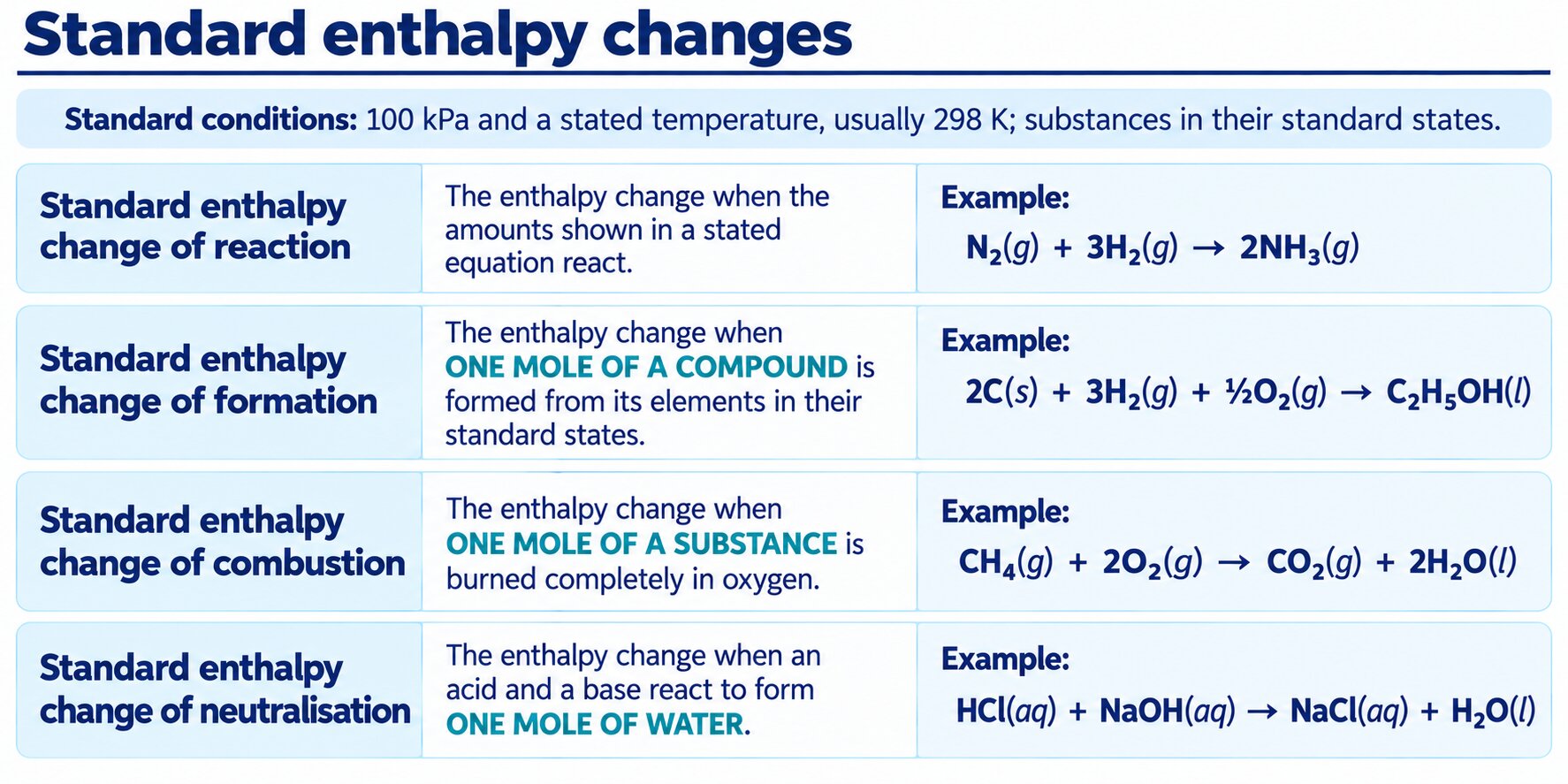
Each definition fixes one mole of something different; the highlighted species in each equation is the one that must be one mole.
Exam sentence: The standard enthalpy change of formation of ethanol is the enthalpy change when one mole of ethanol is formed from its elements in their standard states under standard conditions.
Quick Check: Find the Mistake
Each of these four equations has exactly one thing wrong with it. Click it.
Common Exam Points
Define the standard enthalpy change of combustion
The enthalpy change when one mole of a substance is completely burned in oxygen under standard conditions, all substances in their standard states.
Write the equation for the enthalpy change of formation
One mole of product, elements in their standard states, fractions allowed on the left.
State the enthalpy change of formation of oxygen
Zero, because it is an element in its standard state.
Do not say
“One mole of reactants”; “burned in air” instead of “completely burned in oxygen”; “per mole of acid” for neutralisation.
FAQs
Use these quick answers to check the definitions Cambridge International expects word for word.
Why does the definition say “one mole”?
Each standard enthalpy change is fixed per mole of a particular species, so the equation has to show one mole of it, even if that needs fractions elsewhere.
Why is the enthalpy change of formation of an element zero?
Forming an element in its standard state from itself involves no change, so no energy is transferred.
What is the difference between combustion in oxygen and burning in air?
The definition requires complete combustion in oxygen, which gives only carbon dioxide and water from a hydrocarbon. Burning in air can be incomplete, which releases less energy.
Why is the enthalpy change of neutralisation about the same for all strong acids and bases?
The reaction in each case is H⁺(aq) + OH⁻(aq) → H₂O(l), so the energy released per mole of water is the same, about −57 kJ mol⁻¹.
Can an enthalpy change of formation be positive?
Yes. A few compounds, such as ethene and benzene, have positive values because they are less stable than their elements.
Copyright and author footprint: This OLS revision page was written for Online Learning System by Dr. Mohammed Al-Fatah. It is designed for A Level Chemistry revision and should not be copied or redistributed without permission.
Keep this note — free
Save your progress across every Cambridge topic. A free account remembers which topics you have covered, saves your question scores, and syncs across your phone and laptop.
- Track every topic you have finished
- Keep your practice-question scores
- No payment, no card, free forever
Already registered? Log in