Calorimetry: Measuring Enthalpy Changes
A concise revision guide to measuring enthalpy changes by calorimetry: q = mcΔT, converting to kJ mol⁻¹, the cooling-curve correction, and evaluating errors and assumptions, for Cambridge International A Level Chemistry.
GCSE Recap: Temperature Change, Mass and Moles
Before you start, check the three GCSE skills this calculation is built from.
The Key Equation: q = mcΔT
A calorimetry experiment measures the temperature change of a known mass of water or solution and uses it to calculate the energy transferred:
Key equation: q = m × c × ΔT
| Symbol | Meaning | Units |
|---|---|---|
| q | energy transferred to or from the surroundings | J |
| m | mass of the water or solution being heated or cooled (not the mass of the reactants) | g |
| c | specific heat capacity; 4.18 J g⁻¹ K⁻¹ for water and dilute solutions | J g⁻¹ K⁻¹ |
| ΔT | temperature change; a change of 1 K equals a change of 1 °C | K |
For dilute aqueous solutions it is assumed that the density is 1.00 g cm⁻³, so 50.0 cm³ of solution has a mass of 50.0 g, and that the specific heat capacity is the same as that of water.
Common mistake: Using the mass of the solid added as m. The energy heats the water or solution, so m is the mass of the liquid.
From q to the Enthalpy Change
q gives the energy for the amounts used in the experiment. To find the enthalpy change in kJ mol⁻¹:
- Calculate q = mcΔT in joules.
- Calculate the moles of the reactant that is not in excess.
- Divide q by those moles and convert to kJ by dividing by 1000.
- Add the sign: negative if the temperature rose (exothermic), positive if it fell.
An endothermic case. 10.11 g of potassium nitrate, KNO₃, M = 101.1 g mol⁻¹, is stirred into 100 g of water and the temperature falls by 8.4 K. q = 100 × 4.18 × 8.4 = 3511 J; n = 10.11 ÷ 101.1 = 0.100 mol; ΔH = 3511 ÷ 0.100 = 35 110 J mol⁻¹ = +35.1 kJ mol⁻¹. The temperature fell, so the sign is positive.
Cambridge summarises the steps as ΔH = −mcΔT ÷ n, where the minus sign makes a temperature rise give a negative ΔH.
Exam sentence: Both a sign and units are required in the final answer, for example ΔH = −56.8 kJ mol⁻¹. An answer without a sign is incomplete.
Quick Check: Follow the Four Steps
Drag the words and numbers into place to work through a new experiment.
Worked Example 1: Reaction in Solution
50.0 cm³ of 1.00 mol dm⁻³ hydrochloric acid is mixed with 50.0 cm³ of 1.10 mol dm⁻³ sodium hydroxide in a polystyrene cup. The temperature rises by 6.8 K. Calculate the enthalpy change of neutralisation.
- Mass of solution = 100.0 g; q = 100.0 × 4.18 × 6.8 = 2842 J
- n(HCl) = 1.00 × 50.0 ÷ 1000 = 0.0500 mol and n(NaOH) = 1.10 × 50.0 ÷ 1000 = 0.0550 mol; they react in a 1:1 ratio, so the acid runs out first and 0.0500 mol of water forms
- ΔH = −2842 ÷ 0.0500 = −56 840 J mol⁻¹ = −56.8 kJ mol⁻¹
Key idea: Add the volumes of both solutions to get the mass heated. Divide by the moles of the reagent that is used up, not the one in excess.
Quick Check: Mass and Moles
Decide which mass and which number of moles this experiment needs.
Worked Example 2: Combustion of a Fuel
Burning 0.460 g of ethanol, C₂H₅OH, from a spirit burner raises the temperature of 100 g of water in a copper can by 20.0 K. Calculate the enthalpy change of combustion.
- q = 100 × 4.18 × 20.0 = 8360 J
- n(C₂H₅OH) = 0.460 ÷ 46.0 = 0.0100 mol
- ΔH = −8360 ÷ 0.0100 = −836 000 J mol⁻¹ = −836 kJ mol⁻¹
The data book value is −1367 kJ mol⁻¹. The experimental value is far less exothermic because much of the energy heats the air and the can rather than the water, and some ethanol burns incompletely. Combustion calorimetry nearly always underestimates the enthalpy change.
Exam focus: When asked why an experimental value is less exothermic than the data value, give heat loss to the surroundings first, then incomplete combustion or evaporation of the fuel.
Quick Check: Four Calculations
Work each one out in full, with a sign and units, before you flip the card.
Correcting for Heat Loss: the Cooling Curve
In a slower reaction the solution starts losing heat before the maximum temperature is reached, so the highest reading is too low. The correction is to take readings every minute before and after mixing, plot temperature against time, draw a best-fit line through the cooling points and extrapolate it back to the time of mixing. The temperature change is read from the graph at that time.
For example, if both solutions were steady at 20.5 °C before mixing, the highest reading afterwards was 27.9 °C and the extrapolated line reached 28.6 °C at the moment of mixing, then ΔT is 28.6 − 20.5 = 8.1 K, not the 7.4 K that the highest reading would have given.
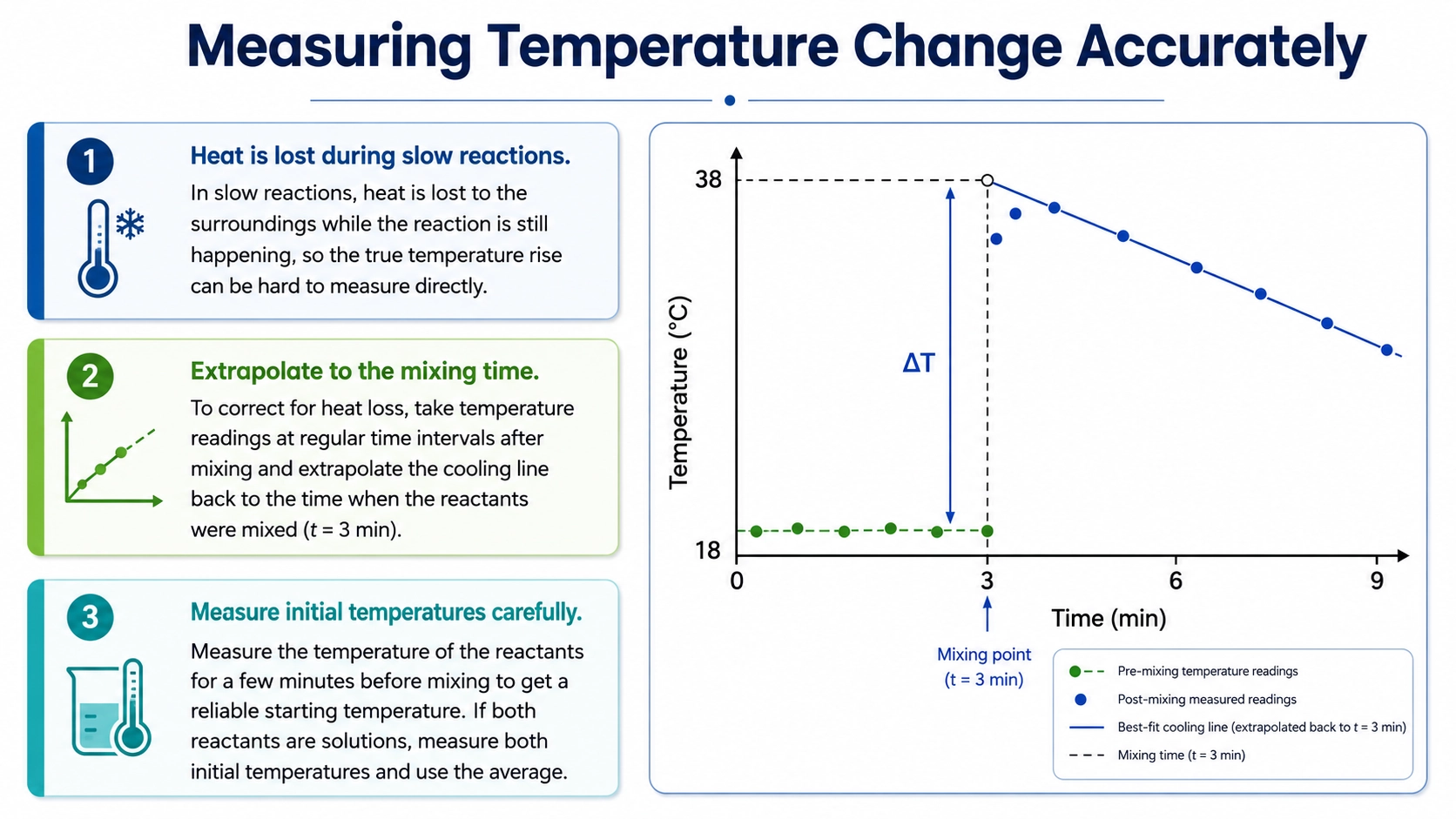
Extrapolating the cooling line back to the moment of mixing gives the temperature rise that would have been reached with no heat loss.
Remember: Record the starting temperature for a few minutes before mixing; if two solutions are used, measure both and take the mean.
Quick Check: Read the Graph
Use the described graph to work out the temperature change that should be used.
Errors, Assumptions and Technique
Questions often ask you to evaluate the method. The main sources of error and the assumptions made are:
| Source | Effect | Improvement |
|---|---|---|
| Heat lost to the surroundings | ΔT too small, so ΔH not exothermic enough | lid on the cup, insulate, use the cooling-curve correction |
| Heat absorbed by the cup or can | ignored in the calculation | use a polystyrene cup, which has a very low heat capacity |
| Solution assumed to have c = 4.18 J g⁻¹ K⁻¹ and density 1.00 g cm⁻³ | small systematic error | accept as a stated assumption |
| Incomplete reaction or incomplete combustion | less energy released | stir; use excess of one reagent; ensure a good oxygen supply |
| Thermometer resolution | large percentage uncertainty in small ΔT | use a 0.1 °C thermometer or a larger ΔT |
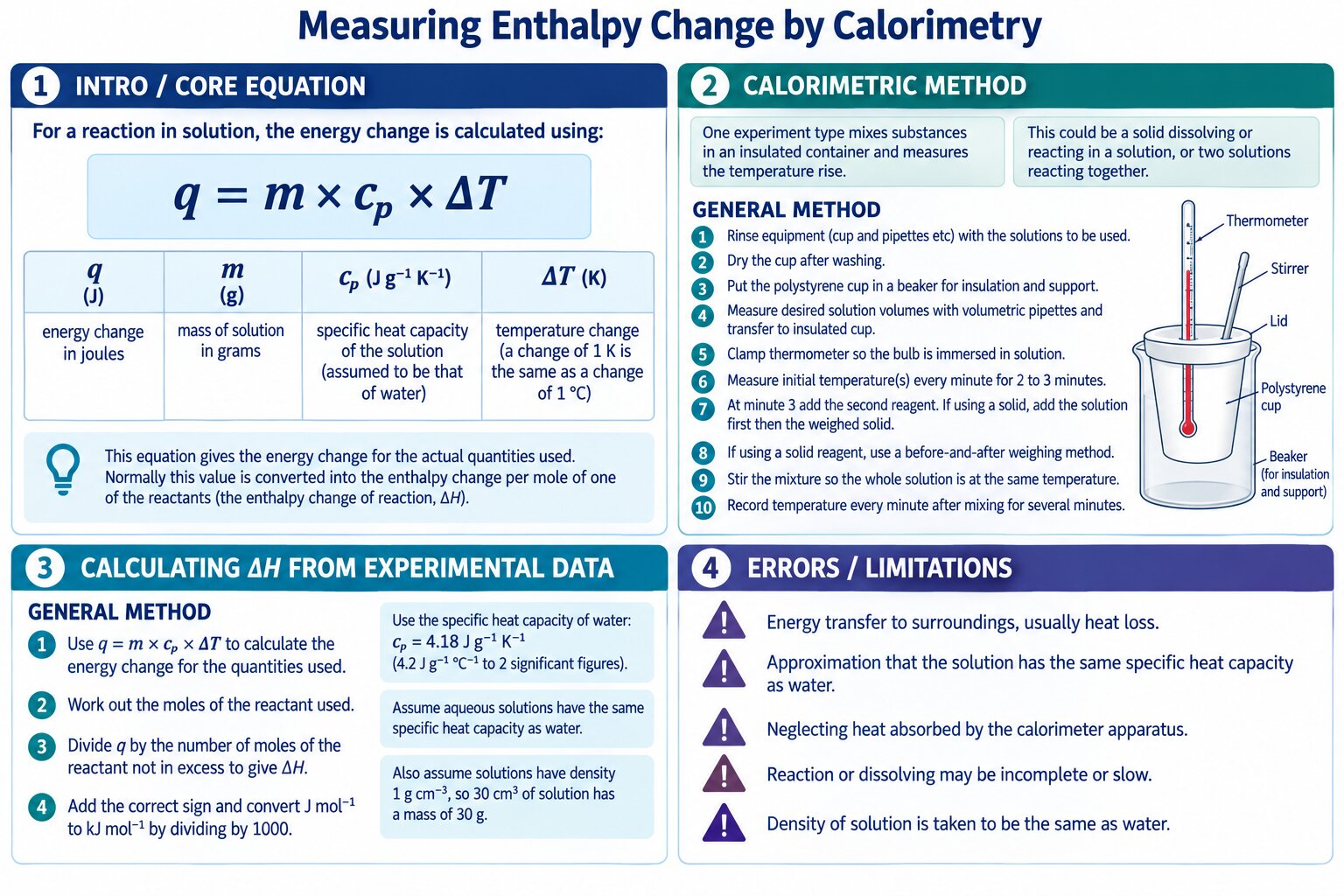
The calorimetric method in one view: the equation, the practical steps, the calculation and the main limitations.
This method is assessed in the practical skills papers, which uses measured temperature changes to find an enthalpy change.
Percentage uncertainty = (uncertainty ÷ measurement) × 100. A temperature change is the difference between two readings, so the uncertainty of the thermometer counts twice: read to ±0.1 °C, ΔT carries ±0.2 °C, which on the 6.8 K rise above is (0.2 ÷ 6.8) × 100 = 2.9 per cent. The larger the temperature change, the smaller that percentage.
Exam sentence: The value is less exothermic than expected because heat is lost to the surroundings, so the measured temperature rise is smaller than the true value.
Quick Check: What Went Wrong?
In each round, choose the one statement that is accurate.
Common Exam Points
Calculate an enthalpy change from a temperature rise
q = mcΔT with the mass of solution, divide by moles of the reagent not in excess, convert to kJ, add a negative sign.
Explain the extrapolation on a temperature-time graph
It corrects for heat lost while the reaction is still taking place, giving the temperature at the moment of mixing.
Suggest why the experimental value differs from the data value
Heat loss to the surroundings, heat absorbed by the apparatus, incomplete reaction or combustion.
Do not say
“Human error”; “m is the mass of the solid”; an answer with no sign.
FAQs
Use these quick answers to check the calorimetry calculations and practical points.
What mass goes into q = mcΔT?
The mass of the water or solution being heated. For dilute solutions, 1 cm³ is taken to have a mass of 1 g.
Why is the answer negative when the temperature rises?
A temperature rise shows energy was released to the surroundings, so the reaction is exothermic and ΔH is negative.
Which moles do I divide by?
The moles of the reactant that is not in excess, because that decides how much reaction takes place.
Why are experimental values usually less exothermic than data book values?
Heat is lost to the surroundings and absorbed by the apparatus, so the measured temperature change is smaller than the true value.
Why use a polystyrene cup?
It is a good insulator and has a very low heat capacity, so little energy is lost through it or used to heat it.
Copyright and author footprint: This OLS revision page was written for Online Learning System by Dr. Mohammed Al-Fatah. It is designed for A Level Chemistry revision and should not be copied or redistributed without permission.
Keep this note — free
Save your progress across every Cambridge topic. A free account remembers which topics you have covered, saves your question scores, and syncs across your phone and laptop.
- Track every topic you have finished
- Keep your practice-question scores
- No payment, no card, free forever
Already registered? Log in