Choose Your Course
Select the topic course you want to study. Each AQA card pools the relevant specification references into the same course-style groupings used across OLS.
AQA Topic Courses
These AQA courses match the current OLS course-card structure, but the pills show the precise AQA specification references rather than Edexcel topic numbers.
Atomic Structure and the Periodic Table
Build the AQA foundation with atomic structure, isotopes, time-of-flight mass spectrometry, electron configuration, ionisation energy and Period 3 periodicity.
Covalent Bonding, Structure and Shapes of Molecules
Pool covalent and dative covalent bonding with crystal structures, VSEPR shapes, bond polarity and intermolecular forces.
Metallic Bonding
Understand metallic bonding, delocalised electrons, metallic crystal structure, conductivity and melting-point reasoning.
Organic Chemistry and Alkanes
Start AQA organic chemistry with nomenclature, mechanisms, isomerism, crude oil, cracking, combustion and free-radical substitution.
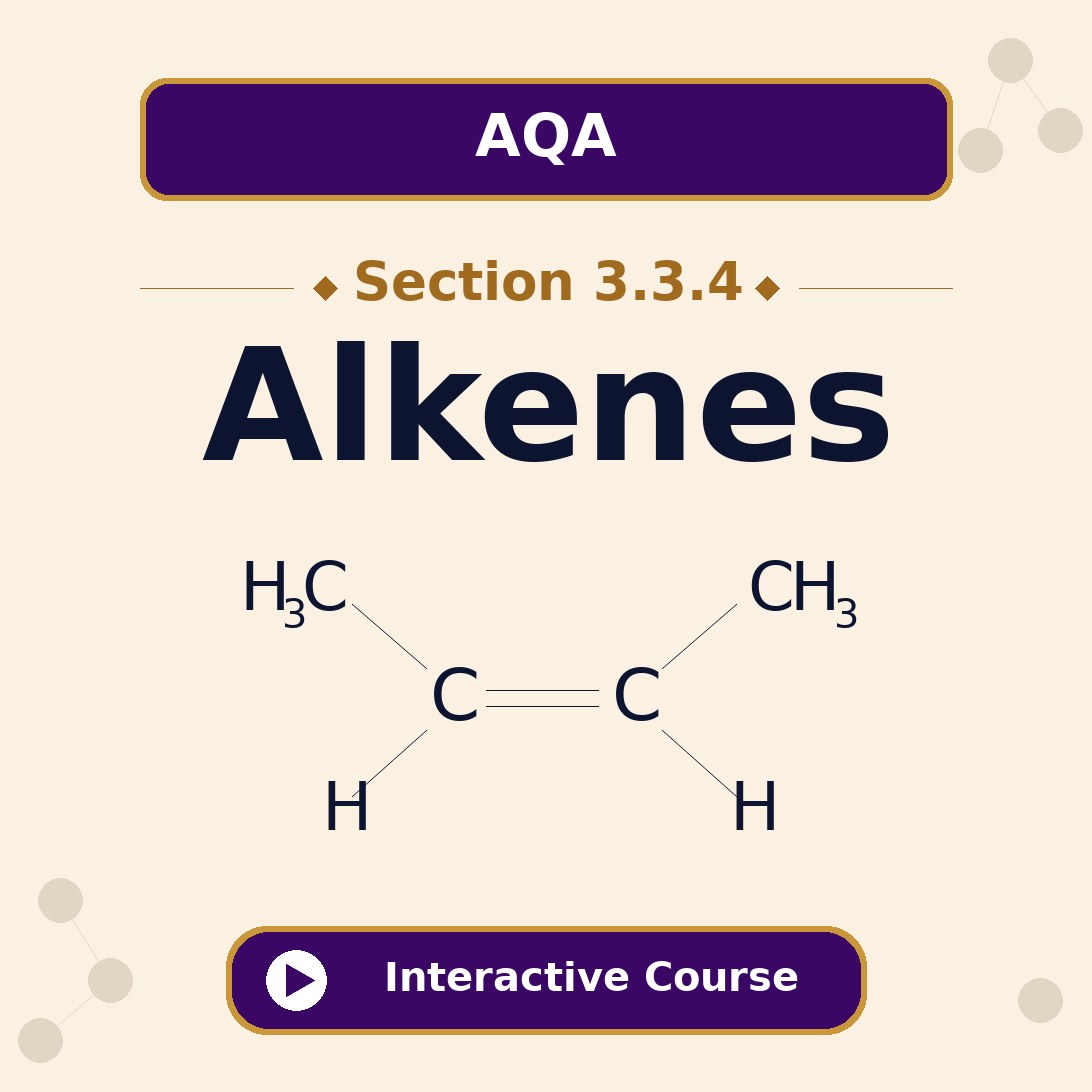
Alkenes
Learn alkene bonding, electrophilic addition with HBr, H2SO4 and Br2, bromine-water testing, major and minor products, E/Z isomerism and addition polymers.
Courses Being Built
These AQA A Level Chemistry courses are included in the full pathway but product pages are not live yet.
Amount of Substance
This calculation course will cover moles, Avogadro constant, ideal gas equation, empirical formulae, balanced equations, yield, atom economy and titration calculations.
Energetics
This course will support enthalpy change, calorimetry, Hess’s law, bond enthalpies and energy-cycle calculations.
Kinetics
This course will introduce collision theory, activation energy, Maxwell–Boltzmann distributions, temperature, concentration, pressure and catalysts.
Chemical Equilibria, Le Chatelier’s Principle and Kc
This course will support reversible reactions, dynamic equilibrium, Le Chatelier’s principle, industrial compromises and Kc calculations.
Oxidation, Reduction and Redox Equations
This course will support oxidation states, oxidising and reducing agents, half-equations and combined redox equations.
Group 2, the Alkaline Earth Metals
This course will cover Group 2 trends, reactions with water, hydroxide and sulfate solubility, medical uses and environmental applications.
Group 7, the Halogens
This course will support halogen trends, displacement reactions, halide reducing ability, silver nitrate tests and chlorine in water treatment.
Halogenoalkanes
This course will cover nucleophilic substitution, elimination, carbon–halogen bond enthalpy and ozone depletion.
Alcohols
This course will cover alcohol production, fermentation, hydration of alkenes, oxidation, elimination and practical distillation.
Organic Analysis
This course will support functional-group tests, organic mass spectrometry, infrared spectroscopy and structure identification.
Thermodynamics
This A-level-only course will support Born–Haber cycles, lattice enthalpy, entropy, Gibbs free energy and feasibility calculations.
Rate Equations
This A-level-only course will cover rate equations, reaction orders, rate constants, Arrhenius plots and rate-determining steps.
Equilibrium Constant Kp
This A-level-only course will support partial pressures, Kp expressions, Kp calculations and equilibrium predictions.
Electrode Potentials and Electrochemical Cells
This course will cover standard electrode potentials, EMF, electrochemical series, fuel cells and commercial cell applications.
Acids and Bases
This A-level-only course will support pH, Kw, Ka, pKa, titration curves, indicators and buffer calculations.
Period 3 Elements and Their Oxides
This course will cover reactions with oxygen, melting-point trends, oxide reactions with water and acid-base behaviour of oxides.
Transition Metals and Aqueous Ions
This course will cover transition-metal properties, ligand substitution, complex shapes, colours, redox, catalysis and aqueous ion tests.
Further Organic Chemistry
This course will support optical isomerism, carbonyls, carboxylic acids, acylation, aromatic chemistry, amines, polymers, amino acids and organic synthesis.
NMR and Chromatography
This course will cover proton and carbon-13 NMR, integration, splitting, chromatography, Rf values, retention times and GC-MS links.
Synoptic Chemistry Skills
This course will support multi-topic exam questions that combine physical, inorganic and organic chemistry with practical and analytical reasoning.
Practical Principles and Required Practicals
This course will support experimental methods, practical planning, apparatus, uncertainty, analysis, evaluation and application of required practical knowledge.
Calculations and Extended Responses
This course will focus on calculation strategy, mathematical skills, data interpretation, practical evaluation and high-mark response structure.
Volumetric Solution and Acid–Base Titration
This required practical course will support making a volumetric solution, titration method, titre selection, concentration calculations and uncertainty.
Measurement of an Enthalpy Change
This required practical course will cover calorimetry, q = mcΔT, molar enthalpy calculations, heat loss and evaluation.
Rate of Reaction and Temperature
This required practical course will support initial-rate methods, timing technique, temperature control, graphs and collision-theory interpretation.
Test-tube Reactions to Identify Ions
This required practical course will cover cation and anion tests, including Group 2, ammonium, halides, hydroxide, carbonate and sulfate ions.
Distillation of a Product from a Reaction
This required practical course will support distillation apparatus, product separation, heating control, organic practical safety and evaluation.
Tests for Alcohol, Aldehyde, Alkene and Carboxylic Acid
This required practical course will support functional-group tests, observations, deductions and organic analysis conclusions.
Measuring Rate by Initial Rate and Continuous Monitoring
This required practical course will support rate data collection, concentration-time graphs, tangents, gradients and rate-equation interpretation.
Measuring the EMF of an Electrochemical Cell
This required practical course will support cell construction, salt bridges, standard conditions, EMF measurement and practical limitations.
pH Changes in Acid–Base Titrations
This required practical course will support pH curves for weak/strong acid-base combinations, data plotting and indicator selection.
Preparation of a Pure Organic Solid and Liquid
This required practical course will cover organic synthesis, purification, recrystallisation, distillation, melting point and purity testing.
Identify Transition Metal Ions in Aqueous Solution
This required practical course will support test-tube reactions of metal-aqua ions with bases and evidence-based identification.
Separation of Species by Thin-layer Chromatography
This required practical course will cover TLC method, solvent front, Rf values, standards, identification and chromatographic evaluation.