Choose Your Course
Choose a branch of the syllabus, then a course. Each live course opens its course page; greyed courses are being built.
Physical Chemistry
Topics 1–8 and 23–26. 14 courses.
Atomic Structure and the Periodic Table
This course will cover atomic structure, isotopes, electron configuration, ionisation energy and the periodicity of Period 3 elements and their compounds.
Atoms, Molecules and Stoichiometry
This calculation course will cover relative masses, the mole and the Avogadro constant, formulae, balanced equations and reacting-mass and volume calculations.
Covalent Bonding and Shapes of Molecules
This course will cover electronegativity, covalent and coordinate bonding, σ and π bonds, hybridisation, bond energies and the shapes of molecules.
Ionic and Metallic Bonding
This course will cover ionic bonding, metallic bonding and giant lattices, and how structure explains physical properties.
Intermolecular Forces
This course will cover hydrogen bonding and van der Waals’ forces, and how intermolecular forces compare with ionic, covalent and metallic bonds.
States of Matter
This course will cover the gaseous, liquid and solid states, the ideal gas equation and the giant and simple lattice structures of solids.
Chemical Energetics
This course will cover enthalpy changes and standard conditions, calorimetry, Hess’s law and bond energies.
Electrochemistry
This course will cover oxidation numbers, redox reactions, oxidising and reducing agents and balancing redox equations.
Equilibria
This course will cover dynamic equilibrium, le Chatelier’s principle, Kc and Kp, the Haber and Contact processes, and Brønsted–Lowry acids and bases.
Reaction Kinetics
This course will cover rates of reaction, collision theory, activation energy, the Boltzmann distribution and catalysis.
Chemical Energetics
This course will cover lattice energy, Born–Haber cycles, enthalpies of solution and hydration, entropy and Gibbs free energy.
Electrochemistry
This course will cover electrolysis, standard electrode potentials, cell potentials, the Nernst equation and the feasibility of reactions.
Equilibria
This course will cover pH, Ka and pKa, Kw, buffers, solubility products and the common ion effect, and partition coefficients.
Reaction Kinetics
This course will cover rate equations, orders and half-life, rate-determining steps, the Arrhenius equation and homogeneous and heterogeneous catalysts.
Inorganic Chemistry
Topics 9–12 and 27–28. 6 courses.
Atomic Structure and the Periodic Table
This course will cover atomic structure, isotopes, electron configuration, ionisation energy and the periodicity of Period 3 elements and their compounds.
Group 2
This course will cover the reactions of the Group 2 elements and their compounds, and trends in their properties.
Group 17
This course will cover the physical and chemical trends of the halogens, the reactions of halide ions, and the reactions of chlorine.
Nitrogen and Sulfur
This course will cover the lack of reactivity of nitrogen, ammonia and the ammonium ion, nitrogen oxides in the atmosphere and sulfur dioxide.
Group 2
This course will cover the trends in thermal stability and solubility of the Group 2 nitrates, carbonates, hydroxides and sulfates.
Chemistry of Transition Elements
This course will cover transition elements, complex ions and their shapes, stereoisomerism, ligand exchange, colour, redox reactions and stability constants.
Organic Chemistry
Topics 13–22 and 29–37. 19 courses.
Introduction to Organic Chemistry and Alkanes
This course will cover organic formulae, nomenclature, isomerism, reaction mechanisms and the chemistry of alkanes.
Alkenes
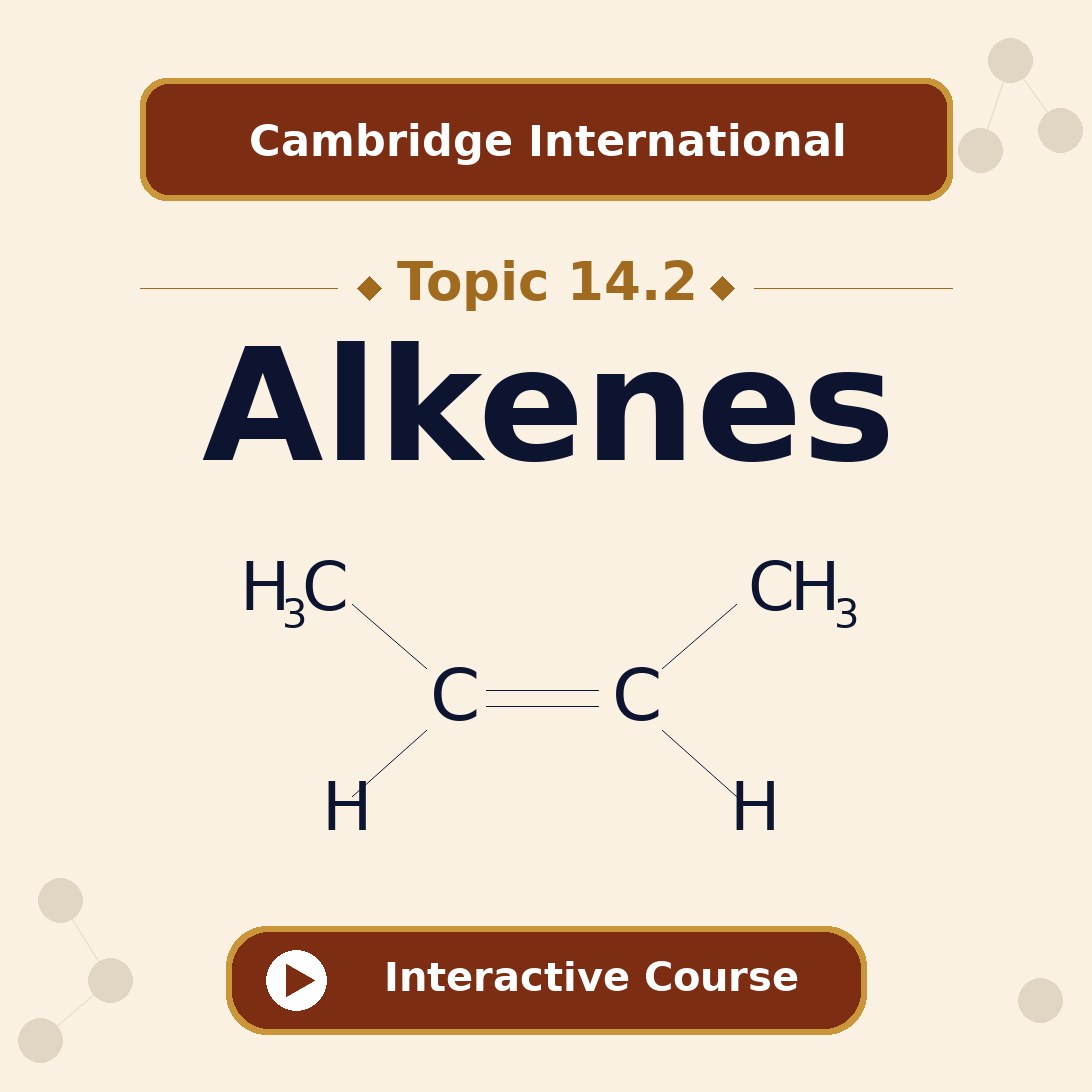
Learn alkene production, bonding and cis/trans isomerism, electrophilic addition and Markovnikov addition, oxidation with KMnO4, addition polymerisation and polymer waste.
Halogen Compounds
This course will cover halogenoalkanes: classification, nucleophilic substitution by SN1 and SN2, elimination and their reactivity.
Hydroxy Compounds
This course will cover alcohols: their production, oxidation, substitution and dehydration, and the tri-iodomethane test.
Carbonyl Compounds
This course will cover aldehydes and ketones, nucleophilic addition, reduction and the tests that tell them apart.
Carboxylic Acids and Derivatives
This course will cover carboxylic acids, their acidity and preparation, and esters and their hydrolysis.
Nitrogen Compounds
This course will cover the AS nitrogen compounds: amines and nitriles from halogenoalkanes, and hydroxynitriles.
Polymerisation
This course will cover addition polymerisation, deducing repeat units, and the disposal of poly(alkenes).
Organic Synthesis
This course will cover identifying the functional groups in a molecule and planning two-stage synthetic routes.
Analytical Techniques
This course will cover infrared spectroscopy and mass spectrometry, including the M+1 peak, to identify organic compounds.
An Introduction to A Level Organic Chemistry
This course will cover the formulae and naming of A Level organic compounds and optical isomerism around chiral centres.
Hydrocarbons
This course will cover arenes: the structure of benzene, electrophilic substitution and the reactions of methylbenzene.
Halogen Compounds
This course will cover making halogenoarenes and why they resist the nucleophilic substitution that halogenoalkanes undergo.
Hydroxy Compounds
This course will cover phenol: its acidity and its electrophilic substitution reactions.
Carboxylic Acids and Derivatives
This course will cover acyl chlorides and their reactions with water, alcohols, phenols and amines.
Nitrogen Compounds
This course will cover amines, phenylamine and azo compounds, amides, amino acids and peptides, and electrophoresis.
Polymerisation
This course will cover condensation polymers, polyesters and polyamides, deducing repeat units and their degradability.
Organic Synthesis
This course will cover multi-step synthetic routes, including carbon–carbon bond formation, and choosing reagents and conditions.
Analytical Techniques
This course will cover thin-layer and gas chromatography, carbon-13 NMR and proton NMR spectroscopy.
Practical Skills: Papers 3 and 5
Papers 3 and 5. 2 courses.
Advanced Practical Skills
This course will build the Paper 3 practical skills: manipulation, measurement and observation, presenting data, and analysis, conclusions and evaluation.
Planning, Analysis and Evaluation
This course will build the Paper 5 skills: planning an investigation, analysing and evaluating data, and drawing conclusions with their uncertainties.