Carboxylic Acids: Structure, Properties and Preparation
A concise revision guide to carboxylic acids: the –COOH group, naming and drawing acids, hydrogen bonding and its effect on boiling point and solubility, and how acids are made by oxidation and by hydrolysis of nitriles, with the relative acidities of acids, phenols and alcohols.
- 18.1.1(a)-i
- 18.1.1(a)-ii
- 18.1.1(b)
- 18.1.1(c)
What these spec points say
- 18.1.1(a)-i recall the reaction by which carboxylic acids can be produced: oxidation of primary alcohols with acidified K2Cr2O7 or acidified KMnO4 and refluxing
- 18.1.1(a)-ii recall the reaction by which carboxylic acids can be produced: oxidation of aldehydes with acidified K2Cr2O7 or acidified KMnO4 and refluxing
- 18.1.1(b) recall the reaction by which carboxylic acids can be produced: hydrolysis of nitriles with dilute acid or dilute alkali followed by acidification
- 18.1.1(c) recall the reaction by which carboxylic acids can be produced: hydrolysis of esters with dilute acid or dilute alkali and heat followed by acidification
Recap: Weak Acids and the Oxidation of Alcohols
Check what you remember about weak acids as partly dissociated proton donors, and about oxidising primary alcohols by distillation or under reflux, before you start carboxylic acids.
The Carboxyl Group
A carboxylic acid contains the carboxyl group, –COOH: a carbonyl group, C=O, and a hydroxyl group, O–H, joined to the same carbon atom.
- The general formula is RCOOH, or CₙH₂ₙ₊₁COOH for an acid with an alkyl group.
- The carboxyl carbon has three bonding regions, so the group is trigonal planar with bond angles of about 120°.
- Both the C=O and the O–H bonds are polar: oxygen is δ− in each, and the hydroxyl hydrogen is δ+.
- The two groups affect each other, so –COOH does not behave like a ketone or like an alcohol.
Why it is an acid
In water a small fraction of the molecules donate a proton. Carboxylic acids are weak acids: the equilibrium lies well to the left.
CH₃COOH(aq) ⇌ CH₃COO⁻(aq) + H⁺(aq)
The anion formed is a carboxylate ion. Its negative charge is shared by both oxygen atoms, which makes it stable enough to form.
Key idea: The carboxyl group, –COOH, is a C=O and an O–H on the same carbon. It is polar, it can form hydrogen bonds, and it donates a proton to a small extent.
Naming and Drawing Carboxylic Acids
- Count the carbon atoms in the longest chain that includes the –COOH carbon.
- Replace the final -e of the alkane name with -oic acid.
- The carboxyl carbon is always carbon 1, so no number is needed for it.
- Number the chain from that carbon to locate any branches or other groups.
- Two carboxyl groups give a -dioic acid, and the final -e of the alkane name is kept.
| Name | Structural formula | Notes |
|---|---|---|
| methanoic acid | HCOOH | one carbon: H is joined to –COOH |
| ethanoic acid | CH₃COOH | the acid in vinegar |
| propanoic acid | CH₃CH₂COOH | three carbons including –COOH |
| butanoic acid | CH₃CH₂CH₂COOH | four carbons including –COOH |
| 2-methylpropanoic acid | (CH₃)₂CHCOOH | branch on carbon 2 |
| ethanedioic acid | HOOCCOOH | two –COOH groups |
| benzoic acid | C₆H₅COOH | –COOH joined to a benzene ring |

Displayed and skeletal formulae of six carboxylic acids. In a skeletal formula the –COOH carbon is the end of the zig-zag line, with =O and –OH drawn on it.
Drawing tips
- In a displayed formula draw the O–H bond of –COOH as well as the C=O bond.
- Write –COOH or –CO₂H in a structural formula, never –COHO or –OCOH.
- A carboxylic acid and an ester can share a molecular formula. C₂H₄O₂ is ethanoic acid, CH₃COOH, or methyl methanoate, HCOOCH₃.
Check: Naming and Drawing Carboxylic Acids
Name carboxylic acids from structural formulae and work out formulae from names, for acids not used on this page.
Hydrogen Bonding, Boiling point and Solubility
Carboxylic acids have higher boiling points than other organic compounds of similar relative molecular mass.
| Compound | Mr | Boiling point / °C | Strongest force between molecules |
|---|---|---|---|
| butane, C₄H₁₀ | 58 | −1 | weak forces between non-polar molecules |
| propanal, CH₃CH₂CHO | 58 | 49 | permanent dipole–dipole forces |
| propan-1-ol, CH₃CH₂CH₂OH | 60 | 97 | hydrogen bonds |
| ethanoic acid, CH₃COOH | 60 | 118 | hydrogen bonds, more of them |
Why the boiling point is so high
- The O–H hydrogen is strongly δ+ and both oxygen atoms have lone pairs, so the molecules form hydrogen bonds with each other.
- Each –COOH group can form two hydrogen bonds with one neighbouring molecule: C=O to H–O, twice.
- More energy is needed to overcome these forces than the single hydrogen bond between two alcohol molecules.
- The boiling point rises along the series as the chain grows: 101 °C, 118 °C, 141 °C and 164 °C from methanoic to butanoic acid.
Dimers
In the pure liquid, in the vapour just above the boiling point and in non-polar solvents, carboxylic acid molecules pair up as dimers held together by two hydrogen bonds.
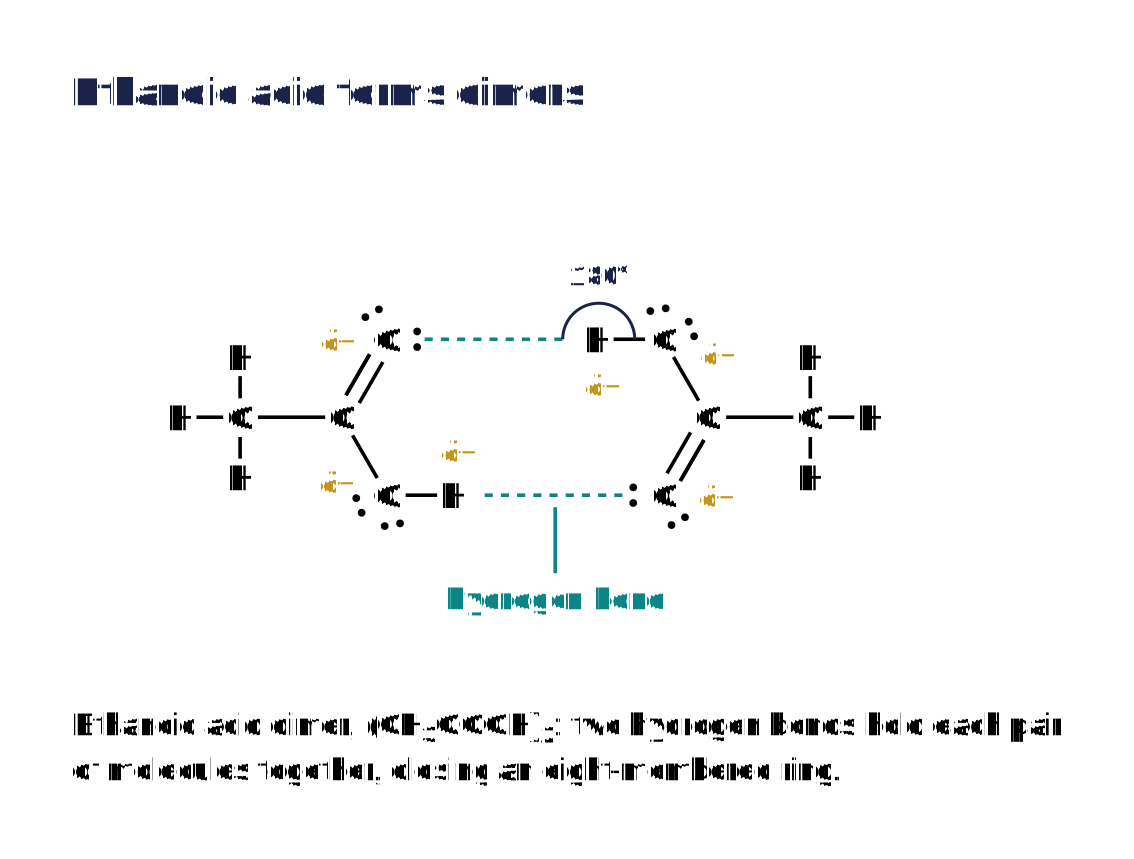
Two ethanoic acid molecules joined as a dimer. Each hydrogen bond runs from a lone pair on a C=O oxygen to the δ+ hydrogen of the other molecule’s O–H group.
Solubility in water
- The –COOH group forms hydrogen bonds with water molecules, through both its C=O oxygen and its O–H group.
- Methanoic, ethanoic, propanoic and butanoic acid mix with water in all proportions.
- A longer hydrocarbon chain is non-polar and cannot hydrogen bond. It disrupts the hydrogen bonding between water molecules.
- So solubility falls as the chain grows: hexanoic acid is only slightly soluble and octadecanoic acid is insoluble.
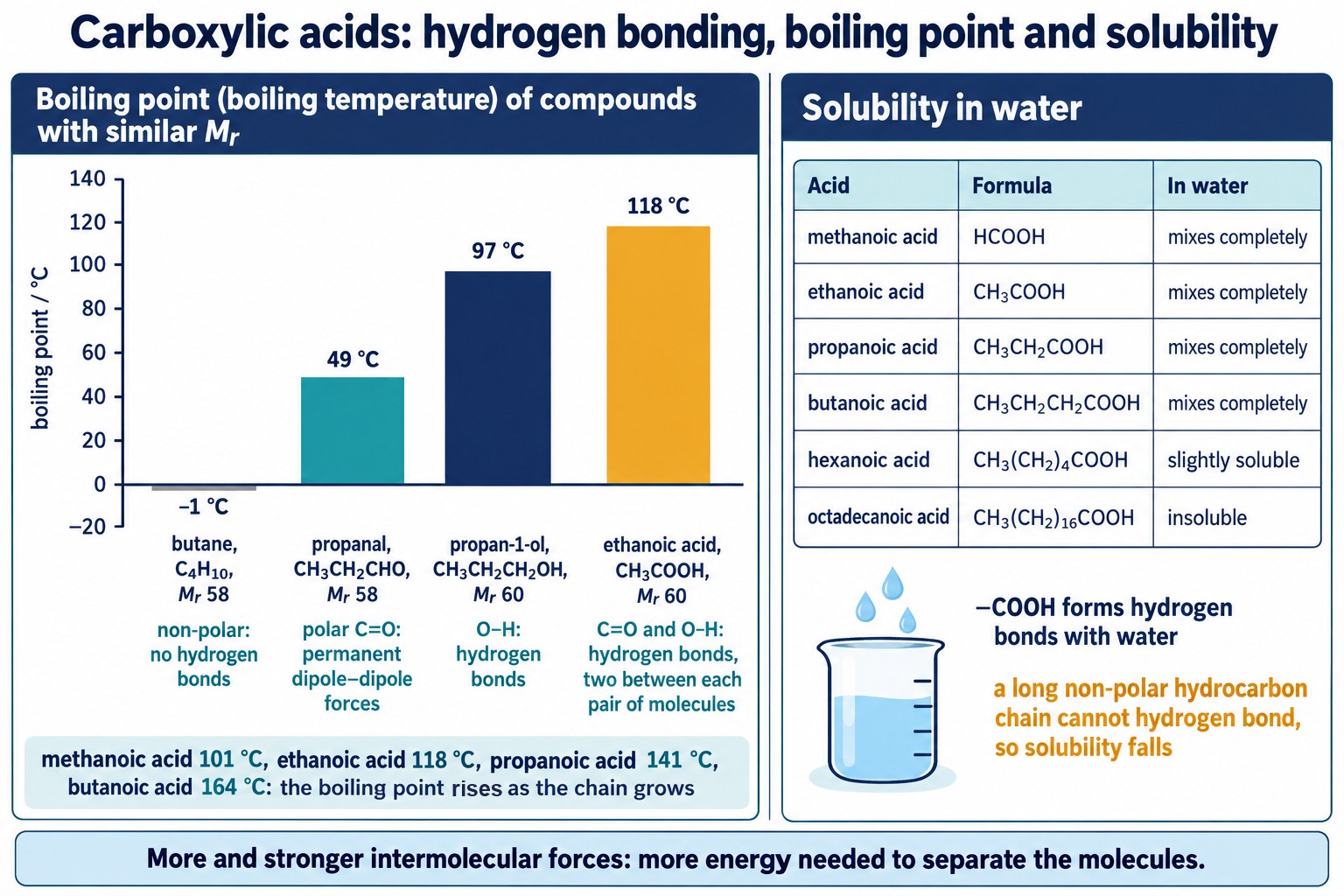
Boiling points of four compounds of similar Mr, showing the effect of hydrogen bonding in ethanoic acid, and the solubility of carboxylic acids in water falling as the hydrocarbon chain grows.
Exam wording: “Carboxylic acids form hydrogen bonds between molecules. These are stronger than the forces between aldehyde or alkane molecules of similar Mr, so more energy is needed to separate the molecules.”
Quick Check: Rank the Four Compounds
Four new compounds have almost the same Mr, so the forces between the molecules decide the order.
Making Carboxylic Acids
1. Oxidation of a primary alcohol or an aldehyde
Heat the alcohol or aldehyde under reflux with an excess of acidified potassium dichromate(VI), K₂Cr₂O₇ in dilute H₂SO₄. The orange solution turns green as Cr₂O₇²⁻ is reduced to Cr³⁺.
CH₃CH₂OH + 2[O] → CH₃COOH + H₂O
CH₃CHO + [O] → CH₃COOH
- Reflux keeps the aldehyde, formed first, in the flask until it is oxidised further.
- Distilling instead would remove the aldehyde as it forms.
- The alcohol chemistry is in Topic 16 Hydroxy compounds; the oxidation of aldehydes is on Oxidation and Tests for Carbonyl Compounds.
2. Hydrolysis of a nitrile
A nitrile, RCN, is hydrolysed when it is heated under reflux with dilute acid or with aqueous alkali. The C≡N group becomes –COOH.
| Reagent | Equation | Then |
|---|---|---|
| dilute HCl, reflux | CH₃CH₂CN + 2H₂O + HCl → CH₃CH₂COOH + NH₄Cl | the acid is formed directly |
| NaOH(aq), reflux | CH₃CH₂CN + H₂O + NaOH → CH₃CH₂COONa + NH₃ | add dilute HCl: CH₃CH₂COONa + HCl → CH₃CH₂COOH + NaCl |
- Nitriles are made from a halogenoalkane and KCN, which adds one carbon atom to the chain.
- The hydroxynitriles on Reduction and Nucleophilic Addition hydrolyse in the same way: CH₃CH(OH)CN gives 2-hydroxypropanoic acid, CH₃CH(OH)COOH.
3. Hydrolysis of an ester
Heating an ester with dilute acid, or with dilute alkali followed by acidification, gives the carboxylic acid and an alcohol. The details are on Esters and Their Hydrolysis.
CH₃COOCH₂CH₃ + H₂O ⇌ CH₃COOH + CH₃CH₂OH
4. Benzoic acid from an alkylbenzene
An alkyl side chain on a benzene ring is oxidised to –COOH by hot alkaline KMnO₄, followed by dilute acid. The purple manganate(VII) is reduced to a brown precipitate of MnO₂.
C₆H₅CH₃ + 3[O] → C₆H₅COOH + H₂O
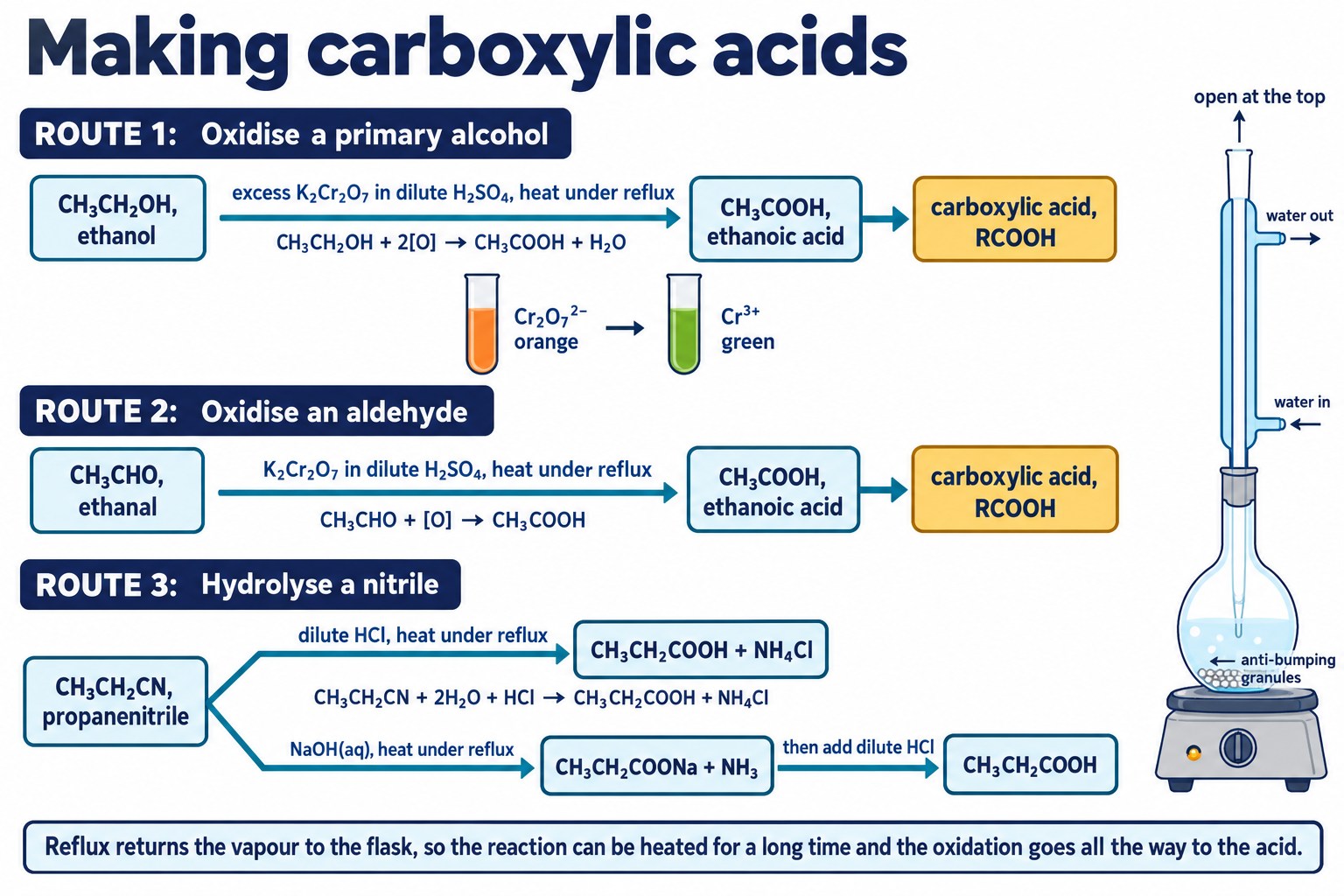
Routes to a carboxylic acid: oxidation of a primary alcohol or an aldehyde under reflux with acidified dichromate(VI), and hydrolysis of a nitrile with dilute acid or with alkali followed by acid.
Worked example
Outline how butanoic acid can be made from 1-bromopropane in two steps.
Answer. Heat butanenitrile under reflux with dilute HCl: CH₃CH₂CH₂CN + 2H₂O + HCl → CH₃CH₂CH₂COOH + NH₄Cl
Exam focus: For a full oxidation mark give the reagent (acidified K₂Cr₂O₇), the condition (heat under reflux) and the colour change (orange to green). Use [O] in the equation.
Check: Properties and Preparation of Carboxylic Acids
Explain boiling points and solubility using hydrogen bonding, and choose reagents, conditions and equations for making carboxylic acids, using compounds not used on this page.
Relative Acidities of Carboxylic Acids, Phenols and Alcohols
The more stable the anion left behind, the more readily a molecule gives up its proton, and the stronger the acid. The order is:
carboxylic acid > phenol > water > alcohol
| Compound | Anion formed | Why the anion is stable or unstable |
|---|---|---|
| ethanoic acid, pKa 4.76 | CH₃COO⁻ | negative charge delocalised over two oxygen atoms |
| phenol, pKa 10.0 | C₆H₅O⁻ | an oxygen lone pair overlaps with the ring π system, spreading the charge |
| water | OH⁻ | charge fixed on one oxygen atom |
| ethanol | CH₃CH₂O⁻ | the electron-donating alkyl group increases the charge on oxygen |
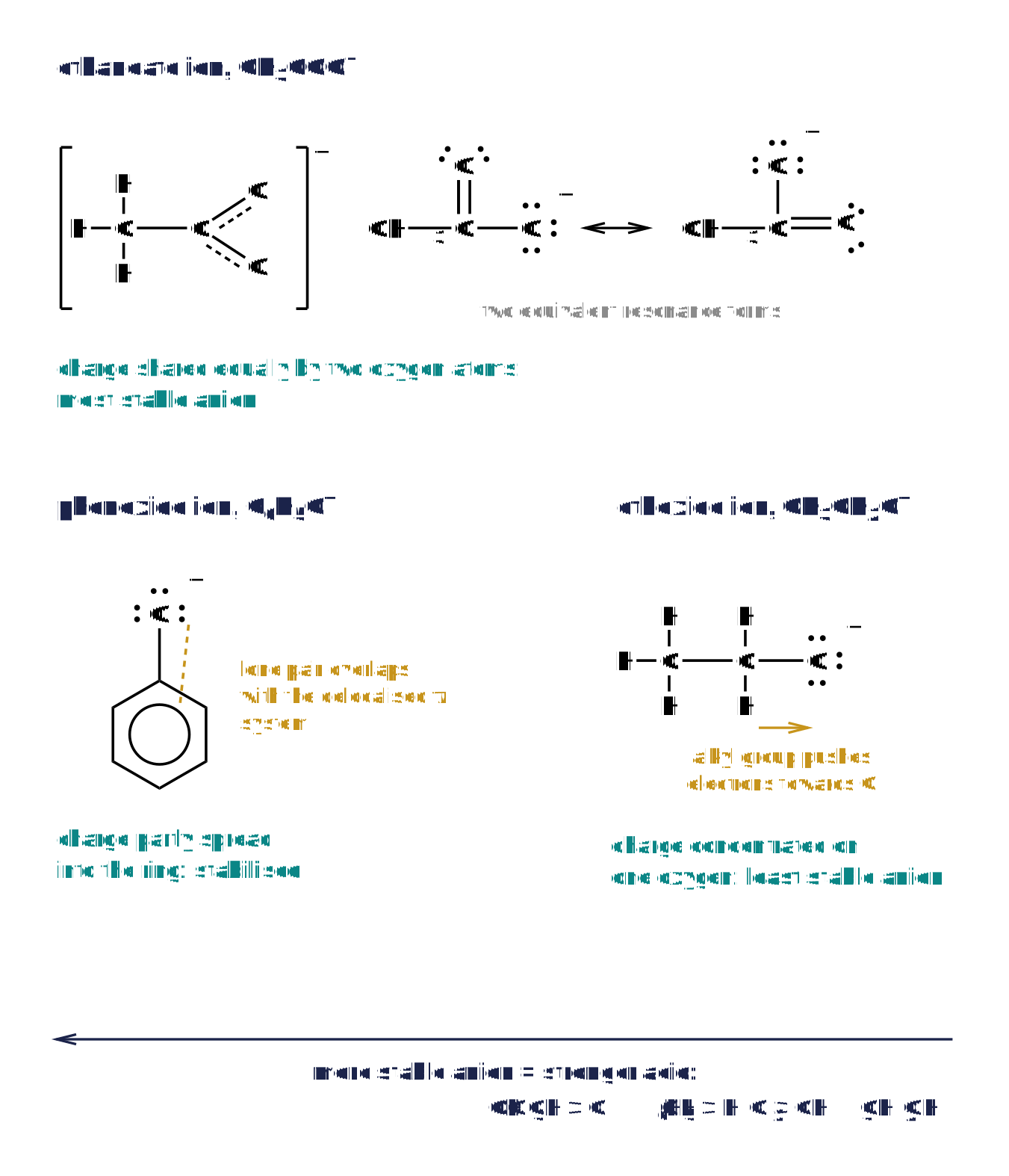
The ethanoate, phenoxide and ethoxide ions. The more the negative charge is spread out, the more stable the anion and the stronger the acid that forms it.
Chlorine-substituted acids
A chlorine atom is electron-withdrawing. It pulls electron density away from the –COO⁻ group, spreads the negative charge and stabilises the anion. It also weakens the O–H bond.
| Acid | Formula | pKa |
|---|---|---|
| ethanoic acid | CH₃COOH | 4.76 |
| chloroethanoic acid | CH₂ClCOOH | 2.86 |
| dichloroethanoic acid | CHCl₂COOH | 1.29 |
| trichloroethanoic acid | CCl₃COOH | 0.65 |
- More chlorine atoms withdraw more electron density, so the acid is stronger and its pKa is lower.
- A chlorine atom closer to –COOH has a greater effect: 2-chloropropanoic acid is stronger than 3-chloropropanoic acid.
- An alkyl group is electron-donating, so ethanoic acid (pKa 4.76) is weaker than methanoic acid (pKa 3.75).
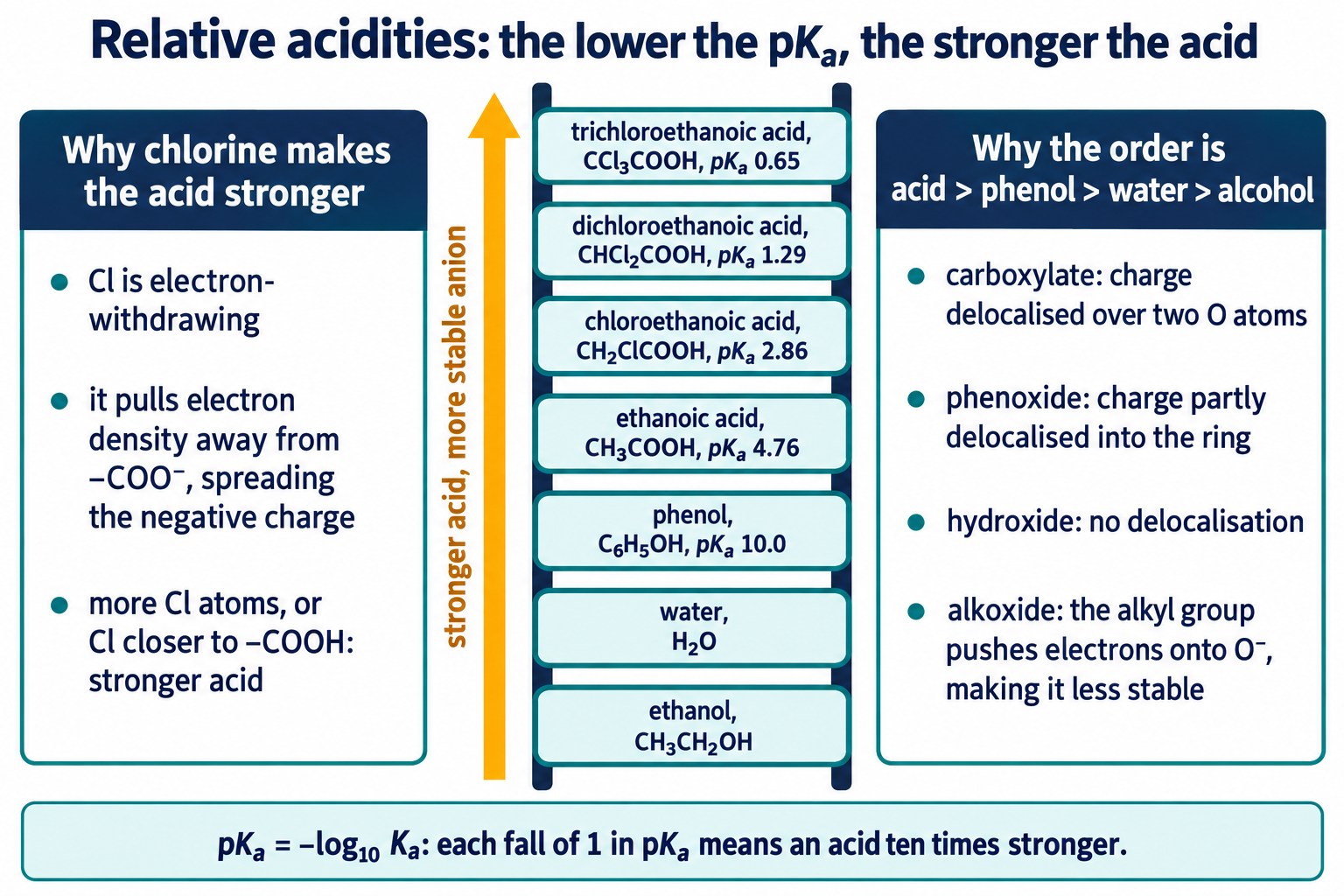
A pKa ladder from trichloroethanoic acid (0.65) down to ethanol, with the reasons: electron-withdrawing chlorine atoms and delocalisation of the negative charge stabilise the anion.
Exam wording: “Chlorine is electron-withdrawing, so it reduces the electron density on the –COO⁻ group. The negative charge is more spread out, the anion is more stable, and the acid dissociates more.”
Quick Check: Stronger Than Ethanoic Acid?
Use electron-withdrawing and electron-donating groups to compare new acids with ethanoic acid.
Common Exam Points
Say
- “Hydrogen bonds form between carboxylic acid molecules” and state which atoms are involved.
- “Heat under reflux with acidified potassium dichromate(VI); orange to green.”
- “Solubility falls as the non-polar hydrocarbon chain becomes longer.”
Do not say
- “The O–H and C=O bonds break when the acid boils” (only intermolecular forces are overcome).
- “Carboxylic acids are strong acids because they contain two oxygen atoms” (they are weak acids).
- “The nitrile is oxidised to the acid” (it is hydrolysed).
Watch for
- Carbon counting: the –COOH carbon is part of the chain, so CH₃CH₂COOH is propanoic acid.
- Hydrogen-bond diagrams: show lone pairs, δ+ and δ− charges and a straight O–H···O.
- Nitrile hydrolysis: acid gives an ammonium salt; alkali gives the carboxylate salt and ammonia.
- Acidity questions: argue from the stability of the anion, not from the strength of the acid molecule.
FAQs
Use these quick answers to check the structure, properties and preparation of carboxylic acids.
Why do carboxylic acids have high boiling points?
The COOH group has both a polar C=O and an OH group, so each molecule can form two hydrogen bonds with a neighbour, giving hydrogen-bonded pairs called dimers. More energy is needed to separate the molecules than for an alcohol of similar size.
How are carboxylic acids named?
Count the longest chain including the COOH carbon, which is always carbon 1, and use the ending -oic acid: CH₃CH₂COOH is propanoic acid. Two COOH groups give -dioic acid, as in ethanedioic acid, HOOCCOOH.
Why are small carboxylic acids soluble in water?
The COOH group forms hydrogen bonds with water molecules through its C=O oxygen and its OH group. Acids with up to four carbon atoms mix with water; solubility then falls as the non-polar hydrocarbon chain grows.
How do I make a carboxylic acid from an alcohol?
Heat a primary alcohol under reflux with excess acidified potassium dichromate(VI). Reflux keeps the aldehyde, formed first, in the flask until it is oxidised further. The solution turns from orange to green: CH₃CH₂OH + 2[O] → CH₃COOH + H₂O.
Why is chloroethanoic acid a stronger acid than ethanoic acid?
The electron-withdrawing chlorine atom pulls electron density away from the COO⁻ group, spreading the negative charge and stabilising the anion. The acid therefore dissociates more: pKa falls from 4.76 for ethanoic acid to 2.86 for chloroethanoic acid.

Copyright notice: This OLS revision content, including the explanations, layout, diagrams, tables and embedded learning structure, is authored for Online Learning System by Dr. Mohammed Al-Fatah. It may not be copied, reproduced, redistributed or adapted without written permission.
Keep this note — free
Save your progress across every Cambridge topic. A free account remembers which topics you have covered, saves your question scores, and syncs across your phone and laptop.
- Track every topic you have finished
- Keep your practice-question scores
- No payment, no card, free forever
Already registered? Log in