Reactions of Carboxylic Acids
A concise revision guide to the reactions of carboxylic acids: salt formation with bases, carbonates and metals, esterification with an alcohol and an acid catalyst, reduction with LiAlH₄, and making acyl chlorides with PCl₃ and heat, PCl₅ or SOCl₂.
- 18.1.2(a)
- 18.1.2(b)
- 18.1.2(c)
- 18.1.2(d)
- 18.1.2(e)
- 18.2.1(a)
What these spec points say
- 18.1.2(a) describe the redox reaction of carboxylic acids with reactive metals to produce a salt and H2(g)
- 18.1.2(b) describe the neutralisation reaction of carboxylic acids with alkalis to produce a salt and H2O(l)
- 18.1.2(c) describe the acid–base reaction of carboxylic acids with carbonates to produce a salt and H2O(l) and CO2(g)
- 18.1.2(d) describe esterification of carboxylic acids with alcohols with concentrated H2SO4 as catalyst
- 18.1.2(e) describe reduction of carboxylic acids by LiAlH4 to form a primary alcohol
- 18.2.1(a) recall the reaction (reagents and conditions) by which esters can be produced: the condensation reaction between an alcohol and a carboxylic acid with concentrated H2SO4 as catalyst
Before You Start
This page follows Carboxylic Acids: Structure, Properties and Preparation, which covers the structure of the –COOH group and why carboxylic acids are weak acids. The esters made here are studied further on Esters and Their Hydrolysis.
GCSE Recap: Carboxylic Acids as a Series
Three quick questions on the GCSE ideas this page builds on.
Carboxylic Acids as Weak Acids
A carboxylic acid is only partly dissociated in water, but it still shows the typical reactions of an acid. Its salts are carboxylates, named with the ending -oate.
CH₃COOH(aq) ⇌ CH₃COO⁻(aq) + H⁺(aq)
| Reacts with | Equation | Salt | What is seen |
|---|---|---|---|
| alkali | CH₃COOH + NaOH → CH₃COONa + H₂O | sodium ethanoate | no visible change; the mixture warms |
| carbonate | 2CH₃COOH + Na₂CO₃ → 2CH₃COONa + H₂O + CO₂ | sodium ethanoate | effervescence |
| hydrogencarbonate | CH₃COOH + NaHCO₃ → CH₃COONa + H₂O + CO₂ | sodium ethanoate | effervescence |
| reactive metal | 2CH₃COOH + Mg → (CH₃COO)₂Mg + H₂ | magnesium ethanoate | effervescence; the metal dissolves |
| metal oxide | 2CH₃COOH + CuO → (CH₃COO)₂Cu + H₂O | copper(II) ethanoate | black solid dissolves; blue solution |
Ionic equations
The acid is weak, so it is written as the undissociated molecule. The carboxylate ion carries the charge; the metal ion is a spectator.
CH₃COOH + OH⁻ → CH₃COO⁻ + H₂O
2CH₃COOH + CO₃²⁻ → 2CH₃COO⁻ + H₂O + CO₂
2CH₃COOH + Mg → 2CH₃COO⁻ + Mg²⁺ + H₂
The test for a carboxylic acid
- Add sodium carbonate or sodium hydrogencarbonate, as a solid or in solution.
- A carboxylic acid gives effervescence.
- Bubble the gas through limewater: it turns cloudy, showing the gas is carbon dioxide.
Alcohols and phenols are weaker acids than carbonic acid, so they give no carbon dioxide. This test separates a carboxylic acid from both.
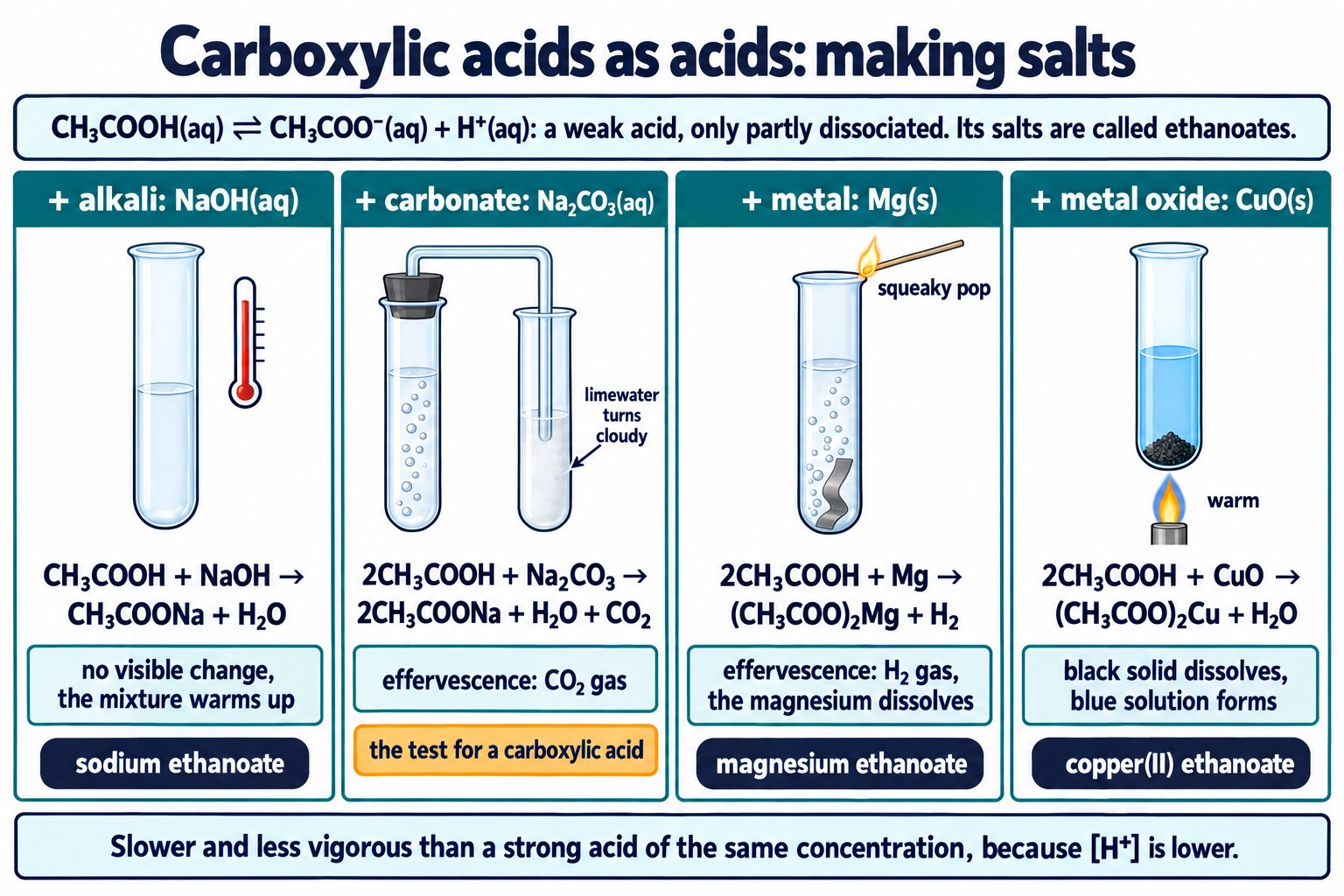
Ethanoic acid reacting as an acid with an alkali, a carbonate, a metal and a metal oxide, with the equation and the observation for each reaction.
Key idea: Acid + base gives a salt and water. Acid + carbonate gives a salt, water and carbon dioxide. Acid + metal gives a salt and hydrogen. The salt of a carboxylic acid is a carboxylate.
Check: Salts of Carboxylic Acids
Name the salts and write full and ionic equations for carboxylic acids reacting with bases, carbonates and metals, using acids and reagents not used on this page.
Esterification
A carboxylic acid reacts with an alcohol to form an ester and water. The reaction is called esterification.
CH₃COOH + CH₃CH₂OH ⇌ CH₃COOCH₂CH₃ + H₂O
| Feature | Detail |
|---|---|
| Reagents | carboxylic acid and alcohol |
| Catalyst | a few drops of concentrated H₂SO₄ (an acid catalyst) |
| Conditions | heat under reflux, or warm gently in a water bath on a small scale |
| Type of reaction | reversible; also called condensation, because water is lost |
| General equation | RCOOH + R′OH ⇌ RCOOR′ + H₂O |
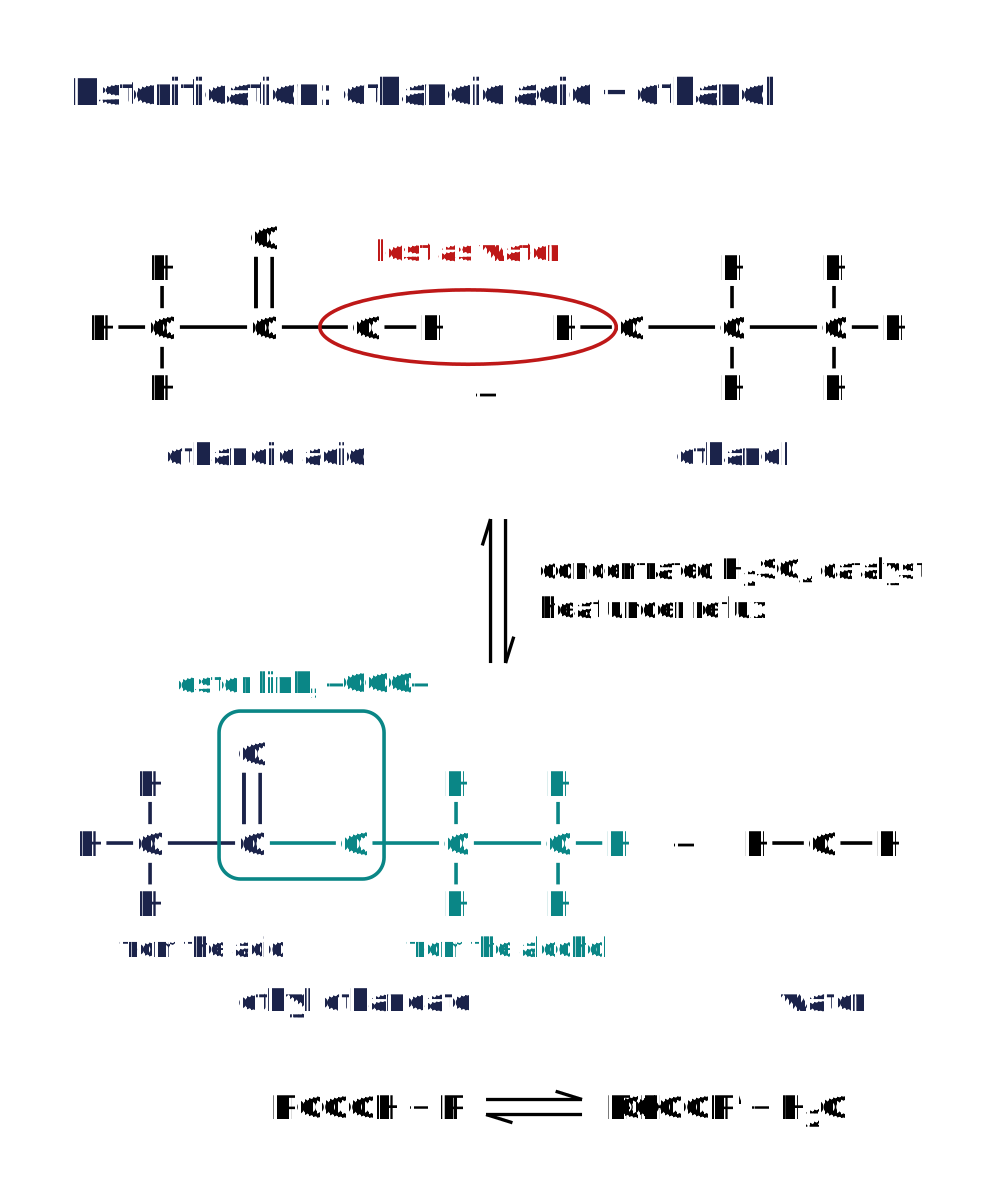
Ethanoic acid and ethanol forming ethyl ethanoate and water. The O–H of the acid and the H of the alcohol are lost as water, leaving the ester link.
Getting a good yield
- The reaction is slow and reaches equilibrium, so it never goes to completion.
- Use an excess of the cheaper reactant to shift the equilibrium towards the ester.
- Distil off the ester as it forms: it usually has the lowest boiling point in the mixture, because it cannot hydrogen bond with itself.
On a test-tube scale
- Warm the acid and the alcohol with a few drops of concentrated H₂SO₄ in a water bath.
- Pour the mixture into sodium carbonate solution to neutralise the unreacted acid and the catalyst.
- The ester floats as an oily layer and has a sweet, fruity smell.
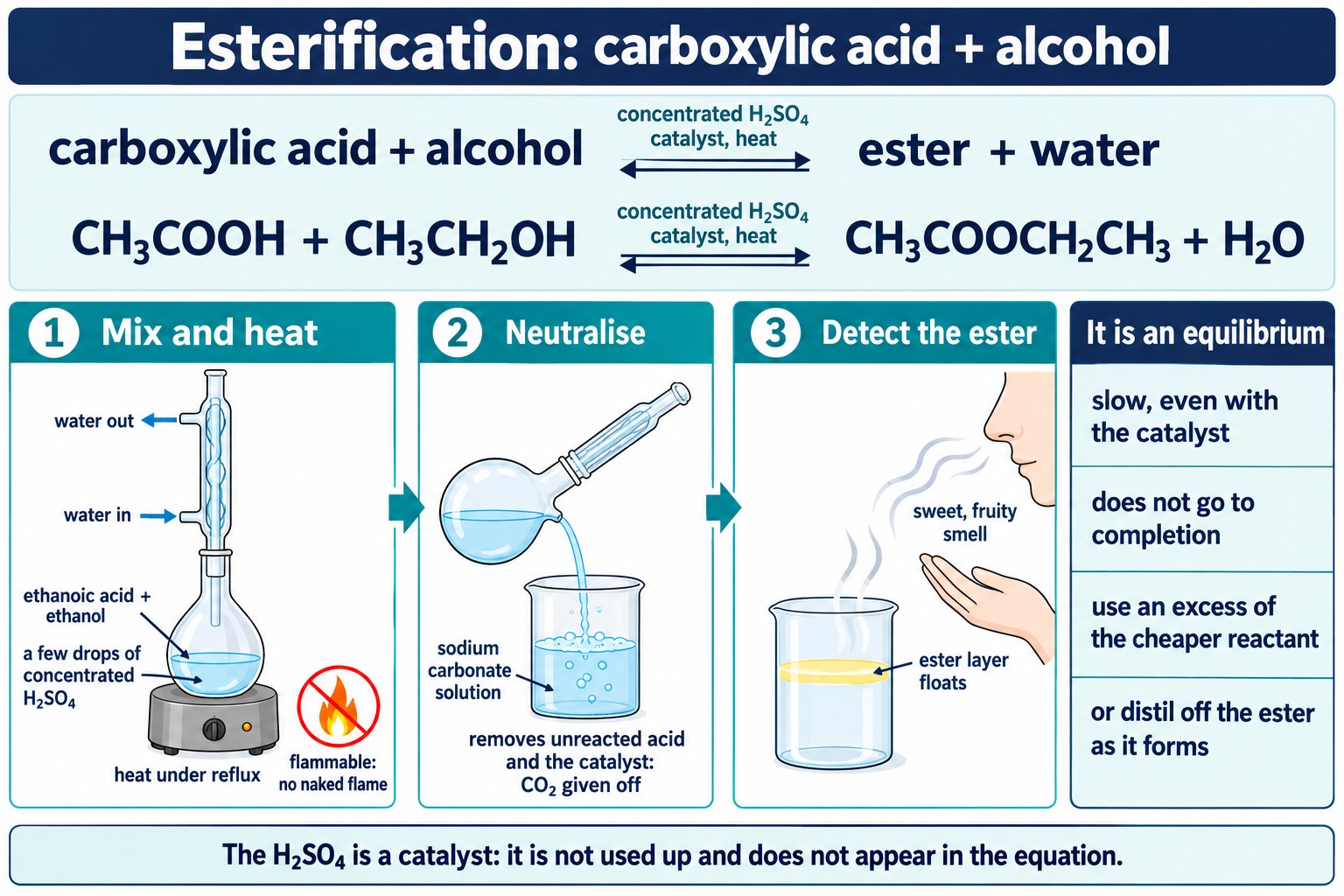
Making an ester: heating the acid and alcohol with a concentrated sulfuric acid catalyst, neutralising with sodium carbonate solution, and detecting the ester by its smell.
Worked example
Name the ester formed from propanoic acid and methanol, and write the equation.
Step 1. The alcohol gives the first word: methanol gives methyl.
Step 2. The acid gives the second word: propanoic acid gives propanoate.
Answer. Methyl propanoate: CH₃CH₂COOH + CH₃OH ⇌ CH₃CH₂COOCH₃ + H₂O
An ester is made faster, and in a reaction that goes to completion, from an acyl chloride and an alcohol: see Acyl Chlorides.
Check: Esterification
Name the ester, give the conditions and write the equation for acid and alcohol pairs not used on this page, and work back from an ester to the acid and alcohol that made it.
Quick Check: Making and Purifying a New Ester
Pick the one accurate statement in each set, using esters that are new to this page.
Reduction to a Primary Alcohol
A carboxylic acid is reduced to a primary alcohol by lithium tetrahydridoaluminate(III), LiAlH₄ (lithium aluminium hydride), in dry ether (ethoxyethane). [H] stands for the reducing agent.
CH₃COOH + 4[H] → CH₃CH₂OH + H₂O
- The ether must be dry because LiAlH₄ reacts violently with water.
- An aldehyde forms first, but it is reduced at once and cannot be isolated.
- Reduction is the reverse of the oxidation that makes the acid: primary alcohol → aldehyde → carboxylic acid.
- NaBH₄ is not a powerful enough reducing agent: it reduces aldehydes and ketones but not carboxylic acids.
Exam focus: Balance with 4[H]: two hydrogen atoms add to the carbon and two remove the oxygen as water. Quote both the reagent, LiAlH₄, and the solvent, dry ether.
Making Acyl Chlorides
The –OH of the carboxyl group can be replaced by a chlorine atom. The product is an acyl chloride, RCOCl, a far more reactive compound studied on Acyl Chlorides.
| Reagent | Equation | Notes |
|---|---|---|
| phosphorus(V) chloride, PCl₅ | CH₃COOH + PCl₅ → CH₃COCl + POCl₃ + HCl | solid PCl₅, room temperature; misty (steamy) fumes of HCl |
| phosphorus(III) chloride, PCl₃ | 3CH₃COOH + PCl₃ → 3CH₃COCl + H₃PO₃ | heat; no HCl is formed |
| sulfur dichloride oxide, SOCl₂ | CH₃COOH + SOCl₂ → CH₃COCl + SO₂ + HCl | both other products are gases, so the acyl chloride is easy to purify |
- The product from ethanoic acid is ethanoyl chloride, CH₃COCl.
- The reagents and apparatus must be dry: the acyl chloride reacts with water.
- HCl fumes turn damp blue litmus paper red and give white smoke with ammonia gas.
- Misty fumes with PCl₅ are a test for an –OH group, so alcohols give the same result as carboxylic acids.
Remember: All three reagents swap –OH for –Cl. Learn the other products: POCl₃ and HCl with PCl₅, H₃PO₃ with PCl₃, SO₂ and HCl with SOCl₂.
Quick Check: Applying PCl₅ to a Dicarboxylic Acid
Use the acyl chloride equation on an acid with two functional groups.
Further Oxidation of Methanoic Acid and Ethanedioic Acid
Most carboxylic acids resist oxidation. Two are exceptions, and both are oxidised to carbon dioxide.
Methanoic acid
The molecule HCOOH contains an H–C=O unit, like an aldehyde, so it is oxidised by the same mild oxidising agents.
HCOOH + [O] → CO₂ + H₂O
| Oxidising agent | What is seen |
|---|---|
| Fehling’s solution, warm | blue solution gives a red precipitate of Cu₂O |
| Tollens’ reagent, warm | silver mirror |
| acidified KMnO₄ | purple solution turns colourless |
| acidified K₂Cr₂O₇ | orange solution turns green |
Ethanedioic acid
Ethanedioic acid, HOOCCOOH, is oxidised by warm acidified KMnO₄. The purple colour fades to colourless as Mn²⁺ forms.
HOOCCOOH + [O] → 2CO₂ + H₂O
2MnO₄⁻ + 5H₂C₂O₄ + 6H⁺ → 2Mn²⁺ + 10CO₂ + 8H₂O
Key idea: Methanoic acid and ethanedioic acid are reducing agents. Each is oxidised to CO₂; other carboxylic acids, such as ethanoic acid, are not oxidised by these reagents.
Summary of the Reactions
| Reagent | Conditions | Organic product | Type of reaction |
|---|---|---|---|
| NaOH(aq) | room temperature | carboxylate salt, RCOONa | neutralisation |
| Na₂CO₃ or NaHCO₃ | room temperature | carboxylate salt (and CO₂) | neutralisation |
| Mg | room temperature | carboxylate salt (and H₂) | redox |
| alcohol, R′OH | concentrated H₂SO₄ catalyst, heat | ester, RCOOR′ | esterification |
| LiAlH₄ | dry ether | primary alcohol, RCH₂OH | reduction |
| PCl₅ | room temperature, dry | acyl chloride, RCOCl | substitution of –OH by –Cl |
| PCl₃ | heat, dry | acyl chloride, RCOCl | substitution of –OH by –Cl |
| SOCl₂ | dry | acyl chloride, RCOCl | substitution of –OH by –Cl |
Common Exam Points
Say
- “Effervescence with sodium carbonate; the gas turns limewater cloudy.”
- “Concentrated sulfuric acid acts as a catalyst” for esterification.
- “LiAlH₄ in dry ether” for the reduction to a primary alcohol.
Do not say
- “Carbon dioxide is seen” (say effervescence, bubbles or fizzing: the observation, not the name).
- “Esterification goes to completion” (it is an equilibrium).
- “Sodium ethanoate is CH₃COOHNa” (the acidic hydrogen is replaced: CH₃COONa).
Watch for
- Balancing: two moles of a carboxylic acid react with one mole of a carbonate, of magnesium or of a metal oxide.
- Salts of 2+ ions: (CH₃COO)₂Mg needs brackets and a subscript 2.
- Ester names: the alcohol part comes first, even though the acid part is written first in the formula.
- Acyl chloride equations: include every inorganic product.
Check: Reactions of Carboxylic Acids
Predict products, choose reagents and conditions, and describe observations for reactions of carboxylic acids, in sequences and with compounds not used on this page.
FAQs
Use these quick answers to check the reactions of carboxylic acids.
How can I test for a carboxylic acid?
Add sodium carbonate or sodium hydrogencarbonate. A carboxylic acid gives effervescence of carbon dioxide: 2CH₃COOH + Na₂CO₃ → 2CH₃COONa + H₂O + CO₂. Alcohols are much weaker acids and give no reaction with carbonates.
What salts do carboxylic acids form?
With bases they give salts ending in -oate. Ethanoic acid and sodium hydroxide give sodium ethanoate: CH₃COOH + NaOH → CH₃COONa + H₂O. The ionic equation is CH₃COOH + OH⁻ → CH₃COO⁻ + H₂O, because the weak acid is mostly undissociated.
Why is concentrated sulfuric acid used in esterification?
It is the catalyst for the reaction between a carboxylic acid and an alcohol, which is slow and reversible: CH₃COOH + CH₃CH₂OH ⇌ CH₃COOCH₂CH₃ + H₂O. The mixture is heated under reflux and reaches equilibrium rather than going to completion.
Why is the yield of ester never 100%?
Esterification is reversible, so the mixture reaches an equilibrium that still contains carboxylic acid and alcohol. Using an excess of one reactant shifts the position of equilibrium towards the ester and water, but the reaction never goes to completion.
How is a carboxylic acid reduced?
Use LiAlH₄ in dry ether, followed by dilute acid. The carboxylic acid is reduced all the way to a primary alcohol: CH₃COOH + 4[H] → CH₃CH₂OH + H₂O. The reaction does not stop at the aldehyde.

Copyright notice: This OLS revision content, including the explanations, layout, diagrams, tables and embedded learning structure, is authored for Online Learning System by Dr. Mohammed Al-Fatah. It may not be copied, reproduced, redistributed or adapted without written permission.
Keep this note — free
Save your progress across every Cambridge topic. A free account remembers which topics you have covered, saves your question scores, and syncs across your phone and laptop.
- Track every topic you have finished
- Keep your practice-question scores
- No payment, no card, free forever
Already registered? Log in