Acyl Chlorides
A concise revision guide to acyl chlorides: naming and structure, why they are so reactive, their reactions with water, alcohols, ammonia and amines, and the nucleophilic addition–elimination mechanism.
- 33.2.1(a)-i
- 33.2.1(a)-ii
- 33.3.2(a)
- 33.3.2(b)
- 33.3.2(c)
- 33.3.2(d)
- 33.3.2(e)
- 33.3.3
- 33.3.4
What these spec points say
- 33.2.1(a)-i recall the reaction by which esters can be produced: reaction of alcohols with acyl chlorides using the formation of ethyl ethanoate as an example
- 33.2.1(a)-ii recall the reaction by which esters can be produced: reaction of alcohols with acyl chlorides using the formation of phenyl benzoate as an example
- 33.3.2(a) describe the hydrolysis of acyl chlorides on addition of water at room temperature to give the carboxylic acid and HCl
- 33.3.2(b) describe the reaction of acyl chlorides with an alcohol at room temperature to produce an ester and HCl
- 33.3.2(c) describe the reaction of acyl chlorides with phenol at room temperature to produce an ester and HCl
- 33.3.2(d) describe the reaction of acyl chlorides with ammonia at room temperature to produce an amide and HCl
- 33.3.2(e) describe the reaction of acyl chlorides with a primary or secondary amine at room temperature to produce an amide and HCl
- 33.3.3 describe the addition–elimination mechanism of acyl chlorides in reactions in 33.3.2(a)–(e)
- 33.3.4 explain the relative ease of hydrolysis of acyl chlorides, alkyl chlorides and halogenoarenes (aryl chlorides)
Acyl Chlorides: Addition then Elimination
See why ethanoyl chloride is so reactive: a water molecule adds to its very δ+ carbon, the chloride ion is pushed out, and HCl is lost; then the same two steps with alcohols, ammonia and amines.
© Dr. Mohammed Al-Fatah – onlinelearningsystem.net
Before You Start
Acyl chlorides are derivatives of carboxylic acids, so this page builds on Reactions of Carboxylic Acids. The esters they make are covered on Esters and Their Hydrolysis.
GCSE Recap: Carboxylic Acids and Esters
Three quick questions on the GCSE ideas this page builds on.
Structure and Naming of Acyl Chlorides
An acyl chloride has the functional group –COCl: the –OH of a carboxylic acid is replaced by a chlorine atom. The general formula is RCOCl.
Naming
Take the name of the parent carboxylic acid and change -oic acid to -oyl chloride. The –COCl carbon is carbon 1.
| Parent acid | Acyl chloride | Structural formula |
|---|---|---|
| ethanoic acid | ethanoyl chloride | CH₃COCl |
| propanoic acid | propanoyl chloride | CH₃CH₂COCl |
| 2-methylpropanoic acid | 2-methylpropanoyl chloride | (CH₃)₂CHCOCl |
| benzoic acid | benzoyl chloride | C₆H₅COCl |
Acyl chlorides are made from the carboxylic acid and PCl₃ and heat, PCl₅ or SOCl₂, as shown on Reactions of Carboxylic Acids.
Why acyl chlorides are so reactive
- The carbonyl carbon is bonded to two very electronegative atoms, oxygen and chlorine.
- Both pull electron density away from it, so the carbon is strongly δ+.
- Nucleophiles, species with a lone pair to donate, are strongly attracted to this carbon.
- The chlorine leaves easily as a chloride ion, Cl⁻, so it is replaced by the nucleophile.
The reactions are fast at room temperature. Acyl chlorides even react with moisture in the air, giving misty fumes of hydrogen chloride, so they are stored and used dry.
Key idea: In every reaction on this page the Cl of –COCl is replaced by the nucleophile and HCl is formed. The acyl group, RCO–, stays intact.
Check: Naming Acyl Chlorides and Explaining Their Reactivity
Name acyl chlorides, work out their formulae and explain why the –COCl carbon is attacked by nucleophiles, using compounds not used on this page.
Reactions With Water, Alcohols, Ammonia and Amines
Water, alcohols, ammonia and amines are all nucleophiles: each has a lone pair on an oxygen or nitrogen atom. All four react vigorously with an acyl chloride at room temperature.
| Nucleophile | Equation | Organic product |
|---|---|---|
| water | CH₃COCl + H₂O → CH₃COOH + HCl | ethanoic acid (carboxylic acid) |
| ethanol | CH₃COCl + CH₃CH₂OH → CH₃COOCH₂CH₃ + HCl | ethyl ethanoate (ester) |
| concentrated ammonia | CH₃COCl + NH₃ → CH₃CONH₂ + HCl | ethanamide (primary amide) |
| methylamine | CH₃COCl + CH₃NH₂ → CH₃CONHCH₃ + HCl | N-methylethanamide (N-substituted, or secondary, amide) |
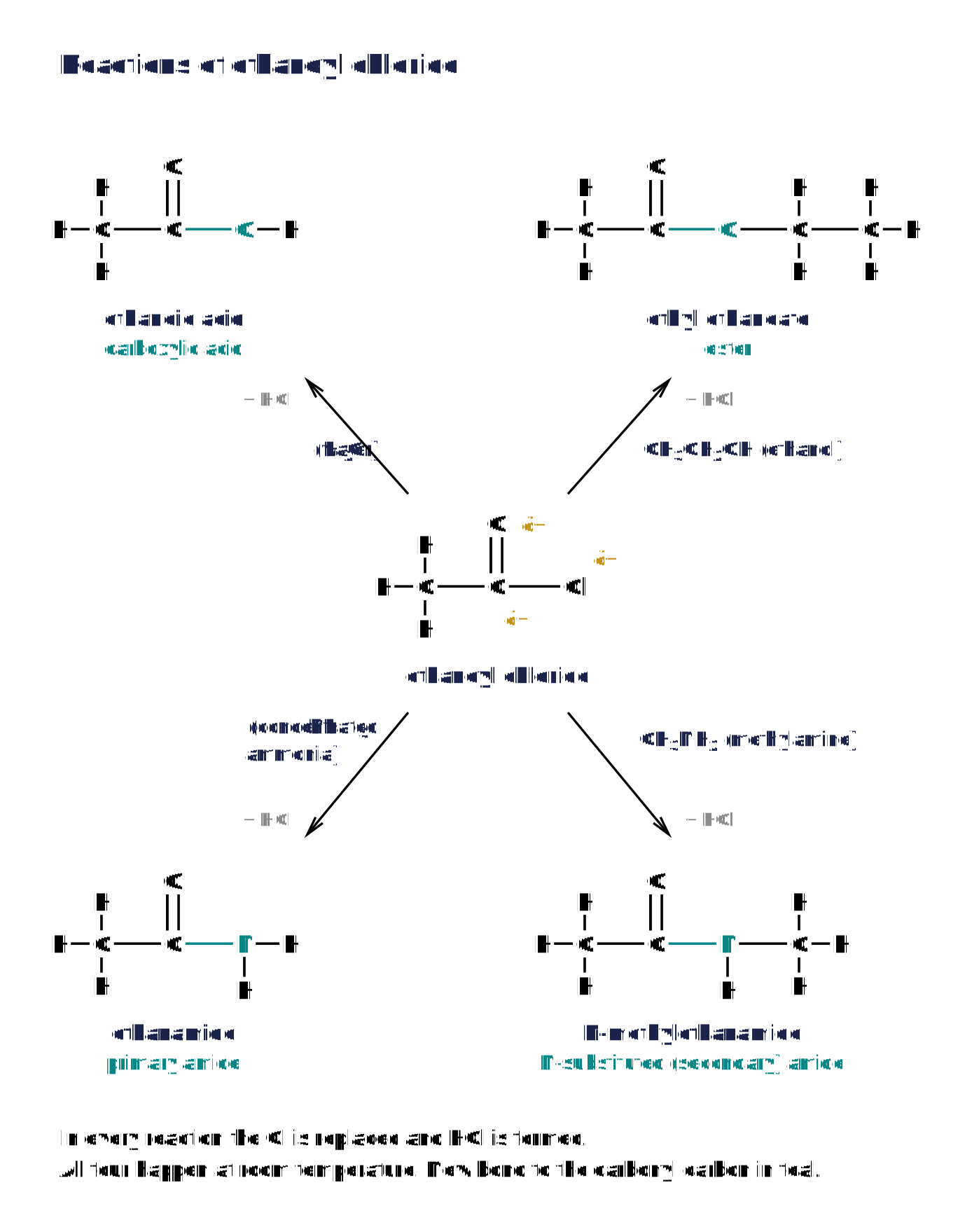
Ethanoyl chloride and its four products. In each reaction the chlorine atom is replaced and hydrogen chloride is lost.
What is seen
- Each reaction is vigorous and exothermic, and gives misty (steamy) fumes of HCl.
- The reaction with water is a hydrolysis.
- With ammonia or an amine, white smoke or a white solid also forms.
Excess ammonia or amine
Ammonia and amines are bases, so they react with the HCl produced and form a salt. With an excess the overall equations are:
CH₃COCl + 2NH₃ → CH₃CONH₂ + NH₄Cl
CH₃COCl + 2CH₃NH₂ → CH₃CONHCH₃ + CH₃NH₃Cl
Naming the amides
- A primary amide, RCONH₂, has the ending -amide: ethanamide, propanamide.
- An N-substituted amide (a secondary amide), RCONHR′, names the group on nitrogen first, after the letter N: N-methylethanamide.
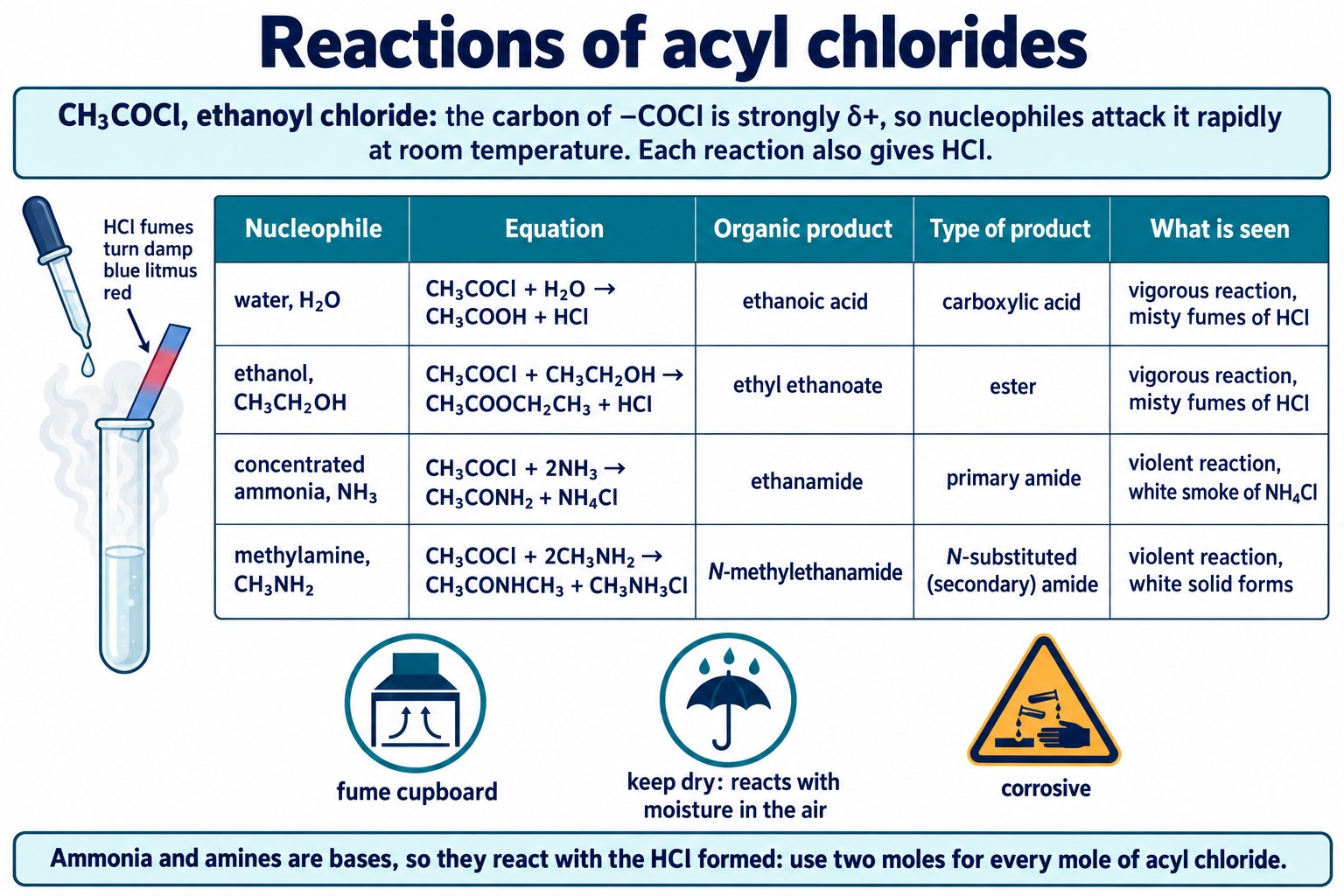
The four reactions of ethanoyl chloride at room temperature: equations, the type of organic product and the observations, with the safety precautions needed.
Worked example
Write the equation for the reaction of propanoyl chloride with methanol and name the organic product.
Check: Products of Acyl Chloride Reactions
Predict and name the organic product, and write the equation, for acyl chlorides reacting with water, alcohols, ammonia and amines not used on this page.
Acyl Chlorides in Synthesis
An ester can be made from an alcohol in two ways. The acyl chloride route is usually the better laboratory method.
| Carboxylic acid + alcohol | Acyl chloride + alcohol | |
|---|---|---|
| Equation | CH₃COOH + CH₃CH₂OH ⇌ CH₃COOCH₂CH₃ + H₂O | CH₃COCl + CH₃CH₂OH → CH₃COOCH₂CH₃ + HCl |
| Reversible? | yes: an equilibrium | no: goes to completion |
| Rate | slow | fast |
| Conditions | concentrated H₂SO₄ catalyst and heat | room temperature, no catalyst |
| Yield | limited by the equilibrium | high |
| Drawback | low yield | HCl fumes are corrosive; must be kept dry |
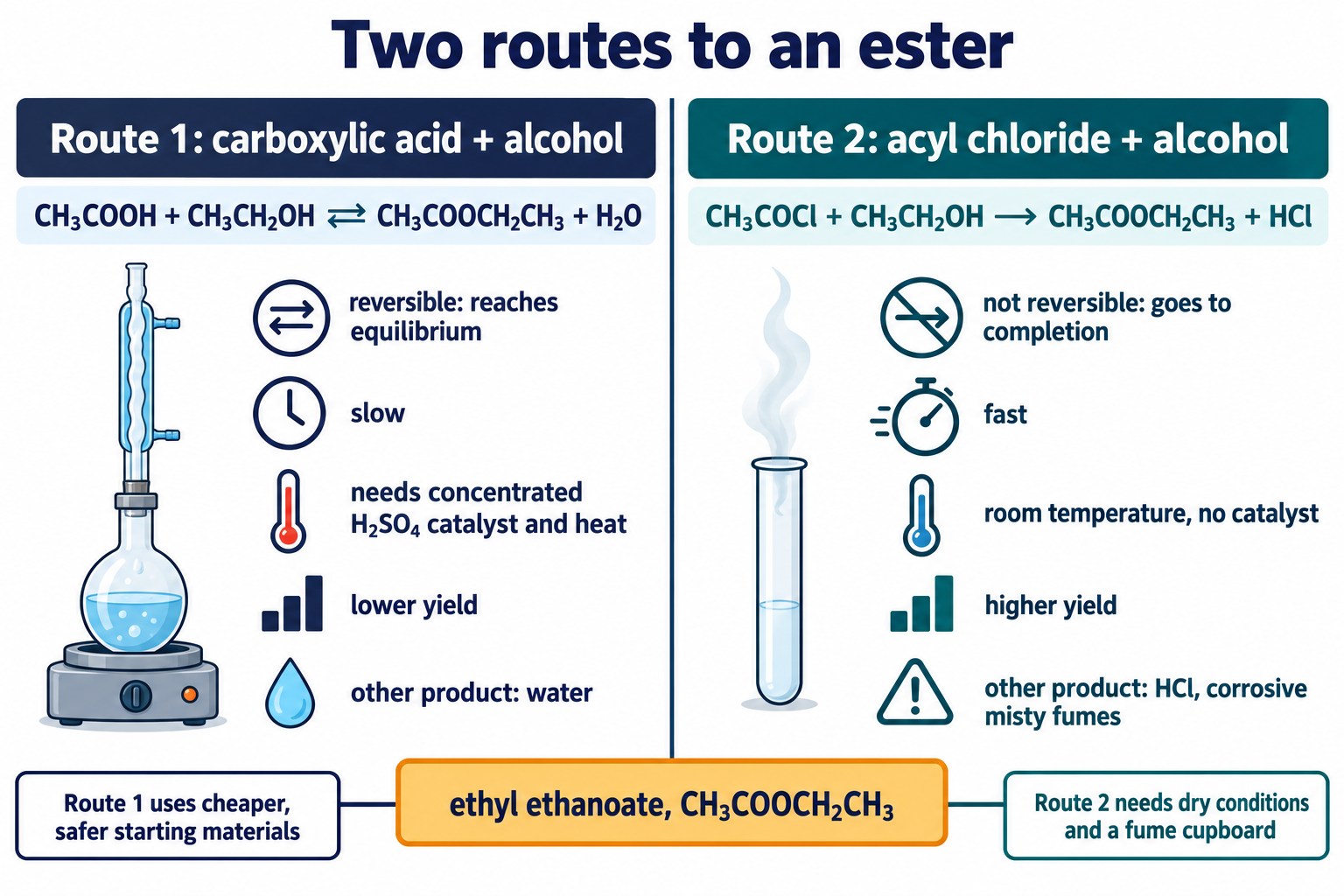
Two routes to ethyl ethanoate compared: the slow, reversible reaction of ethanoic acid with ethanol, and the fast, complete reaction of ethanoyl chloride with ethanol.
- Acyl chlorides are also the standard way to make amides. A carboxylic acid and ammonia only form a salt at room temperature.
- A typical two-step synthesis: carboxylic acid → acyl chloride → ester or amide.
- Work in a fume cupboard with dry apparatus.
Exam wording: “The reaction of an acyl chloride with an alcohol is not reversible and is faster, so it gives a higher yield of ester than the reaction of a carboxylic acid with an alcohol.”
Quick Check: Amide Product and Mass of Amine
Name the product, then work out how much amine the reaction really uses.
The Nucleophilic Addition–Elimination Mechanism
All four reactions follow the same mechanism: nucleophilic addition–elimination. The nucleophile adds to the C=O carbon, then HCl is eliminated.
Addition
- A lone pair on the nucleophile (the O of water or an alcohol, the N of ammonia or an amine) attacks the δ+ carbon.
- At the same time the π pair of the C=O bond moves on to the oxygen.
- The intermediate has a negatively charged oxygen, O⁻, and a positively charged O or N where the nucleophile joined.
Elimination
- A lone pair on the O⁻ moves back to re-form the C=O double bond.
- The C–Cl bond breaks and both of its electrons leave with the chlorine as Cl⁻.
- The positively charged O or N loses H⁺, as the pair of electrons in an O–H or N–H bond moves on to it.
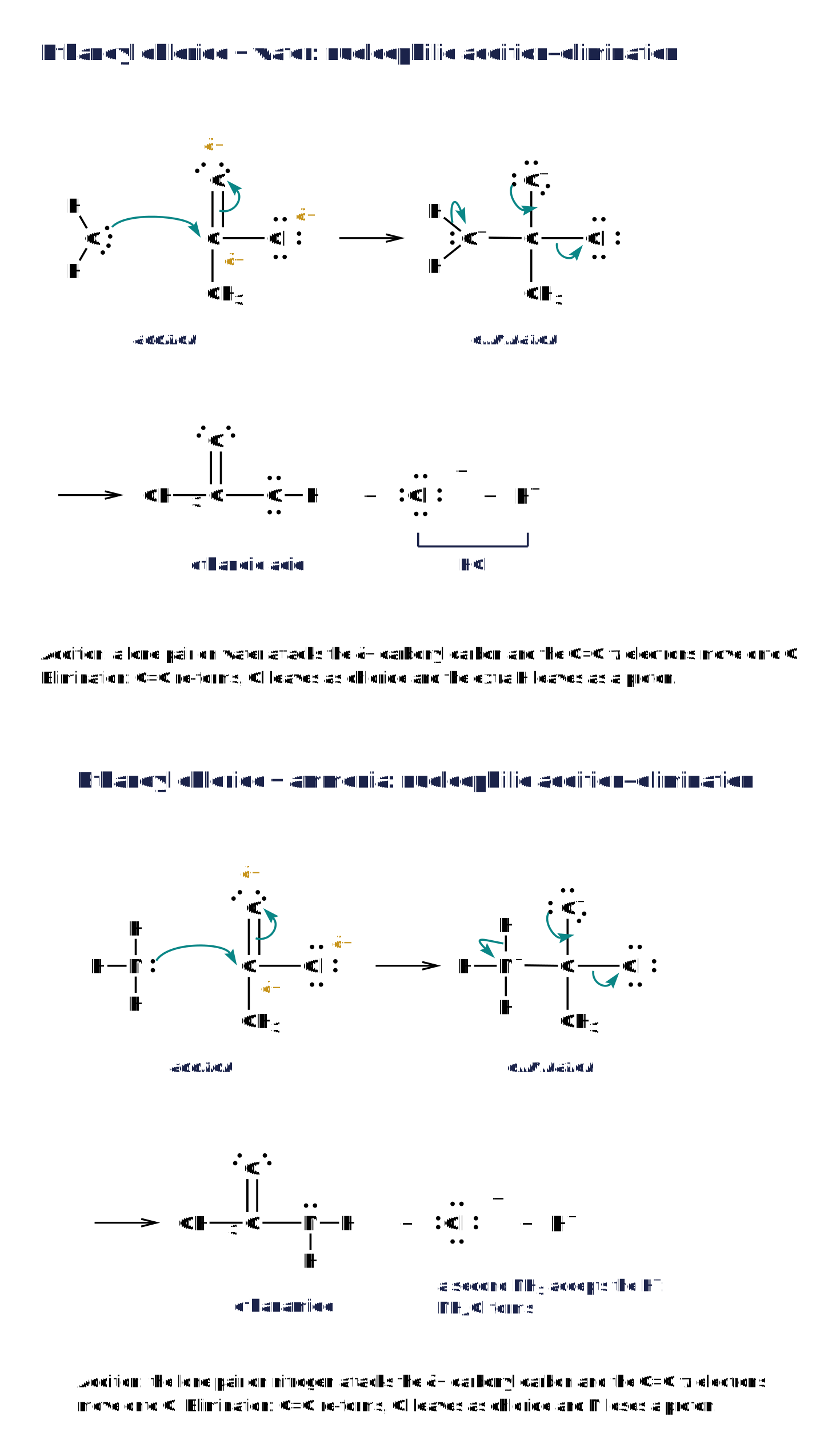
Nucleophilic addition–elimination of ethanoyl chloride with water and with ammonia: the lone pair attacks the δ+ carbon, then C=O re-forms as Cl⁻ and H⁺ are lost.
- With water the products are ethanoic acid and HCl.
- With ammonia the H⁺ is removed by a second ammonia molecule, giving NH₄⁺Cl⁻.
- Every curly arrow starts at a lone pair or at a bond, and each shows the movement of a pair of electrons.
Exam focus: Six things earn the marks: the lone pair on the nucleophile, the arrow to the δ+ carbon, the arrow from C=O to O, the charged intermediate, the arrows that re-form C=O and release Cl⁻, and the arrow showing loss of H⁺ from the O⁺ or N⁺.
Phenyl Esters, Secondary Amines and Ease of Hydrolysis
Esters of phenol
Phenol reacts too slowly with carboxylic acids to make an ester that way. With an acyl chloride it reacts at room temperature to give a phenyl ester.
C₆H₅OH + C₆H₅COCl → C₆H₅COOC₆H₅ + HCl
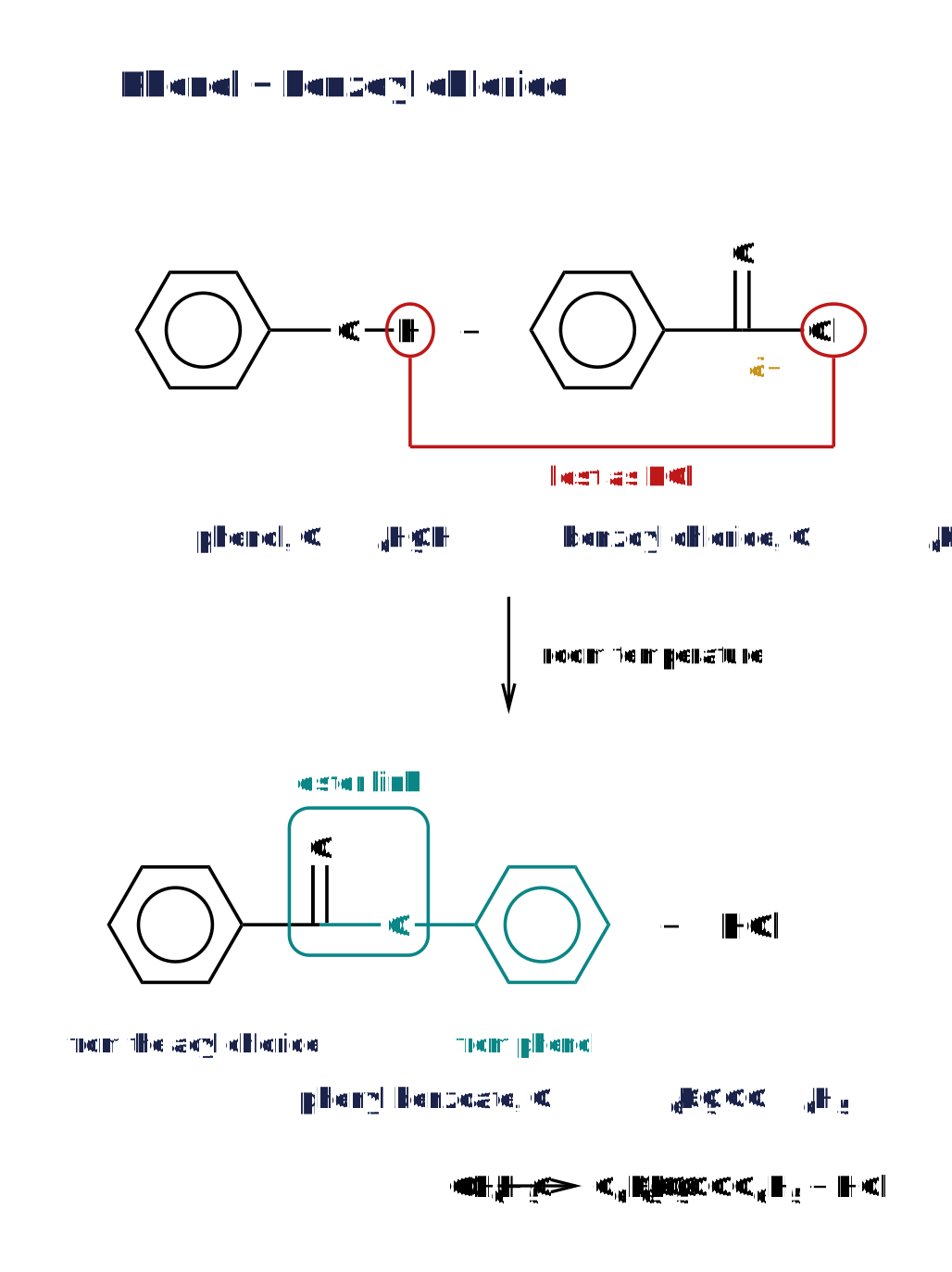
Phenol and benzoyl chloride forming phenyl benzoate and hydrogen chloride. The O–H hydrogen of phenol and the chlorine of the acyl chloride are lost.
Secondary amines
A secondary amine still has one N–H bond, so it also reacts, giving an amide with two groups on the nitrogen atom.
CH₃COCl + (CH₃)₂NH → CH₃CON(CH₃)₂ + HCl
Relative ease of hydrolysis
acyl chloride > alkyl chloride > aryl chloride
| Compound | Hydrolysis | Reason |
|---|---|---|
| ethanoyl chloride, CH₃COCl | rapid with cold water | carbon bonded to both O and Cl, so it is very strongly δ+ |
| chloroethane, CH₃CH₂Cl | slow; needs hot NaOH(aq) under reflux | carbon bonded to one electronegative atom only, so it is less δ+ |
| chlorobenzene, C₆H₅Cl | none under normal laboratory conditions | a lone pair on Cl overlaps with the ring π system, strengthening the C–Cl bond |
- In chlorobenzene the C–Cl bond has some double-bond character, so it is shorter and harder to break.
- The electron-rich benzene ring also repels an approaching nucleophile.
Common Exam Points
Say
- “Misty fumes of hydrogen chloride are given off.”
- “The carbon atom is strongly δ+ because it is bonded to two electronegative atoms, O and Cl.”
- “With excess ammonia the products are the amide and ammonium chloride.”
Do not say
- “Chlorine gas is given off” (the gas is hydrogen chloride, HCl).
- “The reaction with an alcohol needs an acid catalyst” (no catalyst and no heating are needed).
- “Ethanoyl chloride dissolves in water” (it reacts with water: it is hydrolysed).
Watch for
- Amide formulae: –CONH₂ for a primary amide, –CONH– for an N-substituted amide.
- Balancing with excess ammonia or amine: two moles react with each mole of acyl chloride.
- Mechanisms: the name is nucleophilic addition–elimination, and every lone pair and charge must be shown.
Check: Using Acyl Chlorides in Synthesis
Choose between routes to esters and amides, justify the choice, and describe the observations and precautions, for target compounds not used on this page.
FAQs
Use these quick answers to check acyl chlorides and their reactions.
Why are acyl chlorides so reactive?
The carbonyl carbon is bonded to two electronegative atoms, oxygen and chlorine, so it is strongly δ+ and readily attacked by nucleophiles. Chloride is also a good leaving group. Reactions are vigorous at room temperature and give misty fumes of HCl.
How are acyl chlorides named?
Replace -oic acid in the name of the parent acid with -oyl chloride. CH₃COCl is ethanoyl chloride and CH₃CH₂COCl is propanoyl chloride. The COCl carbon counts as carbon 1 of the chain.
What do acyl chlorides give with water, alcohols, ammonia and amines?
Water gives a carboxylic acid, an alcohol gives an ester, ammonia gives a primary amide and a primary amine gives an N-substituted (secondary) amide. Each reaction also forms HCl, which reacts with excess ammonia or amine to form a salt.
Why make an ester from an acyl chloride instead of a carboxylic acid?
The reaction with an alcohol is fast at room temperature, needs no catalyst and is not reversible, so it goes to completion and gives a better yield: CH₃COCl + CH₃CH₂OH → CH₃COOCH₂CH₃ + HCl.
What happens in the nucleophilic addition-elimination mechanism?
A lone pair on the nucleophile attacks the δ+ carbon and the π electrons of C=O move onto oxygen. The C=O bond then reforms, a chloride ion leaves, and the attacking atom loses H⁺.

Copyright notice: This OLS revision content, including the explanations, layout, diagrams, tables and embedded learning structure, is authored for Online Learning System by Dr. Mohammed Al-Fatah. It may not be copied, reproduced, redistributed or adapted without written permission.
Keep this note — free
Save your progress across every Cambridge topic. A free account remembers which topics you have covered, saves your question scores, and syncs across your phone and laptop.
- Track every topic you have finished
- Keep your practice-question scores
- No payment, no card, free forever
Already registered? Log in