Making Amines and Nitriles from Halogenoalkanes
A concise revision guide to two nucleophilic substitutions of halogenoalkanes: heating with ethanolic ammonia under pressure to make a primary amine, and heating under reflux with potassium cyanide in ethanol to make a nitrile with one more carbon atom, with the mechanisms, conditions, side products and the reasons behind each choice.
Recap: Nucleophilic Substitution of Halogenoalkanes
Five quick questions on what this page builds on: the δ+ carbon of a C–Br bond, the lone pair of a nucleophile, the Sₙ2 mechanism and the hydrolysis of a halogenoalkane by hydroxide ions (Nucleophilic Substitution Reactions, Topic 15 Halogen Compounds).
Amines from Halogenoalkanes
Ammonia is a nucleophile for the same reason it is a base: the lone pair on nitrogen. It attacks the δ+ carbon of a halogenoalkane and replaces the halogen with an NH₂ group.
- Change: halogenoalkane to primary amine. Bromoethane gives ethylamine: CH₃CH₂Br + 2NH₃ → CH₃CH₂NH₂ + NH₄Br.
- Reagent: concentrated ammonia dissolved in ethanol, in excess.
- Conditions: heated under pressure in a sealed tube. Ammonia is a gas at room temperature; the pressure keeps it in solution and the heat supplies the activation energy.
- Type: nucleophilic substitution. The first ammonia molecule attacks; the second removes the proton, which is why two NH₃ appear in the equation.
- Why ethanol: both the halogenoalkane and ammonia dissolve in it. Water would compete as a nucleophile and give the alcohol instead.
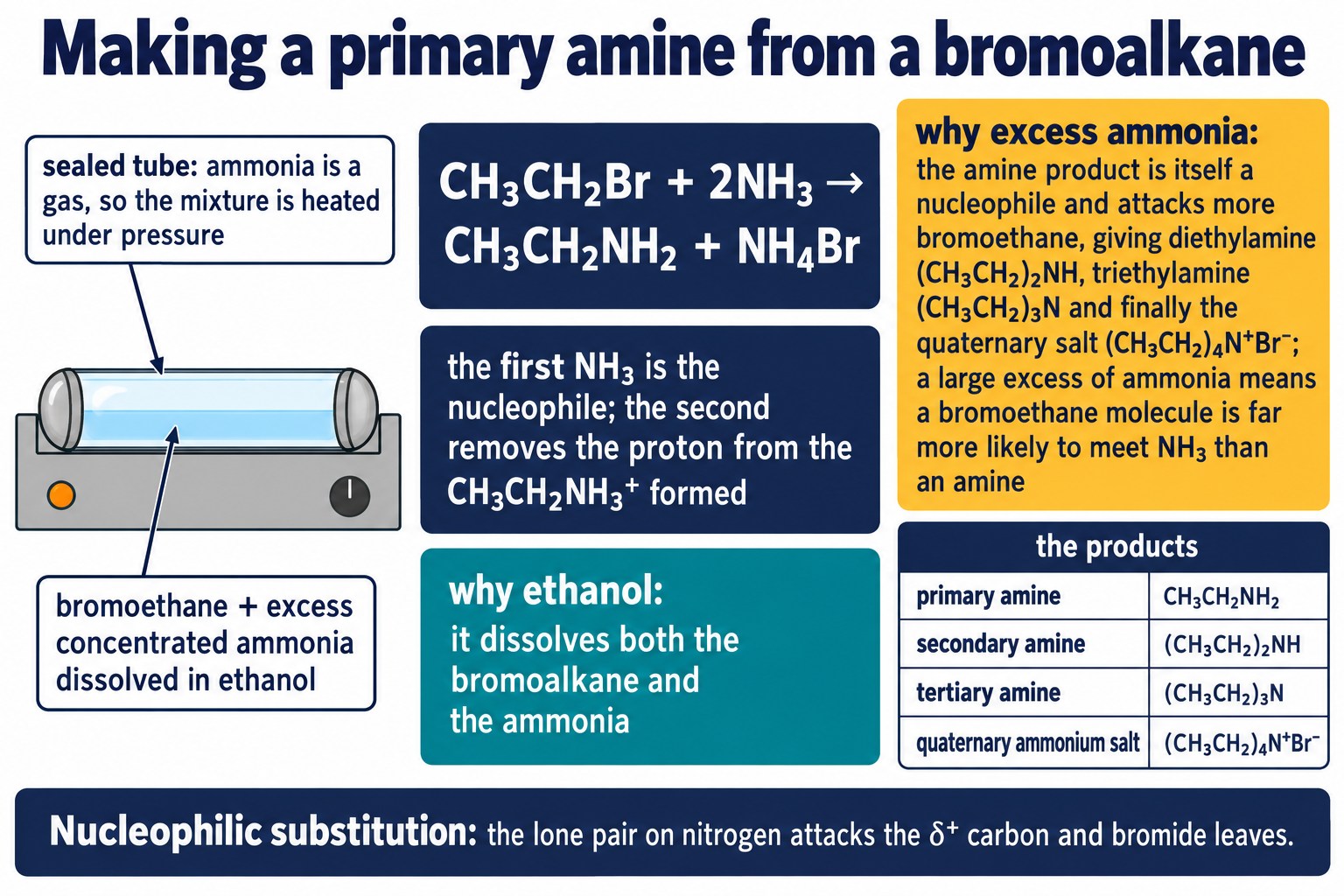
The conditions for making a primary amine as a poster: the sealed tube, excess concentrated ammonia in ethanol, heat and pressure, and the equation with its two products.
Exam focus: Three words earn the condition marks: “ethanol”, “heat” and “under pressure” (or “sealed tube”). Write 2NH₃ so that the HBr is shown as NH₄Br.
Why Excess Ammonia: Further Substitution
The amine formed still has a lone pair on nitrogen, so it is a nucleophile too, often a better one than ammonia. It can attack another molecule of the halogenoalkane.
| Product class | Example from bromoethane | How it forms |
|---|---|---|
| primary amine | ethylamine, CH₃CH₂NH₂ | NH₃ attacks CH₃CH₂Br |
| secondary amine | diethylamine, (CH₃CH₂)₂NH | CH₃CH₂NH₂ + CH₃CH₂Br → (CH₃CH₂)₂NH + HBr |
| tertiary amine | triethylamine, (CH₃CH₂)₃N | (CH₃CH₂)₂NH + CH₃CH₂Br → (CH₃CH₂)₃N + HBr |
| quaternary ammonium salt | tetraethylammonium bromide, (CH₃CH₂)₄N⁺Br⁻ | (CH₃CH₂)₃N + CH₃CH₂Br → (CH₃CH₂)₄N⁺Br⁻ |
- A large excess of ammonia means a halogenoalkane molecule is far more likely to meet NH₃ than an amine, so the primary amine dominates.
- Even so the product is a mixture, separated by fractional distillation, so the yield of pure primary amine is modest.
- A cleaner route to a primary amine reduces a nitrile with LiAlH₄ or hydrogen over nickel: Preparing Amines (A Level).
Common mistake: Saying excess ammonia “stops” further substitution. It reduces the chance of it; the correct word is “favours” or “maximises” the primary amine.
Check: Amines from Halogenoalkanes
Give the reagent and conditions for making a primary amine, name the products of further substitution, and explain the role of excess ammonia and of ethanol.
Nitriles from Halogenoalkanes
The cyanide ion is a strong nucleophile: a lone pair and a negative charge on carbon, written ⁻:C≡N. It replaces the halogen of a halogenoalkane with a C≡N group, adding one carbon to the chain.
- Change: halogenoalkane to nitrile. Bromoethane gives propanenitrile: CH₃CH₂Br + KCN → CH₃CH₂CN + KBr.
- The ionic equation shows the real nucleophile: CH₃CH₂Br + CN⁻ → CH₃CH₂CN + Br⁻.
- Reagent and conditions: potassium cyanide (or sodium cyanide) dissolved in ethanol, heated under reflux.
- Chain extension: bromoethane has two carbons, propanenitrile has three. The nitrile carbon is counted and numbered 1 in the name.
- Why ethanol: the polar solvent dissolves both ionic KCN and the halogenoalkane. In water, hydroxide and water would hydrolyse the halogenoalkane to the alcohol instead.
- Why reflux: the reaction is slow at room temperature, and the volatile halogenoalkane would otherwise escape; the condenser returns it to the flask.
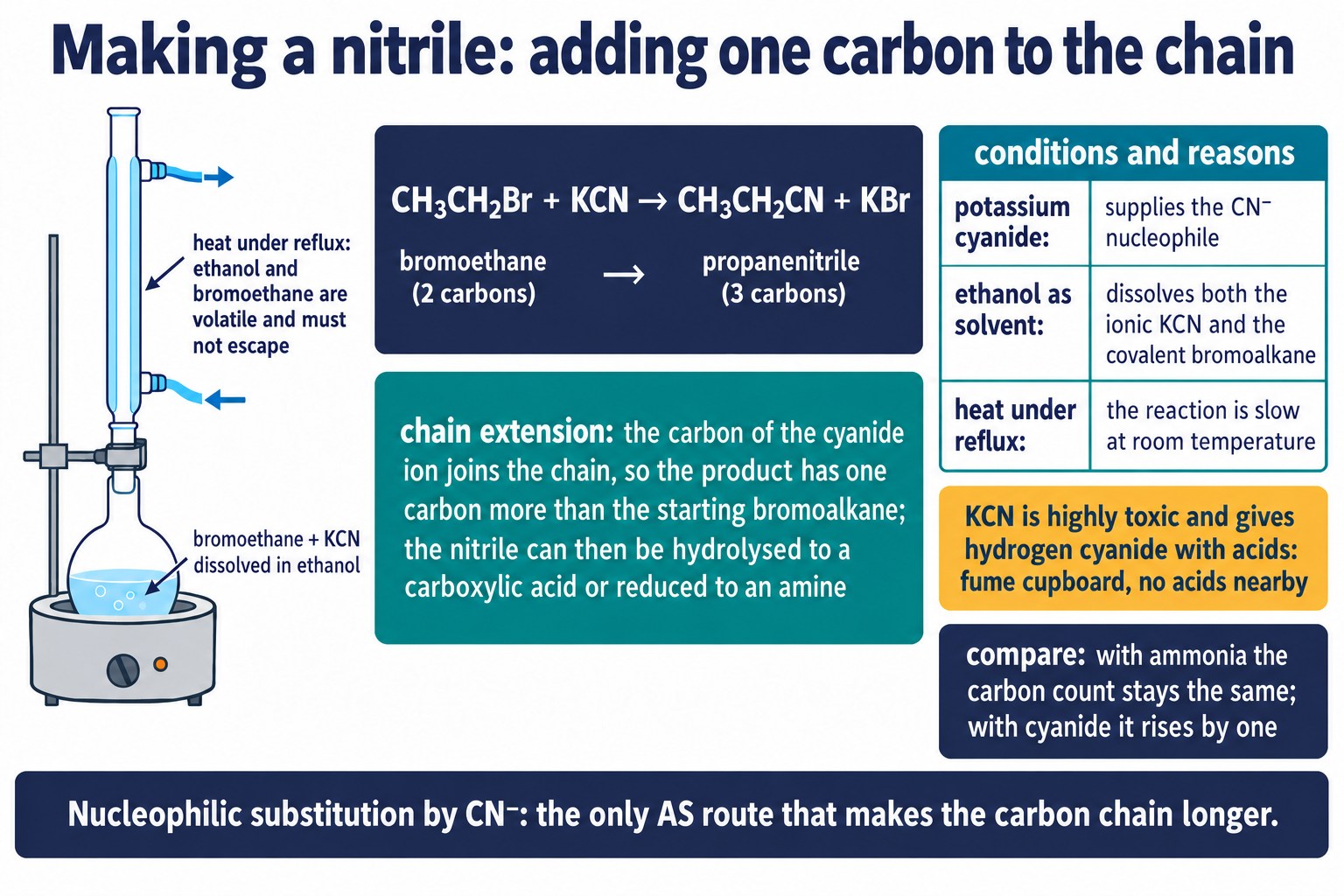
The conditions for making a nitrile as a poster: KCN in ethanol under reflux, the equation, and the carbon count rising from two to three.
Remember: The new C–C bond makes this reaction the usual way of lengthening a carbon chain by one atom (Carbon–Carbon Bond Formation). The nitrile is then hydrolysed or reduced: Hydroxynitriles and the Hydrolysis of Nitriles.
The Two Mechanisms
Both reactions follow the Sₙ2 mechanism for a primary halogenoalkane such as bromoethane: the nucleophile attacks as the leaving group leaves, in one step.
Ammonia
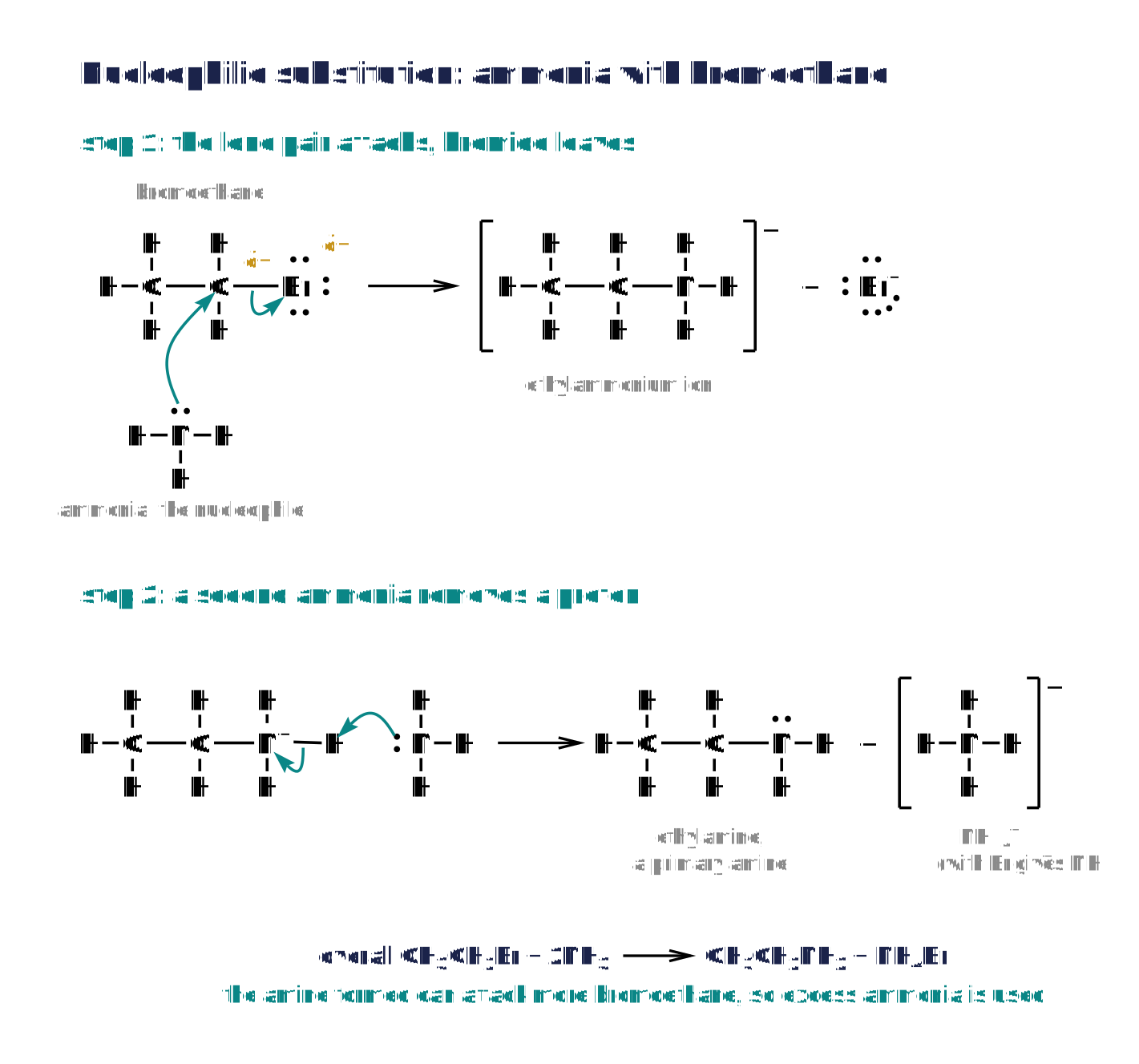
The Sₙ2 attack of ammonia on bromoethane, then the second ammonia molecule removing the proton from the ethylammonium ion.
Cyanide
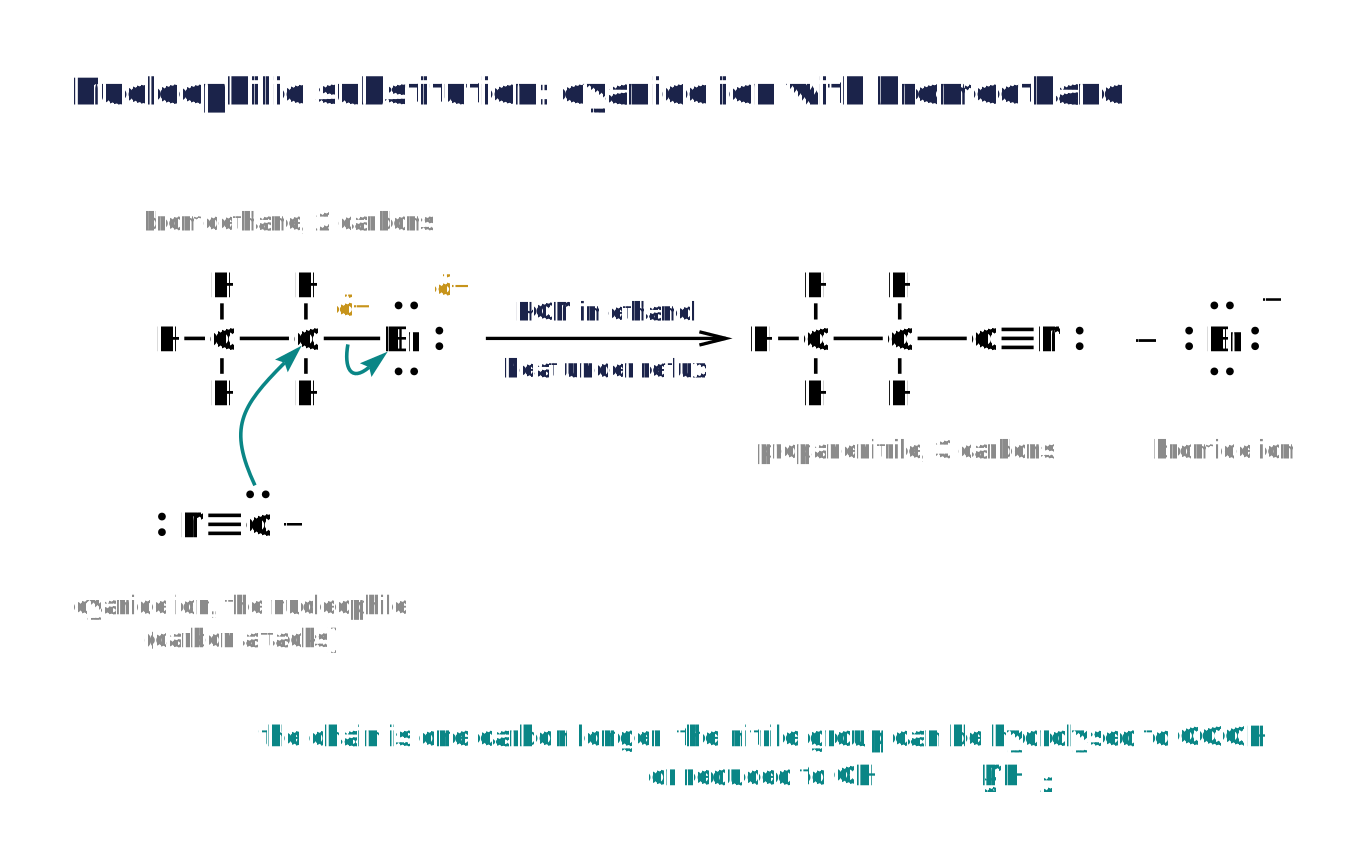
The Sₙ2 attack of the cyanide ion on bromoethane giving propanenitrile and a bromide ion.
- In both mechanisms the curly arrow starts at the lone pair of the nucleophile and ends at the δ+ carbon; a second arrow moves the C–Br electrons onto bromine.
- A tertiary halogenoalkane would react by the Sₙ1 route instead: the C–Br bond breaks first to give a carbocation that the nucleophile then attacks.
Exam focus: Draw the δ+ and δ− on the C–Br bond, the lone pair on N or C, and show the charge on the leaving bromide. For ammonia, remember the deprotonation step.
Comparing the Two Routes
The two substitutions look alike but differ in the nucleophile, the conditions and what the product is good for. Keep the differences straight.
| Feature | Ammonia route | Cyanide route |
|---|---|---|
| nucleophile | :NH₃, a neutral molecule with a lone pair | ⁻:C≡N, an anion with a lone pair on carbon |
| reagent | concentrated ammonia in ethanol, in excess | KCN (or NaCN) in ethanol |
| conditions | heat under pressure in a sealed tube | heat under reflux |
| product from bromoethane | ethylamine, CH₃CH₂NH₂ (two carbons) | propanenitrile, CH₃CH₂CN (three carbons) |
| by-products | NH₄Br, plus secondary and tertiary amines and the quaternary salt | KBr only |
| what the product is for | amines are bases and nucleophiles themselves | hydrolysis to a carboxylic acid; reduction to a primary amine |
Remember: Same carbon count with ammonia, one carbon more with cyanide. Ask “how many carbons does the target have?” before choosing the route.
Quick Check: Choosing a Clean Route
Match the carbon count of the target and keep unwanted products out.
Hazards and Handling
Both preparations use hazardous reagents, and examiners ask for the precautions as well as the chemistry.
- Potassium cyanide is highly toxic, and any acid releases hydrogen cyanide gas: keep it away from acids, work in a fume cupboard and wear gloves.
- Ammonia is a toxic, irritant gas; a sealed tube under pressure can burst, so it is heated behind a screen.
- Halogenoalkanes and ethanol are volatile and flammable: heat with a water bath or an electric heating mantle, never a naked flame.
- A reflux condenser must be open at the top; a sealed system other than the designed pressure tube would build up pressure and shatter.
Exam focus: A one-mark hazard answer names the substance and the hazard: “KCN is toxic and releases HCN with acid” or “the sealed tube is under pressure”.
Check: Nitriles and the Mechanisms
Name the nitrile made from a given bromoalkane, give the reagent and conditions, draw the Sₙ2 steps with ammonia and cyanide, and state the hazards.
Common Exam Points
- Primary amine: halogenoalkane + excess concentrated ammonia in ethanol, heated under pressure in a sealed tube: CH₃CH₂Br + 2NH₃ → CH₃CH₂NH₂ + NH₄Br.
- Excess ammonia favours the primary amine; otherwise the amine attacks again to give secondary and tertiary amines and a quaternary ammonium salt.
- Nitrile: halogenoalkane + KCN in ethanol, heated under reflux: CH₃CH₂Br + KCN → CH₃CH₂CN + KBr. The chain grows by one carbon.
- Both are nucleophilic substitutions: the lone pair on N or on the carbon of CN⁻ attacks the δ+ carbon and the halide ion leaves.
- In the ammonia mechanism a second NH₃ removes the proton from the alkylammonium ion; the cyanide mechanism needs no second step.
- Ethanol is the solvent because it dissolves both reagents; water would give the alcohol by hydrolysis instead.
- Name nitriles by counting the C≡N carbon: bromoethane gives propanenitrile, 1-bromopropane gives butanenitrile.
- Hazards: KCN is toxic and gives HCN with acid; ammonia is toxic and the tube is under pressure; use a fume cupboard and no naked flames.
FAQs
Use these quick answers to check how a halogenoalkane is converted into a primary amine with ammonia and into a nitrile with potassium cyanide, the conditions and mechanisms, why excess ammonia is used and the hazards.
What conditions do I need to make a primary amine from a halogenoalkane?
Heat the halogenoalkane with an excess of concentrated ammonia dissolved in ethanol in a sealed tube under pressure, because ammonia is a gas at the reaction temperature.
Bromoethane gives ethylamine: CH₃CH₂Br + 2NH₃ → CH₃CH₂NH₂ + NH₄Br, with the second ammonia removing the HBr formed.
Why must the ammonia be in excess?
The primary amine formed still has a lone pair on nitrogen and is itself a nucleophile, so it attacks more bromoethane to give secondary and tertiary amines and finally a quaternary ammonium salt. Excess ammonia makes bromoethane far more likely to meet ammonia.
How do I make a nitrile from a halogenoalkane, and why is it useful?
Heat the halogenoalkane under reflux with potassium cyanide dissolved in ethanol: CH₃CH₂Br + KCN → CH₃CH₂CN + KBr, giving propanenitrile. The cyanide ion is the nucleophile. The product has one more carbon atom than the starting material: the standard way to lengthen a chain.
What do the two mechanisms have in common?
Both are nucleophilic substitutions. The nucleophile, the lone pair on the nitrogen of ammonia or the carbon of the cyanide ion, attacks the δ+ carbon of the C–Br bond, and bromide leaves as the new bond forms. With ammonia a second step removes a proton.
Why is ethanol used as the solvent, and what are the hazards?
Ethanol dissolves both the reagent and the halogenoalkane, so the two can meet, and it avoids the competing hydrolysis that water would allow. Potassium cyanide is highly toxic and releases HCN with acids, and concentrated ammonia is corrosive, so a fume cupboard is essential.

Copyright notice: This OLS revision content, including the explanations, layout, diagrams, tables and embedded learning structure, is authored for Online Learning System by Dr. Mohammed Al-Fatah. It may not be copied, reproduced, redistributed or adapted without written permission.
Keep this note — free
Save your progress across every Cambridge topic. A free account remembers which topics you have covered, saves your question scores, and syncs across your phone and laptop.
- Track every topic you have finished
- Keep your practice-question scores
- No payment, no card, free forever
Already registered? Log in