Hydroxynitriles and the Hydrolysis of Nitriles
A concise revision guide to the nucleophilic addition of hydrogen cyanide to aldehydes and ketones to form hydroxynitriles, with the KCN catalyst and the mechanism, and to the hydrolysis of nitriles with dilute acid or dilute alkali followed by acidification to give carboxylic acids, with equations, conditions and the place of each step in a synthesis.
Before You Start
Two reactions of the nitrile group, C≡N, are on this page: making it by adding HCN to a carbonyl compound, and breaking it down to a carboxylic acid by hydrolysis.
- The carbonyl carbon is δ+ because oxygen is more electronegative: the basis of nucleophilic addition in Reduction and Nucleophilic Addition.
- Nitriles are also made from halogenoalkanes with KCN: Making Amines and Nitriles from Halogenoalkanes.
- The product of hydrolysis is a carboxylic acid, whose properties are in Carboxylic Acids: Structure, Properties and Preparation.
- Naming: the carbon of C≡N is carbon 1, so a hydroxynitrile from an aldehyde or ketone always has its OH on carbon 2.
Forming Hydroxynitriles
Hydrogen cyanide adds across the C=O bond of an aldehyde or a ketone. The H goes to the oxygen and the CN to the carbon, giving a 2-hydroxynitrile.
- Ethanal gives 2-hydroxypropanenitrile: CH₃CHO + HCN → CH₃CH(OH)CN.
- Propanone gives 2-hydroxy-2-methylpropanenitrile: CH₃COCH₃ + HCN → (CH₃)₂C(OH)CN.
- Reagent: hydrogen cyanide with potassium cyanide as a catalyst, or sodium cyanide with a little dilute acid to generate HCN in the flask.
- Conditions: warm gently in a fume cupboard. The reaction is a nucleophilic addition.
- The chain grows by one carbon: ethanal (two carbons) gives a three-carbon product, so the name changes from ethan- to propane-.
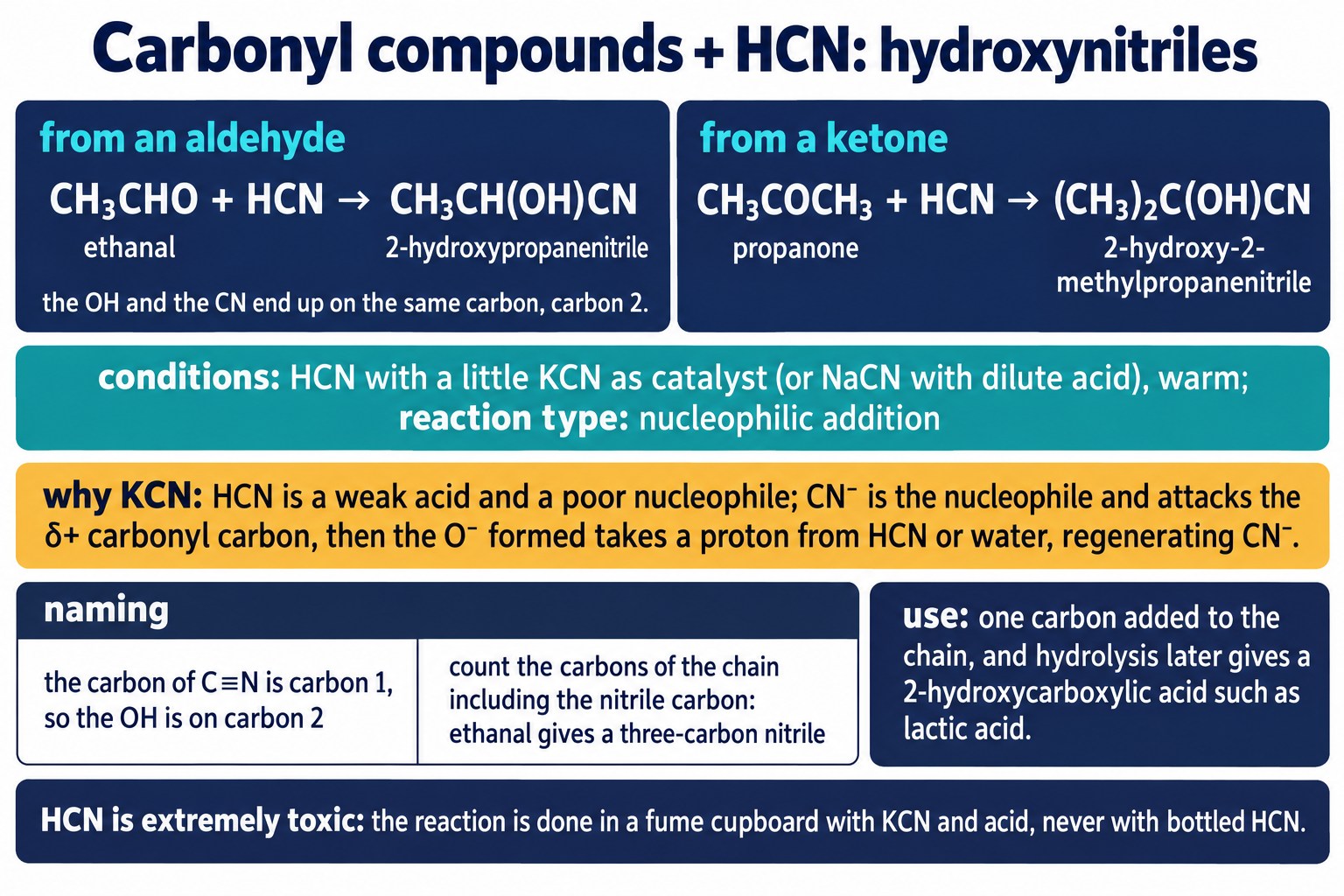
Which carbonyl compound gives which hydroxynitrile: ethanal, propanone, propanal and butanone with their products named and the carbon count written beside each.
Exam focus: Name the type of reaction and the type of reagent: nucleophilic addition by the cyanide ion. Then give the full name of the product with the 2-hydroxy prefix.
Why KCN Is Needed
The reaction is written with HCN, but the species that attacks is the cyanide ion. Potassium cyanide is there to provide it.
- HCN is a weak acid (pKₐ about 9.2), so on its own it gives very few CN⁻ ions in solution.
- The HCN molecule is a poor nucleophile: it has no negative charge, and its lone pair sits on nitrogen, not on the carbon that must form the new bond.
- KCN supplies CN⁻, a strong nucleophile with a lone pair and a full negative charge on carbon.
- After the addition, the negatively charged oxygen takes a proton from an HCN molecule, which regenerates CN⁻: the cyanide ion is used and remade, so it is a catalyst.
- Too much base would turn all the HCN into CN⁻ and leave nothing to protonate the intermediate, so a catalytic amount of KCN is best.
Remember: HCN alone: slow, because there is too little CN⁻. HCN with a little KCN: fast, because CN⁻ attacks and HCN supplies the proton.
The Mechanism: Nucleophilic Addition
The carbonyl carbon is δ+ because the C=O bond is polar. A planar carbonyl group is open to attack from above or below the plane.
Result. The trigonal planar carbonyl carbon becomes tetrahedral, bonded to OH, CN and the two groups it already carried.
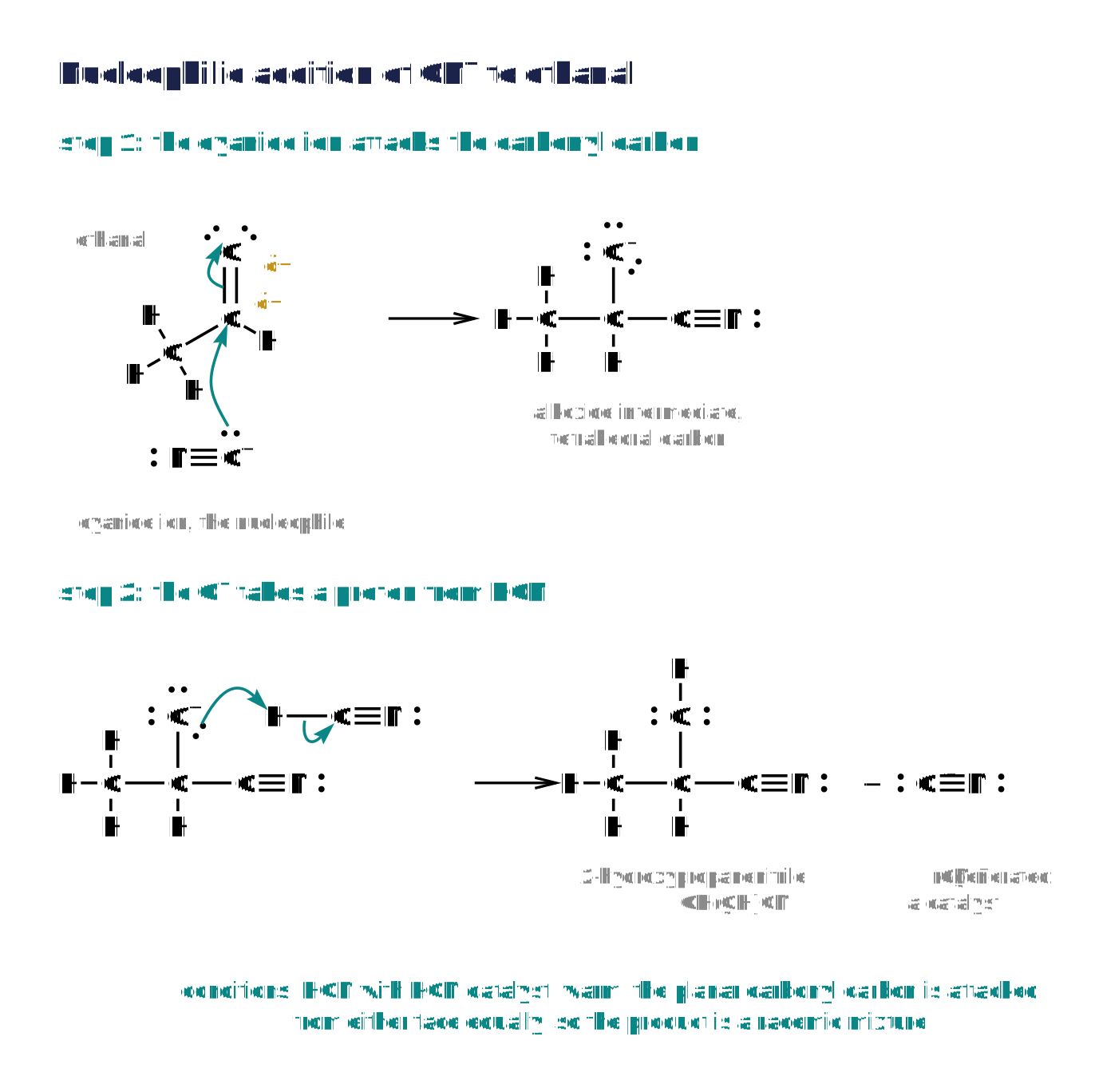
The nucleophilic addition of the cyanide ion to ethanal, then protonation of the alkoxide intermediate by HCN to give 2-hydroxypropanenitrile.
- From ethanal the new tetrahedral carbon carries H, CH₃, OH and CN: four different groups, so the product is chiral.
- CN⁻ attacks the flat carbonyl group equally from either face, so the two enantiomers form in equal amounts: a racemic mixture with no optical activity.
- From propanone the carbon carries two CH₃ groups, so 2-hydroxy-2-methylpropanenitrile is not chiral.
Common mistake: Starting the arrow from HCN or from the nitrogen of cyanide. The arrow begins at the lone pair on the carbon of CN⁻ and ends on the carbonyl carbon.
Check: Hydroxynitriles and the Mechanism
Name the hydroxynitrile from a given aldehyde or ketone, explain why KCN is added, draw the two steps of the mechanism and decide whether the product is chiral.
Quick Check: Chiral Product or Not?
Each carbonyl compound reacts with HCN and a little KCN. Decide what forms at the new tetrahedral carbon.
Hydrolysis of Nitriles with Dilute Acid
Heating a nitrile under reflux with dilute acid converts the C≡N group to a carboxylic acid. The nitrogen leaves as an ammonium ion.
- Propanenitrile gives propanoic acid: CH₃CH₂CN + 2H₂O + HCl → CH₃CH₂COOH + NH₄Cl.
- In general: RCN + 2H₂O + HCl → RCOOH + NH₄Cl, with dilute hydrochloric or sulfuric acid, heated under reflux.
- Two water molecules are needed: one gives the C=O and OH of the acid, the other supplies the hydrogens that make NH₃, which the acid turns into NH₄⁺.
- The reaction passes through the amide, CH₃CH₂CONH₂, which is hydrolysed further under the same conditions.
- The carboxylic acid is obtained directly, because the solution is already acidic.
Remember: Dilute acid: the products are the carboxylic acid and an ammonium salt. Count the carbons: the acid has the same number as the nitrile.
Hydrolysis with Dilute Alkali, then Acidification
Heating under reflux with dilute sodium hydroxide also hydrolyses the nitrile, but the product is the sodium salt of the acid and ammonia gas is given off.
- In general: RCN + H₂O + NaOH → RCOONa + NH₃, then RCOONa + HCl → RCOOH + NaCl.
- Why acidify: in alkali the acid exists as its anion, RCOO⁻. Only adding a strong acid converts the salt into the carboxylic acid itself.
- The two routes give the same acid; they differ in the fate of the nitrogen (NH₄⁺ in acid, NH₃ gas in alkali) and in the need for a second step.
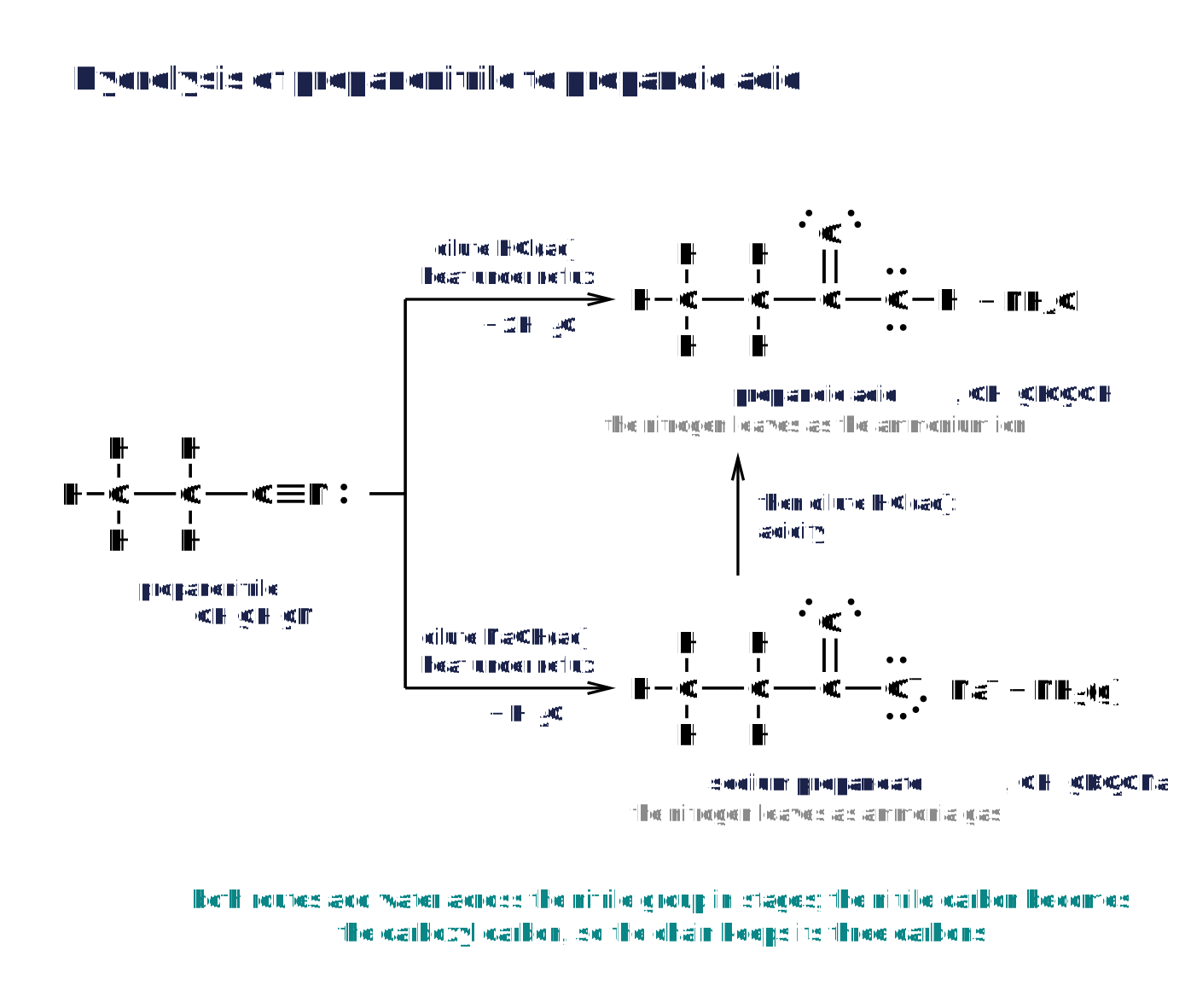
Propanenitrile hydrolysed two ways: dilute acid under reflux straight to propanoic acid, and dilute alkali under reflux to sodium propanoate followed by acidification.
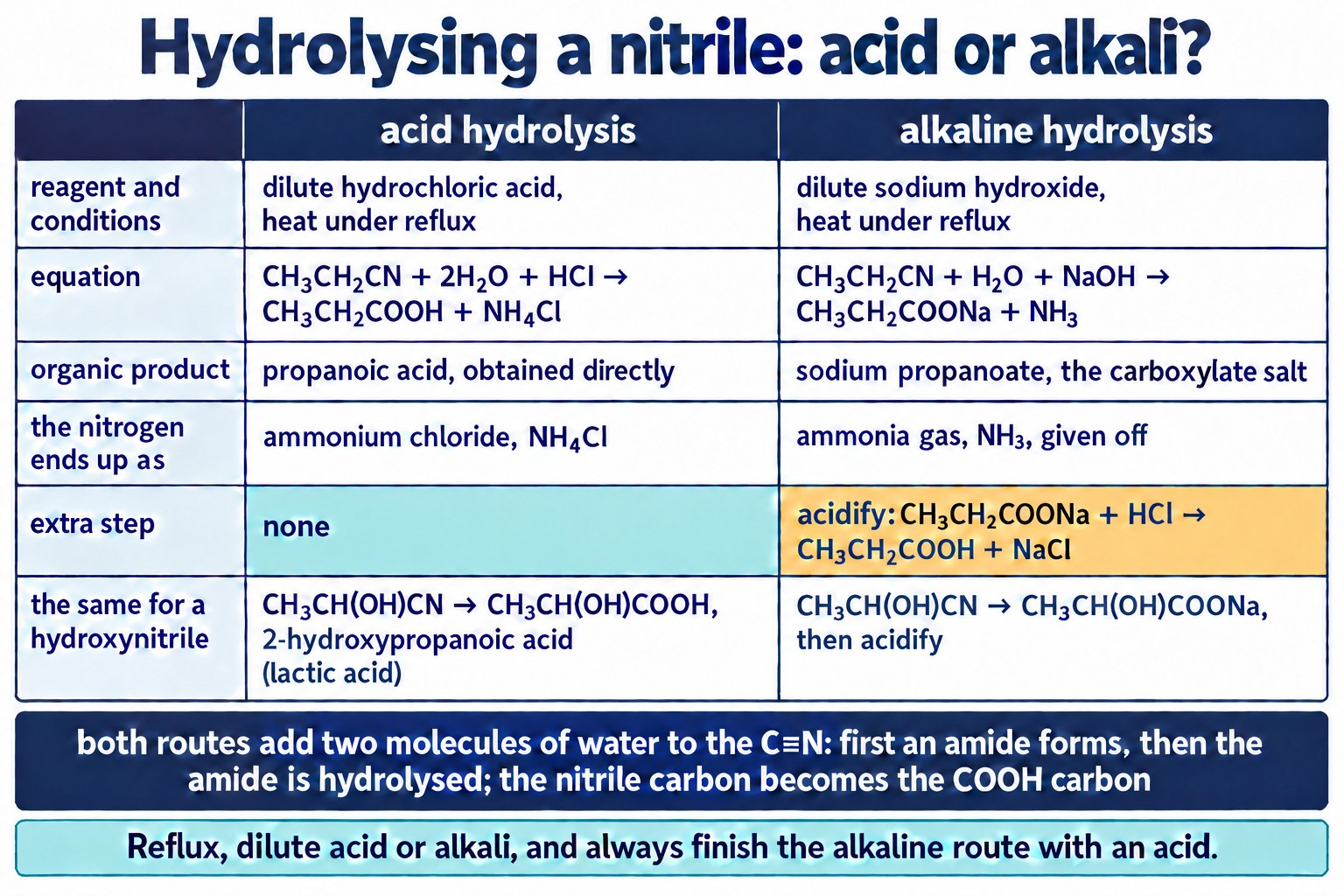
Acid hydrolysis and alkaline hydrolysis compared as a table: reagent, conditions, nitrogen product, organic product and whether acidification is needed.
Exam focus: Alkaline hydrolysis is two steps and both must be written: reflux with NaOH gives the salt and ammonia; then dilute acid gives the carboxylic acid.
Quick Check: Following an Alkaline Hydrolysis
Work out each answer on paper, then flip the card to check your working. The quantities are invented for this exercise.
Hydroxynitriles to 2-Hydroxy Acids
Hydrolysing a hydroxynitrile keeps the OH group and converts the C≡N to COOH. The products are 2-hydroxycarboxylic acids, a family that includes lactic acid.
Step 1. Ethanal + HCN with KCN catalyst gives 2-hydroxypropanenitrile, CH₃CH(OH)CN.
Step 2. Reflux with dilute HCl: CH₃CH(OH)CN + 2H₂O + HCl → CH₃CH(OH)COOH + NH₄Cl.
Product. 2-Hydroxypropanoic acid, lactic acid, the acid of sour milk and tired muscles. Made this way it is a racemic mixture; the body makes a single enantiomer.
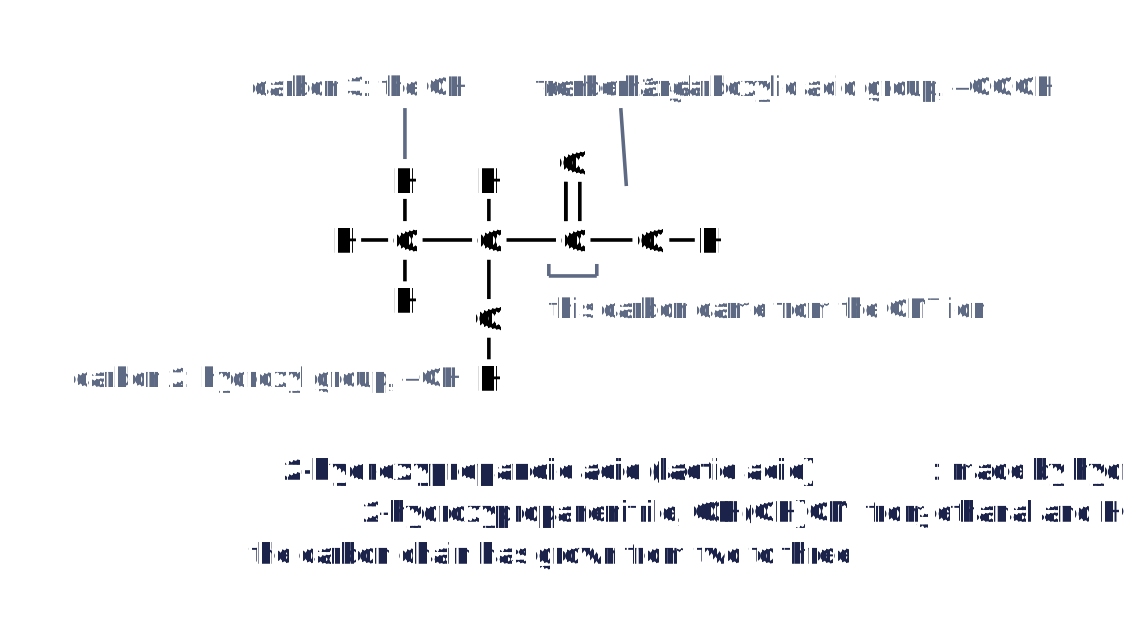
2-Hydroxypropanoic acid (lactic acid), CH₃CH(OH)COOH: the chiral carbon carries H, CH₃, OH and COOH.
- Propanone gives 2-hydroxy-2-methylpropanoic acid, (CH₃)₂C(OH)COOH, by the same two steps.
- Each route adds one carbon to the original aldehyde or ketone and places an acid group where the carbonyl was.
Remember: Hydroxynitrile hydrolysis is the standard route to a 2-hydroxy acid: carbonyl compound, then HCN/KCN, then dilute acid under reflux.
Where Nitriles Fit in Synthesis
The nitrile group is a hub in synthesis. It is made from two different starting points and converted into two different products, and every route changes the carbon count by one.
| Starting compound | Reagent and conditions | Product | Carbons |
|---|---|---|---|
| halogenoalkane, RBr | KCN in ethanol, reflux | nitrile, RCN | one more |
| aldehyde or ketone | HCN with KCN catalyst, warm | 2-hydroxynitrile | one more |
| nitrile | dilute HCl, reflux | carboxylic acid + NH₄Cl | same |
| nitrile | dilute NaOH, reflux, then HCl | carboxylic acid + NaCl | same |
| nitrile | LiAlH₄, or H₂ with a nickel catalyst (A Level) | primary amine | same |
- A two-step route from bromoethane to propanoic acid, or from ethanal to lactic acid, is a standard examination question: Carbon–Carbon Bond Formation.
- The reduction of nitriles to amines is the A Level route to primary amines: Preparing Amines.
Exam focus: For a route question write every stage as “reagent, conditions, product”: for example “KCN in ethanol, reflux; then dilute HCl, reflux”.
Check: Hydrolysing Nitriles
Write the equations for acid and alkaline hydrolysis of a given nitrile, explain the acidification step, and plan a two-step route to a carboxylic acid or a 2-hydroxy acid.
Common Exam Points
- Aldehydes and ketones add HCN to give 2-hydroxynitriles: CH₃CHO + HCN → CH₃CH(OH)CN, 2-hydroxypropanenitrile; KCN is the catalyst.
- The mechanism is nucleophilic addition: CN⁻ attacks the δ+ carbonyl carbon, the π electrons move to oxygen, then the O⁻ takes a proton from HCN.
- KCN is needed because HCN is a weak acid and a poor nucleophile; CN⁻ attacks and is regenerated when the intermediate is protonated.
- From an aldehyde the product carbon has four different groups: a racemic mixture of a chiral hydroxynitrile forms. From propanone the product is not chiral.
- Acid hydrolysis: RCN + 2H₂O + HCl → RCOOH + NH₄Cl, dilute acid under reflux; e.g. propanenitrile to propanoic acid.
- Alkaline hydrolysis: RCN + H₂O + NaOH → RCOONa + NH₃ under reflux, then acidify: RCOONa + HCl → RCOOH + NaCl.
- Hydrolysing a hydroxynitrile gives a 2-hydroxy acid: 2-hydroxypropanenitrile gives 2-hydroxypropanoic acid (lactic acid).
- Carbon count: making the nitrile adds one carbon; hydrolysis keeps it. Use this to plan routes from a bromoalkane or a carbonyl compound to an acid.
FAQs
Use these quick answers to check how aldehydes and ketones form hydroxynitriles with HCN, why potassium cyanide is the catalyst, the nucleophilic addition mechanism, and how nitriles are hydrolysed with acid or alkali to give carboxylic acids.
What is a hydroxynitrile and how do I make one?
A compound with an O–H and a C≡N group on the same carbon, made by adding hydrogen cyanide across the C=O bond of an aldehyde or ketone.
Ethanal gives 2-hydroxypropanenitrile, CH₃CH(OH)CN, and propanone gives 2-hydroxy-2-methylpropanenitrile, (CH₃)₂C(OH)CN, each with one more carbon.
Why is potassium cyanide added if hydrogen cyanide is the reagent?
HCN is a weak acid, so very few cyanide ions exist in it, and the undissociated molecule is a poor nucleophile. Adding KCN, or NaCN with a little dilute acid, supplies cyanide ions that attack the δ+ carbonyl carbon quickly; HCN then protonates the intermediate.
What is the mechanism for the addition of HCN to ethanal?
Nucleophilic addition. The cyanide ion uses its lone pair on carbon to attack the δ+ carbonyl carbon while the C=O π bond breaks, putting a negative charge on oxygen. This intermediate then takes a proton from HCN or water, giving the hydroxynitrile and regenerating cyanide.
How do I hydrolyse a nitrile to a carboxylic acid?
Heat under reflux with dilute hydrochloric acid: CH₃CH₂CN + 2H₂O + HCl → CH₃CH₂COOH + NH₄Cl, giving the acid directly.
Or heat under reflux with dilute sodium hydroxide, which gives the sodium salt and ammonia, then acidify: CH₃CH₂COONa + HCl → CH₃CH₂COOH + NaCl.
Where does the hydroxynitrile step fit into a synthesis?
It adds one carbon and creates two functional groups at once. Hydrolysing the nitrile group converts a hydroxynitrile into a 2-hydroxy acid: 2-hydroxypropanenitrile from ethanal becomes 2-hydroxypropanoic acid, lactic acid. The route turns a two-carbon aldehyde into a three-carbon acid in two steps.

Copyright notice: This OLS revision content, including the explanations, layout, diagrams, tables and embedded learning structure, is authored for Online Learning System by Dr. Mohammed Al-Fatah. It may not be copied, reproduced, redistributed or adapted without written permission.
Keep this note — free
Save your progress across every Cambridge topic. A free account remembers which topics you have covered, saves your question scores, and syncs across your phone and laptop.
- Track every topic you have finished
- Keep your practice-question scores
- No payment, no card, free forever
Already registered? Log in