Preparing Amines
A concise revision guide to the preparation of amines: primary aliphatic amines from halogenoalkanes with excess ethanolic ammonia and by the reduction of nitriles, and aromatic amines by the reduction of nitrobenzene with tin and concentrated hydrochloric acid.
Before You Start
All three routes to an amine use chemistry met earlier. Check these ideas first.
- A halogenoalkane has a polar C–X bond with a δ+ carbon that nucleophiles attack: nucleophilic substitution. See Nucleophilic Substitution Reactions.
- A halogenoalkane with potassium cyanide in ethanol gives a nitrile, R–C≡N, adding one carbon to the chain: CH₃CH₂Br + CN⁻ → CH₃CH₂CN + Br⁻.
- Nitriles are also made from aldehydes and ketones with HCN: Reduction and Nucleophilic Addition.
- Nitrobenzene is made by nitrating benzene with concentrated nitric and sulfuric acids: Nitration of Benzene.
- Reduction is written with [H] in organic equations: 4[H] for a nitrile, 6[H] for a nitro group.
Route 1: Halogenoalkanes with Ammonia
Ammonia is a nucleophile. Its lone pair attacks the δ+ carbon of a halogenoalkane and the halide ion leaves. The product is a primary aliphatic amine.
| Detail | |
|---|---|
| reagent | in ethanol, heated under pressure |
| equation | CH₃CH₂CH₂CH₂Br + 2NH₃ → CH₃CH₂CH₂CH₂NH₂ + NH₄Br |
| first product | the salt butylammonium bromide, CH₃CH₂CH₂CH₂NH₃⁺Br⁻; a second NH₃ removes the proton |
| type of reaction | nucleophilic substitution |
- With one mole of ammonia the product is the ammonium salt; the excess ammonia (a base) frees the amine: CH₃CH₂CH₂CH₂NH₃⁺ + NH₃ → CH₃CH₂CH₂CH₂NH₂ + NH₄⁺.
- Ethylamine is made the same way from bromoethane: CH₃CH₂Br + 2NH₃ → CH₃CH₂NH₂ + NH₄Br.
- A primary amine in place of ammonia gives a secondary amine under the same conditions: Amines as Nucleophiles.
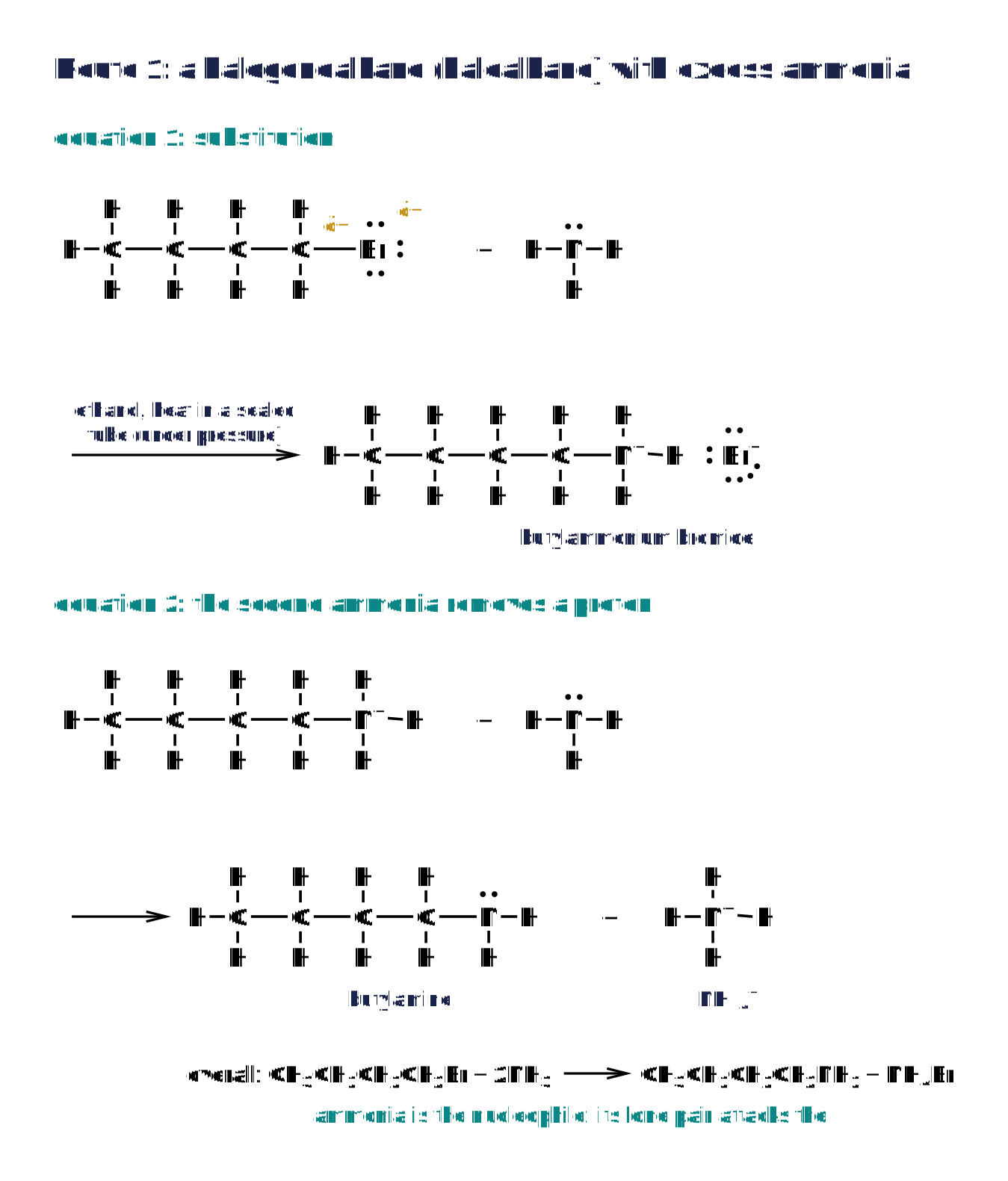
1-Bromobutane with ammonia: the salt forms first and a second ammonia molecule removes the proton. Words and equations are enough here: no mechanism is needed.
Why ethanol, and why excess ammonia?
- Ethanol is the solvent because water would also react: hydroxide ions and water substitute the halogen, giving the alcohol instead.
- The primary amine formed still has a lone pair, so it is a nucleophile too. It attacks more halogenoalkane, giving secondary and tertiary amines and a quaternary ammonium salt.
- A large excess of ammonia means a halogenoalkane molecule is far more likely to meet NH₃ than an amine, so the primary amine is the main product.
- The amine formed can react further, so a mixture forms: the reaction of amines with halogenoalkanes is covered in Amines as Nucleophiles.
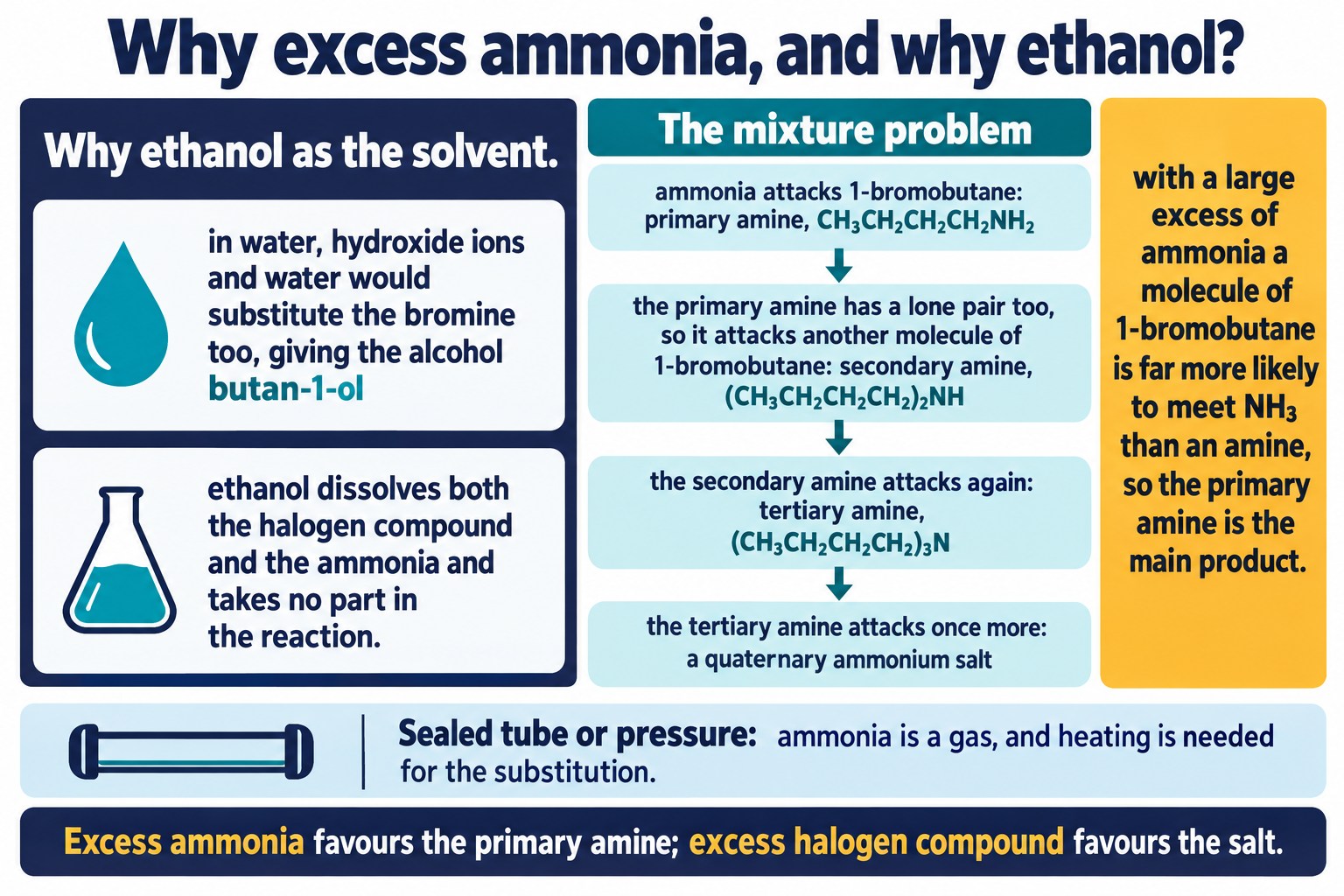
The two conditions explained: ethanol keeps water out, and excess ammonia keeps the primary amine as the main product.
Exam focus: Three conditions to quote: ammonia in excess, dissolved in ethanol, heated under pressure (a sealed tube) because ammonia is a gas.
Check: Halogenoalkanes and Ammonia
Give the reagents and conditions for making a primary amine from ammonia, write the equation and explain the choice of solvent and the excess of ammonia.
Route 2: Reduction of Nitriles
A nitrile, R–C≡N, is reduced to a primary amine, R–CH₂NH₂. Four hydrogen atoms are added across the triple bond: RCN + 4[H] → RCH₂NH₂.
| Detail | |
|---|---|
| reducing agent | LiAlH₄ in dry ether followed by water, or hydrogen with a nickel (or platinum) catalyst under heat and pressure |
| example | CH₃CH₂CN + 4[H] → CH₃CH₂CH₂NH₂ (propanenitrile → propylamine) |
| second example | CH₃CN + 4[H] → CH₃CH₂NH₂ (ethanenitrile → ethylamine) |
| advantage | a single primary amine; no secondary or tertiary amines, no salt |
- Hydrogen with a nickel catalyst is catalytic hydrogenation, the same reaction used to reduce a C=C bond; LiAlH₄ is used in dry ether because it reacts violently with water.
- The carbon of the nitrile becomes the CH₂ of the amine, so the amine has the same number of carbons as the nitrile.
Chain lengthening: two steps from a bromoalkane
Step 2. Reduce the nitrile: CH₃CH₂CN + 4[H] → CH₃CH₂CH₂NH₂ using LiAlH₄ in dry ether or H₂ with a nickel catalyst.
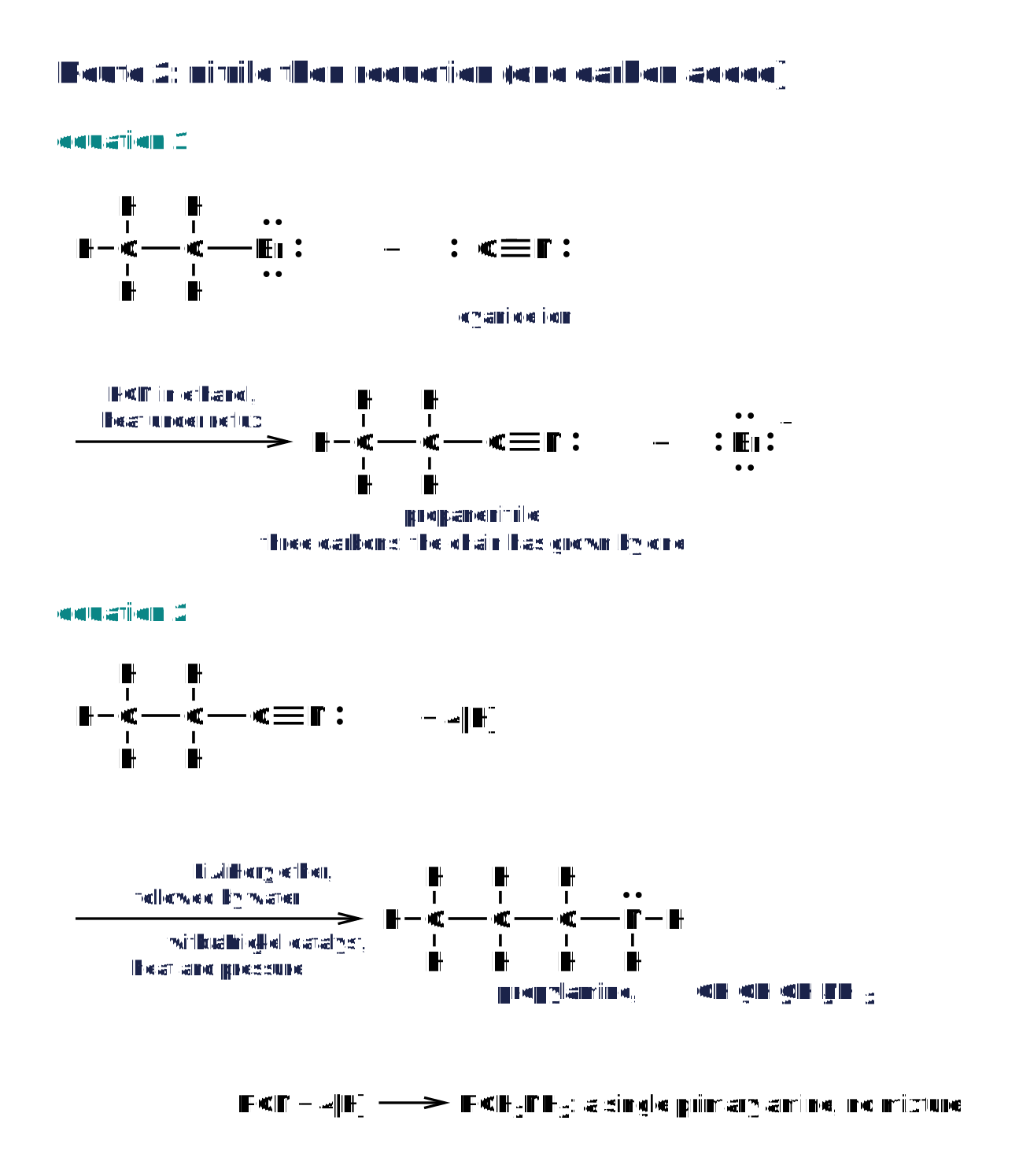
Bromoethane to propanenitrile to propylamine. The nitrile carbon becomes the CH₂ next to the nitrogen.
Exam focus: Count the carbons. Ammonia on a bromoalkane keeps the chain length; the cyanide route adds one carbon and then needs a reduction step.
Quick Check: Reducing Unfamiliar Nitriles
Pick the one accurate statement about each new nitrile.
Reduction of Amides
Amides are reduced by LiAlH₄ in dry ether in the same way. The C=O becomes CH₂ and the product is an amine with the same number of carbons.
- CH₃CONH₂ + 4[H] → CH₃CH₂NH₂ + H₂O: ethanamide gives ethylamine.
- An N-substituted amide gives a secondary amine: CH₃CONHCH₃ + 4[H] → CH₃CH₂NHCH₃ + H₂O.
- Hydrogen with a nickel catalyst does not reduce an amide; LiAlH₄ is needed. The reaction is met again in Amides.
Remember: Nitriles: LiAlH₄ or H₂/Ni. Amides: LiAlH₄ only. Both give amines; the amide also loses a molecule of water.
Route 3: Aromatic Amines from Nitro Compounds
Phenylamine cannot be made from chlorobenzene with ammonia: the C–Cl bond on a ring resists substitution. Instead the nitro group of nitrobenzene is reduced.
| Stage | Reagents and conditions | Equation |
|---|---|---|
| 1 reduction | tin (Sn) and concentrated hydrochloric acid, heated under reflux | C₆H₅NO₂ + 6[H] → C₆H₅NH₂ + 2H₂O |
| salt formed | the acid is in excess, so the amine is protonated | C₆H₅NH₂ + HCl → C₆H₅NH₃⁺Cl⁻ (phenylammonium chloride) |
| 2 liberation | add sodium hydroxide solution | C₆H₅NH₃⁺ + OH⁻ → C₆H₅NH₂ + H₂O |
- The tin and acid supply the hydrogen; the tin is oxidised to tin(IV). Writing 6[H] is accepted.
- The product of stage 1 is the salt, not the free amine, because concentrated HCl is in excess. Alkali is needed to release phenylamine.
- Synthesis in two steps: benzene → nitrobenzene (concentrated HNO₃ and H₂SO₄, below 60 °C) → phenylamine (Sn, concentrated HCl, then NaOH). See Nitration of Benzene.
- Aromatic amines are used to manufacture dyes: Diazonium Salts and Azo Dyes.
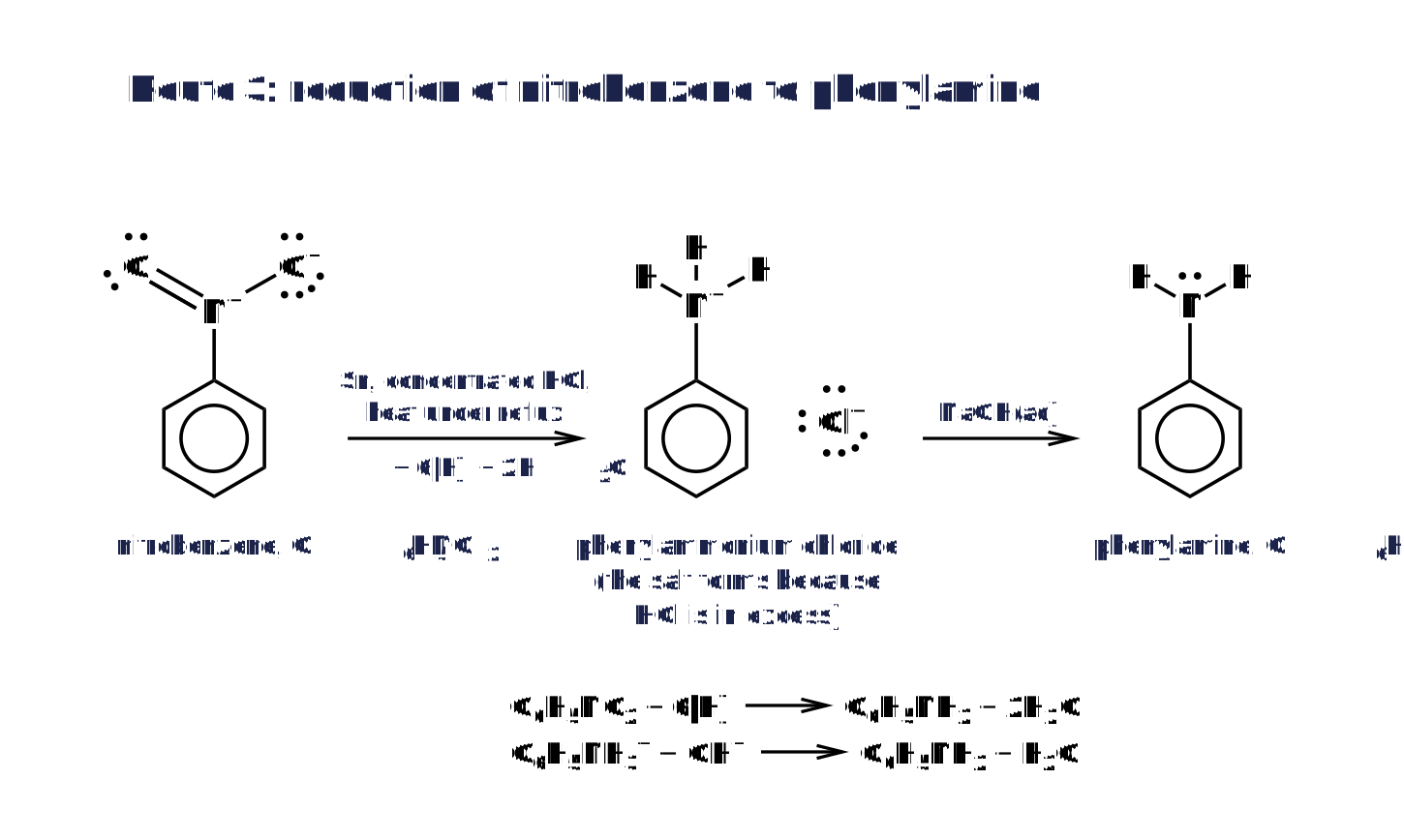
Nitrobenzene to the phenylammonium salt with tin and concentrated hydrochloric acid, then sodium hydroxide to free phenylamine.
Exam focus: Four words earn the conditions marks: tin, concentrated hydrochloric acid, reflux, then sodium hydroxide. Then write the [H] equation.
Quick Check: Equations and Yields for New Amines
Work each one out on paper, then flip the card to compare your working.
The Three Routes Compared
Choose the route from the starting material and the amine wanted.
| Wanted | Start from | Route |
|---|---|---|
| a primary aliphatic amine, same chain length | a halogenoalkane | excess ammonia in ethanol under pressure |
| a primary aliphatic amine, one carbon longer | a halogenoalkane | KCN in ethanol, then reduce the nitrile |
| a pure primary amine with no mixture | a nitrile | reduce with LiAlH₄ or H₂/Ni |
| an aromatic amine | benzene | nitrate, then Sn / concentrated HCl, then NaOH |
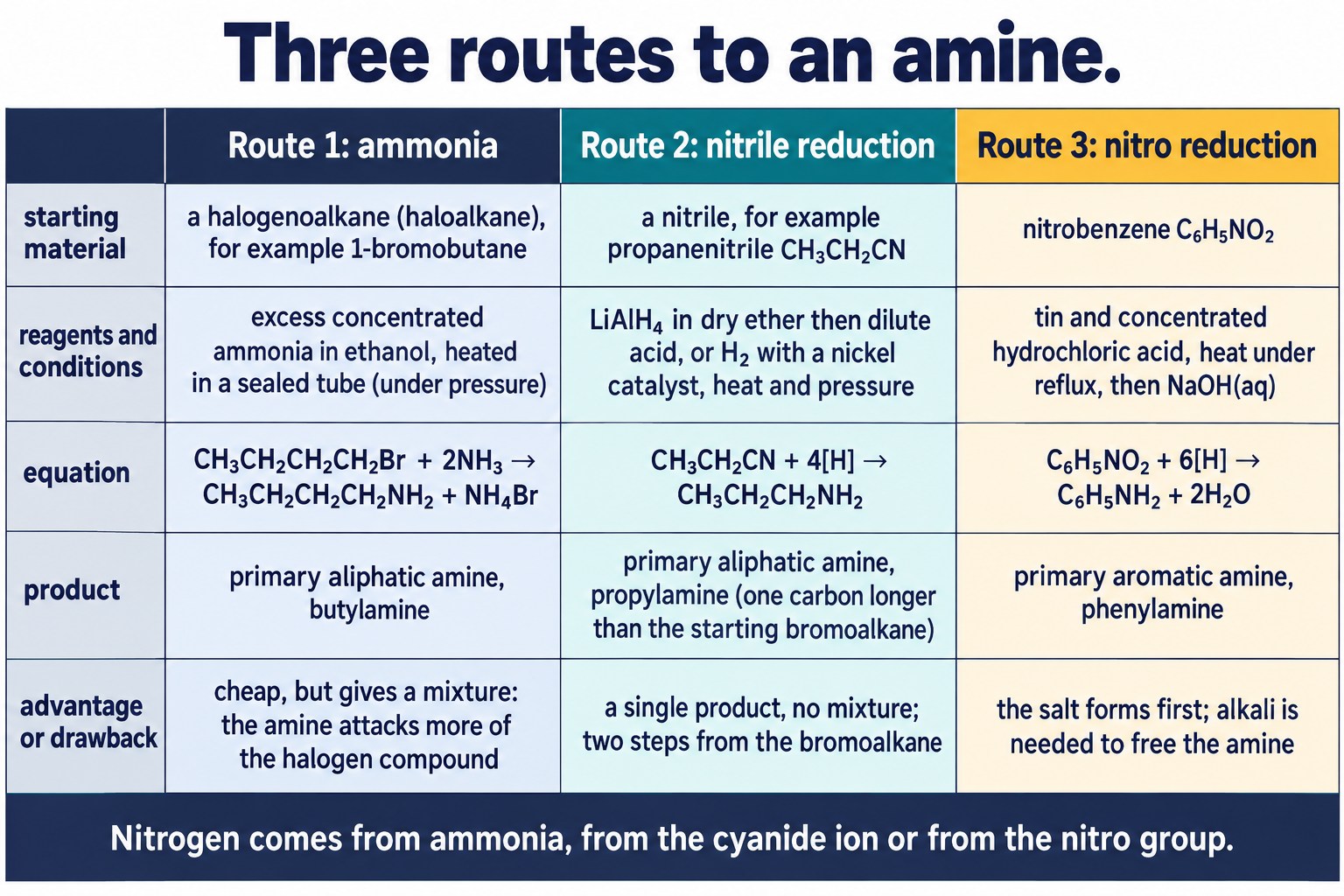
Reagents, conditions, equations, products and the strengths of each route in one table.
Check: Nitriles and Nitrobenzene
Write the reduction equations with [H], give the reagents for reducing a nitrile and a nitro compound, and count the carbons in a chain-lengthening synthesis.
Common Exam Points
- Halogenoalkane + ammonia: excess ammonia, in ethanol, heated under pressure; CH₃CH₂CH₂CH₂Br + 2NH₃ → CH₃CH₂CH₂CH₂NH₂ + NH₄Br.
- Excess ammonia because the amine formed is also a nucleophile and would give a mixture; ethanol because water would give the alcohol.
- The amine formed can react further, so the ammonia route gives a mixture.
- Nitrile reduction: RCN + 4[H] → RCH₂NH₂ with LiAlH₄ in dry ether or H₂ with a nickel catalyst; one product only.
- Halogenoalkane → nitrile → amine adds one carbon: bromoethane gives propylamine.
- Nitrobenzene with tin and concentrated hydrochloric acid under reflux gives phenylammonium chloride; sodium hydroxide liberates phenylamine.
- C₆H₅NO₂ + 6[H] → C₆H₅NH₂ + 2H₂O: the [H] notation is accepted for both reductions.
- Amides are reduced to amines by LiAlH₄ (not by H₂/Ni): CH₃CONH₂ + 4[H] → CH₃CH₂NH₂ + H₂O.
- Aromatic amines are made for the dye industry.
FAQs
Use these quick answers to check the three routes to amines: a halogenoalkane with excess ammonia, the reduction of a nitrile and the reduction of nitrobenzene to phenylamine.
Why is the reaction of a halogenoalkane with ammonia carried out in ethanol?
Water would compete as a nucleophile and give the alcohol instead of the amine. Ethanol dissolves both the halogenoalkane and the ammonia without reacting, so heating the mixture in a sealed tube, under pressure, gives the amine and ammonium bromide.
Why is excess ammonia used?
The primary amine formed still has a lone pair, so it attacks more halogenoalkane and gives secondary and tertiary amines and a quaternary ammonium salt as a mixture. Excess ammonia makes the halogenoalkane far more likely to meet NH₃, so the primary amine dominates.
How do I reduce a nitrile to an amine?
Use LiAlH₄ in dry ether followed by water, or hydrogen with a nickel catalyst under heat and pressure. Propanenitrile gives propylamine: CH₃CH₂CN + 4[H] → CH₃CH₂CH₂NH₂. The product is a single primary amine, with no mixture of further-substituted amines.
How is phenylamine made from nitrobenzene?
Heat nitrobenzene under reflux with tin and concentrated hydrochloric acid: C₆H₅NO₂ + 6[H] → C₆H₅NH₂ + 2H₂O. Because the acid is in excess, the product is phenylammonium chloride; adding sodium hydroxide solution then liberates the free phenylamine.
Why is the nitrile route useful in synthesis?
Making the nitrile from a halogenoalkane with KCN adds one carbon to the chain, and reducing it gives a primary amine with one more carbon than the starting halogenoalkane: bromoethane → propanenitrile → propylamine. Only the primary amine forms, so there is no mixture.

Copyright notice: This OLS revision content, including the explanations, layout, diagrams, tables and embedded learning structure, is authored for Online Learning System by Dr. Mohammed Al-Fatah. It may not be copied, reproduced, redistributed or adapted without written permission.
Keep this note — free
Save your progress across every Cambridge topic. A free account remembers which topics you have covered, saves your question scores, and syncs across your phone and laptop.
- Track every topic you have finished
- Keep your practice-question scores
- No payment, no card, free forever
Already registered? Log in