Nitration of Benzene
A concise revision guide to the nitration of benzene: concentrated nitric and sulfuric acids at between 25 °C and 60 °C, how the nitronium ion NO₂⁺ is generated, the electrophilic substitution mechanism, regenerating the catalyst, and the nitration of methylbenzene.
Nitration of Benzene
Choose a step to watch sulfuric acid make the nitronium ion, the ion attack the ring, and H⁺ leave to give nitrobenzene.
© Dr. Mohammed Al-Fatah – onlinelearningsystem.net
Before You Start
Nitration is the first example of the general mechanism, so have the three moves fresh in your mind.
- Attack, intermediate with the horseshoe, loss of H⁺: Electrophilic Substitution in Benzene.
- An acid is a proton donor and a base is a proton acceptor. Here one acid protonates another.
- A catalyst takes part in the reaction and is regenerated at the end, so it appears in the mechanism but not in the overall equation.
Reagents and Conditions
Benzene is converted into nitrobenzene, C₆H₅NO₂, by a mixture of concentrated nitric acid and concentrated sulfuric acid, often called the nitrating mixture.
| Nitration of benzene | |
|---|---|
| Reagents | concentrated nitric acid, HNO₃, with concentrated sulfuric acid, H₂SO₄ |
| Role of H₂SO₄ | catalyst: it generates the electrophile and is regenerated |
| Temperature | between 25 °C and 60 °C, kept steady with a water bath |
| Apparatus | heat under reflux so that the volatile benzene is not lost |
| Product | nitrobenzene, a pale yellow oil that is denser than water |
| Overall equation | C₆H₆ + HNO₃ → C₆H₅NO₂ + H₂O |
- The temperature is held at between 25 °C and 60 °C because the reaction is exothermic and a higher temperature changes the product.
- Above about 60 °C a second nitro group substitutes, giving 1,3-dinitrobenzene.
- The mixture is added slowly and cooled if needed so that the temperature does not run away.
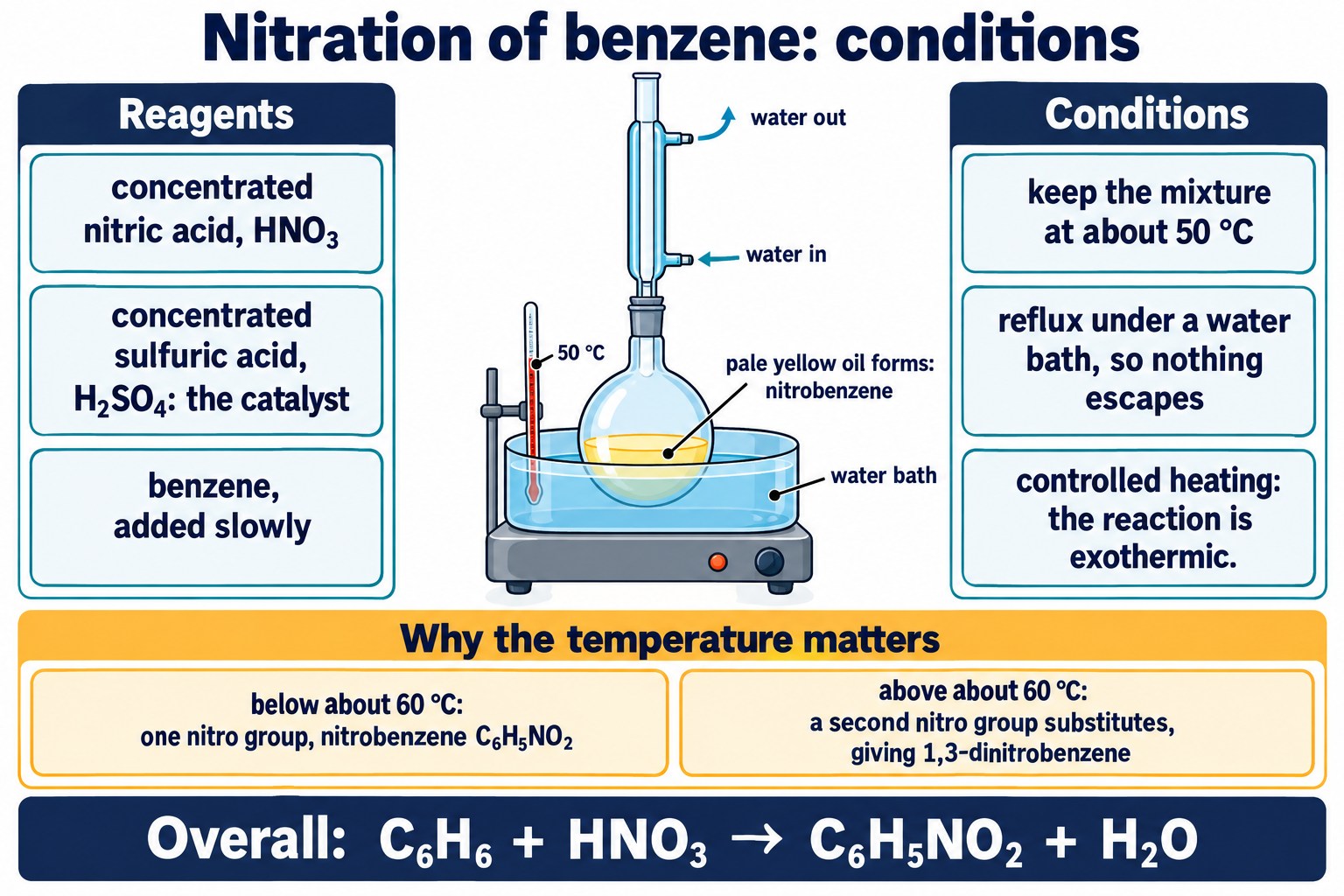
Reflux in a water bath at a controlled temperature. Above about 60 °C a second nitro group substitutes.
Exam focus: Quote all three conditions: concentrated nitric acid, concentrated sulfuric acid catalyst, and a temperature of between 25 °C and 60 °C. Sulfuric acid is not a reactant in the overall equation.
Generating the Electrophile
Nitric acid itself is not the electrophile. The electrophile is the nitronium ion, NO₂⁺ (also called the nitryl cation), made in two steps.
Step 2. The protonated nitric acid loses a water molecule: H₂NO₃⁺ → NO₂⁺ + H₂O.
Overall. The water formed is protonated by a second molecule of sulfuric acid: HNO₃ + 2H₂SO₄ → NO₂⁺ + 2HSO₄⁻ + H₃O⁺.
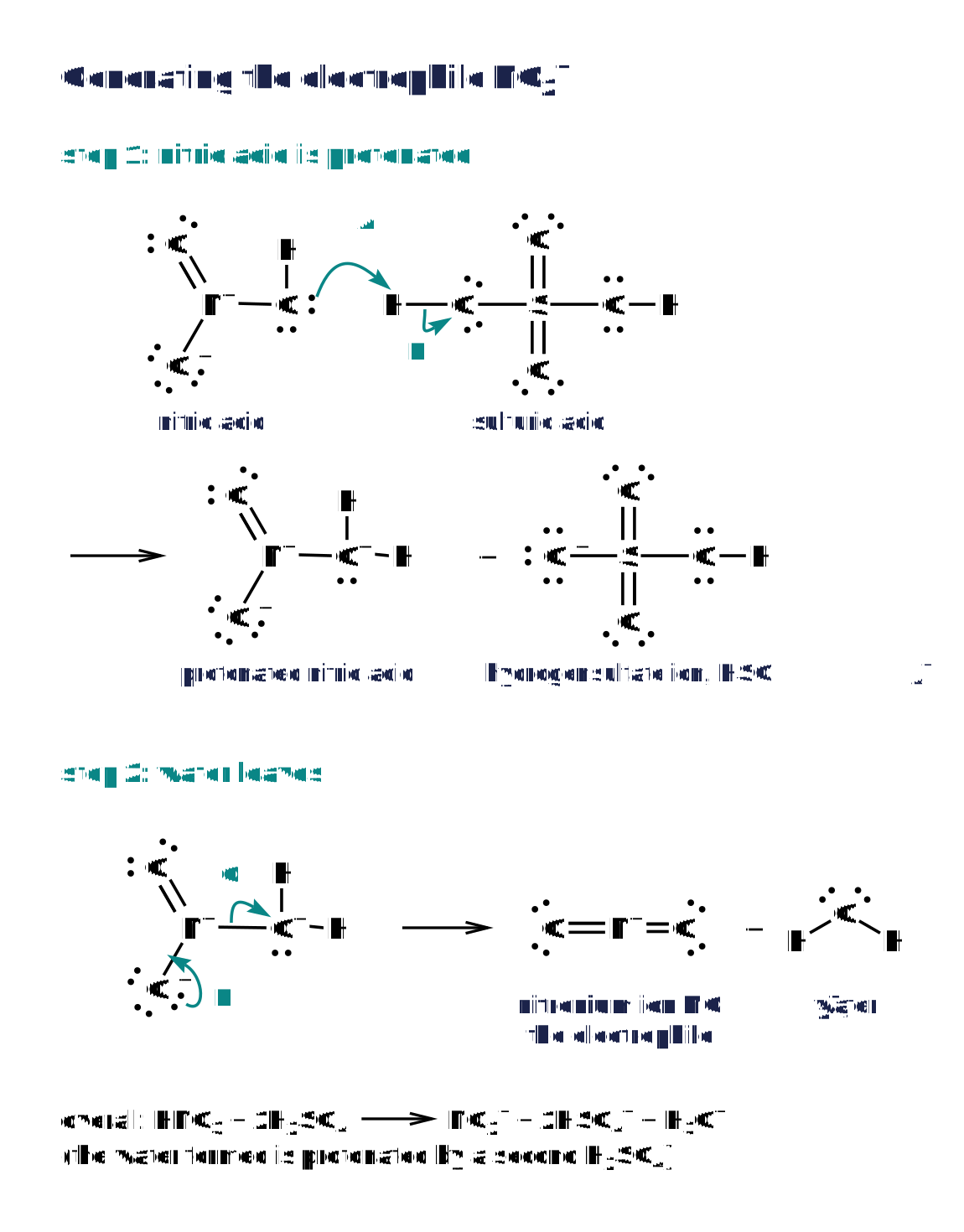
The two steps that make NO₂⁺: sulfuric acid protonates nitric acid (arrows A and B), then water leaves (C) as an O⁻ lone pair forms the second N=O bond (D).
- NO₂⁺ is linear, O=N⁺=O, with the positive charge on the nitrogen atom.
- The nitrogen is strongly electron-deficient, which makes NO₂⁺ a powerful electrophile.
- The HSO₄⁻ ions formed here are the ions that remove H⁺ in the last step of the mechanism.
Remember: Two equations are accepted for making the electrophile: the two-step version or the overall HNO₃ + 2H₂SO₄ → NO₂⁺ + 2HSO₄⁻ + H₃O⁺. Learn one in full and know what the other shows.
Check: Reagents, Conditions and the Electrophile
Identify the electrophile, the role of each acid and the conditions, and balance the equations that generate NO₂⁺.
The Mechanism
With NO₂⁺ in place of E⁺, the general mechanism gives nitrobenzene.
- Attack. The NO₂⁺ electrophile is attracted to the high electron density of the ring. A curly arrow goes from a C=C bond of the ring to the electrophile.
- Intermediate. A C–NO₂ bond forms, so that carbon holds both NO₂ and its H. The positive charge is delocalised over the other five carbons: the horseshoe with a + inside.
- Loss of H⁺. A curly arrow from the C–H bond into the ring restores the delocalised system. The HSO₄⁻ ion takes the H⁺, which regenerates the H₂SO₄ catalyst.
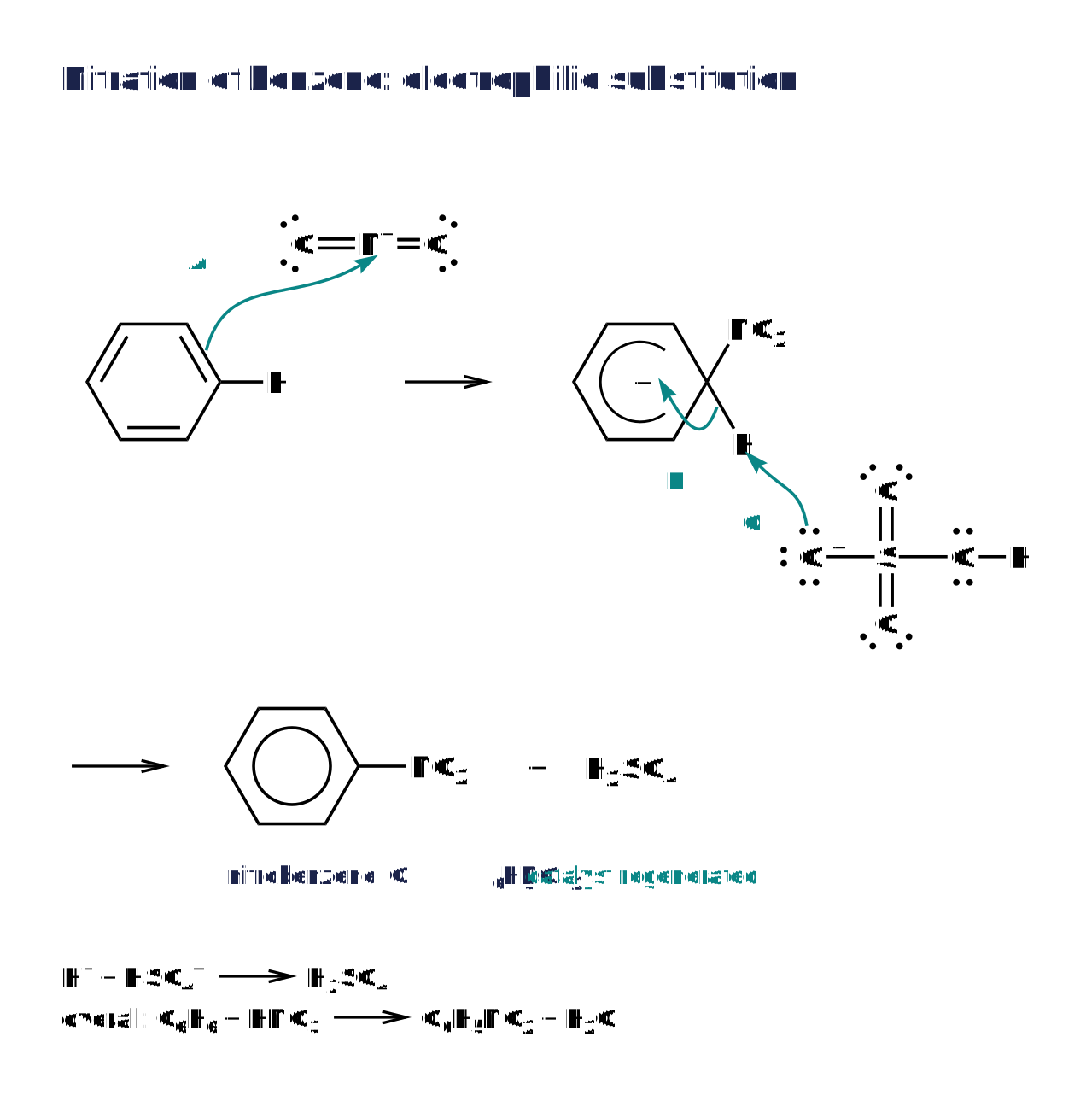
The full mechanism of nitration drawn with the Kekulé form: attack by NO₂⁺, the horseshoe intermediate and removal of H⁺ by HSO₄⁻.
- The arrow from the ring points to the nitrogen atom of NO₂⁺, the atom that carries the positive charge.
- In the intermediate the NO₂ group and the H sit on the same carbon, drawn above and below the ring.
- Regeneration: H⁺ + HSO₄⁻ → H₂SO₄. The catalyst is returned unchanged.
- Overall: C₆H₆ + HNO₃ → C₆H₅NO₂ + H₂O. Water is the only by-product.
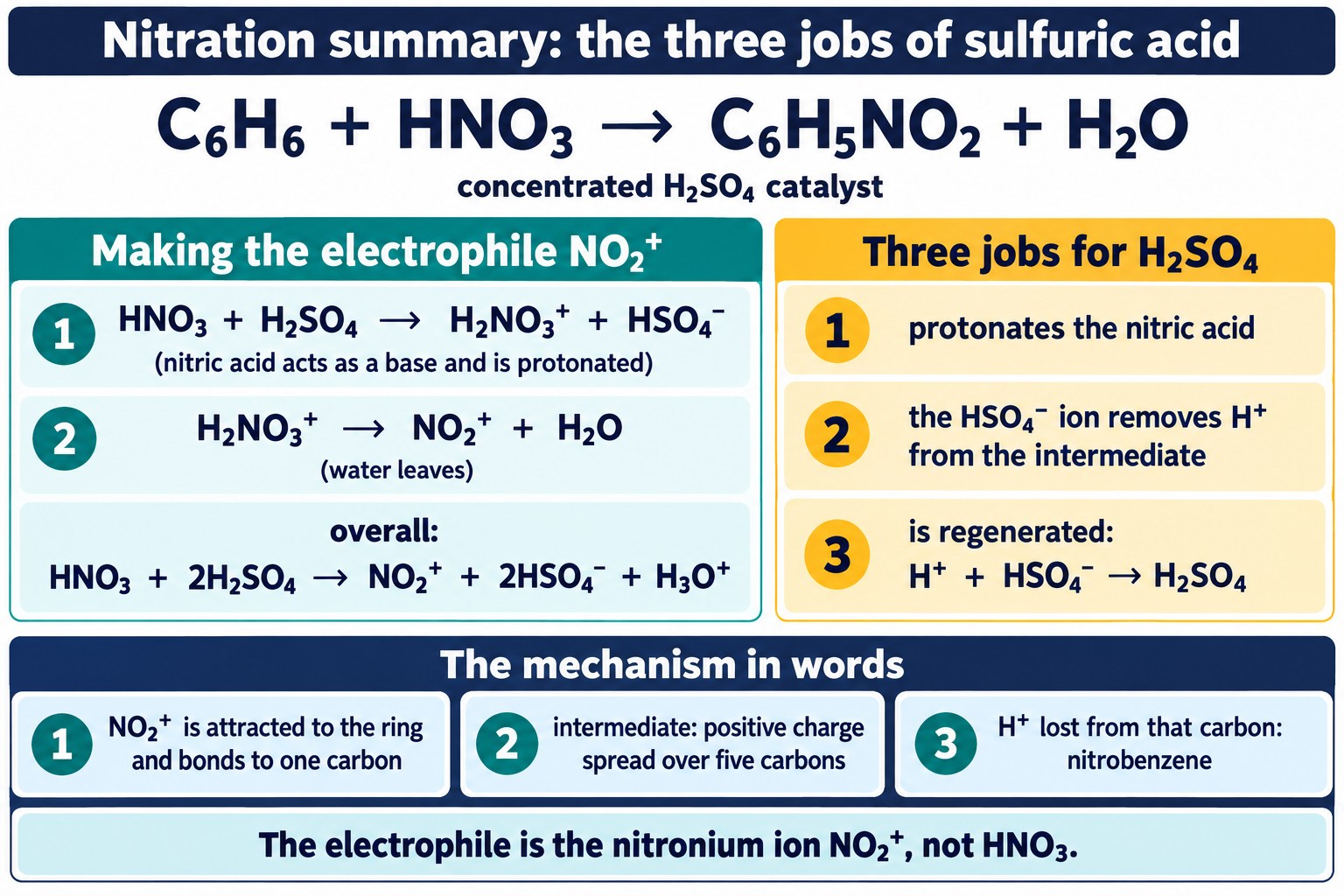
The overall equation, the two steps that make NO₂⁺ and the three jobs of sulfuric acid, written out in words.
Exam focus: Sulfuric acid does three things: it protonates nitric acid, its HSO₄⁻ ion removes the H⁺ from the intermediate, and it is regenerated. Mentioning all three earns the explanation marks.
Quick Check: Applying the Mechanism to a New Case
Pick the one accurate statement in each set, using ideas from the mechanism in cases that are new to this page.
Temperature Control and Further Substitution
Nitrobenzene can itself be nitrated, but less easily than benzene. The nitro group withdraws electrons from the ring, so a second substitution needs a higher temperature.
- At between 25 °C and 60 °C the product is almost entirely nitrobenzene (monosubstitution).
- Above about 60 °C a second NO₂ group goes on at the 3 position, giving 1,3-dinitrobenzene.
- A water bath gives even, controllable heating and cannot overshoot 100 °C.
- Why the second group takes the 3 position is explained in Directing Effects in Electrophilic Substitution.
Common mistake: Writing “heat” or “reflux” alone is not enough. Give the temperature and say why it must not rise much above it: a second nitro group would substitute.
Quick Check: Why a Third Nitro Group Is So Hard to Add
Extend the idea from this card one step further, then compare your answer with the model.
Nitration of Methylbenzene
Methylbenzene is nitrated by the same nitrating mixture under the same conditions, and more readily than benzene. The methyl group releases electrons into the ring.
- Products: a mixture of 2-nitromethylbenzene and 4-nitromethylbenzene. The methyl group directs the new group to the 2 and 4 positions.
- Equation: C₆H₅CH₃ + HNO₃ → CH₃C₆H₄NO₂ + H₂O.
- With hotter, more concentrated acid, further nitration gives 2,4-dinitromethylbenzene and then 2-methyl-1,3,5-trinitrobenzene.
- The directing effect of the methyl group is explained in Directing Effects in Electrophilic Substitution.
Exam focus: Name both products and give the position numbers. The mechanism is the same as for benzene: only the position of attack changes.
Check: The Mechanism of Nitration
Draw the three moves for nitration, spot errors in a described mechanism and account for the role of sulfuric acid.
Common Exam Points
- Conditions: concentrated HNO₃, concentrated H₂SO₄ catalyst, between 25 °C and 60 °C, reflux in a water bath.
- The electrophile is NO₂⁺. Learn HNO₃ + 2H₂SO₄ → NO₂⁺ + 2HSO₄⁻ + H₃O⁺, or the two steps that give it.
- Nitric acid acts as a base when sulfuric acid protonates it.
- The arrow from the ring goes to the nitrogen of NO₂⁺; the horseshoe stops at carbons 2 and 6.
- H⁺ + HSO₄⁻ → H₂SO₄ regenerates the catalyst.
- Above about 60 °C a second nitro group substitutes to give 1,3-dinitrobenzene.
- Methylbenzene gives 2-nitromethylbenzene and 4-nitromethylbenzene.
FAQs
Use these quick answers to check the conditions for nitration, how NO₂⁺ forms and the role of sulfuric acid and the nitration of methylbenzene.
What are the conditions for the nitration of benzene?
Concentrated nitric acid with concentrated sulfuric acid as the catalyst, heated under reflux in a water bath and kept at between 25 °C and 60 °C. Above about 60 °C a second nitro group substitutes, giving 1,3-dinitrobenzene as well as nitrobenzene.
How is the nitronium ion formed?
Sulfuric acid protonates nitric acid, which acts as a base: HNO₃ + H₂SO₄ → H₂NO₃⁺ + HSO₄⁻. The protonated acid loses water: H₂NO₃⁺ → NO₂⁺ + H₂O. Overall HNO₃ + 2H₂SO₄ → NO₂⁺ + 2HSO₄⁻ + H₃O⁺.
Why is sulfuric acid needed if it is not in the overall equation?
Nitric acid alone produces very little NO₂⁺: the ion forms when H₂SO₄ protonates HNO₃. At the end HSO₄⁻ removes H⁺ from the intermediate and re-forms H₂SO₄, so sulfuric acid is a catalyst and overall C₆H₆ + HNO₃ → C₆H₅NO₂ + H₂O.
What is the product of nitration?
Nitrobenzene, C₆H₅NO₂, a pale yellow oil. One ring hydrogen is replaced by the nitro group, so the delocalised ring is kept. Holding the temperature at between 25 °C and 60 °C limits the reaction to a single substitution and keeps the yield of nitrobenzene high.
What happens when methylbenzene is nitrated?
The methyl group releases electrons into the ring, so methylbenzene reacts faster than benzene and the nitro group goes to the 2 or 4 position. The products are 2-nitromethylbenzene and 4-nitromethylbenzene, formed under the same mixed-acid conditions.

Copyright notice: This OLS revision content, including the explanations, layout, diagrams, tables and embedded learning structure, is authored for Online Learning System by Dr. Mohammed Al-Fatah. It may not be copied, reproduced, redistributed or adapted without written permission.
Keep this note — free
Save your progress across every Cambridge topic. A free account remembers which topics you have covered, saves your question scores, and syncs across your phone and laptop.
- Track every topic you have finished
- Keep your practice-question scores
- No payment, no card, free forever
Already registered? Log in