Other Reactions of Benzene and Methylbenzene
A concise revision guide to the remaining reactions of arenes: hydrogenation of the ring to cyclohexane, oxidation of the methyl side chain to benzoic acid, and a reaction map that brings the whole topic together.
Before You Start
This page collects the reactions of benzene and methylbenzene that are not electrophilic substitutions, then draws the whole topic together in one reaction map.
- The three-step mechanism and why benzene substitutes rather than adds: Electrophilic Substitution in Benzene.
- Nitration with concentrated HNO₃ and H₂SO₄ at between 25 °C and 60 °C: Nitration of Benzene.
- Bromination and chlorination with a catalyst such as AlCl₃ or FeBr₃: Halogenation of Benzene.
- Friedel–Crafts alkylation and acylation with anhydrous AlCl₃: Friedel–Crafts Alkylation and Acylation.
- The hydrogenation enthalpy of benzene, −208 kJ mol⁻¹: Evidence for the Structure of Benzene.
Hydrogenation of the Ring
Benzene resists addition because addition destroys the delocalised π system. Under forcing conditions, however, the ring can be hydrogenated all the way to cyclohexane.
- C₆H₆ + 3H₂ → C₆H₁₂ (cyclohexane).
- Conditions: hydrogen gas with a nickel or platinum catalyst, heated, usually under pressure.
- ΔH = −208 kJ mol⁻¹ for the whole molecule, far less exothermic than three times the value for cyclohexene.
- The product has no delocalised electrons: every C–C bond is a single bond of 0.154 nm and the ring is no longer planar.
- This is an addition reaction, the one exception to the rule that benzene substitutes.
- Cyclohexane made this way is a starting material for nylon.
| Cyclohexene + H₂ | Benzene + 3H₂ | |
|---|---|---|
| catalyst | nickel | nickel or platinum |
| conditions | room temperature or gentle warming | heat and pressure: the delocalisation energy must be overcome |
| ΔH / kJ mol⁻¹ | −120 | −208 |
| product | cyclohexane | cyclohexane |
Exam focus: Hydrogenation is forced by the catalyst and heat. Addition is possible but costly because the stability of the delocalised ring is lost: see the enthalpy data in Evidence for the Structure of Benzene.
Check: Substitution or Not?
Decide which reactions of benzene keep the delocalised ring and which destroy it, and account for the atoms in each equation.
Oxidation of the Side Chain of Methylbenzene
Methylbenzene has two places to react: the ring and the CH₃ side chain. Hot alkaline potassium manganate(VII) attacks the side chain, not the ring, and oxidises it completely to a carboxylic acid group.
- Reagents and conditions: KMnO₄(aq) with NaOH(aq), heated under reflux; then dilute acid such as H₂SO₄(aq).
- Observation: the purple MnO₄⁻ solution is decolourised and a brown precipitate of MnO₂ forms.
- In the alkaline mixture the product is the benzoate ion, C₆H₅COO⁻. Adding dilute acid gives benzoic acid, C₆H₅COOH, a white solid.
- Overall, with [O] for the oxidising agent: C₆H₅CH₃ + 3[O] → C₆H₅COOH + H₂O.
- The ring is not oxidised. The delocalised system is too stable.
Which side chains are oxidised?
- Any alkyl side chain with at least one H on the carbon attached to the ring is oxidised to COOH.
- Ethylbenzene, C₆H₅CH₂CH₃, also gives benzoic acid: the extra carbon is lost as CO₂.
- A side chain with no H on that carbon, such as C(CH₃)₃, is not oxidised.
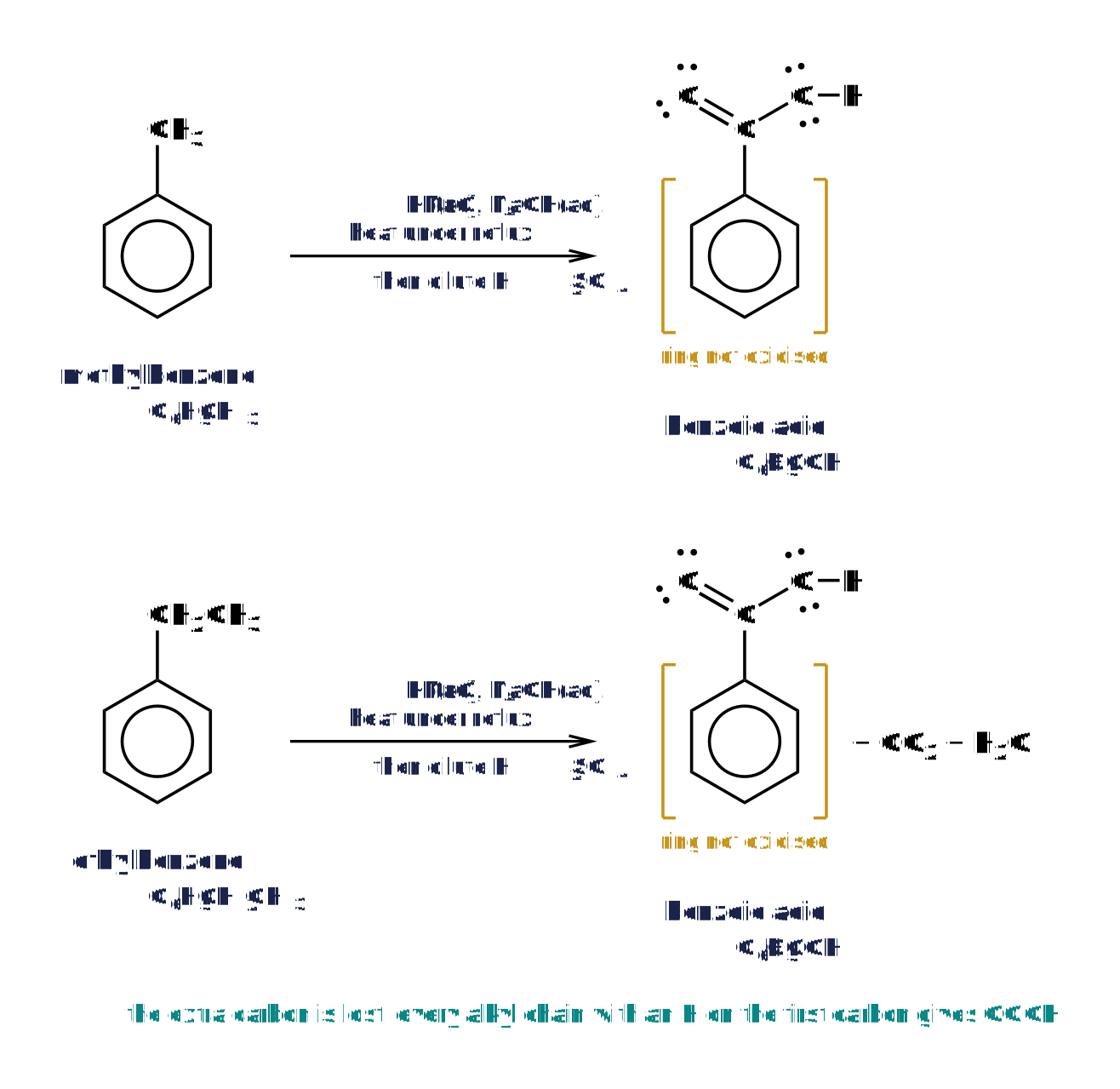
Methylbenzene and ethylbenzene both give benzoic acid. The oxidation stops at the carboxylic acid; the ring is untouched.
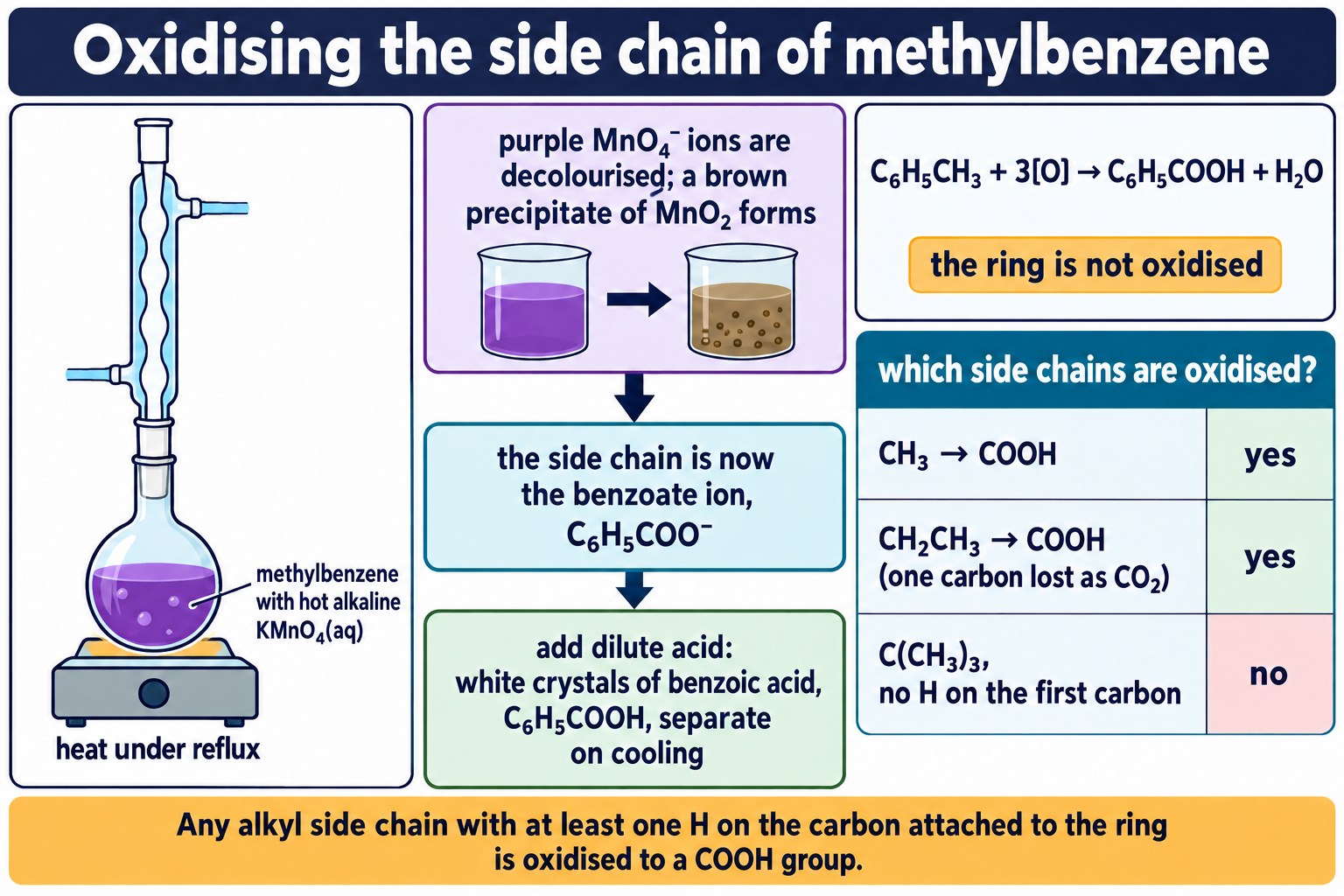
Reflux with hot alkaline manganate(VII), watch purple turn to brown, then acidify to obtain white crystals of benzoic acid.
Common mistake: Write benzoic acid, not benzaldehyde. The hot alkaline oxidation goes all the way to the carboxylic acid. The chemistry of benzoic acid continues in Topic 33 Carboxylic Acids and Derivatives.
Ring or Side Chain?
The conditions decide whether a reagent attacks the ring or the side chain of methylbenzene. Learn the pairs.
| Reagent and conditions | Where it reacts | Product |
|---|---|---|
| Cl₂ with AlCl₃ catalyst, dark, room temperature | ring: electrophilic substitution | 2-chloromethylbenzene and 4-chloromethylbenzene |
| Cl₂ with UV light or boiling, no catalyst | side chain: free-radical substitution | (chloromethyl)benzene, C₆H₅CH₂Cl |
| conc. HNO₃ and conc. H₂SO₄, 25 to 60 °C | ring: electrophilic substitution | 2-nitromethylbenzene and 4-nitromethylbenzene |
| CH₃COCl with AlCl₃, heat | ring: electrophilic substitution | 2- and 4-methylphenylethanone |
| KMnO₄(aq), NaOH(aq), reflux, then dilute acid | side chain: oxidation | benzoic acid, C₆H₅COOH |
| H₂ with Ni or Pt, heat | ring: addition | methylcyclohexane |
- Electrophiles go to the ring, and the methyl group sends them to positions 2 and 4: Directing Effects in Electrophilic Substitution.
- Radicals and oxidising agents go to the side chain. The side-chain chlorination is on Halogenation of Benzene.
Remember: Ring: a catalyst, room temperature, dark. Side chain: UV light or heat with no catalyst, or hot alkaline manganate(VII).
Quick Check: Predicting Ring or Side Chain
Decide from the conditions and the structure of each new arene.
Substitution, Addition or Oxidation?
Every reaction of benzene and methylbenzene on these pages falls into one of a few classes. Sorting them by class is the quickest way to check that a product makes sense.
| Reaction | Class | Ring kept? |
|---|---|---|
| bromination or chlorination with a catalyst | electrophilic substitution | yes |
| nitration with conc. HNO₃ and H₂SO₄ | electrophilic substitution | yes |
| Friedel–Crafts alkylation with a halogenoalkane | electrophilic substitution | yes |
| Friedel–Crafts acylation with an acyl chloride | electrophilic substitution | yes |
| hydrogenation with Ni or Pt | addition | no: cyclohexane forms |
| side-chain oxidation with hot alkaline KMnO₄ | oxidation of the side chain | yes |
- In every electrophilic substitution one hydrogen atom of the ring is replaced and the delocalised system survives.
- The by-product tells you which: HBr or HCl for halogenation and Friedel–Crafts reactions, H₂O for nitration.
- The catalyst is regenerated in the last step: H⁺ + AlCl₄⁻ → AlCl₃ + HCl, or H⁺ + HSO₄⁻ → H₂SO₄.
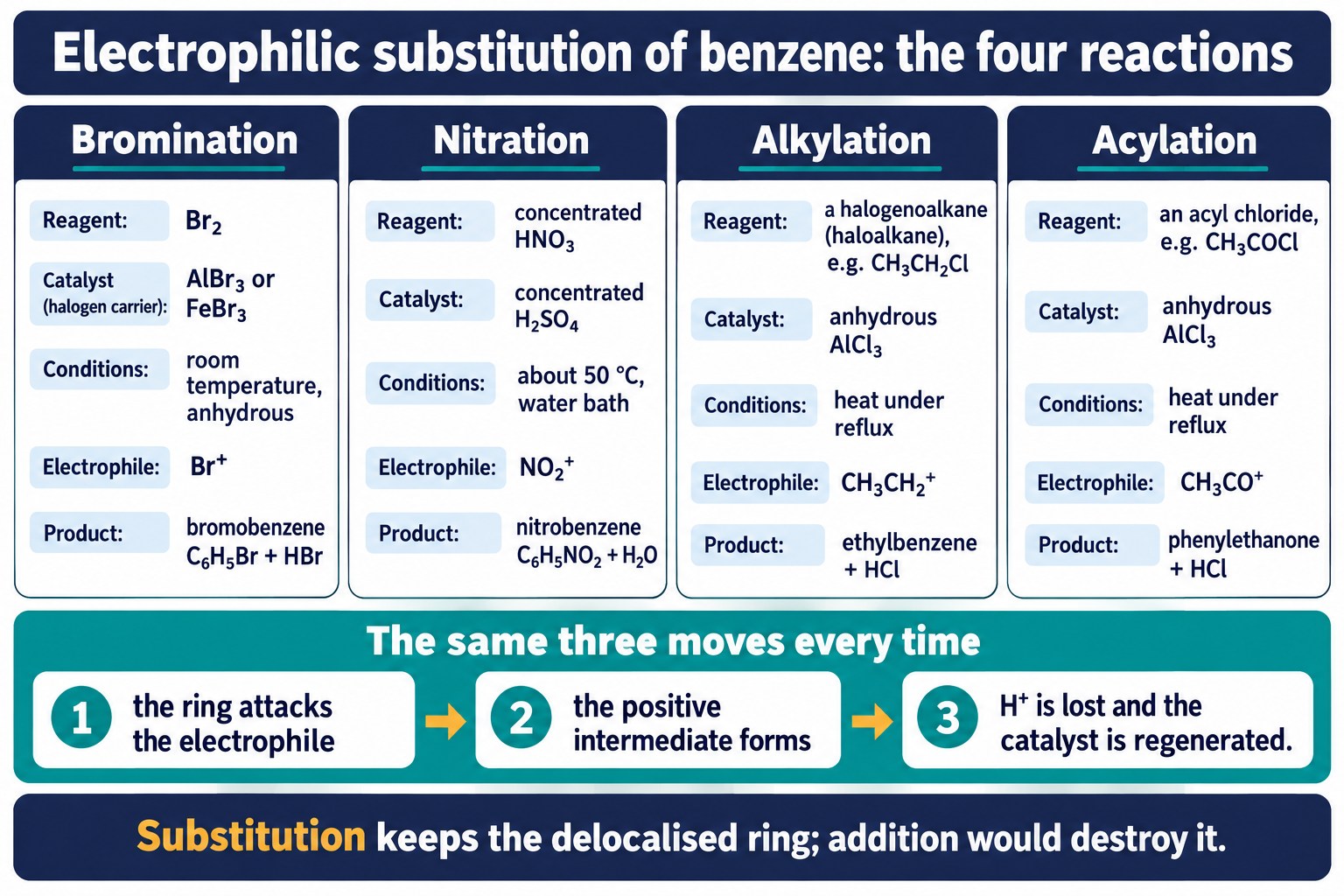
Four reactions, one mechanism. Learn the reagent, the catalyst, the conditions, the electrophile and the product as a set for each.
Quick Check: By-products and Catalysts
Pick the one accurate statement about each new substitution.
Reaction Map
Use the map to revise the whole topic. For each arrow you should be able to give the reagents, the conditions, the type of reaction and a balanced equation.
| Reagents and conditions | Product | Type |
|---|---|---|
| Br₂ with catalyst AlBr₃ or FeBr₃, room temperature | bromobenzene C₆H₅Br + HBr | electrophilic substitution |
| Cl₂ with AlCl₃ catalyst | chlorobenzene C₆H₅Cl + HCl | electrophilic substitution |
| conc. HNO₃ + conc. H₂SO₄, between 25 °C and 60 °C | nitrobenzene C₆H₅NO₂ + H₂O | electrophilic substitution |
| CH₃Cl, AlCl₃, heat | methylbenzene C₆H₅CH₃ + HCl | electrophilic substitution (alkylation) |
| CH₃COCl, anhydrous AlCl₃, heat | phenylethanone C₆H₅COCH₃ + HCl | electrophilic substitution (acylation) |
| H₂, Ni or Pt, heat | cyclohexane C₆H₁₂ | addition |
| methylbenzene with hot alkaline KMnO₄, then dilute acid | benzoic acid C₆H₅COOH | side-chain oxidation |
| methylbenzene with Cl₂, UV light | (chloromethyl)benzene C₆H₅CH₂Cl | free-radical substitution of the side chain |
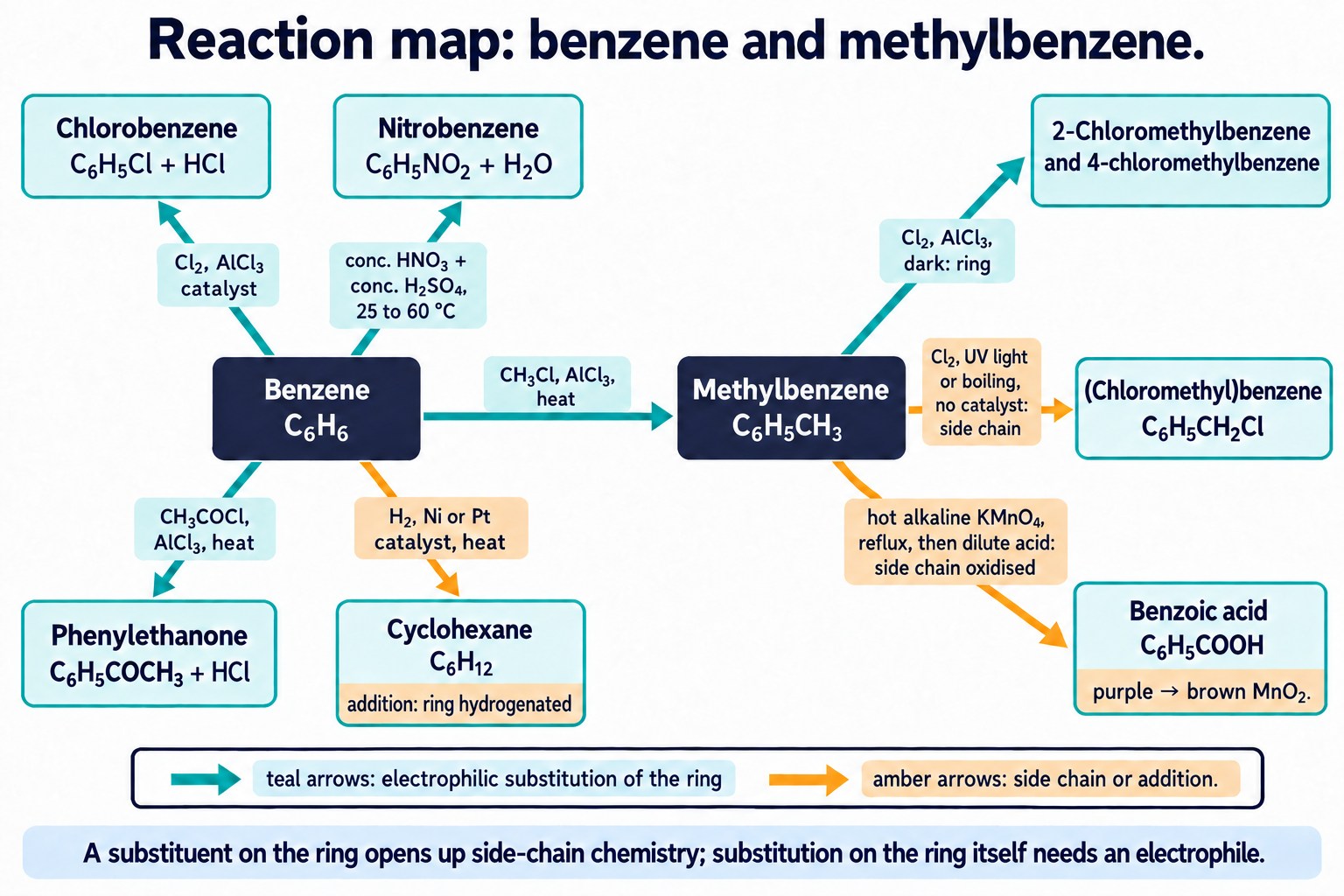
Two centres: benzene, and methylbenzene with its side chain. Teal arrows attack the ring, amber arrows the side chain or the whole ring.
Exam focus: A reaction-map question usually asks for reagents and conditions, then the type of reaction, then a mechanism for one arrow. Name the electrophile every time.
Check: The Reaction Map
Match reagents, conditions and products across the reactions of benzene and methylbenzene, and classify each one.
Quick Check: New Targets from Benzene
Use the map to plan each new product, then flip the card to compare.
Common Exam Points
- Hydrogenation of the ring needs H₂ with Ni or Pt and heat: the only addition reaction of benzene you need, giving cyclohexane.
- Hot alkaline KMnO₄ then dilute acid oxidises any alkyl side chain with an H on its first carbon to COOH: methylbenzene gives benzoic acid.
- Observation for the oxidation: purple to colourless with a brown precipitate of MnO₂.
- Cl₂ with AlCl₃ in the dark substitutes the ring; Cl₂ with UV light substitutes the side chain.
- Every electrophilic substitution keeps the delocalised ring and replaces one H; the by-product is HBr, HCl or H₂O.
- State the catalyst and how it is regenerated whenever a question asks for conditions.
- When asked for a reaction map, give reagents AND conditions for every arrow; one without the other loses the mark.
FAQs
Use these quick answers to check hydrogenation of the ring, side-chain oxidation and the reaction map of arenes.
How is benzene hydrogenated?
Benzene reacts with hydrogen over a nickel or platinum catalyst with heat and pressure: C₆H₆ + 3H₂ → C₆H₁₂, cyclohexane. Forcing conditions are needed because the first addition disrupts the stable delocalised π system.
Why can benzene add hydrogen but not bromine water?
Both additions would break the delocalisation. Catalytic hydrogenation is driven by heat, pressure and the metal surface, which supplies hydrogen atoms to the ring. Bromine at room temperature has no such help and is not polarised by the ring, so nothing happens.
How is methylbenzene oxidised to benzoic acid?
Heat methylbenzene under reflux with alkaline potassium manganate(VII), then acidify with dilute acid. The purple MnO₄⁻ is reduced to brown MnO₂ while the CH₃ group is oxidised to COOH, giving benzoic acid, C₆H₅COOH. The ring itself is not oxidised.
What happens when ethylbenzene is oxidised?
Any alkyl side chain with a hydrogen on the carbon attached to the ring is oxidised right back to a COOH group, so ethylbenzene also gives benzoic acid and the extra carbon is lost as carbon dioxide or carbonate. The aromatic ring resists oxidation.
Which reactions of benzene are substitutions and which are additions?
Nitration, halogenation and Friedel–Crafts reactions are electrophilic substitutions that keep the delocalised ring. Hydrogenation with H₂ and a nickel catalyst is the one addition, and it needs forcing conditions.

Copyright notice: This OLS revision content, including the explanations, layout, diagrams, tables and embedded learning structure, is authored for Online Learning System by Dr. Mohammed Al-Fatah. It may not be copied, reproduced, redistributed or adapted without written permission.
Keep this note — free
Save your progress across every Cambridge topic. A free account remembers which topics you have covered, saves your question scores, and syncs across your phone and laptop.
- Track every topic you have finished
- Keep your practice-question scores
- No payment, no card, free forever
Already registered? Log in