Evidence for the Structure of Benzene
A concise revision guide to the evidence for the delocalised structure of benzene: enthalpy changes of hydrogenation and the delocalisation energy, carbon–carbon bond lengths, and benzene’s resistance to addition reactions.
Before You Start
This page tests the two models of benzene against experiment. Check these ideas first.
- The Kekulé and delocalised models, and the bond lengths 0.154 nm, 0.139 nm and 0.134 nm: Structure and Bonding in Benzene.
- An enthalpy change is the heat energy change at constant pressure; exothermic values are negative. See Topic 5 Chemical Energetics.
- Alkenes undergo electrophilic addition: the π bond of the C=C breaks and two new σ bonds form. See Topic 14 Hydrocarbons (AS).
- Hydrogenation is the addition of H₂ across a C=C bond with a nickel catalyst.
GCSE Recap: Alkenes and Addition Reactions
Three quick questions on the GCSE alkene ideas this page tests benzene against.
Enthalpy Changes of Hydrogenation
Adding hydrogen to one C=C bond in a six-membered ring releases a known amount of energy. If benzene really had three C=C bonds, it should release three times as much.
| Reaction | ΔH / kJ mol⁻¹ | Comment |
|---|---|---|
| cyclohexene + H₂ → cyclohexane | −120 | measured: one C=C bond |
| cyclohexa-1,3,5-triene + 3H₂ → cyclohexane | −360 | expected for the Kekulé structure: 3 × (−120) |
| benzene + 3H₂ → cyclohexane | −208 | measured |
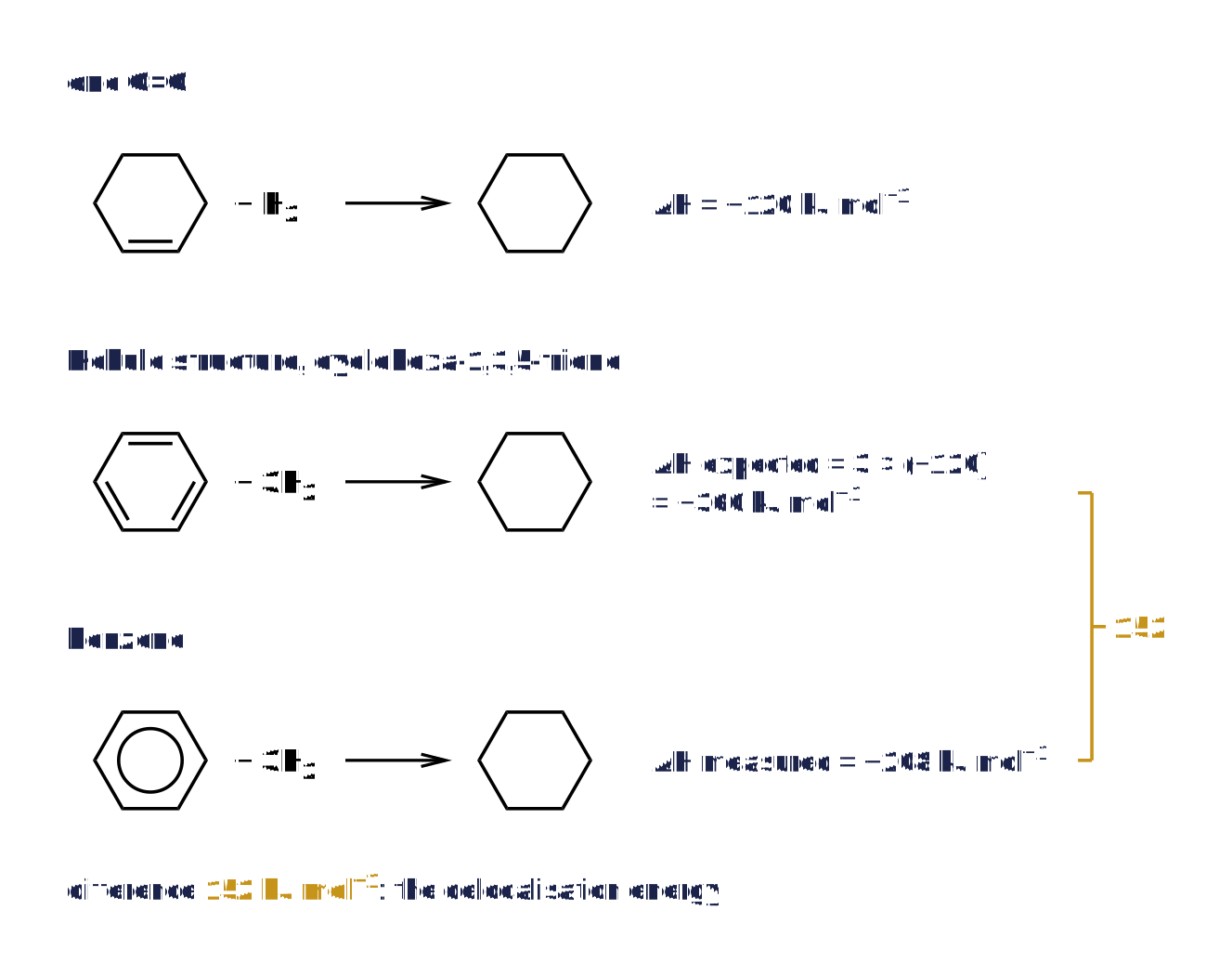
The three hydrogenation equations with their enthalpy changes. The measured value for benzene is 152 kJ mol⁻¹ less exothermic than the Kekulé structure predicts.
Worked example: the delocalisation energy
Step 1. Expected for three separate C=C bonds: 3 × (−120) = −360 kJ mol⁻¹.
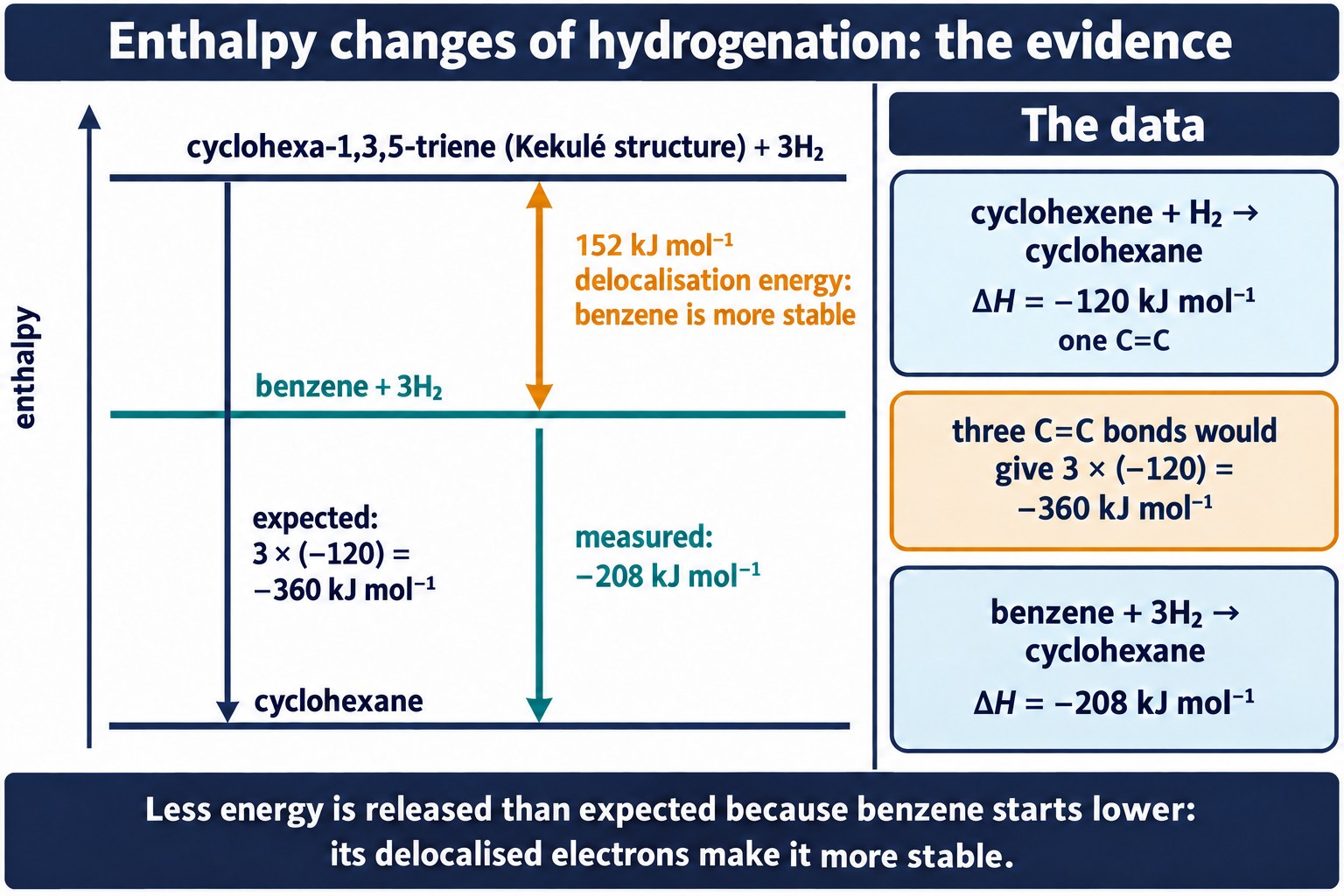
The enthalpy level diagram. The Kekulé structure would sit 152 kJ mol⁻¹ above real benzene; both end at cyclohexane.
- This extra stability is the delocalisation energy (also called the resonance energy or stabilisation energy).
- Delocalising the six π electrons over the ring lowers the energy of the molecule.
- Cyclohexa-1,3,5-triene does not exist. The comparison is with a theoretical molecule.
Exam focus: Always compare with the product in common, cyclohexane. Benzene releases less energy because it starts from a lower enthalpy, not because it forms a different product.
Extension: Partial Delocalisation
Cyclohexa-1,3-diene has two C=C bonds next to each other. This is an extension to show the idea; it is not needed for the exam.
Step 1. Expected for two separate C=C bonds: 2 × (−120) = −240 kJ mol⁻¹.
Step 2. Measured: −232 kJ mol⁻¹.
- In cyclohexa-1,4-diene the two π bonds are too far apart to overlap, so no extra stability is expected.
- Full delocalisation around the whole ring, as in benzene, gives much more stability: 152 kJ mol⁻¹.
Check: Hydrogenation Data
Use given enthalpy changes of hydrogenation to calculate the extra stability of a ring and explain what the result shows.
Bond Lengths
Measurements of the distances between atoms show that benzene is a regular planar hexagon with every C–C bond the same length.
| Bond | Length / nm |
|---|---|
| C–C single bond | 0.154 |
| C–C in benzene (all six) | 0.139 |
| C=C double bond | 0.134 |
- The Kekulé structure needs alternating long (0.154 nm) and short (0.134 nm) bonds. Only one length is found.
- The benzene bond length, 0.139 nm, lies between a single and a double bond, as expected for a σ bond plus a share of six delocalised electrons.
- All the bond angles are 120°, so the ring is a regular hexagon and the molecule is planar.
Remember: Quote the three numbers. “All the bonds are the same length” earns the mark only with the values 0.154, 0.139 and 0.134 nm or with the words “intermediate between single and double”.
Quick Check: Reading Bond Lengths in New Rings
Apply the bond length argument to two ring compounds that are new to this page.
Resistance to Addition
An alkene reacts with bromine at room temperature by electrophilic addition and decolourises bromine water. Benzene does not.
| Cyclohexene | Benzene | |
|---|---|---|
| bromine water, room temperature | decolourised: addition | no change |
| bromine with a catalyst | addition anyway | substitution of one H by Br |
| type of reaction | electrophilic addition | electrophilic substitution |
- Addition across one bond would break up the delocalised π system and lose the 152 kJ mol⁻¹ of stability.
- Substituting a hydrogen keeps the ring intact, so substitution is the reaction that happens.
- Why benzene cannot polarise Br₂ the way an alkene can is explained in Electrophilic Substitution in Benzene.
Exam focus: Link the chemistry to the structure: benzene resists addition because addition would destroy the delocalised π system, which is what makes benzene stable.
Chemical Evidence: One Isomer Only
A further test of the Kekulé model uses the number of isomers of a 1,2-disubstituted benzene such as 1,2-dichlorobenzene.
- With fixed single and double bonds, the two chlorine atoms could sit across a single bond or across a double bond: two different compounds.
- Only one 1,2-dichlorobenzene exists.
- In the delocalised model all six C–C bonds are identical, so there is only one way to place the two chlorines next to each other.
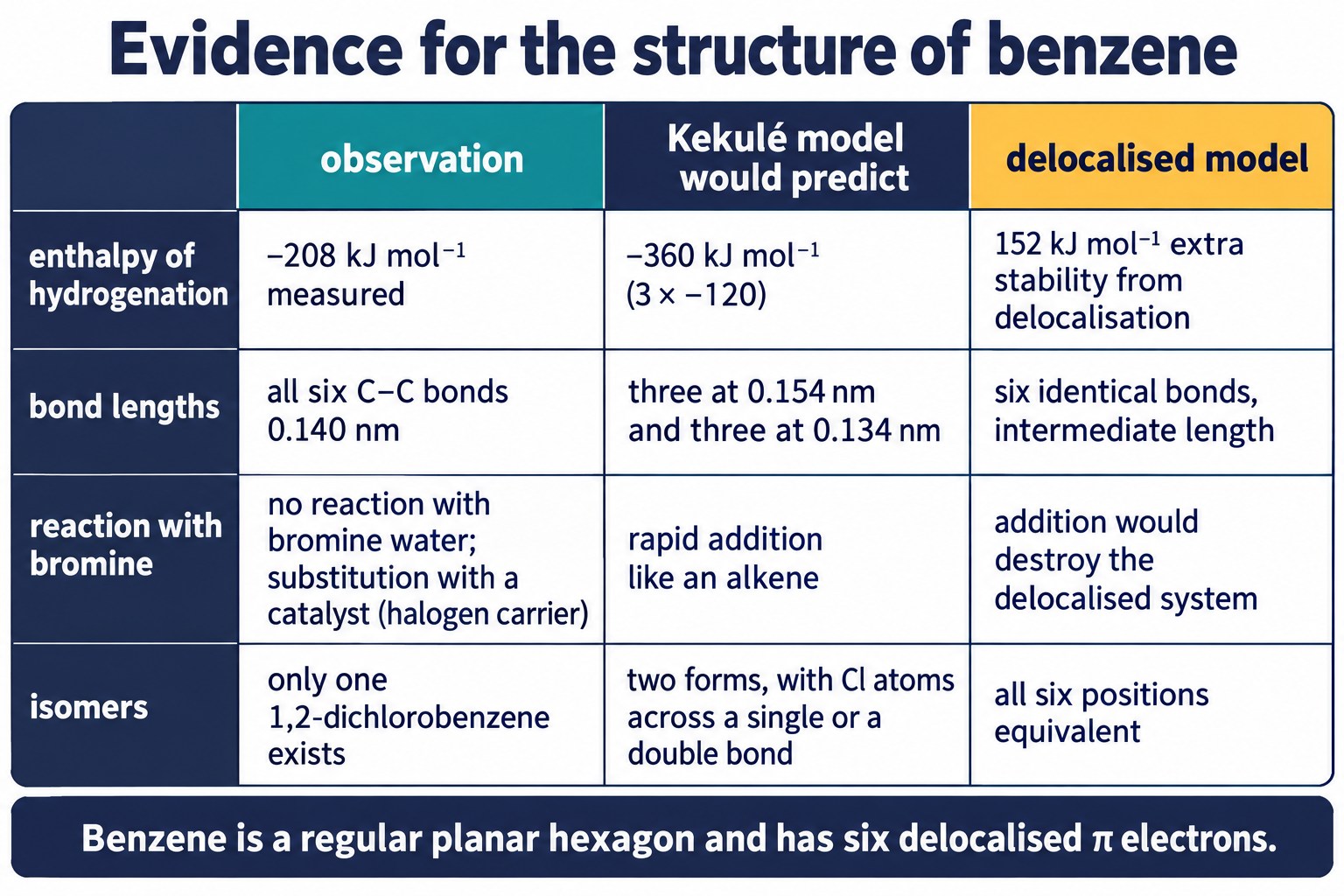
All the evidence in one table: hydrogenation enthalpy, bond lengths, resistance to addition and the number of isomers, each against the Kekulé prediction.
Check: Bond Lengths and Reactions
Match bond lengths to bonds, and explain why benzene resists addition while an alkene does not.
Quick Check: Which Model Fits the Observation?
Decide whether each observation fits both models or only the delocalised one.
Common Exam Points
- Expected ΔH for the Kekulé structure is 3 × (−120) = −360 kJ mol⁻¹; measured for benzene is −208 kJ mol⁻¹; the difference, 152 kJ mol⁻¹, is the delocalisation energy.
- Say “benzene is more stable than expected” or “than the theoretical cyclohexa-1,3,5-triene”, and say why: the π electrons are delocalised.
- All six C–C bonds are 0.139 nm, between 0.154 nm (single) and 0.134 nm (double).
- Benzene does not decolourise bromine water; addition would destroy the delocalised system.
- An enthalpy level diagram must show the Kekulé structure above benzene and both routes ending at cyclohexane.
FAQs
Use these quick answers to check the hydrogenation evidence, the delocalisation energy, bond lengths and why benzene resists addition.
Why is the enthalpy change of hydrogenation evidence for delocalisation?
Cyclohexene + H₂ gives cyclohexane with ΔH = −120 kJ mol⁻¹, so three C=C bonds should give −360 kJ mol⁻¹. Benzene gives only −208 kJ mol⁻¹, so it is 152 kJ mol⁻¹ more stable than the Kekulé structure.
What is the delocalisation energy?
It is the extra stability of benzene compared with the imaginary cyclohexa-1,3,5-triene, about 152 kJ mol⁻¹. Spreading the six π electrons over the whole ring lowers the energy, so breaking the delocalised system costs energy and addition is unfavourable.
What do the bond lengths tell me about the structure of benzene?
All six carbon–carbon bonds are 0.139 nm long, between the single bond of 0.154 nm and the double bond of 0.134 nm. The Kekulé structure would need alternating long and short bonds, so the ring must be a regular hexagon.
Why does benzene not decolourise bromine water?
Alkenes add bromine because their π electrons are concentrated between two carbons. In benzene the six π electrons are spread over six carbons, so the electron density is too low to polarise Br₂. Addition would also destroy the stable delocalised system.
Why is there only one 1,2-dichlorobenzene?
If benzene had fixed single and double bonds, the two chlorine atoms could sit on a single bond or on a double bond, giving two isomers. Only one compound exists, so every carbon–carbon bond in the ring must be identical.

Copyright notice: This OLS revision content, including the explanations, layout, diagrams, tables and embedded learning structure, is authored for Online Learning System by Dr. Mohammed Al-Fatah. It may not be copied, reproduced, redistributed or adapted without written permission.
Keep this note — free
Save your progress across every Cambridge topic. A free account remembers which topics you have covered, saves your question scores, and syncs across your phone and laptop.
- Track every topic you have finished
- Keep your practice-question scores
- No payment, no card, free forever
Already registered? Log in